People have to observe physical distancing in public transportation amid the increasing cases of COVID-19 in the country.
Photo by SANAF MARCELO

The post Physical distancing appeared first on Bulatlat.
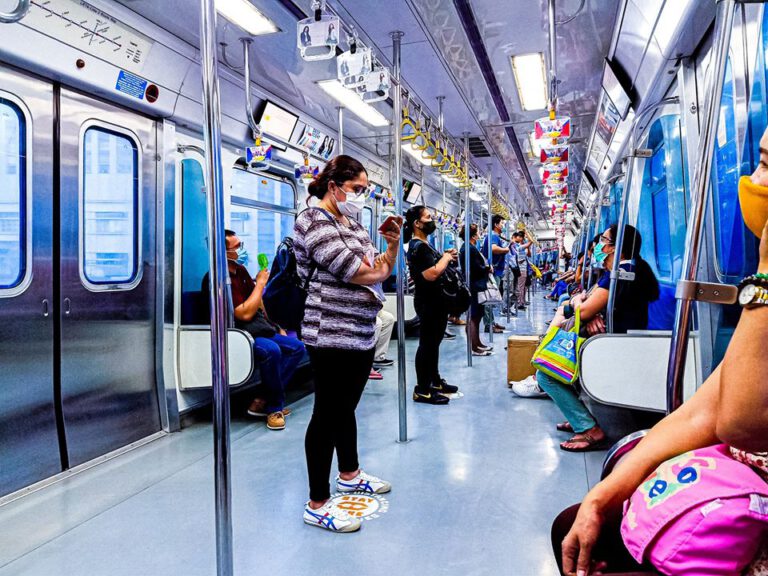
People have to observe physical distancing in public transportation amid the increasing cases of COVID-19 in the country.
Photo by SANAF MARCELO
The post Physical distancing appeared first on Bulatlat.

By FR. ARIS MIRANDA, MI
Psalm 69:8-10,14,17,33-35
Jeremiah 20:10-13
Romans 5:12-15
Matt 10:26-33
“Fear no one. Nothing is concealed that will not be revealed, nor secret that will not be known. What I say to you in the darkness, speak in the light; what you hear whispered, proclaim on the housetops.” (Mt. 10, 26-27)
Oftentimes I hear and read from scholarly articles affirming that we Filipinos are resilient people. Being immersed in the humanitarian mission not only in the Philippines but as well as abroad, fellow workers laud our people for being resilient. We proudly say, “subok na matibay subok na matatag” (proven strong proven lasting). This could be a good reason to claim our fearlessness.
However, the saddest truth is that “the wicked is in torment all his days, and limited years are in store for the ruthless …” (Job 15,20). He never stopped tormenting and terrorizing his people. We have been thrilled and trembled by the coronavirus pandemic. Instead of overcoming the torment that most of us are experiencing, it is being aggravated by introducing an out of tune measure such as the Anti-Terrorism Act of 2020 (House Bill 6875).
Our most urgent concern is the pandemic, saving lives rather than aggaravating the already vulnerable health condiopn of ur people. . Several of our front liners are in danger of death, and yet their cry for mass testing remains unheard. Millions of Filipinos are losing their jobs. Some of them are forced to find their luck in the streets by begging and yet they are being arrested for allegedly violating provisions of the Bayanihan Act to Heal as One Law.
Concerned citizens mobilized and exercised their rights as subsidiary to the government, who failed to adequately respond to the pressing needs of its constituents in the spirit of solidarity, an authentic Bayanihan. Yet, they are being arrested and being falsely accused of politicizing and romanticizing the pandemic, not to mention those who are being killed because of red-tagging.
The wicked is weaponizing the law to subjugate dissent and silence their critics—fear and terror reigns in our land.
“But the LORD is with me, like a mighty champion: my persecutors will stumble, they will not triumph. In their failure, they will be put to utter shame, to lasting, unforgettable confusion.” (Jer. 20,11). This bold and sincere prayer of Jeremiah brings out in him the certainty of God’s faithfulness. The disappointments, adversities, persecutions have shaken, for a moment, his confidence and his hope, but have failed to suffocate and extinguish them.
Our readings of today, calls each of one of us, the new disciples of Jesus of our time, to fear no one. This the theme of our celebration. It’s a reason for us to be bolder in our witnessing as the new prophets of God.
It’s hard to be a prophet; it is difficult to tell and live by the truth, to raise our voice and denounce what is wrong. It is more comfortable to remain at the margins in silence and pretend not to see and hear what is happening, or to let the others talk. Still, if one wants a real change in our society, a community faithful to the Gospel and more docile to the spirit, if one aspires to a newness of life, prophets are needed. Like Jeremiah, may we have the courage to say what the Lord tells us, even at the risk of life.
The same inspiration that St. Matthew, the evangelist, has when he wrote this Gospel amid the coercion of the people to worship emperor Domitian (81-96 AD). The local authorities, the tentacles of the emperor subservient to power, wanted everyone to bow down and worship the one whom the seer of Revelation calls “the beast” (Rev 13:4, 12).
The Christians defied the order. For this, misappropriations (red-tagging), punishments (warrantless arrest), discriminations (suppression of human rights), and confiscation of properties (deprivation of the right to defend) started for them. Many could no longer bear these constant harassments. They were at the limit of endurance and the looming risk of apostasy. In this challenging moment, the Lord never remained silent.
“Fear no one. Nothing is concealed that will not be revealed, nor secret that will not be known. What I say to you in the darkness, speak in the light; what you hear whispered, proclaim on the housetops.” (Mt. 10, 26-27).
As a Christian, persecution is not an accident; it is an inescapable fact. St. Paul reminds us in his letter to Timothy: “All who want to serve God in Christ Jesus will be persecuted” (2Tim 3:12).
In today’s Gospel, St. Matthew highlights three reasons why we must acknowledge our own fears. By our have faith, we trust that we can address them. As disciples, our hearts know well it that our Master is always at our side.
First reason, fear has a positive vital function: it signals the dangers, prevents rash, risky, foolish gestures. However, if it gets out of control, it hinders the courageous actions and resolute choices.
For all of us who embraced Christianity and resolved to follow Christ, fear is often the worst enemy. “It manifests itself in fear of losing one’s position, of seeing the esteem of one’s superiors diminished, of losing friendships, of being deprived of one’s properties, of being punished, demoted, for some even of being killed. Whoever is afraid is no longer free. It is normal to be afraid, but woe to one dominated and guided by fear, one ends up paralyzed.”
We should not be afraid of the external forces, the wicked who sows havoc and fear. What we should be afraid of is the evil that mutes our voices and paralyzes our bodies to move and witness our prophetic calling and faith. This evil is under our full control, and we can extinguish it if we believe in our freedom as we are created originally.
No doubt, it will be a long and painstaking struggle. Most probably, we will not see the seeds of light and goodness germinate, which they have sown with toil and pain. “However, they must cultivate the joyful certainty that the harvest will grow and will be plentiful. Their work will not be in vain; though they are put to death, no enemy force will be able to prevent the realization of God’s Kingdom.
Second reason: “And do not be afraid of those who kill the body but cannot kill the soul; rather, be afraid of the one who can destroy both soul and body in Gehenna.” (Mt. 10,28). “The fear of being mistreated or even put to death is the one who has the power to destroy both soul and body. It is not an external character to us. It is the evil that, since birth, we carry within us. It is the negative force that suggests paths opposed to those of Christ.”
As many of our historic heroic models affirmed that — while they may kill our bodies, and sanction our voices, our dreams and aspirations for a just and lasting peace — the reign of God as opposed to the reign of terror will never die. The consequences might be severe and unwanted, but the gratification is far greater, knowing that what we have done is what we are supposed to be.
Third reason: “Are not two sparrows sold for a small coin? Yet not one of them falls to the ground without your Father’s knowledge. Even all the hairs of your head are counted. So do not be afraid; you are worth more than many sparrows.” (Mt. 10,29-31).
Persecution is a fact, and it frightens us because often it affects us and those around us who may be deprived of the necessary subsistence. Whatever rightful acts we commit, it always has its impact on others because of our fundamental interconnectedness. God knows both the intentions and the goodness that we do. If God knows how to take care of every creature like the sparrows and and look after every strand of our hair, how much more to us the chosen people. No one can escape His love and kindness. He is interested in every creature, even the smallest. The more He will follow the cause of one who is fighting for his kingdom!
Balik-Tanaw is a group blog of Promotion of Church People’s Response. The Lectionary Gospel reflection is an invitation for meditation, contemplation, and action. As we nurture our faith by committing ourselves to journey with the people, we also wish to nourish the perspective coming from the point of view of hope and struggle of the people. It is our constant longing that even as crisis intensifies, the faithful will continue to strengthen their commitment to love God and our neighbor by being one with the people in their dreams and aspirations. The Title of the Lectionary Reflection would be Balik –Tanaw , isang PAGNINILAY . It is about looking back (balik) or revisiting the narratives and stories from the Biblical text and seeing ,reading, and reflecting on these with the current context (tanaw).
The post Balik-Tanaw | Pentecost: Fear No One appeared first on Bulatlat.

“I hope Mary Jane will return soon and my eldest daughter [in Dammam] recover swiftly so that we all can be reunited here. I hope the president is watching, and come to the aid of my daughters,” she added
By ANNE MARXZE D. UMIL
MANILA – Celia Veloso is emotional during a press conference held Friday as her two daughters, both overseas Filipino workers (OFWs), have fallen ill.
Her eldest, Lea Velasco-Ordonez is battling against coronavoris disease 2019 (COVID-19). She is now in Damman, Saudi Arabia working as a domestic helper.
In a video posted in social media, Ordonez said that she is positive for COVID-19 and six others in their house. She asked for help to bring them in the hospital.
Despite being sick, Ordonez said she is still working in the house taking care of an elderly.
“I just take Panandol every six hours. How can I recover?” she said. Panandol is a medicine used for the treatment of mild to moderate pain.
Veloso said Mary Jane, who is on death row in Indonesia, is also not doing well. Her blood pressure is low and she is suffering from ulcer.
“I feel so much misery over their afflictions and if it were not for Migrante, and other generous supporters like church people, I wouldn’t know what to do,” Veloso said in a press conference on June 19.
“I hope Mary Jane will return soon and my eldest daughter [in Dammam] recover swiftly so that we all can be reunited here. I hope the president is watching, and come to the aid of my daughters,” she added.
Data from the Department of Foreign Affairs show that 3,926 OFWs in the Middle East tested positive for the virus as of June 19.
Mary Jane is a victim of human trafficking. She was arrested in Indonesia and was sentenced to death for carrying two kilos of heroin. President Joko Widodo suspended her execution on April 29, 2016 due to international pressure.
The post Mother of Mary Jane Veloso appeals for help for her ill daughters appeared first on Bulatlat.

With no salary and little assistance, some OFWs in the Middle East have resorted to scavenging for food.
By ANNE MARXZE D. UMIL
Bulatlat.com
MANILA – Louie Perez, an aluminum installer in Saudi Arabia has not been receiving his salary regularly since last year. This February, he and his fellow workers went to the office of of Philippine Overseas Labor Office (POLO) in Riyadh to file a complaint against their company. He said they came up with an agreement that if the company has not yet given them their salary until April 15, they would be repatriated. Two months later, Perez and fellow overseas Filipino workers (OFWs) are still waiting for that to happen.
Perez also said that they also applied for Department of Labor and Employment cash assistance program for OFWs but they were told that they are not qualified because there are others who need it more.
Perez said they were abandoned by their company. With no salary and little assistance, they have resorted to scavenging for food in the mall near their dorm.
“Maybe we have waited long enough. Please let us come home,” he said, addressing to the POLO officials.
Perez’s is just one of OFWs in the Middle East who shared their situation during an online press conference organized by Migrante International June 19.
Domestic helper Marife Torres, meanwhile, shared that her employer tested positive for COVID-19. Fearing she might contract the disease, Torres went to the POLO office and relayed her situation but she merely advised to stay away from the patient.
“They also laughed at me,” Torres said.
Torres said she felt some symptoms of the virus and went to the hospital for consultation. She was given the swab test, but she did not mention however, if the result was negative or positive.
“Please help me. I don’t know what to do. I don’t want to be infected. I want to come home,” Torres said.
Torres said she already requested her agency to allow her to go home but she was told that there is still no international flight available.
Based on the government data, there are 3,926 OFWs who were infected with COVID-19 in the Middle East as of June 19. It has exceeded the number of Filipinos infected by the virus in Europe and North America, making Middle East the COVID-19 hotspot for OFWs.
Like Perez and Torres, many OFWs in the Middle East have been aching to go home.
According to POLO Riyadh, there are 23,000 displaced OFWs at present who want to be repatriated. Labor Attache Nasser Mustafa said in a report that affected workers are those whose companies have stopped operating due to COVID-19. Some are affected by the “no work, no pay” contract while others are undocumented and runaways. https://globalnation.inquirer.
For the past three months three months, Bernadette Erlano and other overseas Filipino workers staying in a camp in Al Khobar, Saudi Arabia have not been receiving their salaries. Their company stopped its operation on March 16 due to the pandemic but their salaries for March 1 to 15 were not issued.
Erlano said that many of them have been wanting to come home for fear of contracting coronavirus disease 2019 (COVID-19) there. She lamented though that the company has not been giving updates on when they can finally go home.
Erlano who works as cleaner said they sought help from the Philippine Overseas Labor Office (POLO) but no action has been taken up to now. She is among the 300 Filipino women under Jawa Human Resources Agency.
Another OFW shared the same sentiment. James Cabugsa who has been working in United Arab Emirates (UAE) for seven years, said he has not received his salary since their company stopped operations.
OFWs decried how POLO was unresponsive to their plight.
“We’re supposed to rely on government in this time of the pandemic but we could not expect anything from them,” Cabugsa said.
Cabugsa said that for the past three months, he had no salary because their company has not resumed its operations due to the pandemic. Since March 15, the company has not paid his leave. He applied for the Department of Labor and Employment cash assistance program for OFWs on April 24. But after almost two months, there is still no reply, he said.
Yolanda Lorica who works in a hospital also suffers the same fate as others in Saudi. She said that their employer is coercing them to report to work. If not, they would not have their salary and food allowance.
Lorica said they were being locked up in their dormitory. Some donations like hygiene kit sent for them were blocked by their supervisor. With the help of Migrante, Lorica said they were able to contact POLO officials about their condition.
They sought assistance from POLO office and they were provided by food packs once.

Lorica also wants to go home but the company would not allow them. She said that some of them have no exit visas.
“We all want to be repatriated because we don’t want to risk our health. We don’t know if we have the immunity because we have been scrimping on food just to get by,” she said, adding that they are being asked to pay 15,000 Saudi Riyals (US $4,000) if they want to be granted exit visas.
Filipinos helping fellow Filipinos
Lorica said that when food packs from POLO have run out, they asked help from fellow Filipinos through a live video on social media. Fellow Filipinos immediately sent help, she said.
Cabugsa also said that the Filipino community in UAE has been proactive in helping Filipinos who lost their jobs or have no income like him.
“Here, Filipinos are active in distributing assistance to OFWs. Many groups are contributing just to help our kababayans who really have nothing. It’s inspiring,” Cabugsa said.
He added that he cannot understand why fellow OFWs are quick to help while the Philippine government is slow in acting on their complaints. “The Filipino community is the one who is doing the job of the Philippine government here,” he said.
No VIP treatment
Joanna Concepcion, chairperson of Migrante International (ito ba position niya?), lamented that the testimonies of the OFWs are proof that they are not getting any “VIP treatment” as claimed by President Duterte’s government.
Concepcion said that they will continue to document the conditions of OFWs and will consult with lawyers on possible legal actions if abandonment of OFWs would continue in the Middle East.
She also lambasted the lack of contingency plan for OFWs who are stuck abroad.
“We demand for immediate actions such as repatriation of our kababayans and delivery of assistance for the families of OFWs who died from COVID-19. Stranded OFWs should not be made to pay for flights just to be repatriated. They should be provided with free repatriation and medical assistance,” Concepcion said.
“The OFWs needed every help they could get especially in the time of the pandemic. When the Philippine embassy or consulate are closed or cannot be contacted when needed, it is like they are abandoning our fellow countrymen,” she added.
The post VIPs? OFWs in the Middle East decry ‘insufficient’ government support appeared first on Bulatlat.
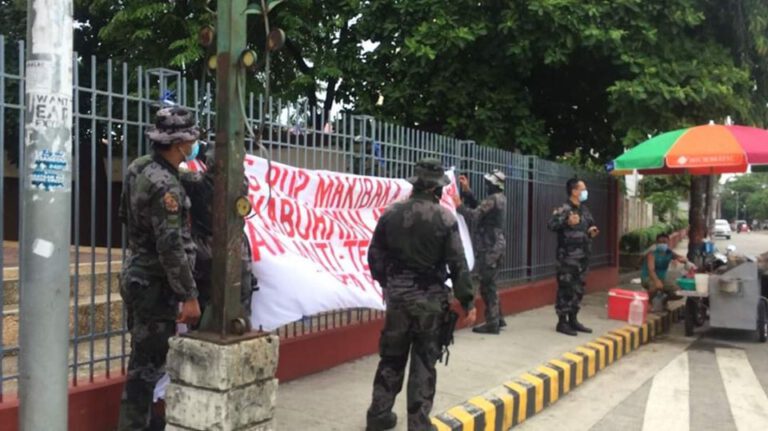
The group said the police’s action is clearly a direct attack on people’s right to expression and assembly, which the group said, what the anti-terror bill seeks to do.
By AARON MACARAEG AND REIN TARINAY
Bulatlat.com
MANILA — Six policemen removed and confiscated on June 20, Thursday, a banner which read, “Komunidad ng PUP, makibaka para sa kalusugan, kabuhayan at karapatan! Ibasura ang anti-terror bill!” (PUP community, struggle for health, livelihood and rights! Junk the anti-terror bill!)
The banner, hanging in front of Polytechnic University of the Philippines (PUP) main campus gate in Sta. Mesa, Manila, was initiated by United PUP, an alliance of students and employees calling for the junking of the Anti-Terror Bill.
Student leaders who staged a program outside the campus were also harassed by policemen. According to political party Samasa-PUP, the police told them that “rallies” are prohibited under the general community quarantine (GCQ).
The students, however, argued they were observing physical distancing and minimum health protocols.
“The state has been relentless in silencing the voices of Filipinos,” Samasa-PUP said in a statement.
The group said the police’s action is clearly a direct attack on people’s right to expression and assembly, which the group said, what the anti-terror bill seeks to do.

The bill, which was railroaded both in the Senate and Congress and labeled as urgent by Malacanang, seeks to amend the Human Security Act. Critics said the bill if enacted could be used against dissenters and ordinary citizens.
The bill is now awaiting President Rodrigo Duterte’s signature. If not vetoed after 30 days, it will automatically lapsed into law.
United PUP has been pushing for their five demands amid the worsening situation brought by the COVID-19 pandemic. These are:
1. Mass promotion;
2. Sufficient adjustment period and alternative classes;
3. Aid and security of tenure for teachers and employees;
4. Free and immediate mass testing; and
5. Active cooperation and clear alternative program which should be a product of democratic participation of members PUP community.
The post Cops take down PUP students’ #JunkTerrorBill banner appeared first on Bulatlat.
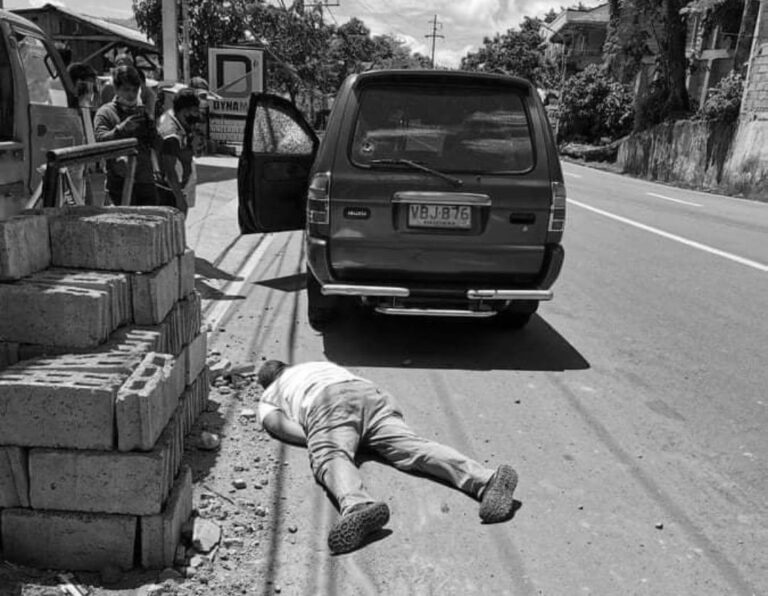
“It is distressing that the community of barangay San Antonio would lose somebody like Hon. Froilan Reyes, especially now when his leadership is needed during a time of great crisis brought about by COVID-19.”
By JUSTIN UMALI
Bulatlat.com
SANTA ROSA, Laguna – The captain of barangay San Antonio, Kalayaan, Laguna was shot dead by unknown assailants while driving his vehicle along the Longos, Kalayaan, June 18.
Froilan Reyes, 48, was shot around 1 p.m. by motorcycle-riding gunmen before escaping towards the municipality of Lumban. Reyes was brought to Pagsanjan Medical Center but passed away while undergoing treatment.
Known to residents by his nickname “Kawing”, he is survived by his wife and two children.
An investigation is currently underway regarding the incident. In the meantime, friends, family, and groups have come out to offer condolences and support.
Friends and neighbors of Reyes took to posting on social media, offering their condolences while also calling for justice. One resident, Jhed Lualhati, described Reyes as “one of the nicest people they met” and “a joker.”
Human rights watchdog Karapatan Southern Tagalog offered their condolences, calling Reyes a “gallant community leader.” The group speculated that the shooting may have been political in nature in light of Reyes’ “advocacies in the community.”
“It is distressing that the community of barangay San Antonio would lose somebody like Hon. Froilan Reyes, especially now when his leadership is needed during a time of great crisis brought about by COVID-19,” said Kyle Salgado, spokesperson for Karapatan ST.
Reyes was also the president of the Association of Barangay Captains in Kalayaan.
In Echague, Isabela, a similar incident also occurred when barangay captain Rogelio Sacro of barangay Busilelao, June 19. Sacro was driving his tricycle on his way home when he was shot in barangay Dammang East by unknown assailants past noon.
Echague Mayor Francis Faustino Dy has offered a reward of P500,000 for information leading to the arrest of the assailants.
In both cases, investigations are still currently underway.
The post Barangay captain in Laguna shot dead appeared first on Bulatlat.

“We must realize that giving the people and organizations behind them permission to gather and use our personal information means that we do pay for their services – not in cash but at the cost of our attention, privacy, and security.”
By REINETTE TARINAY
Bulatlat.com
MANILA– Amid the looming passage of the anti-terror bill, digital rights advocates warned netizens against using FaceApp.
In a statement, Computer Professionals’ Union (CPU) said that FaceApp comes with ‘several risks and dangers’ especially since its popularity surged after Facebook’s alarming issue of duplicate accounts as well as the government’s awful try on COVID-19 contact tracing.
CPU said that suspicious activities online, including the proliferation of doppelgänger accounts on Facebook, could possibly benefit from FaceApp data.
“And with the advent of the Anti-Terrorism Bill possibly becoming law, there is danger that these doppelgänger accounts, coupled with realistic likeness of the persons they’re impersonating, could maliciously act in violation of the provisions of said law thereby framing the actual person,” the group said.
App-ful of data and privacy risk
AI-powered facial transformation tool FaceApp has flooded the social media once again for its gender-changing feature.
In order to use its gender-change feature, FaceApp will need to ask permission to access the user’s personal information, as well as some features of the user’s device.
Under the privacy policy, FaceApp has the authority to use and abuse:
· Personal information and disclose it to law enforcement, government authorities, and private parties.
· To create anonymous, aggregated or de-identified data from your personal information and other individuals whose personal information they collect.
· Disclose your personal information to professional advisors, such as lawyers, bankers, auditors and insurers, where necessary in the course of the professional services that they render to us.
· Sell, transfer or otherwise share some or all of their business or assets, including your personal information, in connection with a business transaction (or potential business transaction)
FaceApp cannot ensure the security of any information you transmit to FaceApp or guarantee that information on the App may not be accessed, disclosed, altered, or destroyed.
While the app is very clear on owning up the data you input through their ‘services,’ it waives your legal rights. From section 8 of their terms of use agreement, FaceApps clearly avoids accountability to any possible damages the app might cause.
According to FaceApp’s Terms of Use Agreement, it states that when using the app, we allow:
· Nonexclusive, royalty-free, worldwide, fully paid license usage, reproduction, modification, adaptation, and create derivative works from, distribute, perform and display your User Content during the term of this Agreement solely to provide you with the Services.
· Process, transfer and storage of information about you in and to the United States and other countries
· Warrant that (y) you are not located in a country that is subject to a U.S. Government embargo, or that has been designated by the U.S. Government as a “terrorist supporting” country
CPU added that the anti-terror bill’s vague provision can easily use FaceApp’s lack of liability as a tool for surveillance and impersonation, endangering lives of human rights defenders, progressives, and dissenters.
Gender sensitivity
Aside from its digital security risks, LGBTQIA+ community also expressed frustration at how the app is being used to dismiss their struggle against discrimination.
Amber, an LGBTQIA+ rights advocate and member of UP Babaylan took to Twitter her dismay on ‘bandwagons’ use of FaceApp while dismissing trans struggles.
Paface app face app challenge pa kayo, transphobic at femmephobic pa rin naman kayo. ? ? ?
— Amber | #JunkTerrorBill #OUSTDuterte (@GeeYanii) June 18, 2020
In an interview with Bulatlat, Amber expressed that what becomes an issue for her, as a trans woman, is when people who deny trans women of their woman-ness and trans men of their man-ness join the bandwagon and act as if they do not have prejudice towards trans people.
“This is basically them appropriating transitioning as an okay activity for them, pero sa amin, bawal just because cishets sila.”.
To review permissions, you allow existing apps on your device, digital security experts recommend the use of AppWatcher.
The post Digital rights advocates warn of FaceApp’s security breach amid terror bill appeared first on Bulatlat.
By JANESS ANN J. ELLAO
Bulatlat.com
MANILA – The recent conviction of Rappler CEO Maria Ressa and former reporter-researcher Reynaldo Santos Jr. brought to the fore cyber libel as a weapon against journalists.
Republic Act No. 10175 or the Cybercrime Prevention Act of 2012 penalizes cyber libel.
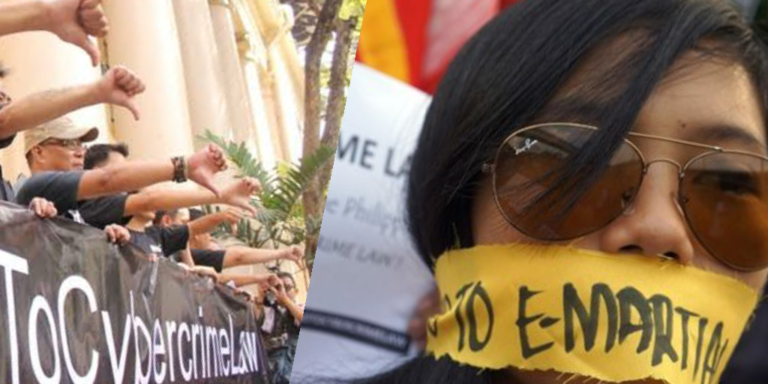
Press freedom advocates, digital rights activists and human rights defenders first took the streets in 2012 to oppose Cybercrime Prevention Act, labeling it as cyber martial-law.
Then President Benigno S. Aquino III defended the signing into law of the controversial Republic Act No. 10175, saying, “Will freedom of expression be stopped? I don’t think that is the purpose of the law.”
Critics pointed out existing laws were sufficient to penalize “acts of terrorism” defined in the RA 10175. They warned that the law will be used to stifle dissent and to harass not only government critics but also journalists and eagle-eyed netizens.
At that time, Bayan Secretary General Renato Reyes Jr. said, “This is a political and legal regression in terms of protecting free speech on the internet. Will we now have offenses such as inciting to sedition with the aid of a computer? Or rebellion committed via the internet? The potential for harassment suits against government critics is so huge under this law.”
Read: Cybercrime law takes effect October 3 amid broad protests
Read: Anti-Cybercrime law, an attack against freedom of expression, other civil rights
At least 15 petitions were filed against the controversial law before the Supreme Court. Still, many provisions questioned were upheld as constitutional in a landmark decision in February 2014. The high court declared Section 4(c)(4), which penalized online libel, is not unconstitutional with respect to the original author of the post but unconstitutional only where it penalizes those who simply receive the post or react to it.”
The Cybercrime Prevention Act imposes higher penalties for libel from a minimum of six months imprisonment in the Revised Penal Code (RPC) per count to a minimum of six years.
Read: ‘Fight vs cybercrime law not over’ — netizens
Under the Duterte administration, what critics said became true.
Ressa and Santos were not the first journalists to be convicted of the crime.
On March 22, 2019, two radio broadcasters in Kidapawan City were convicted of online libel. North Cotabato Governor Emmylou “Lala” Taliño-Mendoza filed the charges against broadcasters Eric Rodinas, anchor of Radyo Natin and Larry Baja Subillaga Jr., a freelance broadcaster, over “malicious” statements posted in their social media accounts on March 14, 2017. The Philippine Daily Inquirer reported that Subillaga said via Facebook that the governor was fooling the people of the province while Rodinas said the governor became rich because of a project.
Judge Jose Tabosares of the Regional Trial Court, Branch 23, in Kidapawan City sentenced the two broadcasters two to four or eight years jail term and ordered them to pay P2.5 million in damages.
Cyber libel was also used to threaten a campus journalist who posted his criticisms to the government’s COVID-19 response.
Read: Campus editor threatened with libel for criticizing gov’t response on COVID-19
Decriminalize libel
The National Union of Journalists of the Philippines (NUJP) and Center for Media Freedom and Responsibility have long been calling for the decriminalization of libel.
Veteran journalist Inday Espina-Varona, said in 2014 after the SC upheld the constitutionality of cyber libel, “The criminal nature of libel in this country makes it the perfect tool of harassment (short of murder, which has also taken out so many Filipino journalists).”
CMFR said, “The libel provisions of the RPC [Revised Penal Code] have been problematic for free expression and press freedom since 1932, when the RPC was implemented, primarily because of the penalty of imprisonment, which has been used in many instances to silence journalists.”
Back then, Presidential Spokesperson Harry Roque sang a different tune. Roque, then with Centerlaw, criticized the SC decision, saying “failing to declare libel as unconstitutional is contrary to human rights law.”
Roque then said that no less than the U.N. Human Rights Committee has already declared that Philippine criminal libel law is contrary to Freedom of Expression. He was referring to the UN Human Rights Committee’s October 2011 decision stating that the Philippine criminal libel law is excessive and is in violation of the International Covenant on Civil and Political Rights in which the Philippines is a signatory.
Now spokesperson, Roque dismissed press freedom advocates’ condemnation of the conviction of Ressa and Santos, saying in a television interview that “it was a case of bad journalism. It was a case of bad lawyering.”
Read: Cybercrime law to be used against critics, netizens, groups fear
It has gone full circle, it seems. But the people’s stand on this issue remains the same – criminal libel and cyberlibel have no rooms in a democracy.
The post What happened before: Cyber libel in the Philippines appeared first on Bulatlat.