Home Blog Page 311

Sleepless in San Juan: Villagers unite to stop demolition

Restless nights have plagued the Burol community in Kabayanan Village, San Juan City, fearing that someone might burn their homes to the ground—small shacks made of wood, tin sheets, and a little bit of low-quality concrete.

“Hindi ako makatulog. Alam mo naman ‘yang mga ‘yan, sunog e. ‘Yun ang kinatatakutan ko. Lalo na ito, puro light material, said bed-ridden resident Alfredo Capulong, 86, recalling the 2012 fire that scorched homes in the nearby St. Joseph Village—a community also threatened by demolition at that time.

(I can’t sleep well. We know their strategy—fire. That’s what I fear. Look at our home, it’s made of light materials.)

Early morning last May 20, policemen carrying long firearms escorted truckloads of men to Burol—men in civilian clothes, wielding sledgehammers, knives, and icepicks. They threatened to smash their homes into pieces of rubble despite the residents’ pending motion before the court.

But some early risers in the neighborhood have already spotted the armed men before they came down to Burol, and were able to sound the alarm. To the still sleepy residents, it was like waking up to a bad, bad dream, except that it was not just a nightmare—it was real.

Siyempre ‘yung iba na-trauma, naglabasan na ng mga gamit. Siyempre gulat, e galing ka ba naman sa tulog tapos ganoon. Takot talaga. May mga may sakit, siyempre aalalayan,” said 60-year-old Lina Balingasa, who owns a small store along the street.

(Of course, some of us were traumatized. We got took our things and ran. We were shocked. Imagine, we were just sleeping then we woke up to that. It was really terrifying. There were people who were ill and had to be assisted.)

It was an early morning panic sequence as Burol residents abandoned their breakfasts or coffee and scurried out to the streets, bringing children and elderlies to safety, trying to secure documents, clothes, and money.

The bed-ridden Capulong, who just woke up at that time, had to be carried by his thin-framed grandson and namesake, Dos, to safety.

In the confusion, some residents tried to setup a small barricade to stop the demolition crew from proceeding to their houses. Those who were finished with securing their things later on replaced the ones in the barricade.

Tension rose when the police came, trying to insist on smashing their homes with sledgehammers. But wielding documents from the court, residents of Burol were able to fend off the demolition team after a few hours of verbal exchange with the cops.

But residents of Burol are not convinced that the ordeal is over. Experience tells them that the people behind the demolition would stop at nothing until they are gone from the area. They have to be vigilant.

“Hindi nga kami magigiba, sunog naman kami. Mas malala naman. E mabilis kumalat ‘yan dito kasi luma na ‘to,” said the 24-year-old Dos, who until the time of the interview has not recovered from the paranoia caused by the incident.

(They may not succeed in destroying our homes but they may also set this place on fire. That’s worse. The blaze will definitely spread quickly because houses here are made of old materials.)

Dos is among a number of community volunteers who do rotational shifts watching over the neighborhood during the wee ours of the night, making sure no one burns their homes to the ground. In the morning and afternoon, another set of volunteers regularly patrol the neighborhood just to make sure the coast is clear.

No relocation plans for residents

For decades, residents of Burol have lived in peace without anyone claiming rights to the land. That is why when a certain 77D Holdings suddenly came in 2011, claiming parcels of land, the residents, especially the elderlies, couldn’t believe what they heard.

“Nananahimik kami tas biglang maliligalig kami. Pati kalooban namin at isipan, di namin alam. Umiiral sa amin ang takot. Bakit nagkaroon ng ganito, dati tahimik naman kami,” said 76-year-old Rosalino Empero, a resident of Burol since 1957.

(We were living in peace until they came and brought a sense of terror. Our minds and hearts are troubled. We are in constant fear. Why did this happen when we were just living here quietly before.)

Around 500 families—mostly original residents of more than 50 years—living in Kabayanan Village, including Burol, Elago, and Urbino, are facing the threat of demolition. No plans of relocation have been laid out, residents said.

Lina Balingasa opens her store early. When the demolition crew came, she said she even gave some of the men free cigarettes and coffee. Photo by Patrick Quintos/Altermidya

“’Yun talaga ang masakit,” added 62-year-old Leonora Guinto, who recalled having seen his elder brothers and their friends literally carrying their house to Burol in a tradition called “Bayanihan” or communal unity.

(The things that are happening now are really painful for us.)

Raymond Alzona, who chairs Burol’s neighborhood association, said they were told by the sheriff that a local court had already ruled against their pending motion quash. However, he said the ruling has not been served to them or even their lawyers.

Alzona added that denying a motion to quash is not the end of case as they still have a lot of legal remedies to exhaust before 77D Holdings can say with finality that they have won. “Tapusin niyo muna ang kaso namin. Kapag kami, natalo sa kaso, aalis kami sa lupa,” he said.

(They should let us see this case through. We’ll only leave if we have really lost the case.)

The last time Burol was threatened with demolition was in 2016, he recalled, but they were able to file cases before the court against 77D Holdings.

However, Alzona said they sensed that the lawyer who were helping them back then have compromised with the corporation, so they broke off and formed another group to file a new case to fight for their right to live in Burol.

Hope under new rule?

Alzona also suspects the push to remove them from Burol could be a revenge of outgoing San Juan City Mayor Guia Gomez, part of the Ejercito-Estrada political dynasty, who has lost in Kabayanan Village for 2 straight elections.

He cited that Gomez has even established an in-city relocation in Kabayanan Village but the settlers who got units in the housing project were from other villages.

“Bawal ang Kabayanan, kasi hindi sila nanalo dito. Ang binigyan nila Barangay Batis at Barangay Salapan e dapat sa Barangay Kabayanan… Baka bawi ‘yan kasi talo na naman sila dito,” he said.

(Kabayanan residents weren’t allowed in that project because they did not win here. They gave the housing to the villages of Batis and Salapan, instead of this village. Maybe they are just doing that because they lost here.)

Now that decades of Estrada rule in San Juan are over and incoming Mayor Francis Zamora is set to take office next month, Alzona said that residents are hoping for changes, especially when it comes to treating the urban poor.

Residents of Burol barricaded the street going to their homes, calling for the stop the planned demolition as they still have a pending case before the court. Photo by Avon Ang/Altermidya

San Juan City is not new to violent demolitions as the villages of St. Joseph and Corazon de Jesus have seen wounded residents and burnt down homes way back in 2011 and 2012.

Some of the residents were forced to relocate to far-flung areas like Bulacan and Rizal, where job, water, and electricity is scare. Zamora has vowed to the residents that there will be no more demolitions when he takes office.

“Ang tao dito, gusto na ng pagbabago. Hindi dahil kay Francis. Kung sino mang umupo at lumaban, kakampihan nila kasi sawa na ang mga tao sa mga Estrada. Ayaw na talaga nila,” he said.

(People here want change. Not just because of Francis. Whoever sits and fights, people will support because the people here are really sick of the Estradas.)

An appeal for help

Until then, the residents will continue to fight for their rights.

Balingasa appealed to the authorities to at least know the truth first and investigate before coming down to Burol with all their sledgehammers and firearms, ready to “shock and awe” their way into demolishing their houses.

“Hindi komo iskwater, mahihirap, dinadaan nila sa harassment. Siyempre sila, nakapuwesto, nakabaril ano ba namang panlaban namin,” she said.

(They should not harass us just because we’re squatters, poor people. They are the people in position who have power and firearms, how could we even fight them?)

“Basta ang pinaglalaban ko lang dito yung karapatan lang. Sa tinagal-tagal ba naman namin dito, hindi nila sabihin na may may-ari pala nito. Dapat noon pa lang sinabi na nila na sila ang may may-ari,” added Guinto, still worried about the coming days.

(We are fighting for our rights. We’ve been here for a long time and no one told us someone owns this place. If someone really have claims on this land, they should have told us a long time ago.)

“Sana ‘yung pakiusap namin, manatili na kami dito, tutal dito na rin napanatag ang kalooban namin,” Empero softly said, expressing hope that things will soon go back to normal in the small community of Burol.

(We hope they allow us to stay here because this is where our peace is.)

Alfredo Capulong, an original resident of Burol, has been immobile for 2 years because of an illness. Photo by Patrick Quintos/Altermidya

Meanwhile, inside his sweltering street-side shanty, the 86-year-old Capulong, one of the oldest residents of Burol, hopes the government could at least give him the peace of mind, knowing his sons and grandsons can have a place to call their own home before he dies.

“Sino ba naman ang hindi maghahangad na bago man lang ako pumanaw, makita ko man lang na matiwasay ang mga anak ko. E wala e, hindi ka makapirmi ng pag-iisip. Baka pag-ano bigla na lang magtakbuhan,” he said.

(Who would not want to die in peace, knowing their sons are secured. Right now, I could not stay calm because anytime something might happen and we have to run again.)

The post Sleepless in San Juan: Villagers unite to stop demolition appeared first on Altermidya.
Guilty verdict against labor leader condemned

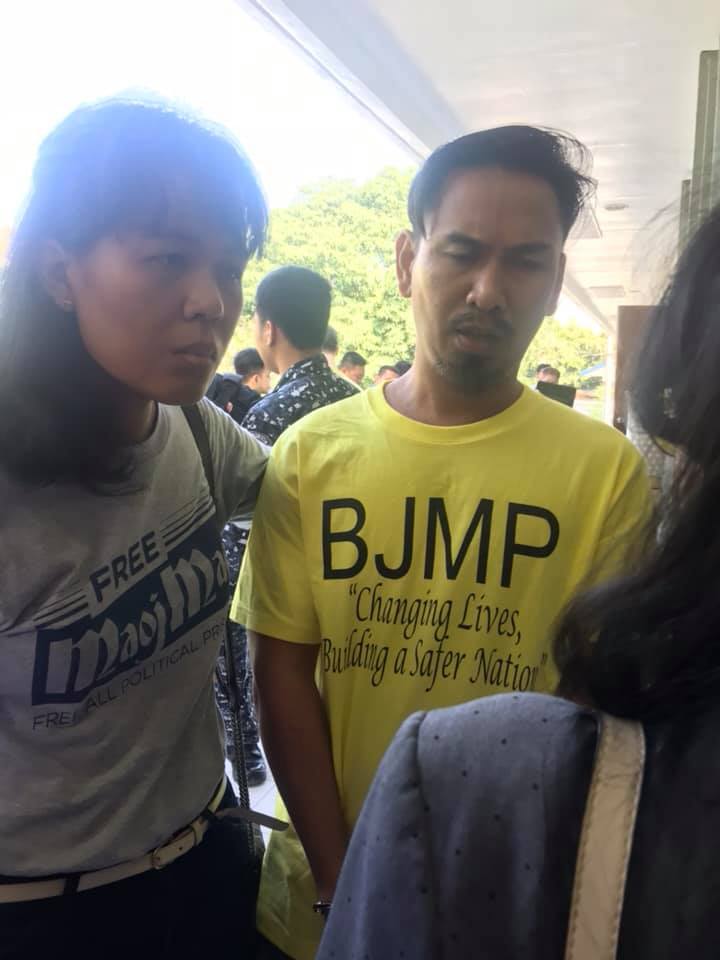
Labor leader Maoj Maga with wife Eleanor de Guzman after the court’s decision (Photo courtesy of Kilusang Mayo Uno)

“While we have to contend with this reality, it is so hard to accept. While we comprehend the rotten system from which these illegal arrests are being made, the imprisonment of these good people, inncocent of any crime they are being accused of is just beyond logic and reason.”

By RONALYN V. OLEA
Bulatlat.com

MANILA — Progressive groups condemned a local court’s decision declaring labor activist Maoj Maga guilty of possession of firearms.

In a decision released May 16, Judge Josephine Zarate-Fernandez of the Regional Trial Court Branch 76 convicted Maga of illegal possession of firearms and sentenced him imprisonment for a period of eight years and one day as minimum to 14 years and eight months as maximum.

Maga was arrested on February 22, 2018 while playing basketball in his neighborhood. Human rights alliance Karapatan said the arresting team planted evidence against Maga. Before the arrest, Maga just sent his then eight-year-old son to school. He is also facing fabricated murder charges in Agusan del Norte where he has never been to.

Maga is currently detained at the Metro Manila District Jail 4 in Camp Bagong Diwa, Bicutan, Taguig City, and is set to be transferred to the New Bilibid Prison following the court’s decision.

Ten-year-old Li Boy cries and hugs his mother as he hears the conviction of his father Maoj Maga. (Photo courtesy of Kilusang Mayo Uno)

In a Facebook post, Maga’s wife Eleanor de Guzman dubbed the court’s decision as “pure injustice.”

Upon learning the verdict, Maga’s ten-year-old son Li Boy cried, hugged his mother and blurted out, “Ang gago ng judge na ‘yan!” (That judge is an idiot!)

“While we have to contend with this reality, it is so hard to accept. While we comprehend the rotten system from which these illegal arrests are being made, the imprisonment of these good people, inncocent of any crime they are being accused of is just beyond logic and reason,” De Guzman said.

There are 532 political prisoners in the country, according to Karapatan.

In a statement, Karapatan Secretary General Cristina Palabay said the “illegal arrest, detention, and conviction of Maoj Maga shows an orchestrated operation to silence dissenters.”

Maga is a full-time labor organizer of Kilusang Mayo Uno. He was one of the founding members of youth group Anakbayan.

“Maoj’s unjust and condemnable conviction is an impetus for human rights advocates, trade unionists and activists to continue pushing back against a climate of political persecution and reprisal. We reiterate that unionism is not a crime, and trade unionists like Maoj are advocates who continue to raise workers’ legitimate demands despite an increasingly hostile environment, Palabay said. (http://bulatlat.com)

The post Guilty verdict against labor leader condemned appeared first on Bulatlat.

Karapatan assails guilty verdict on trade unionist Maoj Maga’s case

0
Today, June 3, 2019, Maoj Maga was falsely convicted of the trumped-up charges of illegal possession of firearms by the San Mateo Rizal Regional Trial Court Branch 76. Maga was illegally arrested on February 22, 2018 while playing basketball in his neighborhood, when police and military operatives accosted him and planted firearms in his belongings. Prior to his arrest, Maga came from accompanying his 8-year-old son to school. He is also facing fabricated murder charges in Agusan del Norte where he has never been to. 

read more

Old woes hound public schools

0

Another school year is set to open next week, but public schools were expected to struggle with same “age-old problems”.

Youth groups storm CHED to protest policies aggravating problems in education

MANILA – Youth groups’ protest action faced police violence after trooping to the Commission on Higher Education (CHED) last May 30 to decry the “worsening state of education” in the country. Three members of the group present in the activity were grabbed by officers after defacing the gates of the commission but were released after the program.

The groups condemned the series of policies that, according to them, would aggravate the current problems of the country’s education system including incessant tuition and other school fees increase, the Supreme Court’s decision on CHED Memo 20, and the bill on mandatory ROTC in the House of Representatives.

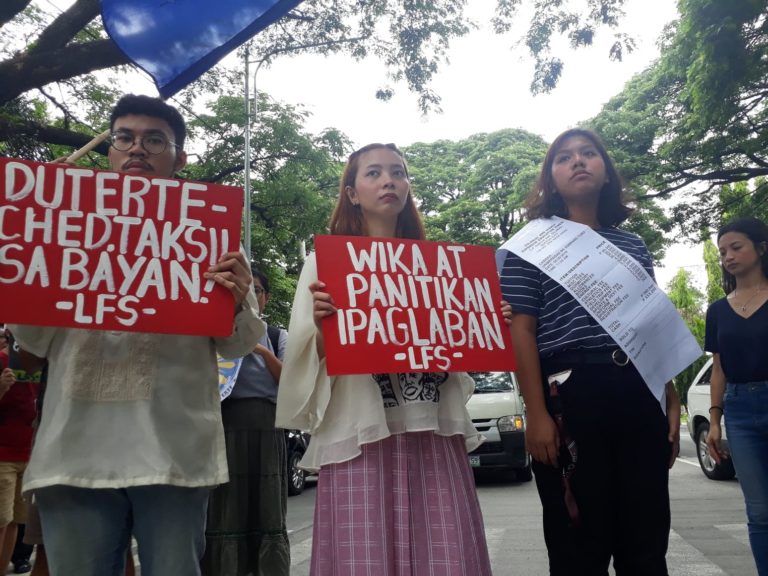
College Editors Guild of the Philippines National President Daryl Baybado slammed CHED Commissioner Prospero de Vera’s press release that lauded the Supreme Court decision on the constitutionality of the CHED Memo 20 that removes Filipino and Panitikan as core subjects in college. Baybado said this policy approved by the Commission and the high court will further exacerbate the commercialized and colonial orientation of the country’s education system.

Meanwhile, Kabataan Partylist Representative Sarah Elago decried the two faces of President Duterte’s administration and CHED. Aside from the memo on Filipino, the youth party slammed the railroading of the mandatory ROTC in senior high school as Congress passed the bill on second reading last May. “Nakakasulasok ang dalawang mukha ng rehimen: sabi nila itutulak daw ang mandatory ROTC para sa ‘nasyunalismo,’ pero aalisin naman nila ito sa pag-aalis ng pag-aaral ng ating wika,” Elago added.

Elago reiterated that the administration is keen on erasing the whole reason why mandatory ROTC is erased following the death of Mark Chua of the University of Santo Tomas.

Fees increases anew

Aside from the aforementioned policies that the organizations condemned, Elago also stressed that CHED will be further burdening parents and students at the onslaught of tuition increases and other fees in private school and even state universities and colleges.

Almost all higher educational institutions (HEIs) throughout the country are applying for a tuition increase, and a huge number will be approved by DepEd, said Raoul Manuel of the National Union of Students of the Philippines (NUSP). In a study by the council alliance, private schools increase their tuition on an average of 5% every year, excluding the collection of other school fees.

Manuel added that the CHED also plans to revise the CHED Memo 03, or the guidelines for tuition increase in attempts to remove “strict” policies on tuition increases, especially in private autonomous units. Some of the salient points of the draft revision include the abolition of regional multisectoral councils on tuition increase, revisions to the consultation process, and lessening the participation of CHED from regulating tuition hikes to monitoring duties only.

Text and photos by JUMAI HERRERA
(http://bulatlat.com)

The post Youth groups storm CHED to protest policies aggravating problems in education appeared first on Bulatlat.

Studying Filipino language, not mandatory military training, instills nationalism

BULATLAT FILE PHOTO. Students join the protest against the elimination of Filipino as a subject, Aug. 25. (Photo by Kathy Yamzon)

“This is a choice between our collective survival as a nation, and our collective death as a free country.”

By JANESS ANN J. ELLAO
Bulatlat.com

MANILA – In light of recent moves to make military training mandatory among students, groups are stressing that to promote nationalism, most especially among the youth, studying the Filipino language and literature is a must.

In a statement written in Filipino, lawmaker France Castro of ACT Teachers Partylist said that studying one’s own language and literature instead of the mandatory Reserve Officer Training Corps for senior high school students will be “our contribution to the world’s cultural education and to the development of our own language, culture, and identity.”

The fight against the Commission on Higher Education’s (CHED) decision to remove Filipino language as a mandatory subject has been ongoing since 2013, with the issuance of CHED Memorandum No. 20. Recently, the Supreme Court has ruled in favor of the CHED memorandum.

What is at stake, after all, the Concerned Artists of the Philippines said, is the Filipino consciousness.

Towards globalization?

Tanggol Wika, a broad group of educators, students, and advocates, said Filipinos’ long colonial past dictates that “we cannot be timid in propagating our own national language and literature.”

“The ravaging tides of globalization and cultural homogenization will surely wipe filipino and panitikan out, if we refuse to institutionalize their propagation in our while education system,” the group said.

Apart from the country’s long colonial past, the Philippines continue to face threats from “foreign powers,” said Tanggol Wika, citing the maritime dispute over West Philippine Sea, the allowing of foreign soldiers to stay in the country, and debts the government has incurred before foreign multilateral financial institutions.

Contrary to CHED’s position, the Department of Humanities of the UP Los Baños stressed that in the age of globalization, it does not mean that the country’s education system should do away with Filipino language and literature as mandatory subjects.

Instead, the Humanities department said, the current situation compels the need to further intensify one’s level of nationalism to promote independent stand on various transnational political and social issues confronting the country.

This also serves as an important instrument to guide students in upholding welfare of the country and their fellow Filipinos, the humanities department added.

On the other hand, poet and musician Juan Miguel Rivera Severo said that as culture is promoted through the use of language, the Supreme Court decision deprives students of the opportunity to better know and love the Filipino language and literature.

“Paano ka magmamahal ng ‘di mo kilala? Paano magmamahal kung walang pagkakataon?” he quipped.

ROTC mandatory?

In an earlier Bulatlat report, the progressive Makabayan bloc warned of the railroading of a proposed law, aimed to make ROTC mandatory among Filipino students.

Partylists belonging to the progressive bloc underlined the numerous cases of abuses, hazing, corruption, and even deaths related to its implementation. Just two months ago, a student from the Iloilo State College was allegedly killed by an ROTC cadet using a lead pipe.

“Mandatory ROTC will not teach the youth love of country, instead it would teach them how to be blind followers and discourage critical thinking,” ACT Partylist Rep. Antonio Tinio earlier said.

Fight continues

In a statement, ACT Teachers Partylist pointed out that attempts to water down young people’s nationalism may also be seen on how the K+12 implementation has disregarded the Philippine History subject and the Philippine Government and Constitution in its curriculum.

Tanggol Wika is set to file a second petition before the Supreme Court, asking it to reinstate its earlier temporary restraining order against the implementation of the controversial CHED order.

“We are saddened by the Supreme Court’s refusal to give course to our motion for reconsideration. We believe that justice has not been served by their refusal to amply hear our arguments. We reiterate that they should have summoned petitioners to an oral argument, rather than issue a ruling on the basis of quick readings of tons of documents that we have submitted.” Tanggol Wika said in a statement.

In the House of Representatives, on the other hand, the ACT Teachers Partylist is pushing for the passing of House 8954, where they are proposing to make Filipino and Literature as mandatory subjects.

Tanggol Wika said, “this is a choice between our collective survival as a nation, and our collective death as a free country.” (http://bulatlat.com)

The post Studying Filipino language, not mandatory military training, instills nationalism appeared first on Bulatlat.

Sin taxes, UHC to fund privatization of health services–IBON

0

Research group IBON said that government must allot a higher budget for public health services rather than fund private health providers through the Universal Health Care (UHC) Act.

Also known as Republic Act (RA) 11223, the UHC Act ostensibly aims to provide all Filipinos with promotive, preventive, curative, rehabilitative, and palliative health services “without causing financial hardship”, and prioritizes Filipinos who cannot afford such services.

The UHC would need Php257 billion in its first year of implementation. The sin tax reform law on the other hand is allegedly intended to augment the funding gap of around Php62 billion in the first year alone.

But IBON observed that the UHC would use government funds to create supplementary coverage by private health care providers such as private health insurance and Health Maintenance Organizations (HMOs) as well as provide network-based licensing, contracting, and accreditation of health facilities. This further privatizes health services, the group said.

The UHC, IBON explained, stipulates that Filipinos would automatically be enrolled in PhilHealth or the National Health Insurance Program (NHIP) either as a direct contributor who would pay premiums or as an indirect contributor. Moreover, the NHIP would have an increase in membership rate by 0.5% annually to fund the UHC.

The group observed that this is not as socialized as it appears to be, as high-income individuals would contribute the same percentage of their salary as low-income earners.

Also, IBON noted, to ensure that basic accommodation services are met, UHC states that government hospitals would operate not less than 90% of their bed capacity as basic accommodation, not less than 70% for specialty hospitals, and not less than 10% for private hospitals.

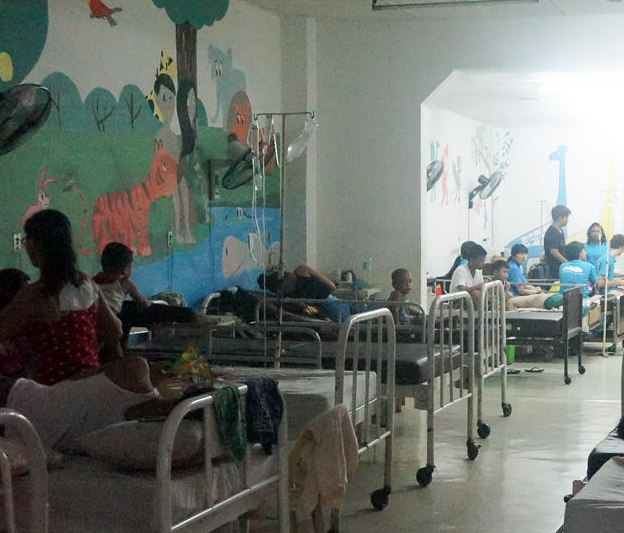
However, IBON observed that hospital beds in the country are not enough to begin with. The World Health Organization (WHO) recommends 20 beds per 10,000 population. The Philippines has never reached the recommended ratio, the group said, and this indicator even worsened from 14.4 beds per 10,000 population in 1990 to only 9.9 beds per population in 2014. The number of government hospitals even fell from 732 in 2011 to 423 in 2015.

Moreover, said IBON, the UHC assures that a National Health Human Resource Master Plan would be formulated to ensure the provision of health programs and services through a guaranteed permanent employment and competitive salary of all health professionals and health care workers. Yet for every 10,000 population the country had only 0.3 government physician and 0.6 public health nurse in 2017.

Despite the scarcity of government health workers, data from the Philippine Overseas Employment Administration (POEA) show that the country has been exporting nurses for decades, which is worsening the brain drain of the health sector, observed IBON. The Philippines deployed 19,551 nurses in 2016 or 53 nurses per day.

IBON emphasized that the UHC is the continuation of the privatization and commercialization of health services of previous administrations, from the Health Sector Reform Agenda of the Estrada administration, Fourmula One for Health of the Arroyo administration, and Aquino’s own UHC agenda. These programs advance less government and more private role in healthcare, making provision of health services less direct and more insurance-driven thus prioritizing private profits over public health, said IBON

Ulan-Dagitab

Ni RENE BOY ABIVA

Halos araw-araw kung tipunin ng dibdib ng langit
ang sumisilakbong alyenasyon ng bakal na mundo;
halos gabi-gabi’y nais niyang pakawalan
ang mga pumailanlang na tibok ng puso
at hininga na mula sa bunganga ng mga dukha
sa lupit-bangis-lalim ng dilim
na animo’y lalamunan ng nilulumot-inaamag na balon;
at walang sandali na ‘di niya ninais na maging kaisa
ng mga nakakuyumos na kamaong gamundo
ang tangis at paghihimagsik
laban sa kalam ng tiyan at balasik ng puhunan;
at sa sandaling maganap ang hinihintay niyang sandali
-ang tag-ulan-
ay tiyak pakakawalan niya ang malamig na butil ng tubig
na nagkukuta sa bukal ng partenon
at walang kapangimi-pangimi niya itong ihahandog
sa mga lumang tapayan na siyang magsisilbing kalis
sa sentro ng sabsabang yari sa basura;
habang ang mga alitaptap na may hawak na sulo
ay lilipad-iindayog sa saliw ng kanyang banayad-madulas
ngunit mabigat-puno ng bagwis at pisik
na ganting-salakay. (http://bulatlat.com)

The post Ulan-Dagitab appeared first on Bulatlat.