In fact, the government went so far as to send a delegation to Europe where they accused several activist organizations, including schools for indigenous people in Mindanao, of being communist fronts.
Rights groups seek protection from high court amid heightening attacks
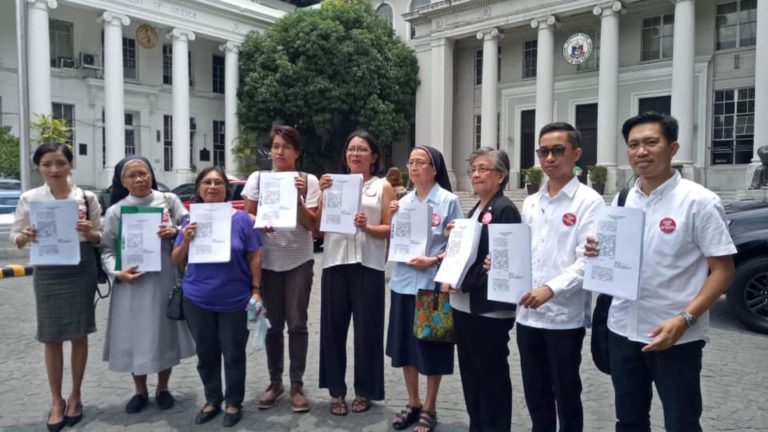
“Human rights advocacy is not a crime, yet human rights workers are being killed, threatened, harassed, and jailed on trumped-up charges.”
By RONALYN V. OLEA
Bulatlat.com
MANILA – Three organizations labeled by Duterte administration as “communist fronts” and whose members became victims of different human rights abuses sought protection from the Supreme Court, May 6.
Human rights alliance Karapatan, Rural Missionaries of the Philippines (RMP) and Gabriela, with the assistance from lawyers of the National Union of People’s Lawyers (NUPL), have filed a petition for writ of amparo and writ of habeas data before the Supreme Court.
The petition for a writ of amparo is a remedy available to any person whose right to life, liberty and security is violated or threatened with violation by an unlawful act or omission of a public official or employee, or of a private individual or entity. It covers extralegal killings and enforced disappearances or threats thereof. The writ of habeas data, meanwhile, is a remedy available to any person whose right to privacy in life, liberty or security is violated or threatened by an unlawful act or omission of a public official or employee, or of a private individual or entity engaged in the gathering, collecting or storing of data or information regarding the person, family, home and correspondence of the aggrieved party.
In a statement, Karapatan National Chairperson Elisa Tita Lubi said the filing of the petition “is a response to the worsening attacks, terrorist- tagging by the Philippine military and the ongoing smear campaign against human rights defenders.”
Respondents to the said petition are President Rodrigo Duterte, Gen. (Ret.) Hermogenes Esperon Jr., Maj. Gen. (Ret.) Delfin Lorenzana, Presidential Spokesperson Salvador Panelo, Gen. Benjamin Madrigal Jr., Brig. Gen. Fernando Trinidad, Maj. Gen. Erwin Bernard Neri, Lt. Gen. Macairog Alberto, Maj. Gen. Antonio Parlade Jr., Alex Paul Monteagudo, Vicente Agdamag, Senior Supt. Omega Jireh Fidel, and Undersecretaries Joel Sy Egco, Severo Catura and Lorraine Marie Badoy.
“We call on the Supreme Court to recognize that our work and activism involves the full exercise of our civil and political rights, and is in no way tantamount to a crime,” Cristina Palabay, Karapatan secretary general, said.
In its 44-page petition, the three organizations underscored the intensified red baiting, vilification, threats and harassment against them.
For at least six times, President Rodrigo Duterte himself publicly tagged Karapatan as a communist front and accused the organization of committing rebellion.
Karapatan said that such labeling has resulted in glaring human rights violations against human rights workers.
“Human rights advocacy is not a crime, yet human rights workers are being killed, threatened, harassed, and jailed on trumped-up charges,” Lubi said.
The groups cited the killing of Karapatan members Elisa Badayos, Mariam Uy Acob and Bernardino Patigas and RMP’s Central Luzon Regional Coordinator Fr. Marcelino Paez. Both Acob and Patigas received death threats and were both red tagged before they were killed.
The groups also cited the arrest of two Karapatan-Western Mindanao staff on Nov. 18, 2017 by the Criminal Investigation and Detection Group (CIDG) Region 9 and the 1st Infantry Tabak Division of the Armed Forces of the Philippines in Pagadian City; the arrest and detention of RMP Southern Mindanao Regional Coordinator Amelia Pond; the arrest and detention of Gabriela’s Hedda DL Calderon; and, the deportation of former RMP National Coordinator Patricia Ann Fox.
Also mentioned in the petition were the trumped-up charges of murder filed against nine members of Karapatan quick reaction team in Nasugbu, Batangas and the inclusion of human rights workers in the Department of Justice’s petition to declare the Communist Party of the Philippines and the New People’s Army as terrorist organizations.
The organizations took offense in the vilification campaign done by government officials against them before the international community. In February this year, members of the National Task Force to End Local Communist Armed Conflict went around Europe and publicly declared Karapatan, RMP and other organizations as communist fronts before the diplomatic community.
State security forces also distributed posters and flyers vilifying the organizations in different parts of the country. Some of those tagged as communists were subjected to surveillance and received death threats.
“… [T]he threats are real and actual, and became more intense after the creation of NTF and after the barrage of accusations targeting the petitioners,” the petition read.
The petitioners added that there is a clear violation of the right to security as this right includes freedom from any threat and can exist independently of the right to liberty.
The petitioners called on the high court to issue a writ of amparo in their favor and to order the respondents to reveal and destroy all information collected about the petitioners.
The post Rights groups seek protection from high court amid heightening attacks appeared first on Bulatlat.
3 more groups ask SC for protection against red-tagging
Human rights group Karapatan, Rural Missionaries of the Philippines, and GABRIELA also filed a petition for a writ of Amparo and habeas data before the Supreme Court (SC) on Monday, May 6, citing “threats to life, liberty, and security” amid accusations of the Armed Forces of the Philippines (AFP) that their organizations are communist fronts.
128 cases of press freedom violations recorded by media groups
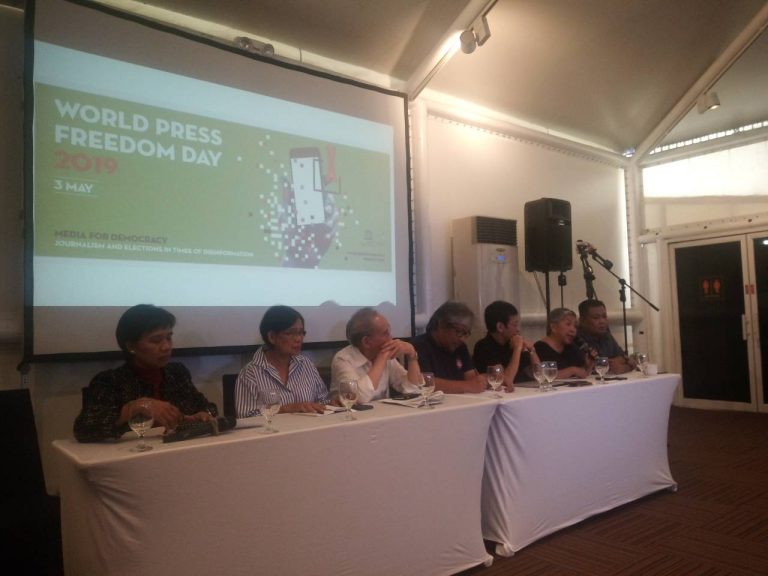
“The reason why government regard the free press as the enemy is because the government fear the free press of its power.”
By ALYSSA MAE CLARIN
Bulatlat.com
MANILA – A network of media organizations documented 128 cases of threats and attacks against the Philippine media under the Duterte administration.
In a forum on World Press Freedom Day, May 3, the Freedom for Media, Freedom for All Network noted a significant increase on the number of violations to press freedom. From 99 cases documented last Nv. 23, 2018, the number of cases jumped to 128 in just six months.
Twelve journalists have been killed in the line of duty while there were eight cases of slay attempt.
Digital attacks are on the rise with 18 cases of online harassment, 10 cases of website attack and five cases of cyber libel.
Online media outfits are on the front-row of these attacks and threats, leading the number of victims with 50 cases.
Luzon remains to have the highest number of attacks with 89 recorded cases while 13 cases were recorded in the Visayas and 26 in Mindanao.

Nearly half of the cases identify state agents as the alleged perpetrators for the attacks. These include local government officials and employees, national government offices and officials, the Philippine National Police and the Armed Forces of the Philippines, the Presidential Security Group, and even a case against one of the officials of the Presidential Task Force on Media Killings, a government body supposedly made to protect the media from any form of harassment and threat.
Matrix, red tagging, DDoS
The network highlighted few cases that they deemed to be causing the biggest spike during the last six months.
Those named in the so-called ouster plot matrix condemned Malacanang’s spin.
Ellen Tordesillas of Vera Files said, “Maraming nakakabahalang aspect itong matrix. Kung ito yung tipo ng intelligence report na pinagbabasehan ni president, nakakatakot. Kasi kung sabi ni Panelo, galing ito sa unidentified SMS… Anong klaseng pamahalaan meron tayo?” (There are many aspects in the matrix that are alarming. If this is the kind of intelligence report that the president relies on, that’s very chilling. Even (Salvador) Panelo said it came from unidentified SMS…What kind of government do we have?)
Panelo is the presidential spokesperson.
Inday Espina-Varona pointed out that the matrix has no basis at all. “We don’t need to defend ourselves because there is not a single piece of evidence against us,” she said.
Maria Ressa, CEO of Rappler, who has been arrested twice and released on bail, said, “Journalism is not a crime.”
Meanwhile, Jaime “Nonoy” Espina, national chairperson of the National Union of Journalists of the Philippines (NUJP), said that red-tagging of individual journalists and media organizations has spiked under the Duterte administration.
The NUJP has been attacked and red-tagged by tabloids as part of a communist front last 2018. The same story also appeared in the state-run Philippine News Agency despite the media group denouncing the claim as soon as it was released.
Espina reiterated that red-tagging is not new, but it is also not good as it poses threats to their members.
He also said that the distributed denial of service (DDoS) attacks on online media, particularly the alternative media that publishes articles critical to the government, are a huge concern on press freedom.
Espina also identified the SEC Memorandum Circular Order no. 15 as “a very insidious threat.”
“What it essentially means is that SEC can look to the finances of NGOs. Not only where the funds come from, but also how the funds are used,” he explained.
The SEC memo was released last November, including a set of guidelines for registered Non-Profit Organizations. purportedly to track ‘money laundering and terrorist funding.’
Espina said that the very dangerous thing on SEC memo was the rule that enables SEC to ask the police and military to come in and investigate NGOs, including the foundations of big broadcast networks.
“Without knowing, they don’t even have to inform you, and they could immediately investigate you,” said Espina.
Espina said they are planning on contesting the memorandum legally, labeling the new SEC memo as “unconstitutional and abridging a lot of basic human rights.”
For his part, Luis Teodoro of the Center for Media Freedom and Responsibility (CMFR), zeroed in on the motives behind the attacks. “The reason why government regard the free press as the enemy is because the government fear the free press of its power,” he said.
The report was compiled and completed by different media organizations such as CMFR, NUJP, Philippine Press Institute (PPI), MindaNews, and Philippine Center for Investigative Journalism (PCIJ).
The post 128 cases of press freedom violations recorded by media groups appeared first on Bulatlat.
Karapatan, RMP, and Gabriela seek legal protection vs threats, vilification at the Supreme Court
On May 6, 2019, Karapatan, together with Rural Missionaries of the Philippines (RMP) and Gabriela, with the assistance from lawyers of the National Union of People’s Lawyers (NUPL), filed petition at the Supreme Court to seek legal protection from threats to life, liberty and security, amid accusations of being fronts of the Communist Party of the Philippines.
CEGP honors NUJP’s Espina with MH del Pilar Award
“On top of his distinguished journalism career, the awardee is, without doubt, a leading force in the defense of press freedom and freedom of expression in the country today,” the CEGP’s citation, read by its secretary general Paula Sabrine Janer, said.
Sison on the May 13, 2019 elections in the Philippines
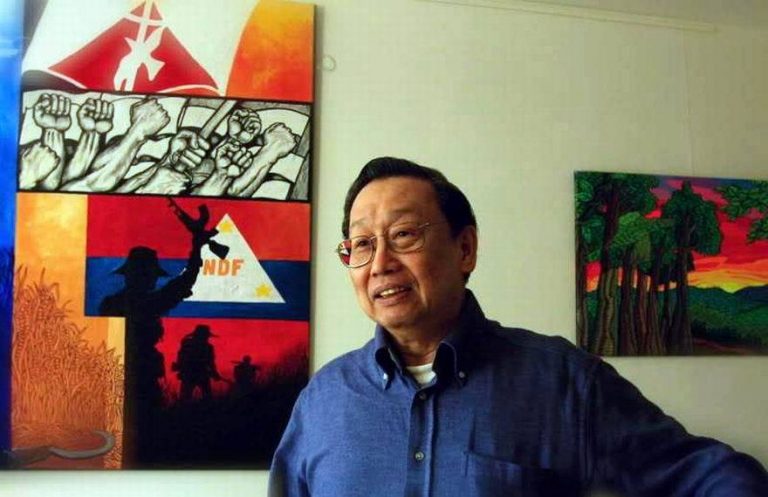
Interview with NDFP Chief Political Consultant Jose Maria Sison
By Rio Mondelo, Editor, Pinoy Abrod
RM 1: The senatorial race in the May 13, 2019 elections in the Philippines is crucial because if Duterte’s candidates in Hugpong ng Pagbabago and PDP-Laban win in an overwhelming way, Duterte will get complete control of the government and two-thirds vote in the Senate to push his federalism project. What are the chances of Duterte’s candidates and the opposition candidates in Otso Deretso, Labor Win, Makabayan, People’s Choice and Catholic Vote?
JMS: If the elections are clean and honest, the senatorial candidates of Duterte will surely lose because they are discredited by their own gross crimes as well as by those of the Duterte regime.
Many of the candidates are notorious plunderers like Marcos, Estrada, Revilla, Enrile and Bong Go and butchers like Enrile as martial law administrator of Marcos and Bato de la Rosa as the chief butcher in the infamous Oplan Tokhang. The Duterte slate stinks because of the shady track record of the candidates. It is so bad in contrast to the clean and brilliant record of the opposition candidates.
The broad masses of the people detest the Duterte regime for the soaring prices of basic commodities and the rise of mass unemployment and poverty. The Duterte candidates are seen as stooges of a tyrant, puppet of China, mass murderer, supreme protector of drug lords, plunderer, incorrigible liar, antagonist of the Christian churches and women and generator of inflation.
RM 2: So, if Duterte’s senatorial candidates are guaranteed to lose if the elections would be clean and honest, what steps will Duterte likely take to deliver victory for his senatorial bets?
JMS: Duterte has total control of the Commission on Elections, and the military and police personnel who will be deputized for election duties, especially in Mindanao which is under martial law, and in other areas deemed as trouble spots by the Comelec, the military and the police.
Duterte is well-known to have a sly criminal mind. He will certainly use his power over the Comelec and the armed services to rig the elections, especially because he wants to increase his despotic powers and prolong his stay in power by railroading charter change to a bogus federalism.
He is mortally afraid that the moment he steps down from power, he is liable for criminal prosecution by the International Criminal Court and for punitive actions by the Filipino people and their revolutionary forces. Thus, he is driven like crazy to prolong his stay in power and gain more powers to oppress and exploit the people.
Even before the elections, the rigging has started. The whole of Mindanao and the so-called trouble spots are already under martial rule. The public school teachers and people from various walks of life are being red-tagged for the purpose of mass intimidation and extrajudicial killings. Opposition candidates are at a huge disadvantage.
RM 3: In view of Duterte’s control of Comelec and the troops to be deputized for the elections and the strong likelihood he will rig the elections to avoid prosecution, why should the opposition candidates still run for the Senate?
JMS: They need to run in order to arouse, organize and mobilize the people for realizing the real majority vote and, when and if elections prove to be rigged, there will be clear ground for the people to take offense and rise up to oust Duterte in the same manner that they rose up after Marcos cheated in the 1986 elections.
Remember that before the 1986 elections there were the huge electoral rallies of the Aquino slate and the mass protest actions of BAYAN. These forces eventually conjoined with the mass following of the Catholic and other Christian churches and those military and police officers who turned against Marcos in order to oust him after he cheated in the elections.
RM 4: Marcos stirred and accumulated the people’s wrath for at least 14 years before he could be ousted. Duterte, on the other hand, seems to have chalked up in just three years this image that he excels at fabricating poll surveys and fake news. Under a thick cloud of mass intimidation created by red-tagging and mass murders through Oplan Tokhang and Oplan Kapayapaan, paid ads of him huckstering for his bets dominate the print and electronic media.
Given such circumstances, are the opposition forces strengthening themselves and building a broad united front to launch huge rallies before the elections? And, like in 1986, are they preparing to oust Duterte after he expectedly cheats in May?
JMS: I presume that the opposition forces are doing their best to strengthen themselves and to build a broad united front. There is less than two weeks before May 13 for the opposition to show huge electoral rallies of opposition candidates as well as the protest rallies of the progressive organizations. We hope these will still happen before election day.
But even if these do not materialize, it is still important for the opposition to do the best possible now so that in the long run, when Duterte continues to abuse the people and violate their national and democratic rights, and to amass power and wealth, the people would be in a position to rise up with the intensity and magnitude of mass actions against Marcos in 1986.
There are certain factors that can run counter to the building of the broad united front. The climate of mass intimidation due to widespread red-tagging and actual murders of social activists might have a dampening effect on certain sections of the population.
There are also anti-Duterte reactionaries who are at the same time more anticommunist and more pro-imperialist than they are anti-Duterte. These are the same elements that would be vulnerable to Duterte’s false assurances that he would step down in 2022 or as soon as his bogus federalism is ratified.
RM 5: It is a known fact that you do not rely solely on elections and legal mass actions allowed by the ruling system. You’re also mindful that, so far, presidents such as Duterte have the clear advantage in terms of power and control over the armed forces and most owners of mass media. For now, what can the people do to assert themselves ?
JMS: The people should never give up the legal mass struggles no matter how much are the mass intimidation, red-tagging and actual murders committed by the Duterte regime against them. By asserting and exerting their democratic rights to speak out and assemble and to create the broadest possible united front, the people themselves make it counterproductive for Duterte to insist on his regime of tyranny, treason, mass murder and plunder.
In the meantime, while all efforts are being exerted to develop the legal democratic struggle against the Duterte regime, the revolutionary forces of the Filipino people are also developing and advancing the people’s democratic revolution through protracted people’s war. If Duterte rigs the elections, he will certainly use his fake electoral victory to suppress the people further and try to go on a killing rampage against the national and democratic forces.
But the revolutionary forces of the people are invincible because their cause is just. They are deeply rooted among the toiling masses nationwide and can at will launch tactical offensives by surprise against the weakest points of the counterrevolutionary regime. As Duterte brutally attacks the legal democratic forces, he unwittingly incites the mass activists to join the armed revolution as Marcos did in the 1970s and 1980s. The growth of the armed revolution is the surest guarantee that the people’s resistance will continue and the Duterte regime will come to an end. Reposted by
The post Sison on the May 13, 2019 elections in the Philippines appeared first on Bulatlat.
Feminist groups call for a women’s strike
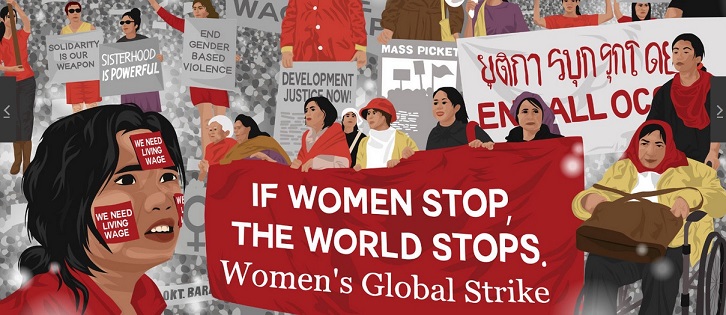
“Our collective power and feminist solidarity are our hope and answer to fight patriarchy, fundamentalisms, capitalism and militarism. And that’s why we are calling for a Women’s Global Strike on International Women’s Day next year!”
By MARYA SALAMAT
Bulatlat.com
MANILA – In Valenzuela City, the 10th most populous city in the Philippines and site of the worst factory fire in recent history, women workers receive wages lower than their male counterparts on the same job. Both are receiving below-minimum wage rates, Malou Santos, chairperson of Women Wise (Women Workers in Struggle for Employment, Empowerment and Emancipation), told Bulatlat in an interview.
Elsewhere in the Philippines, the problem of low wages was raised even more strenuously on May 1 Labor Day celebrations, when the government traditionally tries to give new packages of wage hike or cost of living adjustments and other benefits to workers. But this May 1 and in previous years under President Rodrigo Duterte, the wage rates have been adjusted so little that its purchasing power has actually shrunk despite the increases, according to Ibon research.
The result is that the reality for majority of Filipino working women remains appalling despite the government boasts of improvement in women’s economic participation and opportunity, the Center for Women Resources (CWR) said in its Labor Day statement. The Philippines ranked 8th in the Global Gender Gap Index in 2018. But the realities on the ground for most women belie the government boast. CWR said that to this day, “women are still confronted with very limited work opportunities and are mostly confined as wage and salary workers in manufacturing and retail trade,” in non-regular and low-wage jobs that also are deemed as extensions of women’s domestic chores.
If there were any improvements, it happened because workers, including women workers, have organized themselves and launched concerted actions, the CWR noted. In the Philippines, the likes of the women workers of NutriAsia in Marilao, Bulacan and Sumitomo Fruit Corp (Sumifru) in Compostela Valley have drawn attention and public support when they launched strikes to expose and change their sorry working conditions. Their struggle continues, but women’s advocates drew hope that the plight of working women will soon change for the better if women continue on working collectively in asserting and defending their rights.
A call for Global Women’s Strike, March 8, 2020
Last May 1, a network of feminists, women’s groups and social justice movements in various countries, raised the call for a just, fair and equitable world.
In a statement sent to the media by the Asia Pacific Forum on Women, Law and Development (APWLD), a Thailand-based network of feminist organizations and grassroots activists in Asia Pacific, they reiterated that an equitable world for women includes, among others, a living wage, food sovereignty for all communities, women’s access and control over resources and livelihoods, and certainly no gender wage gap nor gender-based violence.
The APWLD’s network in the Philippines include the CWR, Gabriela, Center for Trade Union and Human Rights, peasant group Amihan, and the Center for Environmental Concerns.
Globally, women earn 37 percent less than men and at the current rate of progress, it will take 202 years to close the gap, the APWLD said.
“In developing countries, two thirds of women are in the informal economy where they are less likely to have legal rights or social protection, and are often not paid enough to enable them to escape poverty. We cannot continue like this anymore,” said Daisy Arago, Center for Trade Union and Human Rights (CTUHR), Philippines.
The current state of development is market-driven and emphasizes individualism, profits, privatization of public services, while protecting corporations through tax breaks, concessions and loans, the APWLD said.
“This system is sustained by lowly paid women who are systematically exploited to maximize profits, spend significant time in unpaid care work, and are excluded from political, social and economic decision making,” said Burnad Fatima, Tamil Nadu Women’s Federation, India.
She urged women’s groups to strongly oppose land grabs by corporations that deprive rural women of livelihoods.
“We want to strike globally to stop the economic exploitation of women,” Fatima declared.
The Global Women’s Strike is slated to happen on March 8, International Working Women’s Day, next year (2020).
Women’s labor rights are rooted in the history of International Women’s Day and women’s struggle to participate in society on an equal footing with men. Misun Woo, director of Asia Pacific Forum on Women, Law and Development, said “We are living in a dangerous world where feminism or women’s human rights are depoliticized and pink-washed by promoting terms such as women’s economic empowerment, or even feminist foreign policy.”
She warned that it is just political manipulation.
“Our collective power and feminist solidarity are our hope and answer to fight patriarchy, fundamentalisms, capitalism and militarism. And that’s why we are calling for a Women’s Global Strike on International Women’s Day next year!” Woo said.
This Labor Day, the women’s coalition also launched the website womensglobalstrike.com, the women and women’s advocates’ resource for information about the campaign, and how women can participate and take actions for the global strike.
The post Feminist groups call for a women’s strike appeared first on Bulatlat.