Sison said the NDFP does not want to be baited into accepting a war panel of the Duterte regime, “whose purpose is merely to seek the impossible, such as the surrender of the revolutionary forces, especially the New People’s Army.”
CDO mayor maintains sports complex not private
The local government-ran sports facility here can never be considered private property despite the ruling of the Office of the Ombudsman upholding the argument of two public officials whose nepotism and graft charges were dismissed by the anti-graft body, according to Mayor Oscar Moreno.
The Chinese connection
China has militarized the Philippines’ Exclusive Economic Zone, and its coast guard cutters have been harassing Filipino fisherfolk, driving them from their traditional fishing grounds, and in some instances even robbing them of their catch. It has lately sent hundreds of sea craft that it insists are non-military and unarmed in the vicinity of Pag-Asa island. The lone barangay of the Philippine municipality of Kalayaan is on Pag-Asa, but past experience suggests that China could very well be eyeing it for occupation.
The flotilla of Chinese vessels and the seeming threat to Pag-Asa seem to have moved the Duterte regime to protest the Chinese presence via the Department of Foreign Affairs, and President Rodrigo Duterte to warn the Chinese to keep off the island or else risk war.
Mr. Duterte said in one of his rambling speeches that if China tries to occupy Pag-Asa, he will send more troops there on a “suicide mission” to defend the island. Even Duterte ally Senator Richard Gordon has weighed in by declaring that a country that sends its military forces to the WPS and harasses Filipino fisherfolk is no friend of the Philippines, contrary to what Mr. Duterte and his henchmen have been saying.
Both the DFA’s diplomatic protests and Mr. Duterte’s attempt at a little saber-rattling are a bit too late. As Mr. Duterte has said a number of times, China is now in control of the WPS. Despite the presence of Philippine troops there, it is quite capable of seizing Pag-Asa if it wants to. As usual contradicting his own statements, Mr. Duterte said in the same speech that he wasn’t really about to go to war with China, and was apparently just bluffing about sending a “suicide mission” to Pag-Asa. He pointed out that the Philippines is entirely at the mercy of Chinese missiles, which that country has deployed on its artificial island-bases — to the construction of which the Duterte regime did not object when it was going on. Neither did the government protest China’s positioning its missiles within striking distance of the rest of the Philippines, including its capital.
Those who have been protesting the regime’s do-nothing policy in the face of Chinese aggression can’t be blamed for suspecting that the seeming shift in its China narrative is intended to influence the results of the midterm elections that are barely five weeks away. Because much of the electorate is dissatisfied with his China policy, it does seem like an attempt to convince the voters that Mr. Duterte and his candidates for the Senate and local posts aren’t really afraid of displeasing China by defending Philippine sovereignty. Despite their demonstrated partiality for, and embarrassing subservience to China, they have had to reluctantly acknowledge the anti-China — and together with it, the pro-US — sentiments of most Filipinos.
The reality is that in its determination to be the next world hegemon after the United States, China has a distinct disadvantage. US prestige and power may be in decline globally, but as the opinion polls have found, it is still the US that most Filipinos trust while being skeptical of China. The reasons are deeply rooted in the history of Philippines-China relations and those between the Philippines and the US.
China and what is now the Philippines have had mostly trade relations that go back several centuries, and many Filipinos have a Chinese ancestor or two in their family trees. But Spanish colonial rule, with its racist foundations, downplayed the first and made the second a disadvantage.
Not only did Spain isolate the Chinese in enclaves called “parians” during its 300-year occupation of the Philippines; it also subjected them to periodic massacres and mass arrests until the 18th century, which imperiled even the liberty and fortunes of those with mixed ancestry (mestizos). As a consequence, most Filipinos echoed Spanish racism by disparaging and discriminating against the Chinese among them.
The US experiment in colonial rule was initially assured through the use of force, but relied as well on cultural power to compel obedience from the “natives.” That power was generated through the forcible use of the English language and the indoctrination of the political elite under its tutelage on such alleged US values as freedom, democracy and individual rights, and the benevolence and supremacy of “the American way,” which eventually found expression in the US-established educational system as well as in the arts, literature, and mass media of the Philippines.
Quite possibly the most successful experiment of its kind in history, US colonialism and imperialism made the Filipino mind a bastion of approval and support for US hegemony. There are material and institutional bases for it such as military and economic aid, and, among others, compacts like the Mutual Defense Treaty and the Visiting Forces Agreement. The use of force is still part of its arsenal of conquest and domination, but US preeminence in the most strategic areas of Philippine life and governance has mostly been assured by its ideological supremacy in the public sphere.
The Philippine population’s US connection is both materially and subjectively based. Together with its minimal subjective influence, China is in contrast still perceived through an anti-communism lens. A legacy of the Cold War, anti-communism has always been the main ideological bias of both US-influenced media and the US music, film, and television industries whose market is the entire world.
China is no longer the socialist country it once was, and is blatantly and aggressively capitalist. But the perception that it is still the China of Mao Zedong persists, with some of those opposed to Chinese intrusion into the WPS attributing its brazenness to its supposed “communism.” The truth is that it was during the period of socialist construction when China made mutual respect and benefit the basis of its international relations, in contrast to its current focus on advancing its interests no matter the consequences on other countries.
China has been trying to influence the Filipino mind through scholarships, films, TV program sponsorships, and familiarization trips with the approval and support of the Duterte regime. These efforts have nevertheless had little visible effect on the Filipino millions, among other reasons because they have been addressed only to a small segment of the population, and cannot even begin to compare with the power of the English language that was early on assured by US colonial policy in the Philippines in the 1900s.
English is the conduit through which the US culture industry keeps US political and ideological influence dominant in this neo-colony. That dominance is the primary reason for the failure of the Duterte regime’s campaign to make its Chinese connection widely acceptable — and for the continuing support for US political, economic and strategic interests among most Filipinos.
Despite its economic power and growing military might, it will take China several generations to even approximate the ideological ascendancy of the US in this country and in much of the world that it seeks to dominate. Hence its use of intimidation, such early 20th century capitalist tricks as the conspicuous display of military power known as gunboat diplomacy, and other far from subtle means to achieve its aims in the Philippines as well as in the rest of the planet.
Luis V. Teodoro is on Facebook and Twitter (@luisteodoro).
www.luisteodoro.com
Published in Business World
April 11, 2019
The post The Chinese connection appeared first on Bulatlat.
Foreign partners support Karapatan vs. red-tagging
Thus the Philippine human rights alliance declared on April 1. It welcomed the announcements by the European Union and the Belgian government that they would look into the allegations that, along with other human rights defenders, the Karapatan acts as “front organization” of the CPP-NPA and that it rechannels overseas funding it receives to the revolutionary armed struggle.
The accusation was made by a team of the Duterte government’s National Task Force to End the Local Communist Armed Conflict (NTF for short), after it had made a round of EU member-states urging them to stop funding certain organizations that have been critical of the administration.
Karapatan has countered that the accusation is “malicious and false… a frantic, outrageous and desperate attempt to gloss over [the government’s] horrendous human rights record.” The aim, it adds, is to “deflect state accountability on the numerous extrajudicial killings and other gross human rights violations and to undermine the work of the human rights defenders in the Philippines.”
In a security report by the Philippine government in October 2018, the Anti-Money Laundering Council, the Securities and Exchange Commission, and the Department of Social Welfare and Development stated there was no evidence proving that non-profit organizations (NPOs) – the more common term in the Philippines is non-government organizations or NGOs – were being used for “terrorist funding.” This same report, Karapatan said, noted that earlier accusations had been based on hearsay and that the NPOs are not the preferred mode of raising funds for so-called threat groups.
Last week Karapatan filed three sets of complaints on the Duterte government’s smear campaign against human rights defenders to these United Nations officials: Assistant Secretary-General for Human Rights Andrew Gilmour, Special Rapporteur on the Situation of Human Rights Defenders Michel Forst, and Special Rapporteur on the Right to Freedom of Peaceful Assembly and Association Clement Nyaletsossi Voule.
It had earlier filed similar complaints on cases of threat, harassment and intimidation, red-tagging and terrorist-labelling at the Commission on Human Rights and the GRP-NDFP Joint Monitoring Committee on the implementation of the Comprehensive Agreement on Respect for Human Rights and International Humanitarian Law between the Philippine government and the National Democratic Front.
Recently a major support-funding organization in Europe came out in full support of Karapatan.
It’s named Aktionsbundnis Menschenrechte-Philippinen (AMP), an initiative of seven major German church-based agencies and human rights organizations, that provides advocacy and information service in Germany and the EU on the human rights situation in the Philippines. Members are: Amnesty International-Germany, Bread for the World, International Peace Observers Network, MISEREOR, Missio Munich, Philippinenburo e V im Asienhaus, and the United Evangelical Mission. Most of these organizations have long supported Philippine concerns, notably during the Filipino struggle against the Marcos dictatorship.
In a letter to DILG Secretary Eduardo Año and Defense Secretary Delfin Lorenzana dated April 9, the AMP expressed deep concern over the Duterte government’s attempts to “discredit civil society organizations, including a number of long-standing partners of our network, by describing them as front organizations of the communist New People’s Army.”
“Ever since the breakdown of the GRP-NDFP peace talks in late 2017,” AMP noted, “harassment, defamation and murder of activists, including land and environmental rights defenders, who are wrongly portrayed as state enemies, communist rebels or terrorists, [have] increased considerably.” While this defamation drive is “nothing new” in the country, AMP added, the Duterte government has also taken other steps to “systematically hamper [the activists’] work.”
AMP cited as one such step the NTF’s accusation, in meetings with the EU and Belgian government in February, that NGOs (including Karapatan, the Rural Missionaries in the Philippines, IBON Foundation, and ALCADEV) were diverting funds received from abroad to the communist rebels.
In late March however, AMP pointed out, “the EU delegation in Manila released a press statement saying that it had so far not been able to verify the allegation, but would conduct a financial audit of one of the accused NGOs.”
“Since the AMP and its members have worked with these organizations for many years, we can attest that the accusations are unfounded and aimed at silencing voices critical of the government,” the letter said.
AMP also noted that in November 2018, the SEC issued Memorandum Circular No. 15 which mandates NGOs to disclose detailed information on their funding sources, current and intended beneficiaries, and the amount of funds received. “Based on an undisclosed point system,” it observed, “organizations will also be assessed whether they pose a risk of money laundering or financing terror. If an organization is deemed to be ‘high-risk’, it will be subjected to enhanced monitoring and surveillance measures.”
The German funding consortium expressed concern over these administrative measures, “which seem to be designed to complicate the registration of NGOs and to limit their access to foreign funding.” Along with the widespread defamation of NGOs and increased violence they suffer, AMP lamented, “these new attempts to obstruct their work are part of a systematic crackdown against civil society in the Philippines.”
The AMP appealed to both the Philippine government and the EU to forestall the worsening of the above-described situation in the country, It called on the Duterte government to take “all necessary steps” to protect human rights defenders from harassment, violence, and killings and likewise to protect their freedom of association; direct state security forces and agencies to refrain from making statements that stigmatize them; and guarantee the right of NPOs/NGOs to seek, receive and utilize funding from national, foreign, and international sources.
To the EU, the AMP urged the Union to publicly declare support to all human rights organizations in the Philippines, “especially those on which it has received accusations [from the NTF].” Further, in suggested that the EU consider the withdrawal of trade preferences given to the Philippines under the Generalized Scheme of Preferences, unless the Duterte government takes immediate steps on the AMP’s recommendations.
Given the uneasy relationship between the Duterte regime and the EU, particularly on human rights issues, it would be interesting to find out what the response of either one would be.
* * *
Email: satur.ocampo@gmail.com
Published in Philippine Star
April 13, 2019
The post Foreign partners support Karapatan vs. red-tagging appeared first on Bulatlat.
2 urban poor activists abducted

By JANESS ANN J. ELLAO
bulatlat.com
MANILA — Two urban poor activists were forcibly disappeared yesterday, April 13, in Bulacan.
The two urban poor organizers are Kadamay member John Griefen Arlegui, 20, and youth group Anakbayan’s Reynaldo Remias, Jr., 24.
They were accosted at gunpoint between 10:00 to 11:00 in the morning while posting posters of senatorial aspirant Neri Colmenares and partylist group Bayan Muna along Angat-Pandi Road, according to eyewitnesses.
Kadamay said in its statement that they were forced into a red car that bore no license plate by armed men in plainclothes, right in front of the Iglesia ni Cristo church in Brgy. Sta Cruz, Angat, Bulacan.
Kadamay’s chapter in Pandi learned of their abduction when they noticed the election sortie vehicle, along with their election materials, parked along the highway in the afternoon of April 13. The two, however, were missing.
Kadamay said they have already searched police stations in Angat, Norzagaray, Sta. Maria, and San Jose del Monte but were told that the two are not in their custody.
Arlegui and Remias were among the members of Kadamay who occupied the abandoned government housing in Pandi, Bulacan.
The urban poor group suspects that the abductors belong to the 48th Infantry Battalion of the Philippine Army.
Last year, no less than President Duterte ordered an elite police force to go against Kadamay, whose members were occupying government housing units. He went as far as ordering to have them killed should Kadamay resist a police takeover in the housing units.
This is not the first time for Kadamay members in Pandi to be subjected to rights abuses.
On March 26, 2019, two Kadamay members Marlon Acedera and Joel Chavez were illegally arrested when bullets were supposedly found in their homes within the occupied housing in Padre Pio Resettlement in Cacarong Bata, Pandi.
The two remain incarcerated as of this writing.
Kadamay national chairperson Gloria Arellano called for the surfacing of their two members.
She added, “we blame the Duterte regime for openly attacking the legal democratic movement with all the possible means in order to quell the resistance of the Filipino people against its anti-poor and anti-people policies.” (bulatlat.com)
The post 2 urban poor activists abducted appeared first on Bulatlat.
Thousands expected to visit Normin religious sites during Lent
More than half a million individuals are expected to visit the various pilgrimage sites in Northern Mindanao, especially in Misamis Oriental, during the Holy Week, a tourism official said.
Family living wage for a family of five members in NCR
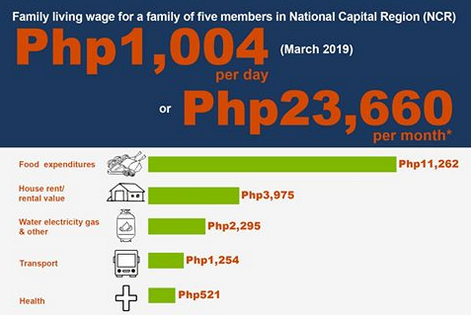
“The choice of official poverty lines is a political one. Setting a high standard indicates the government having a high level of ambition for poverty eradication. Government, however has chosen to set a low standard – in this case, the Php10,481 per month or Php69.87 per day poverty threshold – which results in tens of millions of Filipinos not meeting minimum standards of well-being and hidden behind unrealistic official poverty statistics.”
#MalalangEkonomiya #MayMagagawa #PeopleEconomics #BeyondElections2019
AFP, Parlade mastering the art of spinning lies and sowing intrigues – Karapatan-SMR
“The Armed Forces of the Philippines through its deputy chief of staff for civil-military operations Antonio Parlade Jr. is getting more and more desperate in its vilification campaign.