Home Blog Page 44

US data group: Civilian-targeting by PH gov’t in war on drugs rising

0

By: Tony S. Bergonia -INQUIRER.net /November 23, 2021

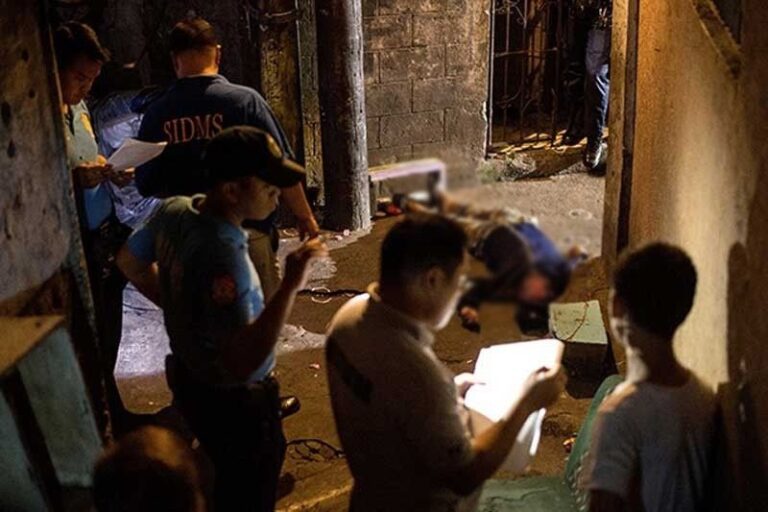
MANILA, Philippines—The direct role of the Philippine government in civilian-targeting in its bloody campaign against drugs has escalated since 2020, and the bloodshed has no signs of subsiding, according to a US data analysis group.

“The Philippine state has taken an increasingly large role in targeting civilians itself, no longer trying to create distance by ‘outsourcing’ the majority of violence to vigilantes,” said the report by Armed Conflict Location and Event Data Project (ACLED), a US-registered nonprofit organization that analyzes information and data on conflicts and violence worldwide.

“Since 2020, there has been an upward trend in the proportion of state involvement in drug war violence,” ACLED said in the report devoted to the ongoing campaign against drugs by Philippine President Rodrigo Duterte.

After studying and analyzing data and information from at least 40 sources, ACLED said it also found that the drug war’s toll on civilians in the Philippines had been underreported.

“Our new data clearly indicate that the government is severely undercounting the drug war’s toll on civilians in the Philippines,” said Dr. Roudabesh Kishi, ACLED director of research and innovation, in an e-mail exchange with INQUIRER.net.

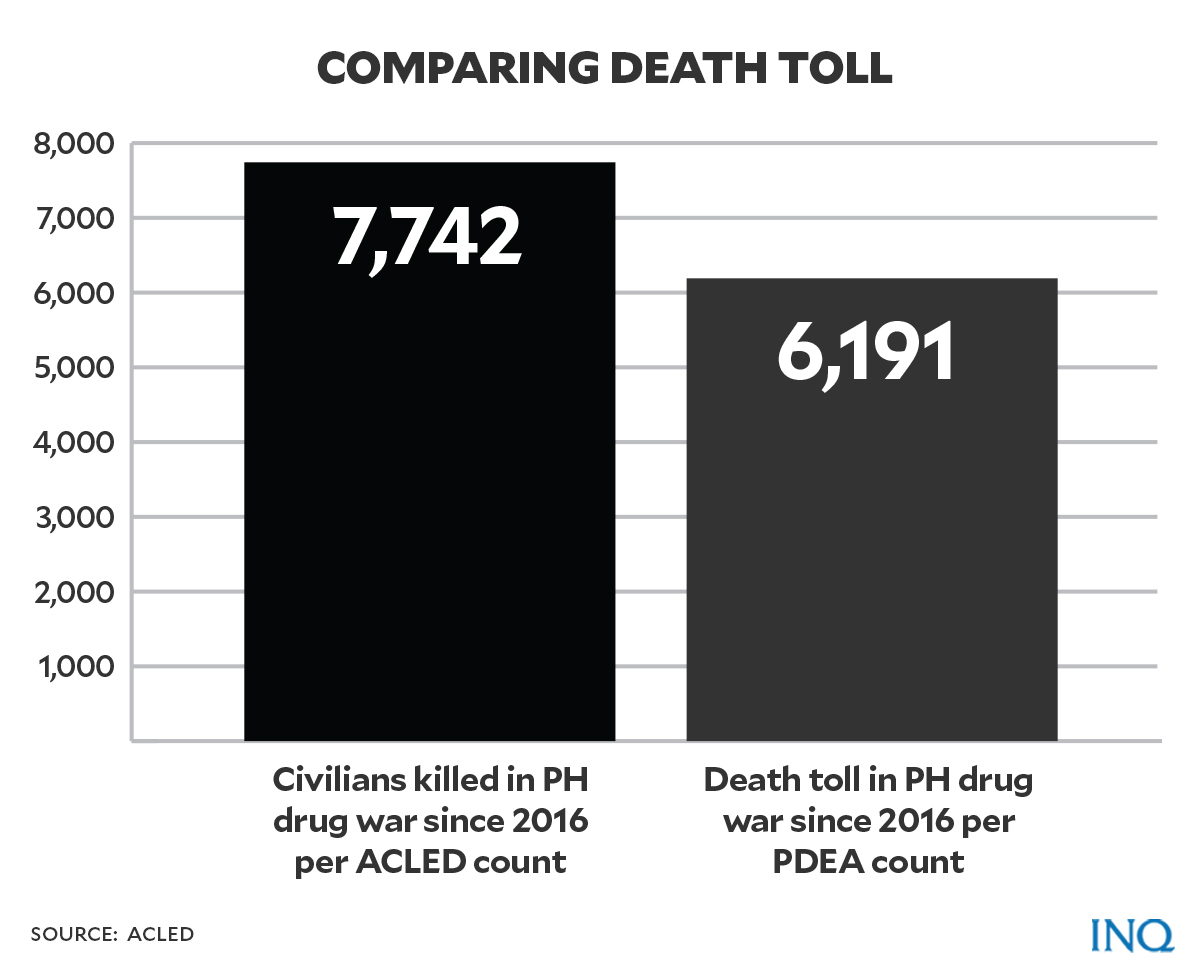
The ACLED report found at least 1,100 fatalities in the anti-drug campaign that the government has not counted. “We now estimate at least 7,742 civilians have been killed in the drug war since 2016,” the report said.

It said analysis of the data showed that the actual civilian death toll in the campaign against drugs was 25 percent higher than the government’s count “even by a conservative estimate.”

“The government admits that over 6,000 killings have occurred during police operations in association with the drug war,” said ACLED.

“These figures exclude ‘vigilante’ killings by non-state actors, however, which played a significant role, especially in the early days of the drug war, in targeting civilians,” ACLED said in its report.

“There are clear ties between anti-drug vigilantes and the state,” said the report. “At minimum, such actors are supporters of Duterte and his drug policies, carrying out attacks inspired by Duterte’s rhetoric.”

“In other cases, the ties between these agents and the state have been more direct, with perpetrators relying on police to secure the perimeter in the lead-up to attacks,” ACLED said.

While the government keeps a death toll, it has done little to hold police officers accountable for killing civilians. “Many officers have already been absolved of any wrongdoing during internal police investigations,” ACLED added.

An e-mail seeking Malacañang reaction sent by INQUIRER.net to the office of Palace spokesperson Secretary Karlo Nograles, who took the place of resigned spokesperson Harry Roque, was acknowledged as received but contained no reply to the ACLED findings.

According to ACLED, its data analyses and research reports are among the key documents being examined by the International Criminal Court in the case filed against Philippine officials in connection with alleged unlawful killings during the campaign against drugs.

“Alongside a range of other key sources, ACLED data and analysis were cited extensively by the ICC in its request for an investigation into potential crimes against humanity during anti-drug operations in the country earlier this year,” said Kishi, referring to the International Criminal Court.

The latest ACLED report, released last Nov. 18, said it found three key new developments in the anti-drug campaign in the Philippines.

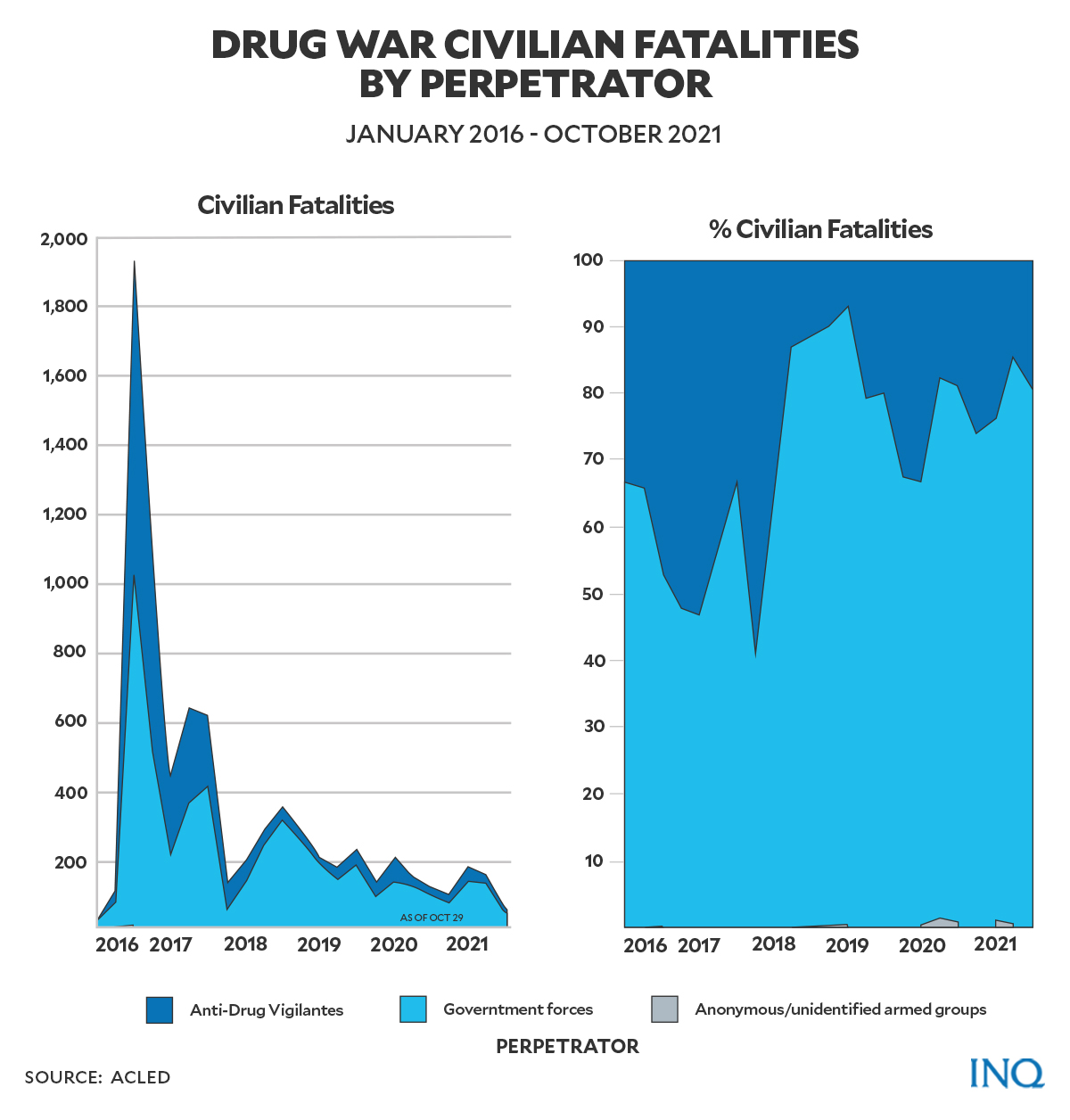
“First, while the overall rate of violence has declined since the height of the drug war in 2016, deadly attacks have continued throughout 2021, with hundreds of civilian fatalities,” said the report.

“Second, state forces, especially [the] police, have taken an even larger role in violence targeting civilians over the course of the drug war,” it said.

The report noted that, although anti-drug vigilantes were largely responsible for a great deal of violence against civilians during the initial months of the war on drugs, “majority of civilian targeting in recent years has been carried out directly by state forces.”

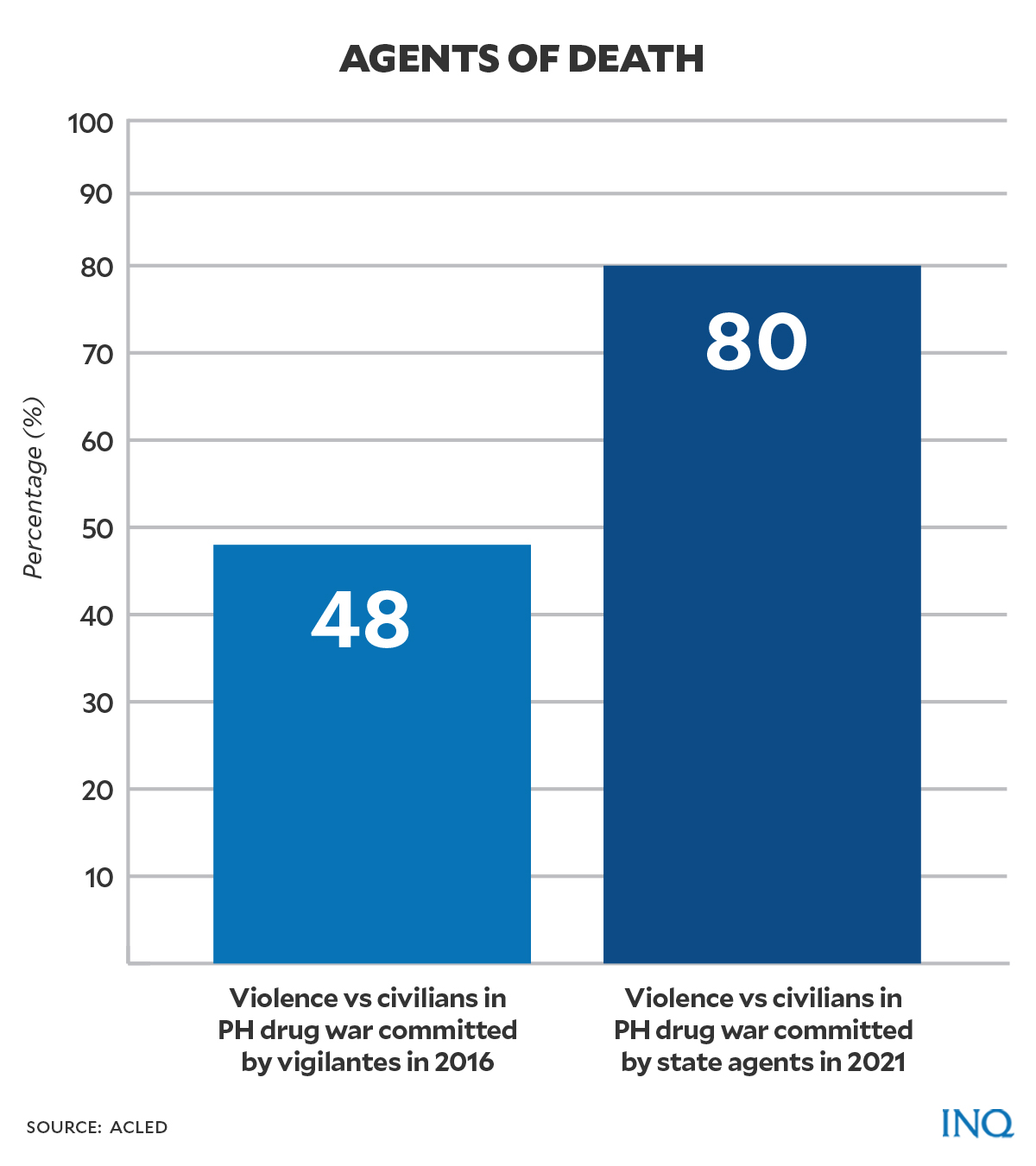
ACLED’s 2016 report estimated that 48 percent of violence committed against civilians during the war on drugs was committed by vigilantes. But in 2021, at least 80 percent of the violence was committed by government agents, the report said.

“The shift appears to be driven by increased scrutiny on vigilantes by the media and the international community, including the ICC,” said ACLED.

Direct targeting of civilians by state forces was partly a result of other fronts in armed conflict against terrorists and communists, according to ACLED.

In the war on drugs, the national police leadership continued to play a leading role, according to the report.

“The official police chain of command allows the government to continue prosecuting the war on drugs while retaining greater oversight of the actors involved—especially against the backdrop of an ICC investigation,” ACLED said.

This was in contrast with the employment of “loosely organized vigilante groups that may prove more unpredictable and difficult to control,” it said.

About a month before he retired as Philippine National Police (PNP) chief, Guillermo Eleazar said he respected the decision of relatives of civilians killed in the war on drugs to file a complaint at ICC.

But he said ICC involvement may not be necessary as “the Philippine justice system works.”

“Proof of this is the conviction of the policemen for the killing of Kian Delos Santos and several other court decisions which have caused the dismissal and imprisonment of other PNP personnel,” Eleazar said in September, more than a month before he left the police force and decided to run for senator under the Lacson-Sotto ticket.

According to ACLED, the third key development in Duterte’s war on drugs was the shift in the geography of the violence.

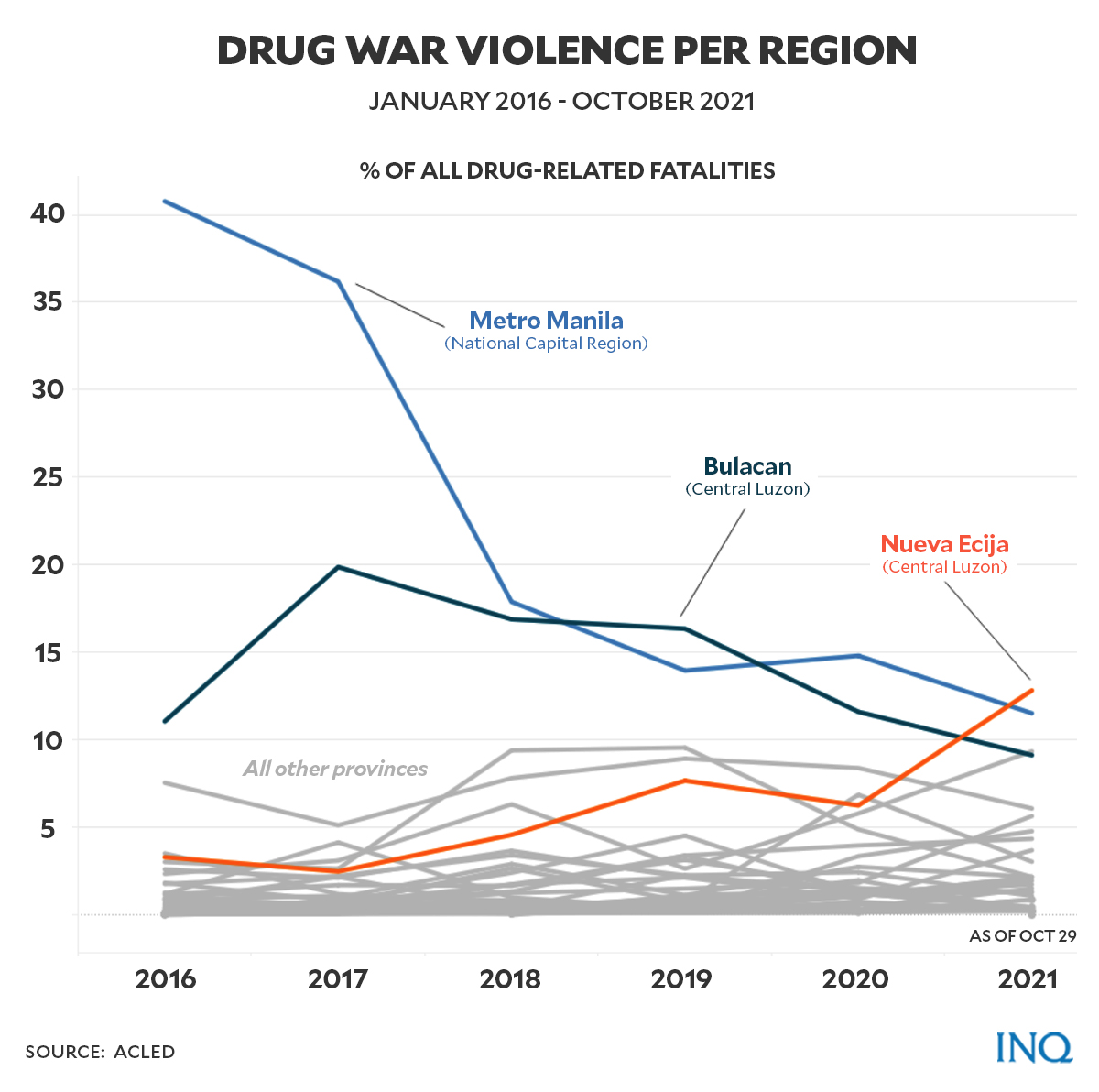
ACLED said the highest concentration of violence and killings has shifted from the National Capital Region, the country’s economic hub, to Central Luzon, particularly Nueva Ecija, which “is now home to the most drug-war related violence in the country.”

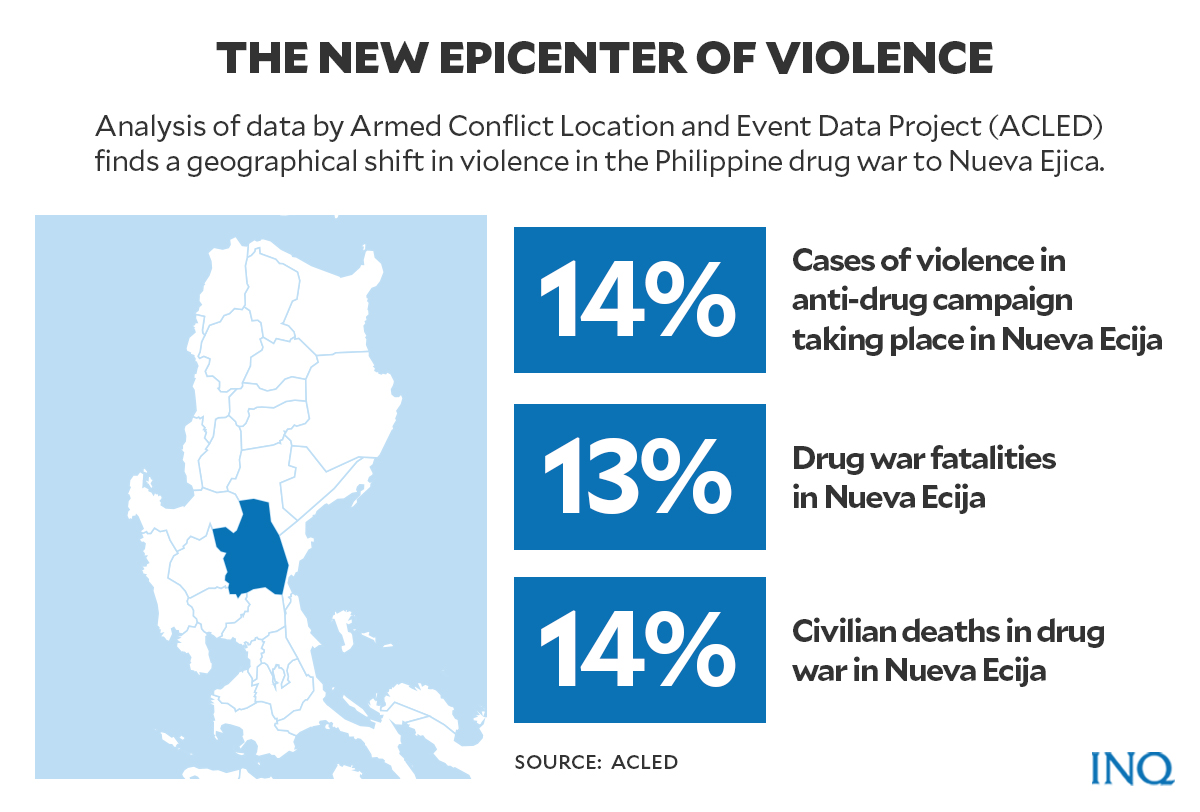
It said 14 percent of cases of drug campaign-related violence took place in Nueva Ecija. At least 13 percent of drug war fatalities were recorded in the province. More than 14 percent of civilian deaths connected with the anti-drug campaign were also recorded in Nueva Ecija.

Nueva Ecija, ACLED said, surpassed Bulacan and Metro Manila in cases of violence and civilian deaths related to the anti-drug campaign “to become the new epicenter of the war.”

“While the reasons for this shift to Nueva Ecija are not yet clear, the broader shift to Central Luzon appears at least in part linked to the transfer of top police officials from the National Capital Region,” ACLED said.

“These officials have continued to be rewarded and incentivized by the Duterte administration even as violence has surged under their command,” it said.

Duterte has repeatedly defended his campaign against drugs, claiming that those protesting what they perceive as human rights violations are unwilling to see how drug abuse is harming the Philippines.

A complaint has been filed at the International Criminal Court (ICC) accusing Duterte and his officials of crimes against humanity in carrying out the campaign against drugs.

The ICC has agreed to investigate but also suspended action upon the request of the Philippine government.

Nograles said while the government reached out to ICC to suspend action, it was “not waiving its position regarding ICC’s lack of jurisdiction.”

“We trust that the matter will be resolved in favor of the exoneration of our government and the recognition of the vibrancy of our justice system,” Nograles said.

Philippine officials point to an ongoing investigation by the Department of Justice (DOJ) as proof there was no impunity, which would justify an investigation by ICC or the United Nations High Commissioner on Human Rights (UNHCHR).

Although the DOJ had completed a review of 52 civilian killings during police anti-drug operations and concluded that 154 police officers could be held liable, ACLED said its analysis found that civilian killings attributable to the state and its agents were “much higher than the official figures suggest.”

“This marks a rare admission by the Philippine state that it may be complicit in abuses stemming from the war on drugs—which continues to rage on,” said ACLED.

The data analysis group said confusion over thousands of other deaths that could be related to the campaign against drugs is preventing a closer look at those killings and was partly caused by the use by police of the term “death under investigation” or DUI.

The complaint filed at ICC cites up to 30,000 killings in the Philippines’ war on drugs, many of which had been tagged as DUI and could not be immediately listed as killings directly related to Duterte’s anti-drug campaign.

However, the lack of transparency by the Philippine government is blocking independent investigations into the campaign against drugs, said ACLED.

“Independent monitoring and data collection [are] critical to ensure that investigative bodies like the ICC have reliable information to support their work and hold perpetrators of abuses accountable,” it said.

3,000 tsinelas protest

0

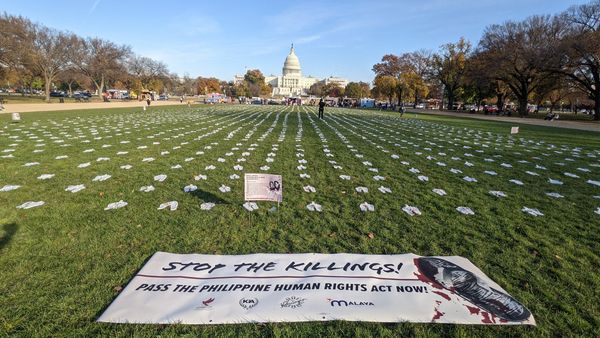
Human rights activists in the US displayed “tsinelas” across Capitol Hill in Washington D.C. to protest the extrajudicial killings in the Philippines.

They called the US Congress to block US security assistance to the Philippines and to stop funding the Philippine police and military.According to the International Coalition for Human Rights, each pair represented 10 killings in the country to account for the 30,000 killings under the Duterte administration.

The “tsinelas action” was organized by the Communications Workers of America, International Coalition for Human Rights in the Philippines (ICHRP), Malaya Movement USA and the Kabataan Alliance. (from Altermidya)

Anti-disinfo coalition calls on Facebook to strengthen election safeguards

0

Nov 17, 2021, Loreben Tuquero

MANILA, Philippines

The newly-launched Movement Against Disinformation will not focus on individual posts but on the platforms that allow them to be disseminated

A newly-launched coalition against disinformation called on Facebook to implement a “more robust approach” to moderating election-related disinformation, in line with the upcoming Philippine national elections in 2022. 

The Movement Against Disinformation, launched on Wednesday, November 17, is composed of lawyers, members of the academe, civil society groups, local and international non-government organizations, and other advocacy groups. 

For its first initiative, the Movement Against Disinformation published an open letter to Facebook with a list of demands regarding transparency on election-related policies, identification and flagging of impostor pages or groups, monitoring violations from authentic accounts, mandatory labeling for political personalities, boosting authoritative news, and maintaining open communication channels, among others.

The coalition believes Facebook’s current measures fail to address its continued reliance on algorithms that, “due to their contextual blindness, tend to amplify and reward the most inflammatory content, including disinformation.”

“You have a significant role in ensuring clean and fair elections in the Philippines in 2022. Please do not allow Facebook to be used, exploited, and weaponized against our democracy again. The Filipino people – your most active users – deserve better,” the letter read.

Lead convenor and Rappler board member Antonio La Viña said one of the objectives of the nonpartisan coalition is to “expose enablers and propagators where we have proof.” However, they will prioritize engaging social media platforms.

“Our focus will not be on individual posts, on individual persons. That’s actually a waste of time and that’s really the one that could violate freedom of expression. Our focus will be on the platforms that allow them to be disseminated,” La Viña said.

He said they would want to establish both formal and informal channels with online platforms in order to course concerns and resolve them. 

“Given the nature of the consortium where we have a lot of legal groups, a lot of lawyers, a lot of colleges of law and academics, the priority is the engagement with the platforms and get the platforms to adopt protective measures against disinformation,” he said.

Facebook – which has changed its company name to Meta – is the first platform the coalition is addressing because it is the one most used by Filipinos. But La Viña said they would eventually “cover all the different social media platforms” one at a time.

A Pulse Asia survey conducted in September 2021 showed that nearly half or 48% of Filipino adults get their political news from the internet, with 44% of them citing Facebook.

La Viña said the coalition also wants to build capacity on spotting and identifying disinformation, and are hoping to supplement, not duplicate, the work of media organizations that conduct fact-checking.

The coalition’s members include the following: 

  • Philippine Bar Association
  • Philippine Chapter-New York Bar Association
  • Lyceum of the Philippines University
  • Ateneo de Naga
  • Ateneo de Davao
  • Xavier University 
  • Alternative Law Groups
  • Ateneo Human Rights Center
  • SALIGAN
  • Karapatan 
  • iDefend
  • Wiki Society of the Philippines
  • Pinoy Media Center
  • Foundation for Media Alternatives
  • Ateneo Sanggunian
  • Members of the faculty of Ateneo Law

Convenor Rico Domingo, president of the Philippine Bar Association, said they would also try to coordinate with the Commission on Elections in monitoring disinformation. – Rappler.com

Int’l rights group urges ICC to proceed with ‘drug war’ probe

0

Philstar.com, November 21, 2021

MANILA, Philippines — A global human rights coalition on Sunday morning called on the International Criminal Court to “proceed without delay” with its investigation into alleged crimes against humanity in the Duterte administration’s “war on drugs”.

In a statement sent to media, the International Coalition for Human Rights in the Philippines said that the ICC’s decision to temporarily suspend its investigation “rewards Duterte and further victimizes those who gave evidence in support of ICC probe.”

The ICC said it would suspend investigative activities for the time being “while it assesses the scope and effect of the deferral request” filed by Manila.

The Philippine government filed the deferral request on November 10, pointing to its own investigations into “drug war” killings. The Palace has said that the government’s request does not concede jurisdiction to the ICC.

“In accordance with the principle of complementarity under which the Court operates, the Philippine government has the first responsibility and right to prosecute international crimes,” the government said in a letter to ICC prosecutor Karim Khan. 

“The Court may only exercise jurisdiction where national legal systems fails to do so, which certainly is not the case in the Philippines… the domestic institutions in the Philippines are fully functional and more than adequate to address the issues and concerns raised,” it also said.

The Philippines has maintained this position amid concerns of human rights violations in the “drug war.”

“The Prosecutor found credible evidence that crimes against humanity had occurred. Any suspension or delay is an absolute betrayal of those brave individuals who came forward at great personal risk to provide evidence and testimony regarding these alleged crimes,” ICHRP chairperson Peter Murphy said. 

READ: CHR: ‘Drug war’ review report credibility may suffer if done ‘in the shadows’

In its November 10 request to the ICC, the Duterte government claimed it had already begun its own review of 52 cases where police killed suspects during anti-drug operations.

The 52 cases are among 6,100 deaths acknowledged by official police data. Rights groups say as many as 30,000 may have died in the course of the “drug war”.

This, while the newly-minted chief of the national police appointed by Duterte himself has promised continuity in what he said would be the “finale” of the administration’s bloody war on drugs. 

“ICHRP has full confidence in the impartiality of the ICC. We reiterate that the ICC should heed the call of these families to fully investigate the Duterte administration for these crimes against humanity so that, finally, justice may be served and impunity ended,” Murphy said.

Rights group points to ‘failure of domestic remedies’

The ICHRP in its statement also pointed to the findings of global investigating panel Investigate PH which found that Philippine courts had managed to convict two police officers for the 2017 murder of 17-year-old Kian Delos Santos – one case in the 6,011 officially recorded up to the end of 2020.

“The findings of the First and Second Reports of the Independent International Commission of Investigation into Human Rights Violations in the Philippines (Investigate PH) clearly showed the flaws and failure of the domestic remedies now claimed to be operating,” said Murphy.

PNP chiefs routinely bring up the singular conviction of Kian Delos Santos’ cop-killers as proof that the justice system is working for the families of victims searching for justice. 

But Murphy also pointed out that the case only succeeded because the Barangay Captain had failed to switch off the CCTV which recorded the police abduction of Kian.

READ: PNP says 2018 conviction of Kian’s murderers proof that ‘domestic remedies work’

Investigate PH also dispelled the Philippine government claims that the thousands of victims of the war on drugs were killed by police in self-defense or the popular “nanlaban” (fought back) narrative. 

In its report, the panel presented forensic evidence to the ICC of victims with defensive wounds, of victims who had been bound before being killed or others taking bullets to the back.

“There are probably over 30,000 cases of these police killings in anti-drug operations, based on statistics of “Deaths Under Investigation”. And now the Philippine Drug Enforcement Agency no longer reports deaths in anti-drug operations, on their Real Numbers PH webpage.”

The Philippine government now tells the international community that its domestic remedies are working. When the Investigate PH reports came out, though, Duterte’s appointed officials were quick to dismiss it as “malicious” and “uninformed.”

“This kind of review – of 5,655 cases – was first promised by the Secretary of Justice to the UN Human Rights Council in June 2020,” said Murphy.

READ: Abuse in ‘drug war’ routinely covered up, advocates say

In February 2021 Secretary Guevarra reported that just 328 cases had been reviewed, revealing no proper crime scene investigation in more than half the cases.

In May 2021, he reported that the PNP had given access to files on 61 cases, but by June 1, 2021, the police had cut this number to 53 and eventually 52. 

ICHRP pointed out that this figure represented “well below 1 percent of deaths in police anti-drug operations.”

“There is no way that this level of inquiry – most unlikely to be genuine – amounts to an investigation of the crime against humanity of murder which the ICC was investigating,” said Murphy.

“The ICC needs to re-start its investigation of all the evidence it has before it and give justice to the tens of thousands of Filipinos murdered at President Duterte’s repeated incitement.”

Franco Luna with a report from Bella Perez-Rubio 

Death of political prisoner shows double standards in justice system, group says

0

By: Gabriel Pabico Lalu – Reporter /INQUIRER.net /November 19, 2021

MANILA, Philippines — The death of a 67-year-old political prisoner, who succumbed to stomach cancer, shows the alleged double standards of the country’s justice system, rights group Karapatan claimed on Friday.

According to Karapatan’s secretary general Cristina Palabay, the death of Antonio Molina, who was detained at the Puerto Princesa jail, contradicts the justice system’s reasoning for allowing high-profile individuals like former senate president Juan Ponce Enrile and former first lady Imelda Marcos to remain free despite the fact that they should be in jail.

Karapatan said that Molina, a member of the Katipunan ng Samahang Magbubukid sa Timog Katagalugan, died on Thursday night at the Ospital ng Palawan.

“As we grieve with the family, friends and colleagues of Tatay Antonio Molina, we deplore the heartlessness and injustice he suffered from being imprisoned on trumped-up charges and the denial of his plea for compassionate release,” Palabay said in a statement.

“While moneyed and powerful people like Juan Ponce Enrile and Imelda Marcos have been granted bail for massive crimes against the people, poor people like Tatay Antonio have been time and again cruelly denied humane treatment,” she added.

Enrile is facing plunder charges before Sandiganbayan for allegedly bagging kickbacks from pork barrel mastermind Janet Lim Napoles, for diverting funds into bogus non-government organizations operated by the latter.  Plunder is usually a non-bailable case, but the courts allowed Enrile to walk out of jail for health and humanitarian reasons.

Marcos on the other hand was convicted by the same Sandiganbayan for transferring funds into Swiss accounts when she was still occupying posts in government as member of Batasang Pambansa, Metro Manila governor, and as minister of human settlements.

READ: SC upholds ruling granting bail to Enrile 

READ: Imelda Marcos tells Sandiganbayan: I’ll take case to Supreme Court 

As early as July 5, Karapatan was already asking for medical attention for Molina, months after he was diagnosed with cancer.  Palabay said in the previous reports that the political prisoner needs medical treatment before it gets late.

However, Karapatan claims that Molina was only brought to the hospital after his heart rate collapsed, in which he had to be intubated after experiencing cardiac arrest.

Molina was arrested with other six activists after he was accused of being in possession of different firearms.  The group claimed it was planted only by soldiers and police officers.

“These political prisoners had life-threatening illnesses when they were arrested and detained on trumped up charges, and conditions inside prisons have made their conditions worse. Their incarceration had made them more vulnerable – being in an environment that exposed them to minimal if not nil health care and treatment, overcrowded and highly stressful conditions,” Palabay said.

“These deaths highlight the dire problems of the Philippine justice system, and we can never accept how the Duterte administration has further normalized this trend of weaponizing the law and the courts to criminalize dissent and activism resulting in the deaths of the most vulnerable,” she added.

JPV

Duterte rewards alleged key DDS members with promotions, plum posts

0

Nov 18, 2021, Rappler Investigative Team

MANILA, Philippines

Alleged Davao Death Squad members and enablers have become senators, department heads, and leaders in their own offices after Rodrigo Duterte became president

When self-confessed  former Davao Death  Squad (DDS) gunman Arturo Lascañas presented himself to the International Criminal Court, he said he remembered the people whom he worked with. 

Like him when he was with the killing squad, he said they were mostly policemen.

The way Lascañas described it, the DDS operated under the police. It was a shadow group borne of an organization that had sworn to “serve and protect” all, but which instead followed kill orders from Rodrigo Duterte. 

This dark group branched out, Lascañas said, as Duterte instructed police commanders to create death squads of their own to carry out kill operations. The ranks of cops who became members of this group ranged from chief to squad policeman.

And when Duterte became president, the group only grew even more powerful.

After Lascañas named these cops in his ICC affidavit, Rappler took a look at their most recent assignments to see where they had gone years after “Superman” – their code name for Duterte – had risen to Malacañang. 

We found that most of them had retired, but those who remained in the police force and in the government had been promoted or risen in ranks either in Davao or in Manila.

High-ranking officials

Ronald Bato dela Rosa

From being the chief of police of Davao City who later engineered Oplan Tokhang when he became chief of the Philippine National Police, Dela Rosa is now a senator whose term will expire in 2025. 

In the 2019 elections, he ranked 5th among winning senators, gaining the approval of 19 million Filipino voters.

As Duterte’s most trusted police chief, Dela Rosa was accused by Lascañas of carrying out kill orders from Duterte for years in Davao, then taking them to the national level when he became the top cop.

We reached out to Dela Rosa but he refused to comment.

Isidro Lapeña

The DDS’ abduction operations, according to Lascañas, were the “brainchild” of Lapeña. This idea, Lascañas said, was approved by Duterte himself. Lapeña is currently serving as the chief of the Technical Education and Skills Development Authority or TESDA. 

Under Duterte’s administration, Lapeña also served as the chief of the Philippine Drug Enforcement Agency and the chief of the Bureau of Customs – a post he was removed from after a multibillion-peso worth of shabu (methamphetamine) smuggled into the Port of Manila got past the customs officials.

In a text message to Rappler on November 17, Lapeña said “there is no truth” to the accusations of Lascañas.

Vicente Danao

Danao was accused by Lascañas of being behind a series of killings in Davao City while he was there, including the alleged killing of suspected gold swindlers, abduction and killing of suspected shoplifters, killing of Toyota-Davao employees, and the alleged assassination of a former DDS member.

Lascañas recalled being ordered by Danao himself sometime between 2014 and 2016 to “double time” on their killing of drug suspects.

From being the last Davao City police chief Duterte worked with when he was mayor, Danao has risen to become the chief of the National Capital Region Police Office (NCRPO). He was even seen as a strong contender for PNP chief, owing to his close ties to Duterte. Danao belongs to the Philippine Military Academy (PMA) Sambisig Class of 1991. He retires in August 2023.

Rappler reached out to Danao through text and Viber, but he has not replied as of posting.

Alden Delvo

Delvo is a policeman known to be close to former police chief and now senator Ronald dela Rosa. He belongs to the Philippine National Police Academy (PNPA) Class of 1995.

He is currently chief of the management division of the PNP’s Directorate for Comptrollership, which manages the PNP’s budget.

Lascañas described Delvo as someone who has “embraced the evil one’s policy of killings.”

Delvo allegedly co-led a team of DDS members who kidnapped and killed two Muslim small-scale miners in Mati in Davao Oriental sometime between 1999 and 2000. 

In 2007, Lascañas said he joined Delvo in killing former policeman Allan Estrada, after which they planted a gun as evidence against him.

In July 2016, weeks after Duterte became president, Lascañas said Delvo  the special assistant to then-police chief Dela Rosaoffered him a big hit job: kill alleged big-time drug lord Melvin Odicta. Lascañas said he opted out. Weeks later, when he heard about the killing of Odicta and his wife, Lascañas said he congratulated Delvo through text message.

Delvo, according to Lascañas, replied with, “Padalhan taka balato (I’ll send you your share),” referring to the reward money. Lascañas said he got P200,000.

Rappler sought the comment of Delvo on November 16, but, in a phone call, he declined to comment.

Edilberto Leonardo

Lascañas tagged Leonardo as a DDS member, but did not specify any operation he was supposedly a part of. 

Leonardo graduated from the PNPA in 1998. Before retiring from the police service, he was the chief of the Criminal Investigation Group in the Davao Region. He was also briefly the commander of the Manila Police District Moriones Police Station in 2017 when “nanlaban” killings were rampant in the capital.

Leonardo is currently undersecretary for protected areas at the Department of Environment and Natural Resources.

Rappler sought Leonardo’s comment through DENR spokesman Undersecretary Benny Antiporda, but he has not replied as of posting.

Dionisio Abude

Abude was also named by Lascañas as being involved in the DDS, but did not mention him in specific operations.

Abude, according to Lascañas, led the Heinous Crime Task Group (HCTG) between 2005 and 2008, when members allegedly abducted six  shoplifters who were eventually killed.

He is currently the chief of the Davao City Transportation and Traffic Management Office.

Rappler sought the comment of Abude through email on November 17, but he has not replied as of posting.

Antonio Rivera

Rivera is a former policeman who was also identified by Lascañas as being involved in the Davao Death Squad. He served as the regional director of the PDEA in the Davao Region up until he retired in November 2021, as confirmed to Rappler by the PDEA national headquarters.

Like Delvo, Rivera was accused of co-leading a team of DDS members who allegedly kidnapped and killed two Muslim small-scale miners in Mati in Davao Oriental sometime between 1999 and 2000.

Like Abude, Rivera was accused by Lascañas of taking part in the abduction and killing of alleged shoplifters between 2005 and 2008.

Rappler sought the comment of Rivera through the PDEA, but he has not replied as of posting.

Royina Garma

Garma is the lone female cop accused by Lascañas of involvement with the DDS. Garma got closer to Duterte from 2011 to 2015, when she served as the station commander of two problem areas of Davao City: Sasa, which covers their seaport and airport, and Sta. Ana, which encompasses Davao’s bustling Chinatown.

Under the Duterte administration, she became the chief of the Cebu City police and remained at odds with then-mayor Tomas Osmeña, then retired early to head the Philippine Charity Sweepstakes Office.

Lascañas claimed in his affidavit that Garma told him personally that she handled a group of hitmen, following the instruction of then mayoral aide and now senator Bong Go.

Rappler sought the comment of Garma through text and Viber, but she has not replied.

Leonardo Pelonia 

Pelonia, according to Lascañas, supervised 50 or so DDS “force multipliers” – meaning civilians – who each received from P7,000 to P10,000 from the office of Duterte. He was once a police commander in Davao.

According to another Davao policeman accused of involvement with the DDS, Enrique Ayao, Pelonia is currently being detained. Ayao said he does not know the charge against Pelonia.

Simplicio Sagarino

Sagarino was accused by Lascañas of also being a part of the HCTG, but he did not indicate incidents where he took part in a killing. 

Sagarino is currently serving as the anti-scam unit chief of Davao City.

Cops still in active service, as of November 2021
  • Lt. Col. Ronald Lao – Chief, Mobile Patrol Unit, Davao City
  • PSMS Vivencio Jumawan – Team Leader, Investigation Section, Police Station 2, Davao City
  • SMS Enrique Ayao – Chief of Intelligence, Police Station 3, Davao City
  • CMS Reynante Medina – Foot and bike patrolman, Davao City Police Office

Lascañas said Lao, Jumawan, Ayao, and Medina were former members of the DDS through the HCTG, a police unit that took orders from then-mayor Duterte.

Of the four, Lao and Ayao have risen the most in rank, becoming heads of their own units. 

Lao became the chief of the mobile patrol unit, which supports operatives and helps with controlling traffic. Ayao, meanwhile, became the chief of intelligence of his own station – a key position for keeping crucial information related to operations, including anti-drug campaigns.

Jumawan has become a team leader in his station’s investigation section.

Medina, meanwhile, does not hold any key position.

Jumawan was interviewed by the Commission on Human Rights in 2009 when it was investigating killings in Davao City. Jumawan then confirmed the existence of the Heinous Crimes Investigation Section (HCIS), which Lascañas said was a part of the DDS. Jumawan confirmed that Lascañas worked with the HCIS, but denied it was being used to kill people.

Rappler called the units of the four on November 16 and 17, but they were not present in their stations, save for Ayao, who denied Lascañas’ accusations. Lao was on sick leave, according to his subordinates.

Retired cops
  • Maj Ernesto Macasaet
  • Maj Ildefonso Asentista
  • SInsp Fulgencio Pavo
  • SPO4 Alvin Laud
  • SPO4 Bienvenido “Ben” Laud
  • SPO4 Desiderio Cloribel
  • SPO4 Reynaldo Capute
  • SPO4 Sonny Buenaventura
  • SPO4 Teodoro Paguidopon
  • SPO3 Jeremias Baguhin
  • SPO2 Antonio Balolong
  • SPO2 Rizalino Aquino
  • PO3 Jun Naresma
  • SPO1 Ben Furog
  • SPO1 Dionito Ubales
  • SPO1 Jim Tan
  • PO3 Arnold Dechavez
  • PO3 Jun Cabalinan

Most of the policemen named in Lascañas’ affidavit have retired from the service. When he was still part of the DDS, Lascañas said the names above were members of the HCTG.

Among those in the list of retirees, the following stand out:

  • Buenaventura – chief of security and bodyguard of Duterte who also allegedly handed down kill orders
  • Ben Laud – accused of being the “handler” of the Laud quarry, which Lascañas said was the burial site of thousands of victims. Alvin Laud is his son.
  • Macasaet – the highest ranking among the retirees, who, according to Lascañas, has given kill orders himself
  • Paguidopon – according to Lascañas, Paguidopon had his own team of killers who dumped the bodies of their victims near the Davao River bank
  • Cloribel – also accused of handing down kill orders
  • Tan – despite not having a high rank, he was mentioned by Lascañas at least 199 times in his affidavit, he was also mentioned to be a “handler” of the Mandug mass grave

Rappler obtained information about their retirement through the Davao City Police Office. 

At least two of them held a key position after retiring. Desiderio Cloribel became the chief of the Traffic Management Center of Davao City, while Sonny Buenaventura – described by Lascañas as Duterte’s chief of security and driver – became civil security officer of the Davao City Hall,according to a June 2016 story by Sunstar.According to Ayao, Buenaventura has retired and is residing in Davao.

At least three of them have died, according to Davao police: Fulgencio Pavo, Ben Furog, and Jun Cabalinan.

Pavo became a barangay captain before he died. He also spoke with the CHR in 2009, confirming the existence of the HCIS.

One policeman named by Lascañas, Jay Francia, was confirmed by the Davao City Police Office as having worked under the HCTG. But he has ceased working with the police as of November 2021. 

One name given by Lascañas to the ICC that he claimed was a policeman and was a DDS member through the HCTG did not match any name in the records of the Davao City Police Office – a certain Tata Miguellano. 

While some of the policemen, both incumbent and retired, were summoned to the Senate in October 2016 during its probe into the DDS, none of them have been publicly accused of committing crimes. – Rappler.com

Contributors to “THE LASCAÑAS AFFIDAVIT | ‘I KILLED FOR DUTERTE’” series: Lian Buan, Jodesz Gavilan, Glenda M. Gloria, Chay F. Hofileña, Pia Ranada, Rambo Talabong 

‘COP26 sponsor Unilever named among the world’s biggest plastic polluter’

0

You Are Here:Home2021November13 → ‘COP26 sponsor Unilever named among the world’s biggest plastic polluter’

‘COP26 sponsor Unilever named among the world’s biggest plastic polluter’

Dawn Peña November 13, 2021 0 Commentbrand audit, COP 26, plastic pollution

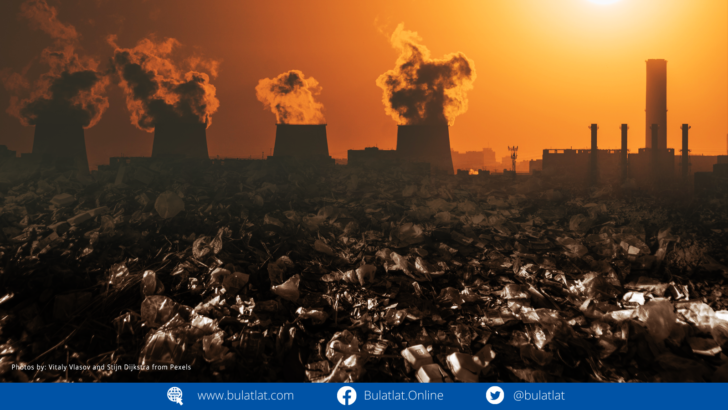
(Graphics by Dawn Cecilia Peña / Bulatlat)

By DAWN CECILIA PEÑA
Bulatlat.com

MANILA – With world leaders holding a summit to agree on how to fight the climate crisis, an international environmental group is pointing out the obvious and how it is “particularly insulting” that one of the world’s biggest single-use plastic polluters is among its principal partners.

“Given that 99 percent of plastic is made from fossil fuels, and that the fossil fuel corporations are actively shifting their focus to plastic as an increasing source of revenue, Unilever’s role in COP26 is particularly insulting,” said environmental group Break Free from Plastic, a coalition of more than 11,000 organizations and individual supporters.

In the Top 10 Corporate Plastic Polluters of 2021, Break Free from Plastic said Unilever landed third in their efforts to count and document plastic waste from a total of 440 global clean-up events in 45 countries.

Phasing out of single-use plastic is among the calls of environmental groups in the United Nations Framework Convention on Climate Change 26th Conference of the Parties or the COP26, which concluded today. Environmentalists and human rights activists have earlier held side events and protest actions in Glasgow, Scotland to demand grassroots solutions to the ongoing climate crisis.

The COP26, they added, is dominated by big economies and corporate interests.

Read: PH environment activists demand grassroots solutions to climate crisis at COP26

“The plastic crisis’ connection to the climate emergency and environmental justice impacts are undeniable. The cost of the continued dependence by corporations on single-use plastics and planned expansion of plastic production are too high to be ignored,” a joint statement of Break Free from Plastic and 56 other environmental groups read.

Pledges have little impact so far

Break Free from Plastic said pledges of multinational corporations have made little impact in resolving plastic pollution.

Citing the case of Coca-Cola, the beverage company has earlier pledged to collect one bottle for every one sold by 2030.

Coca-cola, in a statement issued along with other multinational companies, said they aimed to “build a world without waste.” This includes making packaging 100-percent recyclable by 2025 and to work with stakeholders, nonprofits, communities, governments, and industry partners to recycle and reuse.

However, this year’s audit still showed that Coca-Cola products still topped the list, and had more trash than the next two top plastic polluters combined. This has been the trend for Coca-Cola since 2019.

Leading plastic polluters in the Philippines, according to Break Free From Plastic (Graphics by Dawn Cecilia Peña / Bulatlat)

The same went for PepsiCo, which is still one of the top three plastic polluters for the past three years. This is despite the company’s recent commitments to halve the use of virgin plastic by 2030.

This goal is said to be executed through scaling new business models and reducing absolute tonnage or virgin plastic derived from non-renewable sources.

“PepsiCo will need to make a more ambitious shift to reusable containers in order to move down the list, given the sheer volume of PepsiCo branded plastic pollution being collected around the world,” said the BFFP.

Why phase out single-use plastic

Both Greenpeace and BFFP said plastic is a threat to the planet and contributes significantly to the climate crisis.

“Every stage of plastic’s life cycle produces greenhouse gas (GHG) emissions from fossil fuel exploration and extraction from the ground to its end of life. Plastic production and use were responsible for over 850 million metric tons of GHG emissions in 2019,” they added.

Apart from fueling the climate crisis, the groups pointed out that plastic harms wildlife and disrupts ecosystems. As it stands, the United Nations Environment Program said in a report that plastic pollution has affected an estimated 800 marine and coastal species through ingestion, entanglement, and habitat change.

“Plastic surfaces or particles can carry disease-causing organisms, cause inflammation, and traverse highly selective membranes in animals. Plastics also threaten soil fauna functions and can leach toxic additives into the soil and groundwater, some of which can disrupt the hormone systems of vertebrates and invertebrates,” they explained.

Plastic, too, poses several health risks to people – from its production to disposal as they are exposed to hazardous chemicals during extraction, toxic emissions during production, and pollutant contamination.

“In the Global North, petrochemical refineries which produce components of plastics, and incinerators which burn them, are usually near communities of color and low-income areas. These communities suffer immediate health impacts such as asthma, cancer, and mental health disorders,” they said.

Read: Red lines for the Global South at COP26

These effects mirrored what was seen in the Global South where poor communities residing in the vicinity of landfills are faced with increasing plastic pollution because of illegal imports from high-income counties. This leaves people vulnerable to various health risks brought by air pollution.

False solutions cannot resolve the plastic crisis

While it is necessary to put a stop to the long-enduring environmental crisis around the globe, organizations and defenders were quick to point out that band-aid solutions do not make the situation any better.

“For decades, the plastic industry has worked alongside fossil fuel corporations to present false solutions that allow both to continue with business-as-usual and produce more and more plastic while largely evading their responsibility to prevent this problem,” they noted.

The industry’s most recent strategy is ‘plastic neutrality,’ a term adopted by companies such as Nestle and Nutri-Asia. The groups explained, “Plastic neutrality does not mean companies produce zero or less plastics, but that they will collect the same amount of plastic they produced themselves or via offsets, a strategy that does nothing to address plastic pollution.”

Waste-to-energy plants, which were being passed off as renewable energy sources, were also given a thumbs down as “these waste-burning plants are not only inefficient and non-renewable but are also highly polluting and harmful to human health.”

The group cited a statement by the US Environmental Protection Agency which listed WTE facilities as major sources of mercury and dioxin emissions.

They added, “These chemicals are carcinogenic substances that also result in developmental issues, immune system dysfunction, and internal organ damage. WTE also requires a huge volume of waste in order to operate, encouraging a society that produces more waste.”

Lastly, bioplastics were pointed to give industries license to continue using disposable plastic products and do not resolve issues related to the throwaway culture.

“Designed to be disposable, bioplastics mass disposability is as wasteful, resource-intensive, and unsustainable as regular plastic. Relying on bioplastics may also lead to exploitation of regulatory loopholes for biodegradables, false marketing or improper labeling, and unintentional pollution.”

Adopt reuse systems

To phase out single-use plastics, the organizations appealed to consumer goods companies to urgently act on the intensifying effects of the plastic crisis.

“Urgently begin the phase-out of all single-use plastic packaging and products in their operations. Implement a just transition to affordable and sustainable plastic-free systems, including prioritizing the adoption of reuse and refill systems. Promote accountability by showing full transparency about their plastic footprint, and the environmental, public health, and climate impact of their packaging,” they ended. (JJE, RVO)

The author is a fellow in the 2021 GAIA-BFFP Asia Pacific Media Fellowship – Philippines.

Filipino artists want dictator’s wife Imelda Marcos jailed

0

By JOHN PAUL NACION
Bulatlat.com

MANILA – Filipino artists are calling on the government to jail the other half of the Marcos conjugal dictatorship, Imelda Marcos, who has been convicted of several graft charges three years ago but remains scot-free.

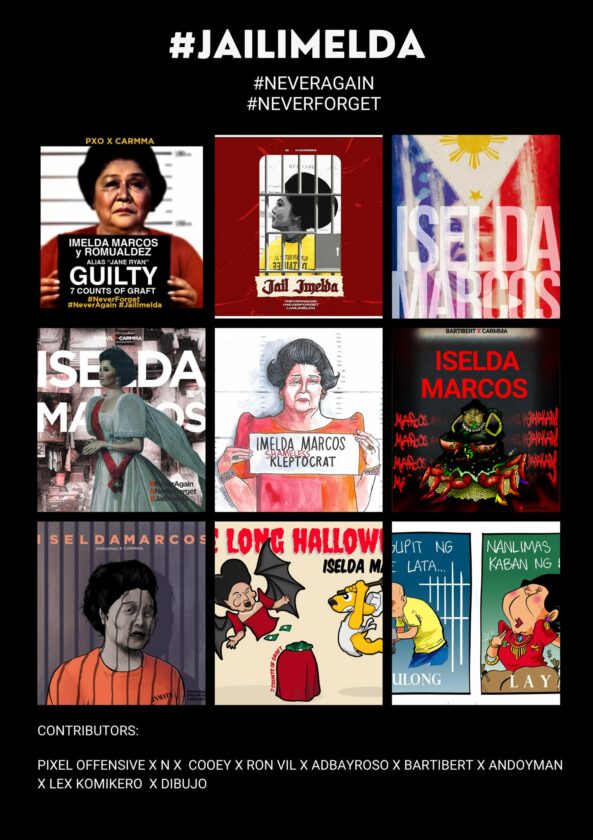
The Campaign Against the Return of the Marcoses and Martial Law (Carmma) posted on its Facebook Page artworks of 44 Filipino artists, whose works depicted Marcos behind bars, saying there “is no place for criminals” but this.

This was posted days after the victims and survivors of the Marcos martial law filed a petition before the Supreme Court to uphold the conviction of the wife of the late dictator.

“We suffered during the Marcos conjugal dictatorship and we continue to suffer as we continue to see that Imelda is out of jail, out of accountability. The dictator’s widow continues to live the life, not sickly and dirt poor, as she receives all the geriatric care she wants and needs using all the wealth from the people’s pockets accumulated in their more than two decades of power and might,” SELDA Vice Chairman Danilo dela Fuente said.

SELDA is an organization of political prisoners in the country.

In a 2018 decision, Sandiganbayan found Marcos guilty of seven graft charges of corruption in relation to the Swiss foundations she established while in public service from 1968 to 1986. This, the decision read, allowed her to pocket at least $200 million from public funds. (JJE, RVO)