Home Blog Page 474

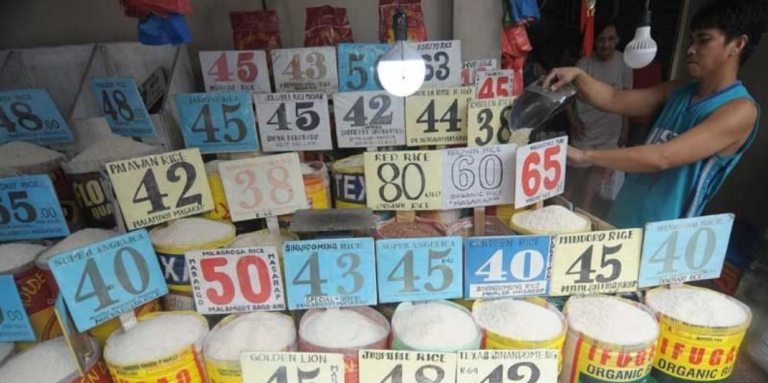
Lowest-income households have lost as much as Php6,800 to high inflation

0

The incomes of the country’s poorest households have eroded after ten months of accelerating inflation. Research group IBON estimates that the poorest 60 million Filipinos have suffered income losses of anywhere from Php2,500 to as much as Php6,800 because of worsening inflation since the start of 2018.

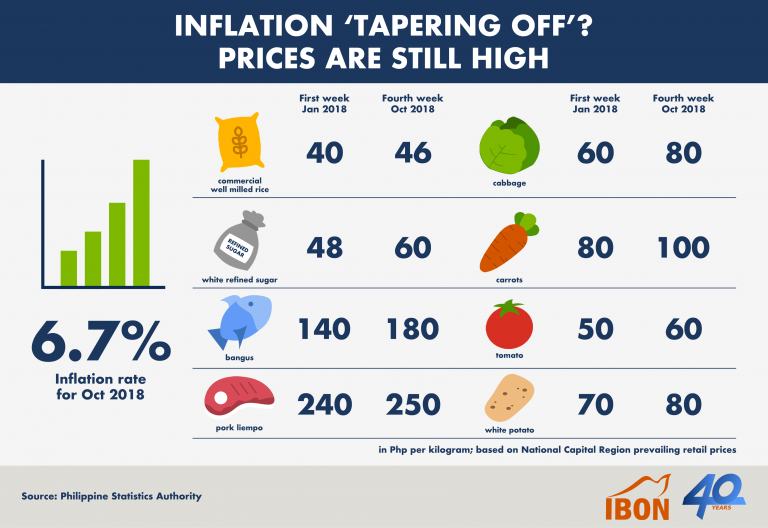
The inflation rate has increased from 3.4% in January 2018 to 6.7% in October. The October inflation rate of 6.7%, unchanged from September, is more than double the 3.1% rate in the same period a year ago and over five times the 1.3% inflation rate in June 2016 at the start of the Duterte administration. Inflation is at the highest in nearly 10 years or since the 7.2% rate February 2009.

The Department of Finance (DOF) has estimated the first to sixth income deciles in the country as having monthly household incomes of Php7,724 to Php21,119 in 2018. Assuming these to be constant, the erosion of household purchasing power can be estimated by deflating them according to the prevailing monthly inflation rate. Each decile covers 10% of the country’s approximately 23 million households arranged from poorest to richest.

IBON estimates that in the first ten months of the year so far, households in the poorest first decile with Php7,724 monthly income have cumulatively lost Php2,467 due to inflation, those in the second decile (Php10,711 monthly income) have lost Php3,422 and those in the third decile (Php12,835 monthly income) have lost Php4,100. Households in the fourth decile (Php15,132 monthly income) have lost Php4,834, those in the fifth decile (Php17,309 monthly income) lost Php5,529, and those in the sixth decile (Php21,119) lost Php6,746.

The peso’s depreciation, rising global oil prices and the Tax Reform for Acceleration and Inclusion (TRAIN) Law are among the most important proximate sources of inflationary pressure. Of these factors, TRAIN Package 1 is most directly within the Duterte administration’s control, said the group.

TRAIN’s mitigating measures have failed to support the incomes of the country’s poorest and most vulnerable, said IBON. Ten months into high inflation, only seven million out of the target 10 million families are reported to have received their supposed unconditional cash transfers. Three million families have not yet gotten anything.

Yet even those transfers have been extremely delayed and millions of families suffered months of high prices and reduced consumption without receiving any cash transfers, said the group. No one received cash transfers in January and February when prices already started to soar. Millions of families still did not get anything in succeeding months: 8.2 million by March, 6.2 million by June, 3.9 million in August, and three million as of October. ###
Stubbornly high inflation increases risk of econ slowdown, unmanageable debt–IBON

0

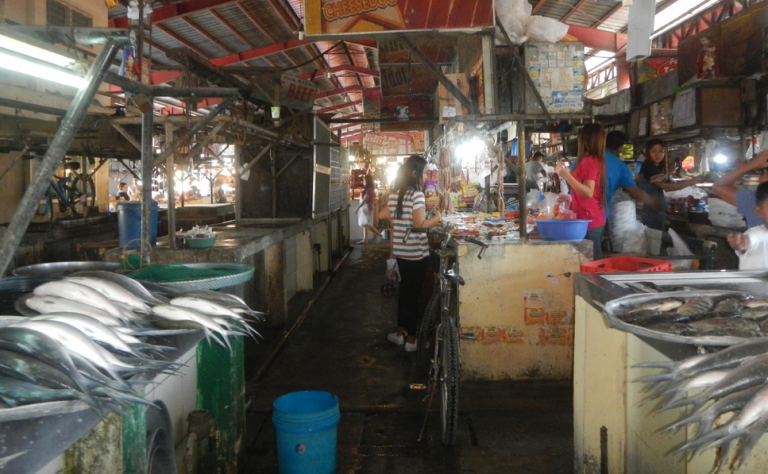
Research group IBON said that the apparently uncontrollable inflation is fast becoming a flashpoint of the administration’s economic mismanagement. High inflation is combining with rising interest rates, slowing remittances and failing exports to dampen economic growth. The administration is desperate for a short-term infrastructure stimulus to compensate for these, said the group, but a major growth slowdown could trigger a renewed debt and financial crisis.

IBON executive director Sonny Africa said that inflation remaining the highest in almost a decade and the worst in the region exposes the government’s short-sightedness in dealing with the problem of soaring prices.

“The government has been overly focused on reining in food prices particularly in Metro Manila to pre-empt rising unrest in the capital against the administration’s economic policies burdening the poor,” said Africa. “It has apparently been able to moderate food inflation in NCR which slowed from 9.2% in September to 7.8% in October. There are signs that the apparent focus on NCR has been at the expense of the regions where food inflation has remained high at 9.8% in October compared to 9.9% in September”, he said.

Africa noted that nevertheless, overall inflation remains high at 6.7% because inflationary pressures continue to work their way across other commodity groups particularly in housing, utilities and transport. Taken together with food these account for 76-84% of total household spending across low and high income groups, he observed. “While inflation has stayed the same at the national level, it has actually remained higher than the national average or even gotten worse in 13 out of the 16 regions outside of NCR,” Africa said.

He also noted that the Bangko Sentral ng Pilipinas (BSP) has already raised its policy rate four times this year, by 150 basis points to 4.5% as of September, and is widely expected to raise it further before the end of the year. Africa explained that the rising interest rates are designed to make borrowing more expensive and choke consumer and producer activity, which will tend to dampen economic growth.

Remittances are also slowing and only grew 2.5% in the first eight months of 2018 or at less than half the 5.4% growth in the same period in 2017, Africa further observed. Exports meanwhile continue to slacken and actually contracted by over 2.0 percent in the first eight months of the year.

“A growth slowdown will bring the problems of the country’s debt-dependent growth to the fore,” said Africa. “For instance, total outstanding government debt at a record Php7.1 trillion by August was equivalent to 42.5% of gross domestic product (GDP) as of end-June. Outstanding bank loans were similarly at a record Php8.2 trillion as of September. The foreign debt of the public and private sector was US$72.2 billion as of end-June, or 22.5% of GDP. Relatively rapid growth has been the main factor so far keeping various debt indicators manageable.”

Africa said that the government can take much more decisive measures to address inflation. He said that immediate measures include suspending the TRAIN law’s inflationary taxes especially on oil products and cracking down on overpricing of food, oil and other goods and services by implementing price controls. “The declining peso however can only be dealt with through long-term solutions such as the comprehensive development of domestic agriculture and Filipino industry,” Africa concluded. ###


Famous booksale coming to Davao

0

The Big Bad Wolf Book Sale is coming to town, that will surely make Davaoenos huff and puff in shopping to around a million books to be sold for everyone.

Namafusa to file raps vs. Sumifru, dispersal team

0

A worker’s union involved in a labor dispute with Sumifru Philippines in Compostela Valley province is set to file raps against the dispersal team composed of police and soldiers for causing physical injuries and damage to properties when the group held a protest strike last October 11.

Acting as drug war witnesses endangers journalists—NUJP

0
The National Union of Journalists of the Philippines (NUJP) launched an online petition asking that journalists be spared from acting as witnesses in the government’s so-called anti-drug war. In its petition on change.org, the NUJP called on law enforcement units to immediately end the practice of requiring journalists to sign as witnesses to the inventory […]

Teary farewell

0

Australian missionary Sr. Patricia Fox left the Philippines on November 3, after 27 years of work helping farmers, indigenous people, workers and urban poor.

Her missionary visa was downgraded to a tourist visa that expires on the Saturday she left. This came after being bad-mouthed by President Rodrigo Duterte as having ‘a foul mouth’, being arrested and held for a night, ordered to be deported and won her deportation case.

Photo by Bro. Ciriaco Santiago III, CSsR

The post Teary farewell appeared first on Manila Today.

33 percent rise in rice allowance for QC teachers

0
The Alliance of Concerned Teachers (ACT) expressed elation over the approval of a bigger quarterly rice allowance for Quezon City public school teachers and employees. “This is a victory for the long campaign of the Quezon City Public School Teachers Association (QCPSTA) and the ACT Teachers Union-National Capital Region,” ACT national president Joselyn Martinez told […]