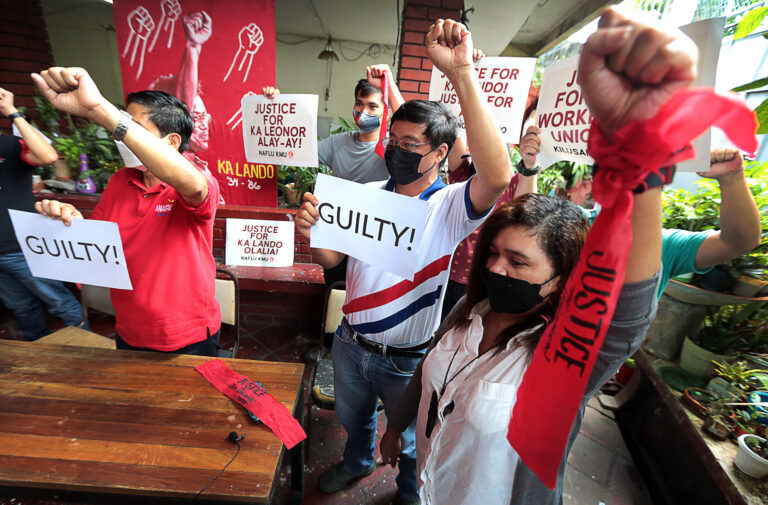
MANILA, Philippines—MANILA, Philippines—After over 30 years of waiting, the Antipolo Regional Trial Court Branch 97 found the members of the Reform the Armed Forces Movement (RAM) guilty for the death of labor leader Atty. Rolando “Ka Lando” Olalia and unionist Leonor Alay-ay.
Found guilty for two counts of murder are Fernando Casanova, Dennis Jabatan, and Desiderio Perez. They are meted with the penalty of up to 40 years imprisonment (reclusion perpetua) and each is ordered to pay a total of P2.1-million civil indemnity and damages to the heirs of Olalia and Alay-ay. The three are the only arrested accused. One is detained in Rizal, the other is detained at the Cainta jail while the other one is detained at the Antipolo Jail.
One of the accused, Col. Red Kapunan, is currently the Philippines’ Ambassador to Germany. He was cleared in 2016 after the court granted his demurrer to evidence. A demurrer to evidence is in effect a motion to dismiss anchored on the ground that the evidence presented is insufficient.
The other nine accused are still at large.
“Our victory today has only stiffened our resolve to never abandon our search for the remaining nine men involved in our father’s brutal killing,” Atty. Rolando Rico Olalia, son of Ka Lando said in a statement.
How the court ruled?
Under Article 248 of the Revised Penal Code, a person shall be guilty of murder if any of the six circumstances are present.
In this case, the court said there is evident premeditation after a witness gave details about the planning and surveillance prior to the abduction of Olalia and Alay-ay in November 1986. Evident premeditation means there was an opportunity to reflect on the actions of the accused but still carried out the crime.
“There should be no doubt, therefore, that the qualifying circumstance of evident premeditation, has been satisfactorily proved,” the court said.
Another circumstance mentioned is the abuse of superior strength when three vehicles carrying more than 10 officers on board abducted Olalia and Alay-ay.
“The Court has carefully sifted through the volumes of records of these cases and is fully convinced that the prosecution was able to establish beyond reasonable doubt the guilt of the accused in these cases,” read the decision.
Witness said Jabatan stabbed Olalia twice. The same witness said Jabatan told him that Olay-ay was taken by another group. Another witness said he was with Jabatan and Perez when they brought the two to a safehouse in Cubao after they were abducted in Pasig.
On the other hand, the witness identified Casanova as the one who took Alay-aya from his vehicle.
Perez denied his participation saying he was in Olongapo when the crime occurred. The court, however, said no other evidence was presented to support his claim. Casanova, on the other hand, said he was no longer in service when the crime occurred. But the court was not convinced given the positive testimony of eyewitnesses.
Jabatan, meanwhile was not able to complete his testimony due to problems with his counsel. Jabatan also said he was already given an amnesty by the National Amnesty Commission. But the court said the murder was not covered by the amnesty.
“Suffice it to say that ‘defenses of denial and alibi, such are inconsequential. Alibi and denial are inherently weak defenses and must be brushed aside when the prosecution has sufficiently and positively ascertained the identity of the accused as in this case. It is axiomatic that positive testimony prevails over negative testimony,” the court said.
Partial victory
The National Union of Peoples’ Lawyers (NUPL) said that while the Antipolo Court’s decision give relief, they still have the “tinge of frustration” as only three accused have been convicted.
“On the one hand, others who are allegedly involved – based on the disturbing testimonial evidence of the prosecution – remain off the hook and are in our midst. Nine of those formally charged are still at large despite 35 years on the run,” NUPL’s Atty. Edre Olalia said.
Olalia said, “for the families of the victims, the judicial proceedings from one court to another were too protracted, the legal tactics were over-utilized, and twists and turns at different junctures, levels and fora were exasperating.”
Teddy Casiño of BAYAN shares the same sentiment who, at a press conference, said: “This victory, while it is welcome, it is too little, too late.”
He called the decision “partial victory.”
Both Casiño and Kilusang Mayo Uno leader Elmer “Bong” Labog said the three who were convicted are only the foot soldiers.
“Only when Cirilo Almario, Jose Bacera, Ricardo Dicon, Gilbert Galicia, Oscar Legaspi, Filomeno Maligaya, Gene Paris, Freddie Sumagaysay, Edger Sumido—and all the other unnamed principals—who have managed to evade the long arm of the law have been found and brought before the courts to be held accountable for their crimes will justice be finally served,” Atty. Rolando Rico Olalia said.
WHAT WENT BEFORE: The Olalia-Alay-ay double murder case
(Reposting this article originally published in the Philippine Daily Inquirer on October 11, 2012.)
On November 13, 1986, Kilusang Mayo Uno (KMU) leader Rolando Olalia and his driver Leonor Alay-ay were found dead in Antipolo, Rizal. Their bodies were mutilated beyond recognition. A scar on Olalia’s leg was the only identifying mark that confirmed his identity.
The National Bureau of Investigation, in its report to then President Corzaon Aquino in 1986, said the killings were a prelude to the staging of “God Save the Queen,” a coup plot by Rebolusyonaryong Alyansang Makabansa (RAM) to rid the Aquino Cabinet of left-leaning members.
In April 1987, Task Force Olalia, which was formed to investigate the killings, filed two counts of murder against Gilberto Galicia and Sgt. Franco Espartero in the Antipolo Regional Trial Court.
In June 1990, Judge Marietta Legaspi acquitted Espartero for failure of the prosecution to prove his guilt beyond reasonable doubt, while Galicia was discharged and made a state witness.
In January 1998, the Department of Justice (DOJ) revived the case as a new witness, former T/Sgt. Medardo Dumlao Barreto came forward, implicating several RAM leaders in the surveillance and abduction of Olalia and Alay-ay.
Barreto said he surfaced out of fear as several military men who knew about the murders were ordered killed or mysteriously died in the past years.
Honasan
Several parties called on the justice department to look into the possible involvement of Sen. Gregorio Honasan, a RAM leader at the time of the murders.
In his 14-page sworn statement, Barreto said M/Sgt. Felizardo Cabanilla, transport officer of the then Ministry of National Defense, had boasted to him that he was personally ordered by Honasan to “clean up” the mess left behind by the vehicle used in tailing Olalia’s car.
Asked later to qualify his statement, Barreto said he did not directly implicate Honasan, stressing that Honasan’s supposed order was relayed by a third person, Cabanilla.
Honasan said he had “absolutely nothing to do” with the plot, and stressed that he participated only in three coup attempts against President Corazon Aquino. He said the “God Save the Queen” plot which allegedly involved the abduction and murder of Olalia was not among those hatched by the RAM.
2 murder cases
In May 1998, a five-man DOJ panel filed two separate cases of murder against 13 RAM members in the Antipolo Regional Trial Court.
Charged were retired Colonels Eduardo Kapunan and Col. Tirso Legaspi, ex-Capt. Ricardo Dicon, ex-Sergeants Gene Paris, Edgardo Sumido and Dennis Jabatan, ex-Staff Sergeants Freddie Sumagaysay and Jose Bacera, ex-Cpl. Cirilo Almario, ex-Staff Sgt. Fernando Casanova, ex-Sergeants Desiderio Perez and Filomeno Maligaya and Gilberto Galicia.
The DOJ panel said the 13 respondents, “with evident premeditation,” conspired and mutually helped one another, in killing the victims by taking advantage of their superior strength with the aid of armed men.
Kapunan and Legaspi sought immunity from prosecution, arguing that Proclamation No. 347 granted by President Fidel Ramos to rebel soldiers “extinguished their criminal liability.”
Arrest warrants
They said political assassinations, such as the Olalia-Alay-ay double murder case, could have been part of simulated events intended to create an unstable situation favorable for a coup.
In 2009, the Supreme Court dismissed their petition and ordered the filing of murder charges.
In February 2012, the Antipolo City Regional Trial Court issued arrest warrants against the 13 suspects.
On July 24, Perez surrendered to authorities and later pleaded “not guilty” to the murder charges. Inquirer Research
By: Miguel R. Camus – Reporter/ Philippine Daily Inquirer /October 10, 2021
MANILA, Philippines — The National Telecommunications Commission (NTC) said it would run after sources of illegal radio gear such as text blast machines that a growing number of politicians or political groups were secretly using in their campaigns to boost their chances during elections.
The agency, however, need not look far.
These devices are widely available in leading e-commerce portals in the country such as Carousell, Facebook Marketplace, Lazada, and Shopee.
More than a dozen sales advertisements for the shoebox-sized transmitters were shown across their platforms, although most of the sites started removing the products starting Oct. 8 after they came to know about the NTC probe in the media.
The listings were a few weeks to a few years old.
Sold under catchy labels like “campaign SMS Blaster Machine,” their target market was clear: politicians who were willing to use unregistered radio equipment, thus violating Republic Act No. 3846, or the Radio Control Law, and Republic Act No. 10175, or the Cybercrime Prevention Act of 2012.
Interviews with telecommunication experts, executives, and even the sellers, under the guise of interest in their products, revealed an illicit business that had been thriving for years and openly operating under the nose of regulators.
A telco executive, who requested anonymity for this report, told the Inquirer that these text blast machines were “weaponized” and their use was already prevalent in smaller towns during the 2019 elections.
“They can, for instance, spoof the [mobile] number of a mayoralty candidate on the last day to say ‘I have withdrawn from the race,’” he added.
He, however, feared that regulators might be ill-equipped to combat the problem.
“It’s a game of cat and mouse. By the time you trace it, they are no longer there,” he said.
NTC Deputy Commissioner Edgardo Cabarios told the Inquirer that he was surprised these devices were easily accessible through online shopping sites.
After reviewing the specifications of the text blast machines, Cabarios said these were illegal and their suppliers were unregistered with the NTC. The regulator is readying show-cause orders to people and entities it will find responsible for the illegal sale of these devices.
“This equipment is not allowed to be purchased, sold, and used,” Cabarios said.
He said the only exemption was its use by the National Disaster Risk Reduction and Management Council (NDRRMC) and other authorized state agencies in times of emergency and “in areas where there is an emergency.”
100,000 texts an hour
The possible use of such unlicensed radio equipment figured in the news on Oct. 6 after unsuspecting recipients at Sofitel Harbor Garden tent—which was used by the Commission on Elections as a venue for filing for certificates of candidacy for the May 2022 polls—got a text blast cheering presidential aspirant Ferdinand “Bongbong” Marcos Jr., the son and namesake of the late dictator.
Although disavowed by the NDRRMC, the telcos, and even Marcos’ camp, the texts mimicked the council’s alert system, stoking fears that illicit transmitters can be used to propel disinformation campaigns while obscuring their source. Text blast machines work by “spoofing” nearby cell towers or functioning as portable cell sites that can only send and not receive data. They can send out messages at a rate of up to 28 texts per second, or 100,000 texts an hour.
Some specialized models can blast messages simultaneously from different fabricated sources targeting different telco networks. These are free of telco charges and can reach cell phones within the vicinity of a few hundred meters to 2 kilometers.
The machines are sold for P200,000 to P3 million per unit—easily affordable for politicians and businesses looking to promote themselves, according to online sellers contacted by this reporter.
A seller on Facebook said politicians gunning for a national post could buy several of these machines while those eyeing a local post could get by with one device.
“It’s mobile so you can go roving,” he said in a chat.
“Two congressmen already ordered this,” he said, without giving names.
The devices require no SIM cards, making them virtually untraceable on cellular networks, and can operate using a range of frequencies.
Text messaging remains a major communication tool for millions of Filipinos, especially in small rural towns with poor internet connectivity.
“SMS (short message service) enables offline connectivity at a very low cost while most messaging applications still rely on the internet to function. This makes SMS readily available for everyone,” said Rico Hernandez, chief executive officer and founder of MyBusybee, an NTC-licensed SMS and digital marketing company.
The illegal use of text blast technology is painting his industry subsector in a bad light, he said.
Untraceable
“Before, there were ordinary text blasts used for political campaign purposes. But then people realized you can report the number to the NTC and have it blocked,” Democracy.Net.PH cofounder Pierre Galla said, referring to the antispamming provisions in RA 10175.
“They (politicians) found another way where they can campaign using texts but won’t get the number blocked because there is no SIM card,” he said.
The use of text blast machines and rogue cell sites also raises questions on how these equipment were able to enter the country in the first place.
Since imported radio equipment requires a permit from the NTC, such devices surfacing and being offered online were likely smuggled.
A seller, who claimed to have started selling such machines in 2016, said his wares came from Malaysia.
On Lazada, another seller openly markets the device as an “SMS Platform for upcoming political campaign 2022.”
“Too many to count,” she said when asked how many units she has sold.
“We do not permit our platform to be used for the unauthorized sale of such items,” Shopee Philippines said in a statement when reached by the Inquirer for comment. “We have removed these listings from the platform and also have in place preemptive measures to intercept similar attempts to sell such items on our platform.”
In an email, a Carousell spokesperson acknowledged that such machines were prohibited and it had “swiftly removed any such listings from its marketplace.”
A Lazada spokesperson, meanwhile, disclosed that the company had launched an investigation and “will not hesitate to take strong actions against parties found involved in illegal activities … ”
A spokesperson for Facebook asked the Inquirer to provide links to illegal text blast machines and gave no further comment. As of this writing, all original listings related to text blast machines remained active on Facebook Marketplace, with two more ads appearing on Saturday.
As of Sept 29, 2021 there are 63.36M registered voters and counting. This might end at 65-68M registered voters once registration period ends on Oct 30. 5M + new voters so far.
Voter turnout was 75% in the 2019 elections
Voter segment
ABC is 13%, D 74% and E 13% .
Urban 49%, Rural 51%
Male 50%, Female 50%
Age
18-24 (15%)
25-34 (20%)
35-44 (20%)
45-54 (20%)
55-64 (15%)
65 and up (10%)
Educational Attainment
No formal edu/ elem (19%)
Some HS (16%)
Completed HS (32%)
Vocational (6%)
Some College (16%)
Completed Coll/Post Grad (11%)
Working (56%)
– govt 4%
– private 11%
– self employed 29%
– farmers/fisherfolk 11%
Not Working (44%)
Geography
NCR (14%)
Balance Luzon (45%)
Visayas (19%)
Mindanao (22%)
Overseas Votes:
There were 431k overseas voters in 2016 (0.96%) of total voters. From 2007 to 2019, the five countries with the highest Filipino voter turnout have been consistent: United Arab Emirates, Saudi Arabia, Hong Kong, Singapore, and the United States
Dialect
Tagalog 42%
Ilocano 6%
Kapampangan 5%
Bicolano 5%
Ilonggo 9%
Cebuano 21%
Waray 4%
Others 8%
Religion
Roman Catholic 83%
INC 3%
Islam 4%
Others 11%
Other info (DICT Survey)
More than 90.0% of surveyed barangays have cellphone signals present in their barangays and more than half of these can access a 4G (LTE) signal
Only about 40.0% of the respondent barangays have TV signals in their area.
Only about 13.0% of population have free public Wi-Fi present in their barangays.
Less than half (47.1%) of the households have communal radios.
Around 82.7% of households have television at home
Only 8.2% of households have their own fixed telephone line
24.0% of households have communal cellphones but only two out of ten have communal computers.
Only 17.7% of households have their own internet access at home, the majority of which use the internet for social media and communication.
The results for the individual survey are as follows:
91.1% of individuals have watched television and that they spend around 3 hours watching TV daily.
79.01% of individuals have used their cellphones while only 33.9% have used a computer in the last three months.
46.88% of individuals have used the internet and many of them have used a cellphone to connect to the internet.
Other data (source: We are Social 2021 report) :
The Philippines tops the world again for time spent using social media, the 6th straight year it has done so. According to the report, Filipinos spend an average of 4 hours and 15 minutes each day on social media, which is 22 minutes higher than last year’s average of 3 hours and 53 minutes, and 3 minutes higher than 2019’s average of 4 hours and 12 minutes.
The global average for social media usage is 2 hours and 25 minutes, with Japan taking the last spot in the rankings, recording an average of 51 minutes.
The Philippines is also again the highest in internet usage, clocking in close to 11 hours per day at 10 hours and 56 minutes. Brazil comes in at second, with an average of 10 hours and 8 minutes, and Colombia at third, with an average of 10 hours and 7 minutes.
Data sources : Comelec website, Pulse Asia survey, DICT survey and other legitimate online sources.
Oct 3, 2021 Don Kevin Hapal/ Raisa Serafica, Rappler.com
MANILA, Philippines
[EXCLUSIVE] Online information operations against activists and progressive groups take off from the Duterte government’s drug war playbook: attack online then kill
Narratives pushed out by the propaganda network focus on the creation of an environment that enables – and justifies – violence by branding activists as “terrorists” and exaggerating the communist threat.
A mix of old and new bloggers, as well as “alternative” news sources, spread these narratives through different clusters that push out content either to the general public or to niche but highly-engaged communities, which then become vectors for distribution. They drown out the real stories of activists being harassed, attacked, and killed.
The National Task Force to End Local Communist Armed Conflict (NTF-ELCAC), established by the Duterte administration in December 2018, is at the center of the network of Facebook pages and groups pushing out red-tagging content.
Parallel to online attacks against personalities and progressive groups are the killings of activists – those who do groundwork in mass organizations. Taking from the tokhang playbook in Duterte’s drug war, some police operations against grassroots organizers and local activist leaders resulted in “nanlaban” deaths.
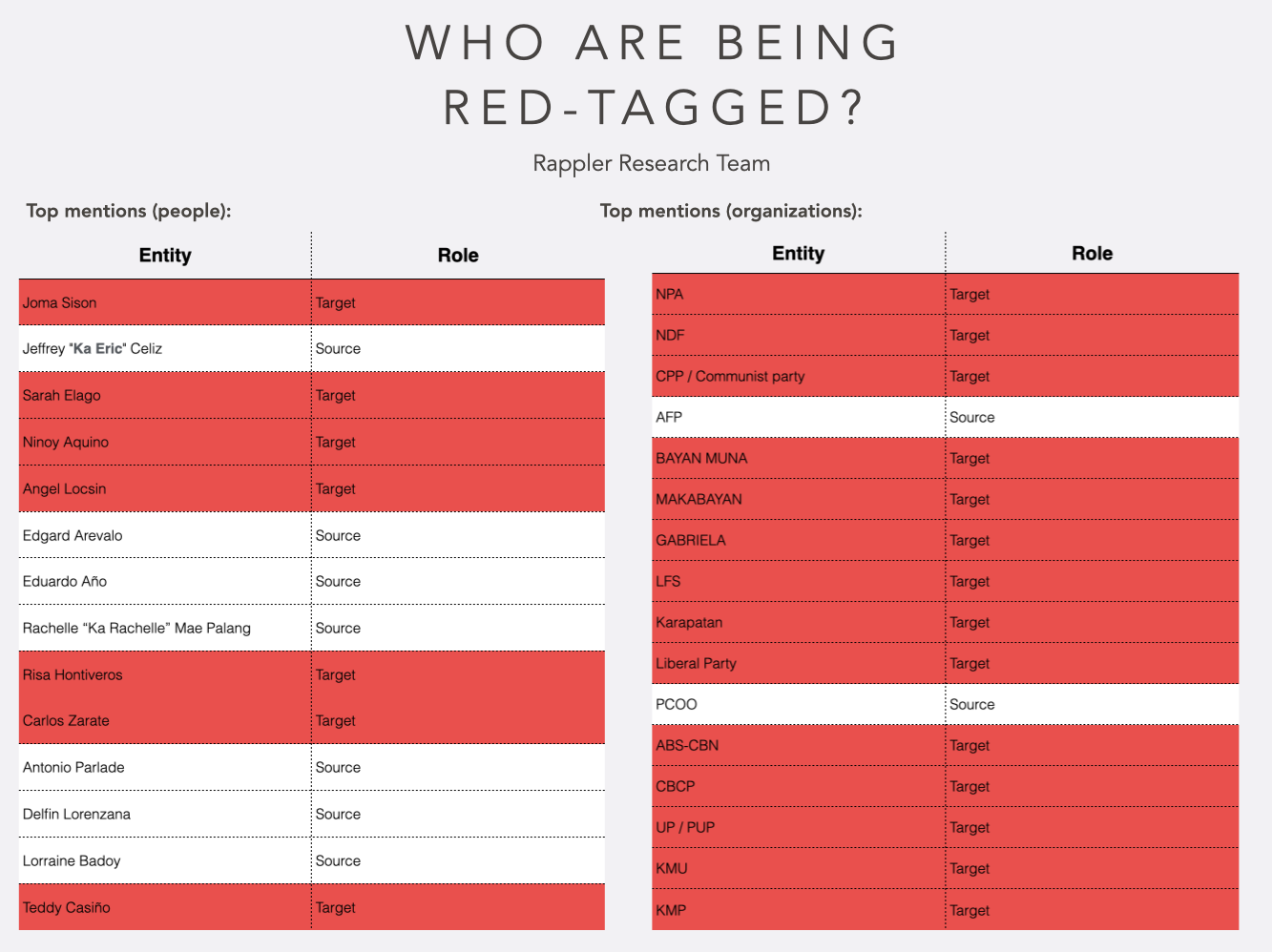
Organizations with top mentions in the scan include leftist groups such as BAYAN MUNA, Makabayan, Gabriela, League of Filipino Students, and Karapatan. There were also significant mentions of state universities like the University of the Philippines and the Polytechnic University of the Philippines, which state authorities accuse of being “recruitment grounds” for rebels, and a nest for activists-turned-terrorists.
Zara Alvarez served as a human rights defender and paralegal in the Negros islands for Karapatan for more than a decade. She worked tirelessly despite threats and intimidation in a province that’s been witness to decades of war between state forces and insurgents.
Alvarez would see her face on posters linking her to the communist underground and she was, in fact, imprisoned for two years.
Nothing prepared her for the bloody Duterte years. In 2018, Alvarez was one of 600 activists tagged as terrorists by the Department of Justice. What followed was persistent red-tagging and harassment – she got attacked online and was constantly followed while she worked.
Two years later, in August 2020, while walking in the streets of Bacolod City, unidentified men shot Alvarez dead. She was 39.
The story of Alvarez illustrates the direct connection between information operations online and physical attacks, a rehash of the government’s war on drugs where supposed drug users and dealers are demonized online to justify attacks against them in the real world.
Rappler’s research team found out that from drug war narratives, the focus of government’s coordinated online propaganda network has shifted to red-tagging, which lumps activists with terrorists and turns the communist insurgency into a problem that’s bigger than what it really is.
Friends turn into bitter foes
President Rodrigo Duterte himself has enabled this through his speeches and policies.
It’s worth noting that prior to the government’s attacks on the Left, Duterte was friends with them for decades – since he was mayor of Davao. The national democratic movement backed his presidential bid in 2016, and after his election,
Duterte appointed prominent leftist leaders to his Cabinet. He reopened peace negotiations with the National Democratic Front and declared the longest ceasefire with communist insurgents in three decades.
But the talks eventually broke down, as the military gained ascendancy in the Duterte government. By the end of 2017, Duterte’s administration sought to tag more than 600 activists and members of the Communist Party of the Philippines (CPP) as “terrorists.”
The list included alleged CPP chairman Benito Tiamzon, Anakpawis chairman Randall Echanis (who would be killed in his home in 2020), ex-Bayan Muna representative Satur Ocampo, and hundreds of John Does. (READ: “The end of the affair? Duterte’s romance with the Reds”)
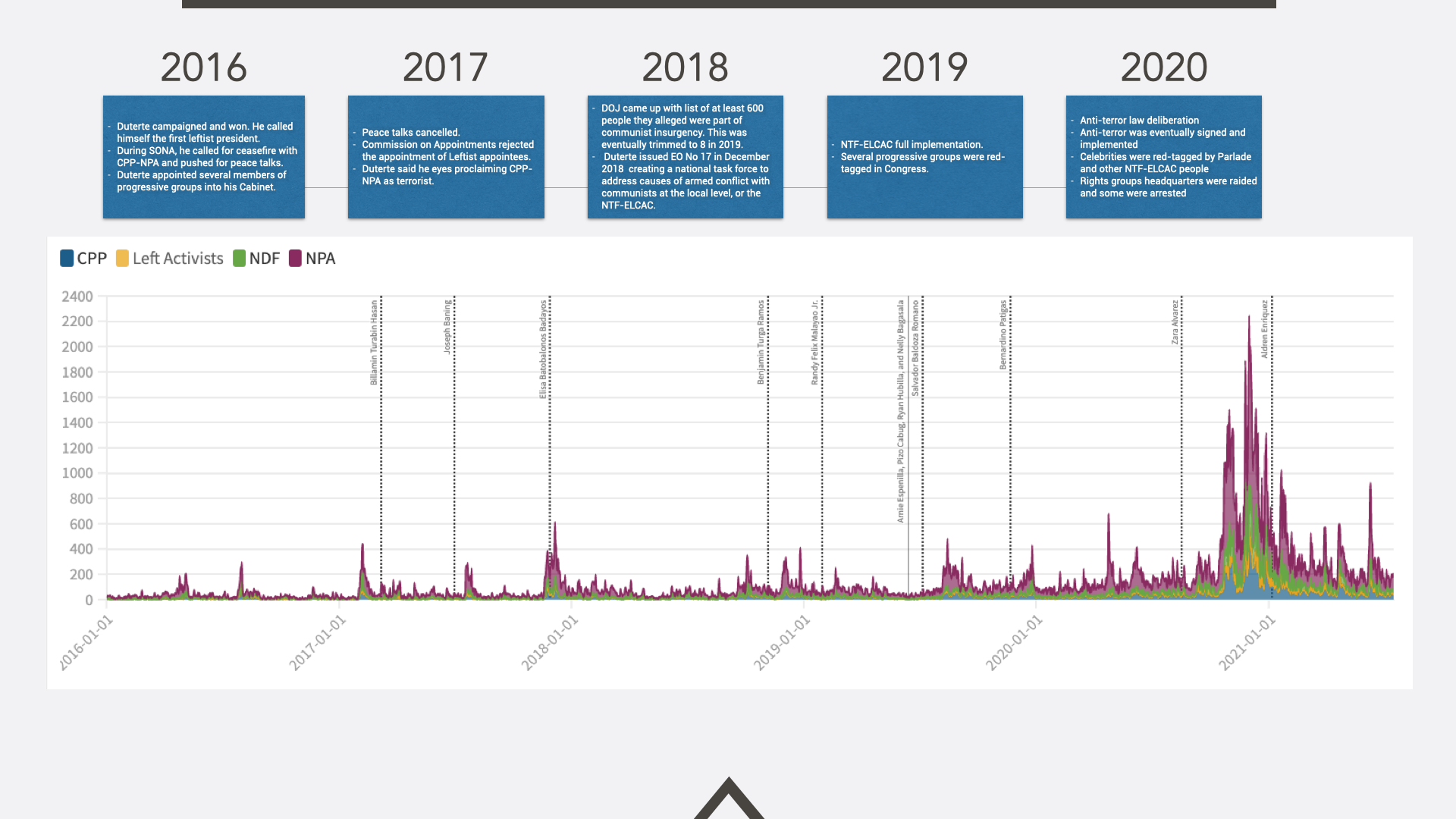
To track red-tagging narratives online from January 2016 to August 2021, Rappler used an initial dataset of posts attacking progressive groups and activists on Facebook, plotted an initial roster of red-tagging entities, and used natural language processing to identify keywords commonly associated with the term. These include keywords like “NPA,” “Left Activists,” and “CPP.”
The graph above shows a timeline of posts with mentions of keywords typically used for red-tagging from 2016 to 2020. While there have been posts in 2016 and 2017 about the insurgency and military propaganda against the Left, information operations intensified in 2018, when it became clear that the Duterte government was abandoning a negotiated settlement of the insurgency and implementing a militarist approach to crush the guerrillas and their supposed front organizations.
In November 2018, for instance, Duterte signed Memorandum 32 that deployed more soldiers and cops in the Negros islands, Samar, and Bicol – known insurgency hotbeds. That same month, Alvarez and the rest of Karapatan-Negros lost a colleague with the murder of human rights lawyer Benjamin Ramos in Kabankalan City. Ramos would be among the first of many Karapatan members and lawyers who would be murdered under the Duterte administration.
The following month, in December 2018, the Duterte administration issued an executive order creating a national task force to address the causes of armed conflict with communists at the local level. This task force came to be known as the National Task Force to End Local Communist Armed Conflict (NTF-ELCAC), the main counter-insurgency vehicle that brings together all government agencies for one goal: crush the communists by the time Duterte ends his term in June 2022.
“Doon nagsimula ang malalagim na araw namin (That was when our bloodiest days started),” Clarizza Singson of Karapatan-Negros said as she recounted the incidents between the Sagay massacre in October to the police operations in Guihulngan City in December 2018. Singson had worked with Alvarez for almost a decade before the latter was killed in 2020.
These attacks, particularly against Karapatan members, come not as a surprise, considering that the Duterte government and the Philippine military believe that human rights groups are front organizations of the armed movement.
As Rappler’s scan showed, the government’s campaign against insurgents was complemented by increased activity online. The biggest surge in red-tagging posts was observed in 2020, as the government deliberated on, and eventually adopted, the Anti-Terrorism Act of 2020 or the Anti-Terror Law.
Shaping the online narrative
The network map above shows Facebook pages and groups amplifying content related to red-tagging and activism. Pages and groups cluster together when they share content from the same sources. The cluster in blue is the main cluster – mainly pushing out harmful red-tagging content and anti-activist propaganda. Note how the clusters became denser starting in 2018, caused by the increased connectedness of the nodes, showing increased networked behavior.
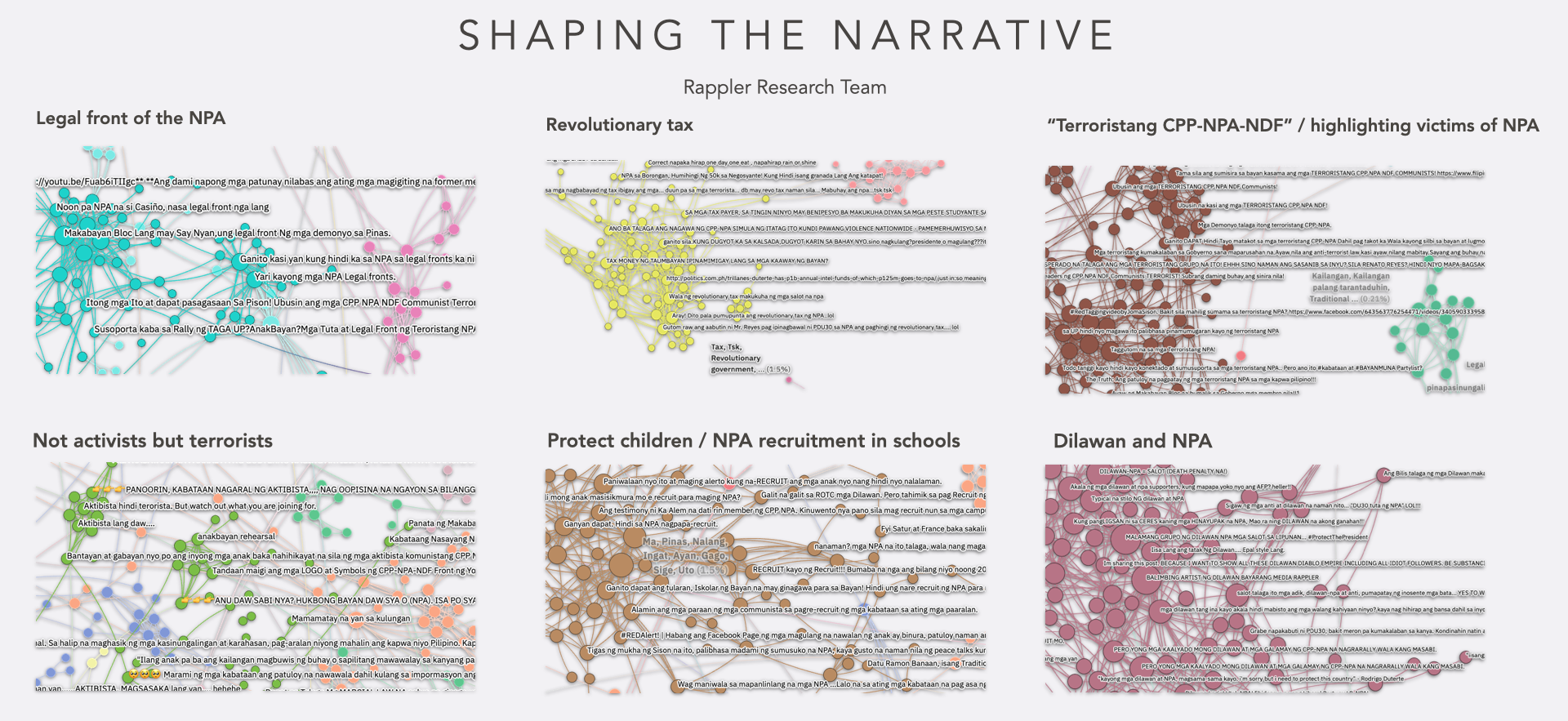
Using natural language processing, we looked at the general themes pushed out by the main red-tagging cluster.
The narratives pushed out by the main red-tagging cluster show a focus on creating an enabling environment for violence where activists are painted as “terrorists” and the communist insurgency is a problem bigger than what it is. The tactic is reminiscent of the propaganda playbook for the Duterte administration’s brutal war on drugs and how it justified the killings of alleged drug pushers. (READ: [OPINION] First they came for the pushers and addicts. Now, the Leftists)
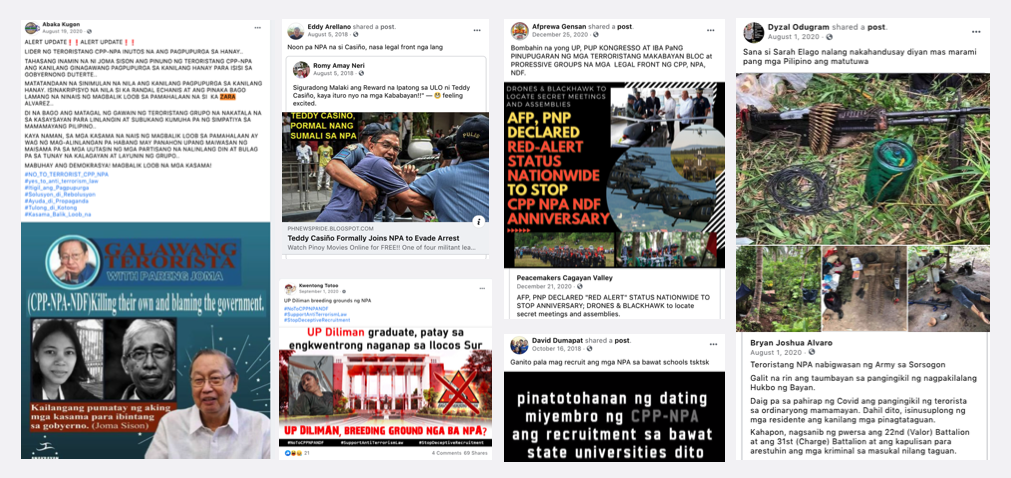
While the scan also spotted the usual news reports on civilian-military operations, the bulk of the posts used hateful and harmful language targeting activists and progressive groups. These groups were also frequently tagged as legal fronts of the communist New People’s Army (NPA).
Even following her death, Alvarez was not spared from false claims that tagged her as part of the armed movement. Some posts even claimed that the NPA killed her so they could put the “blame [on] the government.” This claim was even echoed by NTF-ELCAC’s former spokesperson Antonio Parlade when he said in a statement, posted on NTF-ELCAC’s official Facebook page, that Alvarez “joined the NPA for two years until 2015.”
The narratives pushed out by the main red-tagging cluster show a focus on creating an enabling environment for violence where activists are painted as “terrorists” and the communist insurgency is a problem bigger than what it is. The tactic is reminiscent of the propaganda playbook for the Duterte administration’s brutal war on drugs and how it justified the killings of alleged drug pushers. (READ: [OPINION] First they came for the pushers and addicts. Now, the Leftists)
While the scan also spotted the usual news reports on civilian-military operations, the bulk of the posts used hateful and harmful language targeting activists and progressive groups. These groups were also frequently tagged as legal fronts of the communist New People’s Army (NPA).
Even following her death, Alvarez was not spared from false claims that tagged her as part of the armed movement. Some posts even claimed that the NPA killed her so they could put the “blame [on] the government.” This claim was even echoed by NTF-ELCAC’s former spokesperson Antonio Parlade when he said in a statement, posted on NTF-ELCAC’s official Facebook page, that Alvarez “joined the NPA for two years until 2015.”
Targets: Organizations, big personalities
Organizations with top mentions in the scan include progressive groups like Bayan Muna, Makabayan, Gabriela, League of Filipino Students (LFS), and Karapatan. There were also significant mentions of state universities like the University of the Philippines (UP) and the Polytechnic University of the Philippines (PUP), which are accused of being “recruitment grounds” for rebels, and a nest for activists-turned-terrorists. On the other hand, groups like the Liberal Party and the CBCP tend to be accused of defending and coddling “terrorists.”
Threats and red-tagging often target big progressive voices in Congress, like Kabataan Partylist Representative Sarah Elago and Bayan Muna Representative Carlos Zarate. Akbayan Senator Risa Hontiveros was also often called out for her alleged silence on crimes committed by the NPA.
High-profile activists like former Bayan Muna representative Teddy Casiño, as well as celebrity-turned-activist Angel Locsin, were also often targeted and linked to the NPAs. No less than Parlade himself alleged that Locsin’s sister is an NPA – a claim Locsin has consistently denied.
And aside from military and NTF-ELCAC spokespersons, the propaganda network would quote “ex-rebels” in their propaganda and red-tagging. These “ex-rebels” are often used to “expose” how rebel recruitment is done in schools, and to supposedly unmask activists who are allegedly members of the armed rebellion.
Hiding like criminals
While all these are happening online, activists who are not as popular as the targets of the online information operations are being killed on the ground.
Taking from the same tokhang playbook, some police operations that targeted grassroots organizers and local leaders of progressive groups resulted in “nanlaban” deaths. This included the “bloody Sunday” operations in Calabarzon in March 2021 that left nine activists dead.
“Sanay na kami sa death threat kasi minsan three times a day. Minsan once a week. Minsan once a month…Pero syempre hindi ‘yun empty threats. Pinapatay at namamatay mga kasama ko,” Singson said. (We are used to death threats. Sometimes, we get it three times a day. Sometimes, once a week or once a month. But these threats are not empty threats. My colleagues are being killed and have been killed.)
According to her, they were subjected to surveillance, trumped-up cases, arrests, raids, direct threats, and other forms of harassment. Since Duterte became president in 2016, at least 16 Karapatan members have been killed.
They have adjusted by strengthening their security protocols and learning how surveillance works. They employed a buddy system, changed their schedules, and avoided going outside their homes during the day. In Singson’s case, they went as far as abandoning their home and uprooting her whole family – her two young sons included – to live in rented apartments.
The slain Alvarez experienced close surveillance. According to Singson, unidentified individuals would openly follow and take photos of her even in public spaces.
The necessary adjustments and new security measures disrupted their lives. The tactic of using the drug war playbook against activists seemed to have worked as well. Singson said the way they hid and protected themselves felt like they were being hunted as criminals.
“Yung mga bata ayaw namin isubject sa ganung buhay na nanonormalize ang fear, terror, at killings… Para kaming wanted criminal. Daig pa namin ang wanted criminal,” Singson added. (We don’t want to subject the kids to that kind of life where fear, terror, and killings are normalized. We were like wanted criminals.)
When Alvarez was gunned down, Singson and her other colleagues in the province received messages from anonymous perpetrators: “You’re next.”
Singson fought back against the kind of attacks they experienced. She filed a case at the cybercrime division of the National Bureau of Investigation to track those who, on her Facebook account, threatened to have her head severed. She took screenshots and printed out all the hate messages and death threats she received.
But nothing came out of it. According to her, the cybercrime division concluded that the accounts used to attack her were hacked and that was the end of the story.
Sophisticated information operations
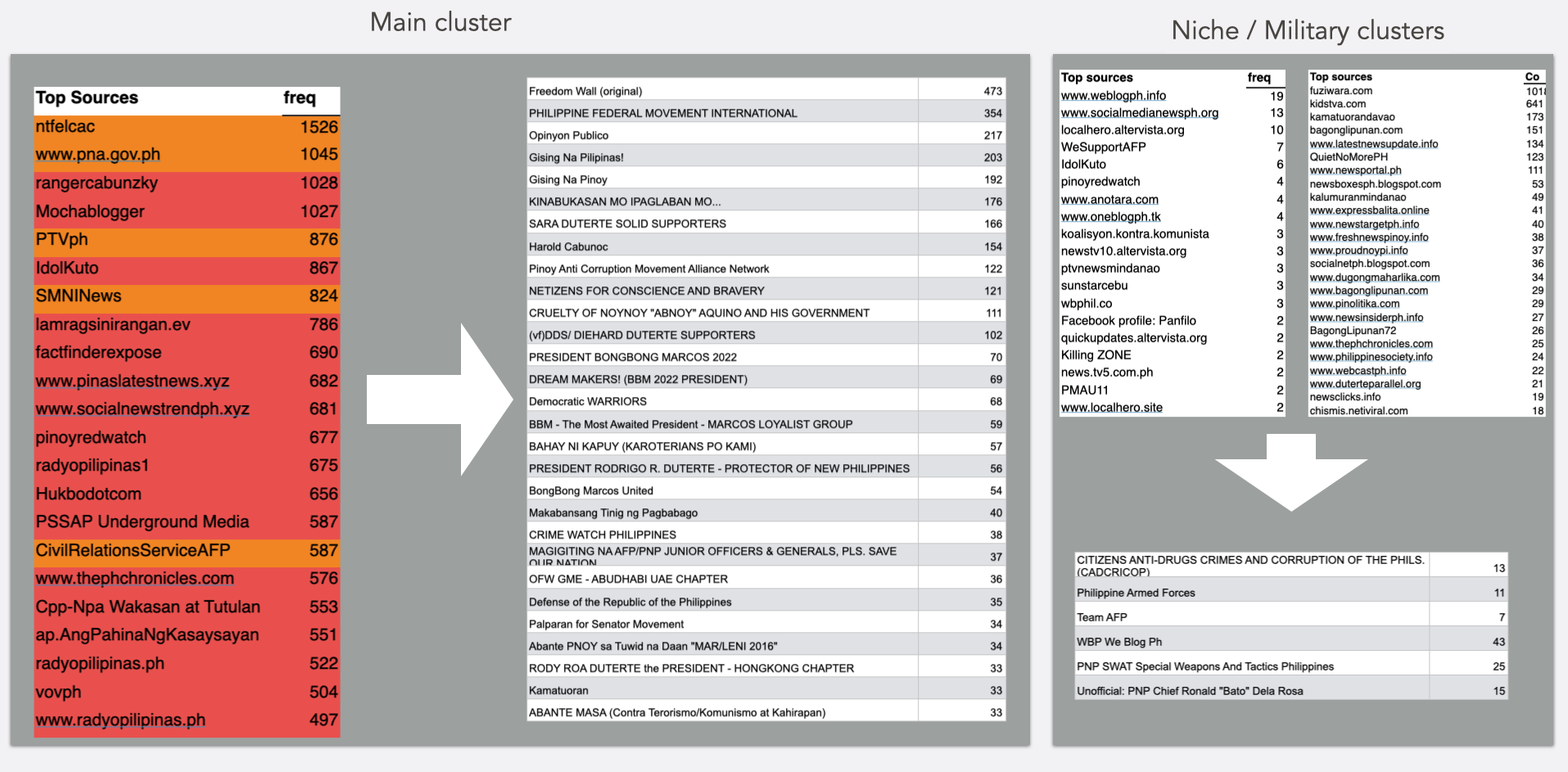
Rappler’s network analysis showed that the online narratives are seeded through a mix of old and new bloggers and “alternative” news sources, with different clusters focused on either funneling to the general public (through hyperlocal and political pages), or niche but engaged communities (e.g., military, police, and their supporters), which become vectors for distribution.
At the center of the campaign is the official Facebook page of NTF-ELCAC. Content from other state media like the Philippine News Agency and PTV is also often pushed to spread red-tagging narratives. Previous Rappler investigation has documented how official government platforms, including the hugely-funded NTF-ELCAC, were being used to attack and red-tag local media. (READ: Gov’t platforms being used to attack, red-tag media)
SMNI News, the broadcasting arm of Filipino televangelist and pro-Duterte church leader Pastor Apollo C. Quiboloy, has also been an active source of news content related to the communist rebellion, often shared by the red-tagging cluster.
Official military channels are also among top content creators amplified by the cluster, such as the official Civil Relations Service Armed Forces of the Philippines.
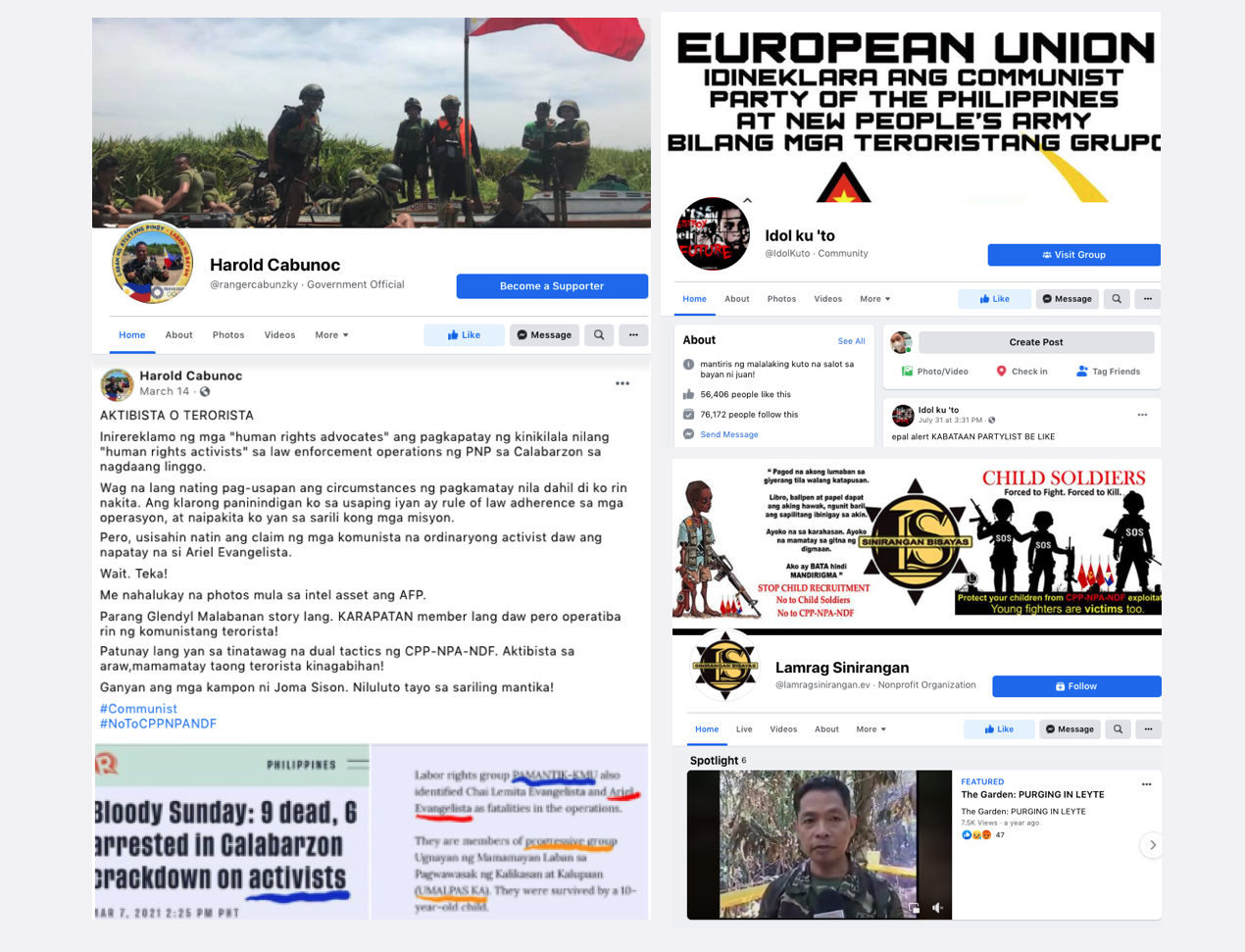
Army officer Colonel Harold Cabunoc’s Facebook page is also among the most active in creating military and anti-insurgency propaganda. The colonel has also had a history of red-tagging online, and has also been red-tagging slain activists.
Other pages shown to be actively pushing out military propaganda are IDOL KU ‘TO, LAMRAG SINIRANGAN, and Pinoy Red Watch.
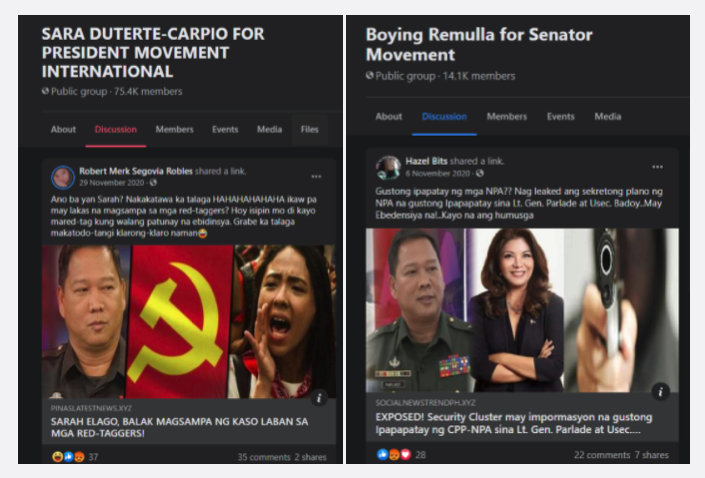
“Alternative” news sources were also actively being funneled by the cluster, including websites pinaslatestnews.xyz, and socialnewstrendph.xqz. These websites post “news” content related to communists, and “report” about government propaganda against activists and progressive groups.
Other pages often amplified by the main cluster include known propaganda pages Mocha Uson Blog and VovPH.
Content from these sources is shared in hundreds of Facebook pages and groups, mostly political but also including community and interest hubs, with captions that actively call out activists as terrorists, and highlight the narratives identified above.
While the main cluster effectively distributes these content to the general public, other clusters showed similar content, also mostly coming from “alternative” news websites and “news aggregators” that are funneled into Facebook groups with special interest in military and anti-insurgency activities, such as Team AFP, Philippine Armed Forces, and the “CITIZENS ANTI-DRUGS CRIMES AND CORRUPTION OF THE PHILS.”
Public support amid culture of terror
While the online and on-the-ground attacks were public and blatant, support for human rights and progressive groups was muted online.
Karapatan secretary-general Cristina Palabay claimed their network and community continuously expanded since 2018 when the attacks against them and other progressive groups increased. “Sa international, after the NTF-ELCAC, dumami rin ang kaibigan namin,” Palabay said. (In the international scene, after the creation of NTF-ELCAC, we gained a lot of supporters.)
But this widespread support and network group has yet to translate online. In the digital space, their stories are often told exclusively by select media and the network of progressive groups and human rights activists.
The network map above shows the network of pages and groups that amplified content with mentions of 16 Karapatan members killed during the Duterte administration. While progressive groups have their own network of pages and distribution channels, as seen above, they are small in comparison to the red-tagging and propaganda network.
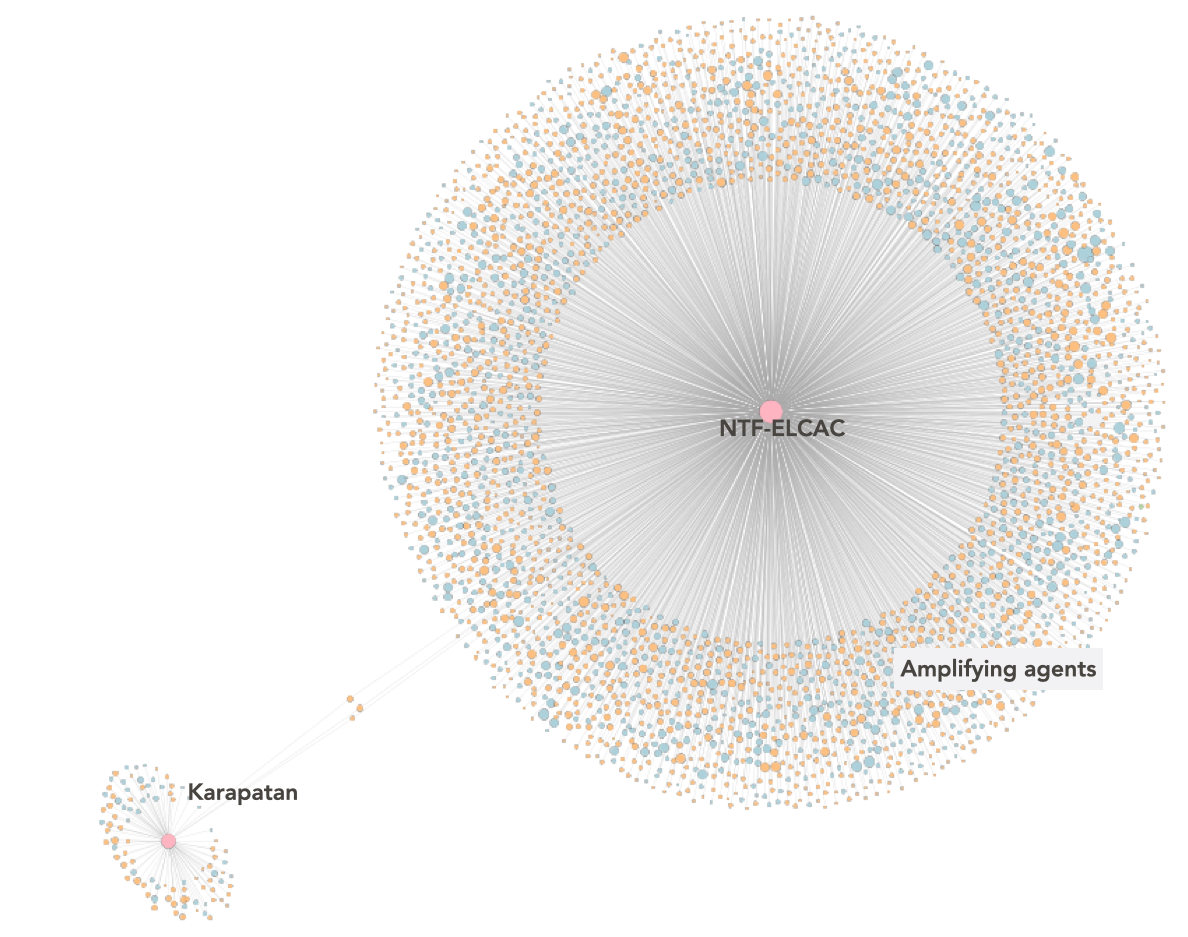
In the visualization below, we compare the amplifying agents (Facebook pages and groups sharing their content) of NTF-ELCAC and progressive group Karapatan, as captured by Rappler’s SharkTank in 2020. The two entities were chosen because they were the most distributed content sources for government propaganda and in conversations on activists killed.
The scan showed a huge difference in the size of the networks that amplify both channels – painting a picture of an environment where stories of slain activists like Alvarez remain within the echo chambers of other activists online and are effectively drowned out by government propaganda that blurs the lines between activism and terrorism.
What makes this enabling online environment more dangerous is how it reinforces the lack of public accountability for the harassment and killings of human rights workers, lawyers, and activists.
It also further weakens mechanisms that are supposed to protect individuals who are already vulnerable to attacks such as Alvarez, who asked the Supreme Court for protective writs because she was being harassed.
She died before the court came up with a decision on her appeal. – Rappler.com
Data visualizations by Akira Medina, Dylan Salcedo
Published October 10, 2021, www.gmanetwork.com/news/pinoyabroad/news
A Filipina health frontliner died in New York on Sunday (PHL time), days after she was assaulted by a mentally disturbed homeless man, the Philippine Consulate General in New York said.
The Consulate General identified the victim as Maria Ambrocio, 58, from Bayonne, New Jersey.
“We grieve with the rest of the Filipino Community over the death of our kababayan, Maria Ambrocio, a 58-year-old health frontliner from Bayonne, New Jersey, who is the latest victim of deranged individuals on the loose in New York City,” the Consulate General said.
Ambrocio had just visited the Philippine Consulate General on Friday afternoon and was walking with a fellow Filipino near Times Square when the suspect knocked her down, it said.
“Maria was walking with a kababayan near Times Square after visiting the Philippine Consulate General when she was struck by the suspect who was reportedly being chased after grabbing a mobile phone from someone,” the Philippine Consulate General said in a Facebook post.
The victim had been placed on life support since Friday.
“Maria’s passing was announced shortly after she was removed from life support a few hours ago. She had been on life support for the head trauma she sustained on Friday afternoon after she was knocked down by someone who was described as a mentally disturbed homeless man,” it said.
Bayonne, New Jersey Mayor James Davis called for prayer for Ambrocio hours earlier. He said Ambrocio was an oncology nurse at the Bayonne Medical Center.
“I’m asking for all Bayonne people to say a prayer for Maria Ambrocio. Maria, an Oncology nurse at Bayonne Medical Center, was viciously attacked in an unprovoked assault by a deranged man in Times Square yesterday. Please keep Maria and her family in your thoughts through these difficult days,” he wrote on Facebook.
Foreign Affairs Secretary Teodoro Locsin, Jr. already asked Philippine Consul General in New York Elmer Cato to help the victim’s family.
“Oh my God. Elmer, go to the family. How can we help. We can take her home. That is our vow and our duty. This is so sad. And after Biden praised our nurses for their compassionate, competent, caring work,” Teodoro said in a tweet.
Cato, meanwhile, said he already got in touch with the victim’s family and conveyed their condolences, and offered assistance.
The incident was “the latest in the series of violent acts committed by mentally-ill individuals against members of the Filipino Community in New York City since the start of the year,” the Consulate General said.
It said several Filipinos, mostly senior citizens, were “violently assaulted by individuals with mental health issues” starting January this year.
“We have joined calls for authorities to take the necessary steps, including heightened police visibility, to protect the public after we noted the surge in anti-Asian hate incidents that targeted some of our kababayan,” the Consulate General added.
“We also supported calls for authorities to take the necessary measures to address mental health issues, especially among the homeless,” it continued.
“We reiterate these calls as we mourn our loss but we also ask ourselves: How many more Maria Ambrocios do we have to mourn before the streets would be made safe again?” it said.
In March, a 65-year-old Filipina was attacked near Times Square in Manhattan, New York City. The Filipina, identified as Vilma Kari by police, was walking down a street when a man suddenly kicked her in the stomach. The suspect was later arrested.
Filipino theater actor and ‘Miss Saigon’ alumnus Miguel Braganza was on his way to his apartment on August 7 when a robber assaulted him and hit him on the head with a gun. —KG, GMA News
By: Denver Del Rosario – Social Media Specialist / INQUIRER.net /October 10, 2021
MANILA, Philippines — How should one engage their family in political conversations when they don’t necessarily share the same views—and what will one gain or lose from doing it?
A recent Twitter Space sought to address these questions with a discussion that provided a window into the struggles the youth face when they become open to their loved ones about their politics.
The six-hour-long online forum, titled “Pamilya at Politika,” dominated Philippine Twitter on Saturday night, rising to the second spot of the trending list and seeing over 1,500 listeners at its peak.
The discussion, anchored to Filipino historian Renato Constantino’s essay titled “Parents and Activists,” featured various Twitter users who shared their experiences on the issue.
Kelsey Hadjirul, one of the organizers, said last night’s virtual forum was the most successful one yet in terms of attendance and reception since their first Space last Thursday.
Chad Booc, one of the main speakers, said they organized the discussion to identify how the youth can encourage their families to join the wider political discourse, especially with the upcoming national elections.
“Sa [isang] discussion, maraming nag-raise ng tanong kung paano pakitunguhan lalo ‘yung mga parents nila na hindi kapareho ng views. So gusto natin magkaroon ng ideya yung iba kung paano ito gawin through listening to other people’s success stories,” Booc said.
(In a [previous] discussion, many users raised the question on how to talk to their parents who don’t share their views. We want others to know how to do it through listening to other people’s success stories.)
No stranger to political vilification, Booc has been constantly red-tagged by state forces, most notably by the National Task Force to End Local Communist Armed Conflict (NTF-ELCAC).
The government’s controversial anti-insurgency task force, which has P19-billion budget this year, has received the ire of various lawmakers who have been pushing for the realignment of its funds to aid people affected by the pandemic.
A Lumad school teacher for over five years, Booc was one of seven individuals arrested during a police operation on a bakwit school in Cebu City last February. Police claimed that the group, also known as the “Bakwit School 7,” were recruiting children to become armed combatants.
They were released last May after the complaints lodged against them were dismissed by the Davao del Norte provincial prosecutor for insufficient evidence and lack of probable cause.
Booc said that while his family remains worried for him amid the state’s various attacks, they have also given him greater support.
While the majority of the stories described being ridiculed and restricted by their families because of their political involvement, Hadjirul had it better—she said that while her mother still fears for her safety, she has also given her freedom.
“Parati ko ngang sinasabi sa kanya na ‘yung ganoong pagmamahal at pagpapaubayang nakukuha ko mula sa kanya ay nakakatulong sa pagpapadali ng pagkilos ko. Maswerte ako doon,” she said.
(I always tell her that the love and freedom I get from her helps me in my activism. I am lucky.)
Last Saturday’s virtual forum, the organizers said, sought to dismantle the narrative pushed by the current administration and its forces that activism destroys families and equates to terrorism.
“Taliwas sa ipinakakalat na disimpormasyon ng estado na terorismo ang pagiging aktibista, ‘yong mga aktibista ay nariyan para paglingkuran ang masa at isulong ang panlipunang pagbabago kung saan walang pinagsasamantalahan at walang inaapi,” Hadjirul said. (Contrary to the disinformation by the state that being an activist is terrorism, activists are here to serve the masses and fight for societal change where no one is being taken advantage of and oppressed.)
“Napatunayan sa mga kwento sa Space kung paano sinisikap ng mga aktibista na mas mapalapit sa kanilang mga magulang at pamilya dahil nga ang pinaglalaban ng mga aktibismo ay kabutihan para sa lahat ng mga anak, mga magulang at pamilya na pinagsasamantalahan ng sistema ngayon,” Booc added.
(The stories in last night’s Space only proved how the youth and activists are trying to further strengthen their relationship with their families, because activism fights for the good of every child, every parent and every family being taken advantage of by the system.)
The youth will play a big role in the upcoming elections as they hold 52 percent of the vote, based on the most recent election data. For the organizers, the youth should support candidates who serve the interest of the masses and protect the welfare of Filipino families.
“We should do away with politicians who only produce more widows and orphans,” Booc said.
‘The overarching issue is Duterte himself. He is repression, he is militarization, he is terrorism. He is EJK. He is corruption. He is China. He is the pandemic.’
Until Leni Robredo declared herself in the running for the presidency, there had been no genuine opposition to Duterte; there had only been pretenders, who, for all their roaring avowals for change, could not even bring themselves to acknowledge that Duterte is the precise immediate cause of the desperate need for the change they’re roaring for.
They keep tiptoeing around him, skipping the prerequisite cleanup to any change, because cleanup implies a mess, and the monstrous mess that is material here is Duterte’s mess. But of course, for them to acknowledge this is to commit themselves to sweeping Duterte away and dumping him, making him pay, as only he deserves, which apparently none of them is prepared to do as his successor.
The reason is not hard to guess: they have all gone along with him, thus making themselves complicit in his mess-making, by voting for or otherwise supporting his Draconian measures. They have done much more to enable him, but the following should speak enough.
Ping Lacson sponsored a law that cannot even define the crime it punishes — terrorism — but allows enough pretexts for furthering Duterte’s authoritarian designs. That should surprise no one: Lacson’s name is inevitably mentioned with that of the abominable Rolando Abadilla’s in the context of torture under Ferdinand Marcos’s martial law.
For his part, Manny Pacquiao, with special help also from Lacson, took up for Duterte the lapdog duty of chasing human rights campaigner and fellow senator Leila de Lima out of the justice committee she chaired preparatory for her being framed and detained on drug charges.
Isko Moreno, a Duterte undersecretary for social welfare and development before becoming mayor of Manila, now makes the particular promise, as a presidential candidate, to continue supporting the implausible case against De Lima. In the same obsequious vein, he says he finds other things admirable and worth pursuing about Duterte’s presidency, but could cite only one — his “Build! Build! Build!” program. As it happens, most if not nearly all that got built under that infrastructure program had been laid out and funded and in some cases actually begun under the preceding presidency of Noynoy Aquino.
To Bongbong Marcos, Duterte’s ties go even stronger, and further: Bongbong’s dictator dad is Duterte’s professed idol, and Bongbong himself was his expressly preferred vice-president, not his own official running mate, the now reticent, apparently belatedly humiliated, Alan Cayetano, when they all ran in 2016. The Marcoses and the Dutertes appear to continue to plot together, raising suspicions of a Bongbong Marcos run with a Duterte for vice president. That would be Rodrigo himself or his daughter Sara, whose theatrical coyness and distancing from her father are only too obviously calculated to fool the electorate that she is a different Duterte — her own father calls her “drama queen.”
The whole affair, indeed, gives off a conspiratorial stink, which lately has grown strong with leaks that Senator Imee Marcos, Bongbong’s sister, is eyeing the Senate presidency and former President Gloria Arroyo the House speakership — in fact, she was once speaker under the Duterte regime — in what they hope to be a succeeding administration that will perpetuate his regime by surrogacy. These leaks reflect a confidence doubtless developed from a relationship with Duterte that has been so special it has set themselves up for this comeback moment.
Arroyo herself brought to the relationship two particular strengths, which may have made her indispensable to Duterte: one, she is the original connection to the Chinese patronage Duterte has been enjoying, treasonously; and, two, he owes her for the Supreme Court that she managed to stack in her unusually long presidency (three years as successor to the impeached Erap Estrada and, after that, six years of an elective term of her own) and that Duterte has subsequently co-opted, allowing him to dispense or deny judicial favors as he pleases.
Given their little-concealed pretensions to opposition to Duterte, the question may yet persist why Robredo had to reach out to the presidential aspirants from the ruling coalition. Naive — as some have said, out of disappointment or anger — she definitely is not. Strategic in her own unpredictable way is how I would be inclined to imagine it. She gave all those pretenders a chance to come around decisively and openly to the righteous cause, but they chose to remain conveniently blind to the real issue, and, with that, the line is decidedly drawn for the vote in May.
The overarching issue is Duterte himself. He is repression, he is militarization, he is terrorism. He is EJK (extrajudicial killings). He is corruption. He is China. He is the pandemic — by his incompetent, uncaring, self-aggrandizing response to it, he has made life more miserable all around than the coronavirus can do by itself.
And Leni Robredo is the exact opposite of all that; all her fellow aspirants to presidential succession are fakes. If you don’t see that, you must be conveniently numb or dumb; either way, you are only contributing to national extinction. – Rappler.com
MANILA, Philippines — Condolences have poured in over social media following the death of Commission on Human Rights (CHR) Chairperson Chito Gascon, who has been hailed as a champion for human rights.
Gascon died while battling COVID-19, his brother Michael said on Facebook Saturday morning.
Hours after his death, the CHR changed the profile picture of its Facebook and Twitter page into a black and white logo of the CHR to mourn the death of its leader.
Vice President Leni Robredo condoled with the family, friends, and colleagues of the late human rights defender.
“Sa trabaho niya at aktibismo (In his work and activism), Chito touched many lives. He was a student leader, advocate, and mentor that so many looked up to… His was a constant light in these dark times. It is now up to all of us to tend to this light. May we all honor his legacy by following his example of compassion, courage, and integrity,” Robredo said in a statement.
On Twitter, Supreme Court Associate Justice Marvic Leonen praised how Gascon “stood [his] ground and inspired many.” “You will be missed,” Leonen said of the late CHR chairman.
Former Supreme Court spokesperson and law professor Ted Te, meanwhile, hailed Gascon for fighting the good fight.
“Chair Chito Gascon, rest in power. You fought the good fight. You stood your ground and held fast. You took the fight to the enemy. You were a giant for human rights. The forest is barer because of your fall, but the seeds that you planted will yield fruit,” said Te.
Vice President Leni Robredo condoled with the family, friends, and colleagues of the late human rights defender.
“Sa trabaho niya at aktibismo (In his work and activism), Chito touched many lives. He was a student leader, advocate, and mentor that so many looked up to… His was a constant light in these dark times. It is now up to all of us to tend to this light. May we all honor his legacy by following his example of compassion, courage, and integrity,” Robredo said in a statement.
On Twitter, Supreme Court Associate Justice Marvic Leonen praised how Gascon “stood [his] ground and inspired many.” “You will be missed,” Leonen said of the late CHR chairman.
Former Supreme Court spokesperson and law professor Ted Te, meanwhile, hailed Gascon for fighting the good fight.
“Chair Chito Gascon, rest in power. You fought the good fight. You stood your ground and held fast. You took the fight to the enemy. You were a giant for human rights. The forest is barer because of your fall, but the seeds that you planted will yield fruit,” said Te.
Senator Richard Gordon said he was saddened by the passing of Gascon.
“I am saddened to hear the news that COVID-19 has claimed another life in Chairman Chito Gascon of the Commission on Human Rights this morning,” the senator said.
For Human Rights Watch Senior Philippines Researcher Carlos Conde, Gascon’s advocacy for human rights “under these trying times” will not be forgotten.
Meanwhile, lawyer Tony La Viña described the death of Gascon as “a day of mourning.”
“Paalam at salamat (Goodbye and thank you), Chito Gascon. This is a day of mourning. Setting aside politics momentarily to remember a good friend, a servant of the people, a true believer and advocate of human rights,” La Viña said.
Kabataan Partylist Rep. Sarah Elago also thanked Gascon for his battle for human rights.
“Maraming salamat at paalam, Chair Chito Gascon. Pagpupugay sa inyong paninindigan sa kabila ng tumitinding atake sa (Praise to you for standing firm despite the intensified attacks against) human rights defenders. The Filipino people, especially the youth, will forever be grateful for your manifold contributions to building a just and humane society,” Elago said.
A former student leader and activist himself in his youth, Gascon, who became a member of the Constitutional Commission, was instrumental in the passage of a legislation allowing the youth sector to participate in governance through the Sanggunihang Kabataan.
Renato Reyes Jr., secretary-general of the Bagong Alyansang Makabayan, also extended sympathy to the family and friends of Gascon.
‘Watchful eyes’
“We grieve with the human rights community over his untimely passing. We pay tribute to his work in the CHR which included supporting the cause of thousands of human rights victims of the Duterte regime, providing a safe space and sanctuary for human rights defenders, and amplifying calls for accountability over the reign of terror of this regime,” said Reyes.
“We thank him for his valuable contribution to the struggle for justice and the full realization of human rights. At a time of escalating state terror, Chito’s voice will be missed. We are comforted by the knowledge that many will carry on the fight. Paalam at pagpupugay, Chito,” he added.


![[Newspoint] Duterte is the issue](https://pinoyabrod.net/wp-content/uploads/2018/03/ICC_DUTERTE-768x613.jpg "[Newspoint] Duterte is the issue")
