Home Blog Page 56

Gov’t cyberattacks

0

Editorial, Philippine Daily Inquirer / September 28, 2021

The Department of Information and Communications Technology’s Computer Emergency Response Team (CERT-PH) has confirmed that the cyberattacks on the sites of two alternative media outlets and a human rights group back in May originated from the computer network of the Philippine Army.

According to Bulatlat and Altermidya-People’s Alternative Media Network, the CERT-PH’s report was able to verify with the Department of Science and Technology (DOST) that the attacks came from an internet protocol (IP) address assigned to the Philippine Army. The CERT-PH’s Aug. 11 report was confidential, but the two outlets decided to disclose it to the public, because “There is no reason to keep it confidential especially if state agents used public funds and resources to infringe upon our right to publish and the people’s right to information,” they said.

The CERT-PH report also validated the findings of a digital forensic analysis made by Swedish company Qurium Media Foundation (QMF) last June that Bulatlat, Altermidya, and Karapatan were the subject of “brief but frequent’’ attacks in the form of distributed denial of service (DDoS), which involved flooding the websites with superfluous requests to overload the host, thus rendering the sites inaccessible.

The attacks occurred on May 17, 18, and 20 and June 6, when the groups — which are among those that have been Red-tagged by the military — were reporting on the International Criminal Court’s investigation of President Duterte’s drug war, the arrest of peasant leaders in Mindanao, and the low testing for COVID-19, among other issues.

The QMF traced the hostile IP address to the Philippine Research, Education and Government Information Network, a unit under the Advanced Science and Technology Institute of the DOST. Another unit in the same IP address was registered to “acepcionecjr@army.mil.ph,” which is under the Army’s official domain and website.

With no less than the government’s main cybersecurity arm making the damning report, the Army has no more grounds to insist on its denial and obfuscation of this sinister crime. It has been caught red-handed through its own digital footprints.

Cyberattacks are punishable under Republic Act No. 10175 or the Cybercrime Prevention Act of 2012, which defines and provides stiff penalties for cybercrime offenses.

These cyberattacks are also a brazen assault on basic freedoms and rights enshrined in the Constitution, and they must be denounced by any freedom-loving citizen, more so if they originate from the military, an institution sworn to protect the people.

Clearly, from the QMF and CERT-PH reports, what happened was not case of a “mere visit’’ or browsing of the sites, as ridiculously claimed by the Army’s spokesperson Col. Ramon Zagala. The QMF report said the perpetrators even conducted a vulnerability scan on the morning after the May 17 attack, to check whether the cyberattacks were successful.

If it has nothing to hide or cover up, the Philippine Army would be more forthcoming and would welcome the chance to cooperate in any inquiry into this illegal activity. But the CERT-PH noted in its report that when it coordinated with the military in July to seek “the right person to engage with” in the investigation, it got no response.

“An additional analysis did not prosper due to the none (sic) established coordination with the organization currently using the said IP,” the report read. Why ignore this official inquiry if no wrongdoing was committed?

Bulatlat and Altermidya-People’s Alternative Media Network have every right to denounce the military’s action. “We condemn the Philippine Army for carrying out cyber crimes against independent media outfits. We take offense at the duplicity they have shown regarding this incident — publicly professing respect for press freedom but launching vicious digital attacks, and never cooperating with other government agencies,’’ the two groups said.

That goes for the DOST, too, which refused the two groups’ request to identify the agency using the IP address involved in the attacks, and has until now failed to provide them a copy of its investigation.

The gravity of the offense and the lack of transparency by the Army and the DOST are unacceptable, and this illegal act, using government resources at that, cries out for a thorough, unrestricted investigation. Under RA 10175, the National Bureau of Investigation and the Philippine National Police are tasked to enforce and investigate violations of the cybercrime law. These agencies must now look into this incident and unmask those who are using the government’s technological arsenal as weapons to ambush and try to shut down online media outlets, especially since the perpetrators point to men in uniform.

Ordinary citizens have been charged for lesser offenses under the cybercrime law. Is the Army above the law?
Church leaders urge revival of peace talks between gov’t, communists

0

By: Jigger Jerusalem – Inquirer Mindanao /September 26, 2021

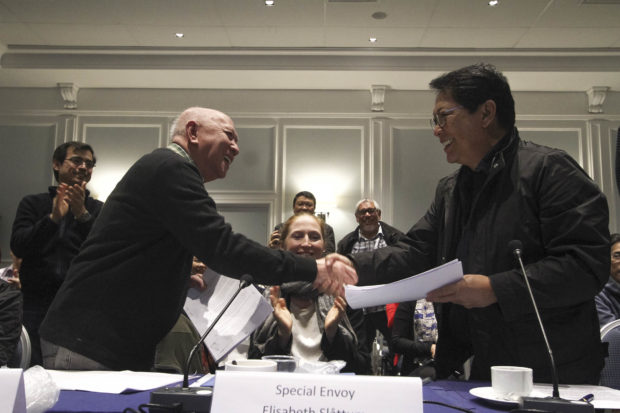
CAGAYAN DE ORO CITY, Misamis Oriental, Philippines — Religious leaders belonging to the Philippine Ecumenical Peace Platform (PEPP)  have renewed their appeal to the government to revive its stalled peace process with communist rebels as the country observes September as the National Peace Consciousness Month.

The International Day of Peace was also observed last Sept. 21.

“It is in this spirit that the Philippine Ecumenical Peace Platform (PEPP) enjoins our people to… call on the government to prioritize the country’s healing,” the group said in a statement.

That healing, it said, can be best exemplified if both parties — the government and the National Democratic Front of the Philippines (NDFP) — will come to an understanding and resume the peace talks.

The negotiations gained momentum during the early months of President Rodrigo Duterte’s administration, but it was eventually terminated by the national government toward the end of 2017.

The PEPP noted that the termination of the talks gave rise to the commission of a series of serious rights violations in various parts of the country, along with more clashes between government troops and the New People’s Army.

“Let us also call on the GRP (government) and the NDFP to join the whole world in this historic occasion by returning to the negotiating table and together put an end to further human rights violations and the loss of life as a result of the conflict,” PEPP said.

The group has acknowledged that the quest for peace between government and the communist rebels “has become elusive again” and achieving it will remain an insurmountable task with the NDFP being branded as a terrorist group by the Anti-Terrorism Council on the basis of the controversial Anti-Terrorism Act of 2020.

“This effectively buried years of laborious and painstaking agreements and gradual steps toward peace,” the PEPP noted.

Tesda ‘miracle’: P4 billion spent in 13 days

0

By: Julie M. Aurelio – Reporter/Philippine Daily Inquirer /September 25, 2021

MANILA, Philippines — Imagine the notoriously slow Tesda (or the Technical Education and Skills Development Authority) spending billions in less than two weeks.

Despite its historically low utilization of its budget, Tesda has “miraculously” done exactly that: obligating P4 billion in scholarship funds in 13 days — and alarming House Deputy Minority Leader and Marikina Rep. Stella Luz Quimbo.

At the House’s plenary deliberations on Friday, Quimbo expressed doubt that the agency could spend its proposed P13.64-billion funding for next year given its past low-efficiency spending.

“The historical data on the budget would show that the efficiency spending levels are really very low .… It’s doubtful if they can really absorb such a huge amount, considering that historically, it takes Tesda almost two years to execute a budget,” she said.

Quimbo moved to defer deliberations on the agency’s proposed budget, a motion with which House Deputy Speaker and Pampanga Rep. Juan Pablo Bondoc agreed.

“We join the minority, particularly in the alarm regarding the spending of Tesda … There are many questions to be answered,” Bondoc said

Tesda, led by its Director General Isidro Lapeña, is under the Department of Trade and Industry (DTI), which has a proposed budget of P23.701 billion for 2022.

As of Friday afternoon, the House plenary has terminated deliberations on the proposed budgets of the DTI, Commission on Human Rights, Office of the Ombudsman and Department of Foreign Affairs.

From P4.9B to P973M

Quimbo was posing questions to Zamboanga del Norte Rep. Romeo Jalosjos Jr., sponsor of Tesda’s budget, when she raised its low utilization rate in past years.

She asked Jalosjos about the unobligated balance of Tesda’s scholarship programs for 2021, noting that utilization rates were between 33 percent and 34 percent in 2019 and 2020.

Jalosjos said Tesda’s unobligated and undisbursed budget was P4.9 billion as of Sept. 10, based on a report submitted by its finance unit to the House. By Sept. 23, he said, the unobligated funds were at P973 million, per a report of Tesda’s management unit.

Quimbo was surprised that Tesda was able to spend P4 billion in less than two weeks. “These figures we are hearing are very surprising …. It seems there is a miracle in Tesda…” she said.

Citing Tesda’s utilization rates for 2019 and 2020, Quimbo said it took the agency “about 21 months to fully utilize an annual budget, and that is why I am very surprised that in the last 13 days, they were able to utilize P4 billion.”

Context

In 2019, Tesda had a P13.69-billion budget, of which P10.88 billion was spent over 21 months, from January 2019 to September 2020, due to the extension of its validity.

In 2020, Tesda’s allocation was P11.9 billion, of which P9.52 billion was spent over 21 months, again because the budget’s validity was extended.

“It takes Tesda that long, almost two years, to fully execute an annual budget. That’s the context of my surprise over the big increase in budget utilization in the last 13 days,” Quimbo said.

She said that from June 30 to Sept. 10, Tesda was also able to utilize P3.4 billion, giving the impression that it was trying to “catch up” with its fund use.

Jalosjos explained that the Sept. 10 and Sept. 23 data were submitted to the House by two different offices in Tesda.

“It looks like a miracle happened with the difference of P4 billion, but the explanation of Tesda is that the Sept. 10 submission is based on the actual finance, but the actual utilization of management is higher than that submitted on Sept. 10,” he said.

As for the average 21 months that Tesda took to fully utilize its budget, Jalosjos cited the delayed passage of the national budget in 2019 and the COVID-19 pandemic in 2020 as the affecting factors.

Fund transfers

But Quimbo also raised Tesda’s transfer of more than P2 billion to the Philippine International Trading Corp. (PITC) in 2019 for the procurement of toolkits for its scholars, as cited by the Commission on Audit (COA) in its 2020 report on Tesda. She raised as well the P5.21-billion transfer by Tesda’s regional offices to operating units in 2020 for the implementation of scholarship programs, which the COA said was meant to avoid the lapsing of the notice of cash allocation.

“We are looking at the tendency of agencies who may be having difficulty in fund utilization, to download the funds to a third party like the PITC and let the PITC have the responsibility to spend those funds,” Quimbo said.

Jalosjos said that in 2020 and 2021, Tesda no longer transferred funds to the PITC and assumed its own procurement.

‘Poor utilization’

It was not the first time that Tesda’s budget proposal for 2022 was disapproved.

The House appropriations committee also did so earlier this month, citing Tesda’s “poor utilization” of and “questionable practices” in its budget.

House Minority Leader and Abang Lingkod Rep. Joseph Stephen Paduano pointed out that Tesda’s budget rose “significantly” from 2017 to 2020 despite “poor utilization” of its funds, which, he said, indicated “poor planning and poor implementation.”

He also questioned the P160-million fund transfer from Tesda’s central office to regional offices to implement activities of the National Task Force to End Local Communist Armed Conflict, even without proper authority or legal basis to do so.

READ ALSO:


Customers Lined Up as Early as 10PM the Previous Day for the Opening of Jollibee’s First-Ever Store in Spain

0

By Anri Ichimura, esquiremag.ph

The Madrid store is now Jollibee’s biggest restaurant in Europe.

Talk about Jollibee fever. 

Madrid-based OFWs and Spanish customers waited as early as 10 p.m. on September 22 for the opening of Jollibee’s first-ever store in Spain on September 23. The eager customers braved Madrid’s cold nighttime weather for a guaranteed seat in Jollibee’s redesigned Spanish store. 

According to Jollibee Foods Corp., this was one of the brand’s biggest openings in Europe to date, with thousands of customers dropping by on the first day. Jollibee Madrid is the brand’s largest store in Europe so far, with a seating capacity of 200 and a redesigned interior to suit Madrid’s crowd. The new bold colors and tropical touches are a head-nod at Jollibee’s Philippine roots even as the now global conglomerate focuses its efforts on its European expansion plan. 

“The heartwarming reception to our opening in Spain inspires us in our journey to bring our much-loved Chickenjoy to more countries in Europe, and is in line with our vision to become among the top five restaurant companies in the world,” said Ernesto Tanmantiong, CEO of Jollibee Group. 

With a strong base secured in the Philippines, Jollibee is now setting its sites abroad as it commits €50 million (P2.9 billion) to open 50 new stores in Europe, with €10 million (P587 million) already going to Spain. 

Jollibee already has 1,400 restaurants around the world, including New York, Rome, London, L.A., and more.

Why stop the hearings?

0

Editorial, Philippine Daily Inquirer /September 24, 2021

The ironically named House committee on good government and accountability has slammed as “political” the Senate probe into the Pharmally deal, which has so far revealed how, among other anomalies, a small favored foreign supplier cornered a multibillion government contract for face masks, personal protective equipment, and test kits without following the prescribed procedure for government procurement.

Echoing President Duterte’s vociferous calls for a halt in the Senate investigation, Diwa party list Rep. Michael Aglipay accused the upper chamber of engaging in “highly publicized hearings” that are “in aid of elections and not of legislation.”

The continuing Senate hearings have stretched so far to at least seven sessions of more than 50 hours. When is enough enough? Not when, like Pandora’s box, the probe continues to uncover a seemingly bottomless trove of malfeasance, intemperate greed, and an arrogant disregard for accountability in the use of taxpayer money.

How explain how Pharmally, with a capitalization of only P625,000 and no track record as a government supplier, was awarded over P8 billion worth of COVID-19 supply contracts in 2020, and more deals worth P2.3 billion in 2021?

President Duterte and Pharmally’s officials have repeatedly used as defense the Bayanihan 1 law which loosened procurement rules under the pandemic. But that law was not yet in effect on March 25, 2020 when Pharmally delivered 500,000 face masks within three hours after receiving a request for price quotation from the government. The law took effect on April 6 after publication in the Official Gazette, noted Sen. Francis Pangilinan.

The preferential treatment extended as well to the use of C-130 planes to transport the supplies from China, an accommodation not given a local supplier, according to Sen. Panfilo Lacson. Mr. Duterte acknowledged the favor as his order, saying: “Ako ang may utos noon, kasi gusto ko madalian. Ako ‘yung president.”

Previous Senate hearings also revealed conflict of interest and possible money laundering involving former presidential adviser Michael Yang, who admitted informing Pharmally about the possible deal, introducing the firm’s officials to suppliers, and was said to have loaned money to the company to pursue the deal—though he later claimed he had borrowed the money from friends he would not name.

The evidence so far indicates that Pharmally had acted as a mere middleman sourcing the products from elsewhere at tremendous markup. For face masks, Sen. Richard Gordon said Pharmally obtained its supplies from another company, Tigerphil Marketing Corp., which got them from Greentrends Trading. Greentrends sold face masks for P18 apiece to Tigerphil, which passed them on to Pharmally at P23.90 each. Finally, Pharmally charged the government P28 per piece for a P1.9-million profit in a single transaction, the senator said.

Such profiteering during the pandemic is particularly deplorable since local manufacturers had been asked to retool their operations to produce pandemic supplies last year, only for them to lose money and retrench workers because the government turned to the Chinese company instead.

The latest hearings have unearthed more irregular transactions. The most appalling is the P550 million worth of 8,000 COVID-19 test kits from Pharmally that expired because they only had a shelf life of six months, contrary to the health department’s technical specification of 24 to 36 months. The kits, which cost P69,500 each, could have done 371,794 reverse transcription-polymerase chain reaction tests at a time when the government was refusing to do mass testing, citing lack of resources. Private sector entities such as Go Negosyo and the Philippine Red Cross were also able to buy test kits at $15 each, while Pharmally’s price was $30.

How lucrative were these deals? It’s been revealed that three Pharmally officials were able to acquire four luxury vehicles less than a year after the firm bagged the P8.6-billion contract in 2020—when it had operated at a loss before that. The two Porsches are estimated to cost from P6.35 to P8.5 million each, while the Lamborghini is worth up to P25 million.

Strangely, the President has been defending this rancid deal to high heavens and lambasting the Senate probe. Last Wednesday, he was at it again, this time threatening to storm the Senate to personally “extract” officials detained for not cooperating with the inquiry.

While the Senate probe has certainly put the spotlight on certain lawmakers eyeing the May 2022 elections, the questions Aglipay’s committee should be asking, if it remotely wants to live up to its name and not be deemed a House committee on summary absolution, are: Who benefits from hushing up the deal? Isn’t the use of taxpayer money a matter of public interest? Why stop the hearings? What is Malacañang trying to hide?

Gordon: Senate uncovered ‘mother of all corruption’ under Duterte admin

0

By: Christia Marie Ramos – Reporter / INQUIRER.net /September 22, 2021

MANILA, Philippines — The Senate Blue Ribbon Committee uncovered the “mother of all corruption” in the Duterte’s administration’s pandemic supply deals with a foreign-led company, Senator Richard Gordon said Wednesday.

As long as more anomalies are discovered, Gordon said his committee will not stop investigating the government’s transactions with Pharmally Pharmaceutical Corp.

Pharmally bagged over P8.6 billion worth of contracts from the Procurement Service of the Department of Budget and Management (PS-DBM) in 2020.

“Hanggang may hinahanap kami, tutuloy namin. ‘Di na kami titigil diyan sa dami,” Gordon said in an interview on Teleradyo.

(Until we still have more things to uncover, we will continue. We will not stop because of the many anomalies that keep popping up.)

“Ang laki-laki nito, biruin mo break the record ito sa corruption, this is the mother of all corruption, sa Duterte administration pa nangyari. Inaasahan ng tao isasalba ang tao sa kahirapan,” he added.

(This is massive, this is record-breaking, this is the mother of all corruption and this happened under the Duterte administration when people are expecting that they will be rescued from poverty.)

The Senate, particularly Gordon, has been at the receiving end of backlash from the President as the chamber continues to look into the controversial purchases made by the government last year.

“Ang ayaw mo, masabihan na may mga corrupt kang tao. Ayaw mong marinig yon. Sapagkat akala mo perfect ka, attorney.)he added, referring to the President, who is a lawyer.

You don’t want to be told you have corrupt people. You don’t want to hear that. Because you think you’re perfect, attorney.)

‘Sick man of Asia again’

Gordon said the Philippines seems to have reverted to being the “sick man of Asia again” as corruption has supposedly thrived under the Duterte administration.

“[We’re] the sick man of Asia again. Naibangon na ang Pilipinas, ngayon balik tayo [We were revived before, now we’re back to being in that status],” the senator said.

During the hearings, senators lamented what they believed was the favor accorded to Pharmally even if the firm’s prices were higher than that offered by Filipino suppliers.

“‘Di Pharmally ang target lang namin, ang target namin, sino ba ang nag-utos mag-kickback diyan ng napakalaki? Sino ang nagplano na nito na ‘kukuha tayo [sa] China, kukuha tayo sa mga hinanda nating supplier para papatungan natin?’” Gordon asked.

(We are not only targeting Pharmally, who we are targeting is who ordered kickbacks. Who planned to get suppliers from China, to order from our prepared suppliers so we can make the price higher?)

The PS-DBM, Malacañang, and the Department of Health have repeatedly defended the government’s transactions with Pharmally and denied alleged irregularities.

“Just to disabuse the mind of some people about corruption, it ain’t here at this time. I suppose that you are barking at the wrong person,” Duterte said in a public address last Aug. 21.

During one of the hearings, Pharmally president Huang Tzu Yen admitted that his firm borrowed money from former presidential economic adviser Michael Yang to help them fulfill some of the government’s orders last year.

In a House hearing last Monday, Yang insisted that it was his friends, not him, who funded Pharmally in some of its contracts with the government.

Huang, for his part, denied that they were favored in any way in the government’s procurement of medical supplies in 2020, saying the small company has been “unfairly prejudged.”

Peace advocates raise concerns on peace consultant Loida Magpatoc, assails Duterte and peace spoilers

0

Pilgrims for Peace, a network of peace advocates which has been supporting the peace negotiations between the Government of the Philippines (GPH) and the National Democratic Front of the Philippines (NDFP), has urged the GPH to assure proper care and treatment for NDFP peace consultant Loida Magpatoc who was arrested several days before in Mindanao. Magpatoc is a JASIG-holder who was working diligently on peace negotiations until Duterte’s unilateral termination of the peace talks.  She was a member of the Reciprocal Working Committee which crated the Comprehensive Agreement on Social And Economic Reforms (CASER).

“Efforts to overcome the obstacles to peace negotiations have been fraught with disappointments. State violations of human rights and international humanitarian law have exacerbated already difficult situations.  Vicious threats and destructive attacks against farmers, indigenous peoples and workers impeded democratic space and hampered peacebuilding. Not only did Duterte unilaterally terminate the GRP-NDFP peace talks, but the killings of NDFP peace consultants laid bare that Duterte and his militarist spoilers are more interested in spilling blood than in building peace,” the Pilgrims for Peace said in a statement.

They urged the Duterte government to respect human rights and pave the way for the resumption of peace talks: “Duterte seems to have a penchant for breaking commitments, whether in peace negotiations or in his constitutional mandate to ensure respect for the human rights of every Filipino.  With the investigation of the International Criminal Court closing in, Duterte might want to rethink his wanton disregard for peace and human rights. The day draws near when he and his henchmen will have to answer for their brazen violations. This will be a relief to many, but especially for us peace advocates, who long to see the GRP-NDFP peace negotiations back on track and a just peace on the horizon.” PAbrod

Pinoys in Canada: Call for end of Duterte rule, ‘a de facto martial law’

September 22, 2021

By Veronica Silva Cusi
The Philippine Reporter

Filipinos in Toronto on September 19 commemorated the 49th anniversary of the declaration of Martial Law in the Philippines with a protest vigil calling for the end of rule of President Rodrigo Duterte, who they likened to the late dictator Ferdinand E. Marcos.

“Never again, never again to Martial Law!” protesters numbering around 50 all cried out during the event held at Bathurst Wilson Parkette at the corner of Bathurst St. and Wilson Ave. west of the city.

Marcos declared Martial Law on September 21, 1972, allowing him to stay in power beyond what was constitutionally allowed. Even after the lifting of Martial Law in 1981 and up until his ouster in 1986 through a People Power revolution, his rule was marked by human rights violations, curtailment of press freedom, and thousands of extrajudicial killings.

Protesters said this is quite like what has been happening under the five-year-old Duterte regime, which organizers referred to as de facto Martial Law.

Kababayans lit candles honouring victims of martial rule, which was known for desaparecidos, or the missing who were snatched without due process and simply disappeared, many of them presumed dead. They also honoured those who survived Martial Law and those who continue to fight to this day.

In the administration of Duterte, extrajudicial killings numbering about 27,000, including some 122 children, persist through his so-called war on drugs. Getting rid of the drug problem was one of his presidential campaign promises, and was his justification on the war on drugs.

The International Criminal Court recently said it authorizes an investigation into these killings. But Duterte refuses to cooperate with any probe.

Aside from arbitrary killings, protesters said graft and corruption are rampant in the administration of Duterte, quite like in the Marcos era.

And the COVID-19 pandemic has made life worse for millions of Filipinos. World Bank data released in June show that the economy contracted 4.2% year-on-year in the first quarter of 2021. This is due to “weak domestic demand, driven by the combination of containment measures, weak confidence, and rising inflation.”

“As the Philippines continues to reel from a historic economic recession made worse by the COVID-19 pandemic, human rights violations continue to escalate at unprecedented rate,” said Anakbayan Toronto chairperson Rosetta Lucente, in her opening remarks at the event.

She added that lockdowns, which were supposedly aimed at containing the spread of the COVID-19 virus, are used by the Duterte government to further suppress concerns of Filipinos.

Organizers said Martial Law is still relevant to Filipinos these days, including to Filipinos based in Canada. They reminded the crowd that it was Marcos who instituted the Philippines’s labour export policy, which continues to drive many Filipinos abroad.

Protesters said Duterte’s rule adversely affects Filipinos in Canada, particularly migrant workers and the undocumented.

Leny Rose Simbre, chair, Migrante Ontario noted the lack of social services supports for thousands of overseas Filipino workers (OFWs) in the proposed national budget for 2022, an election year.

“In addition, there is a lack of repatriation funds, and assistance is barely extended to them (OFWs),” said Simbre at the event. “Moreover, rampant corruption continues at all levels of government to raise funds for the 2022 national election, and the Filipino people are suffering even more.”

Duterte’s term will end in 2022, and under the 1987 Philippine Constitution, the president can hold office for only six years.

Protesters also called out the Canadian government for its ties to the “pompous and murderous Duterte regime.”

“Canadians need to know why … Canada is not pressuring the Duterte regime to uphold the human rights of the Filipino(s) and end his genocidal war against the poor and their human rights advocates,” said Malaya Movement in Canada in a prepared statement read at the event by convenor Ed Muyot.

The International Coalition for Human Rights (ICHRP) Canada Chapter reiterated its call for the Canadian government to end its military support to the Philippines.

“We call on Canada to immediately suspend sale of arms to the PH government, to vocally support the peace talks process, to call on its ally the United States to pass the Philippine Human Rights Act in [U.S.] Congress, and to participate in multilateral global efforts to investigate and condemn the extrajudicial killings and other abuses,” said Ryan Greenlaw of ICHRP in a prepared statement read at the event.

Duterte is also being compared to Marcos due to the recently enacted anti-terror law and red-tagging of any critic – including human rights defenders, farmers, students, and journalists — who questions his policies. Both policies further suppress Filipinos’ human rights as critics are considered as either “terrorists” or “communists.”