As lawyers, we are duty bound, under oath, to be dispensers of justice and as Filipinos, we are morally and historically bound to struggle and protect our freedom and dignity as a people and as a nation.
Broadest workers alliance to march as one to Mendiola on Labor Day
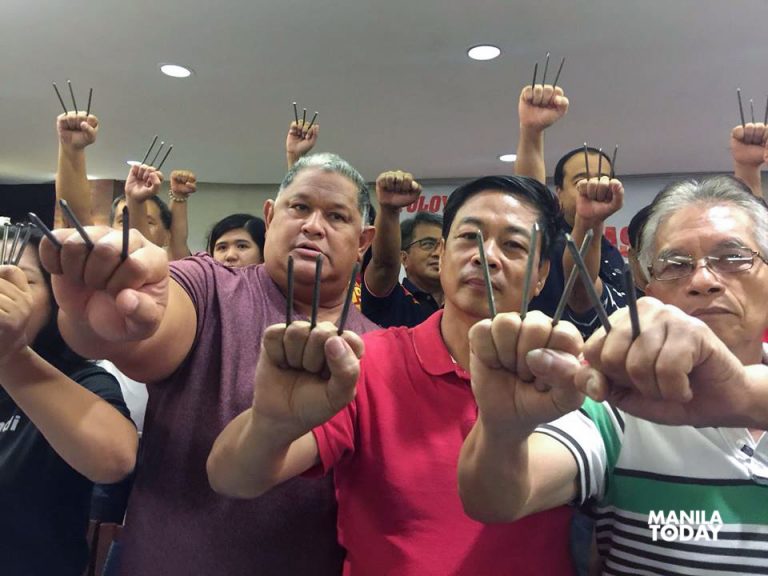
“All roads lead to Mendiola on Labor Day.”
This has been the statement of the broadest alliance of different labor groups under the banner of Kilusang Mayo Uno – Nagkaisa! Labor Coalition (KMU-Nagkaisa) in a press conference held in Manila today.


Leaders of various labor groups displayed nails to depict the “pangakong napako” (failed promise) of President Duterte to end all forms of contractualization in the country.
The group also stressed that the growing frustration, disappointment and dissatisfaction of workers over Duterte’s failure to fulfil a promise have only brought together workers in an alliance.
According to the groups, the forging of this kind of unity will be the first time since 1989.
In the press conference, the labor alliance announced that more than 60,000 workers are expected to march to Mendiola in Metro Manila on May 1 while more than 150,000 will march across the country.
They also called the Labor Day rally as a nationwide indignation rally as thousands will hold simultaneous protests in Panay, Iloilo, Bacolod, General Santos, Iligan, Cebu among other provinces nationwide.
KMU-Nagkaisa also insisted that they will boycott the government’s Labor Day celebration in Cebu but assured that a bigger protest will greet Duterte in the said province.
“This year’s commemoration of Labor Day will be different. it will be a national day of solidarity and action of leaders, members, allies and supporters of KMU-Nagkaisa and all citizens who have been frustrated over the injustices committed against workers and the Filipino people and government’s continued inaction and negligence,” said Elmer Labog, KMU chairperson.
“Let’s march arm-in-arm and be part of this growing solidarity. Let’s unite on Labor Day and work together in the days to come,” said Michael Mendoza, Nagkaisa chairperson.
No backlash?
KMU-Nagkaisa also belied the pronouncement of Presidential spokesperson Harry Roque that the failure of Duterte to issue and executive order on contractualization has no backlash from the labor sector.
Joshua Mata of Nagkaisa said, “If Secretary Roque is looking for backlash then we will let them feel the backlash of protests on May 1 and beyond.”
Labog added, “For two years, we participated in labor summits called by the labor department and three dialogues with the President. We have drafted an EO on contractualization and negotiated with him through five drafts, but all to no avail.”
KMU-Nagkaisa even said that the series of protests will continue even after Labor Day. They also invite other labor unions outside of their coalition to join their mounting protests against contractualization on May 1 and even beyond.
The groups said that they are planning to stage a series of protests in various agencies after May 1 until the government will realizes its promises to the workers to end contractualization.
The post Broadest workers alliance to march as one to Mendiola on Labor Day appeared first on Manila Today.
Contractualization: A Neoliberal Policy (Excerpt from IBON Facts & Figures)
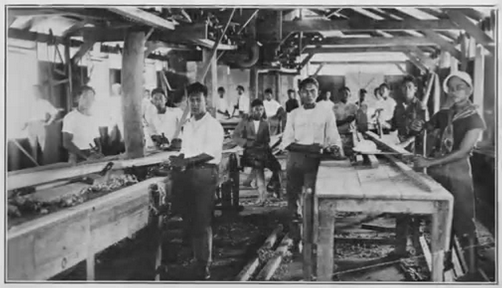
The exploitative practice of labor contracting is a continuing legacy of the country’s feudal and colonial history. It dates back from the cabo system – a labor arrangement that proliferated during Spanish colonialism. Cabos acted as labor negotiators and suppliers to companies and project or contract-based (pakyao) jobs. The system was commonly practiced in small-time construction companies, maritime companies that hired stevedores, and in haciendas that hired seasonal plantation workers.
In the 1850s, sacadas (poor peasants from other provinces) were contracted to work in sugar plantations in Negros through this system. Employed by hacienderos, cabos encouraged sacadas to migrate to the sugarland of Negros and work in plantations on a seasonal basis. Later, the subcontracting practice proliferated in modern export crop plantations especially in banana and pineapple plantations operating in Mindanao.
During US colonialism, the US colonial government implemented a system in labor relations, which was anchored on fake trade unionism and discouraged the cabo system. At that time, only unionized workers were eligible for employment. With the introduction of trade unionism and the prohibition of labor-only contracting by the US colonial government, the cabos were compelled to utilize unionism as a facade. Cabos established their own unions even without employers to bargain with and penetrated existing unions to retain their power. The cabos became the first batch of notorious labor leaders who, instead of upholding workers’ rights to better wages and employment conditions, functioned as labor suppliers.
Although the country was granted nominal independence in 1946, the American colonizers ensured that treatises were in place to maintain the neocolonial relations between the Philippines and the US. This enabled the US to exercise the same political and economic influence and control in the country.
The Martial Law Labor Code
Former President Ferdinand Marcos used martial rule’s dictatorial powers to orient the Philippine economy to serve the demands of foreign corporations for cheap labor, cheap resources, and captive markets. To improve the investment climate and give foreign capital profitable opportunities in the country, the Marcos dictatorship enacted laws aimed at depressing workers’ wages through labor flexibilization.
In 1974Articles 5 and 106 to 109 of the Book on Conditions of Employment of the Labor Code gave the DOLE Secretary the power to issue regulations and guidelines as to how companies can carry out labor contracting.
Institutionalization in the construction industry
Two years after the issuance of PD 442, contractualization was institutionalized in the construction industry when former DOLE Secretary Blas Ople issued Policy Instructions No. 20-76 which provided the definition and rights of project and non-project construction employees allegedly to stabilize employment relations in the industry.
Project employment is a form of contractualization; the contract is based on a specific task or project with a clear duration. Although project employees are directly hired by employers, there is an absence of an employee-employer relationship between the project employee and the principal employer throughout the duration of the contractual employment. Thus, the anti-labor characteristics of project employment also denies workers not only of their right to security of tenure but also of their right to unionize and negotiate for better wages and benefits with principal employers.
In 1993, former Labor Secretary Nieves Confesor issued DO 19, which provided the guidelines governing the employment of workers in the construction industry. DO 19 affirmed the legality of contracting and subcontracting in the construction industry by providing the conditions of employment and the liabilities of employers and contracted workers.
Institutionalization across all economic sectors
Contractualization was institutionalized across all economic sectors in 1997 during the administration of President Fidel Ramos when former Labor Secretary Leonardo Quisumbing issued DO 10, which amended the rules implementing Books III and VI of the Labor Code. The amendment prohibited labor-only contracting but affirmed the practice of ‘permissible’ contracting and other flexible employment arrangements and recognized the legitimacy of trilateral employment relations ‘for the purpose of increasing efficiency and streamlining operations is essential for every business to grow in an atmosphere of free competition.’
After the issuance of this order, contractual work arrangements have become rampant across all economic sectors in the country. The debilitating impact of the proliferation of contractualization was immediately felt and consequently stirred massive protests throughout the country. The strong clamor to repeal contractualization compelled the Arroyo administration to temporarily revoke DO 10 through the issuance of DO 3 by former Labor Secretary Patricia Sto. Tomas in 2001. After one year, however, the anti-labor and market-biased order was essentially restored through the issuance of DO 18-02 by the same Labor Secretary.
In 2011 during the administration of Benigno Aquino III, then Labor Secretary Rosalinda Baldoz added more requirements to existing guidelines on contracutalization through the issuance of DO 18-A. Included is the imposition of a minimum capitalization requirement of at least Php3,000,000 pesos.
The latest order, DO 174, amending the guidelines on contractualization was signed on March 16, 2017 by Labor Secretary Silvestre Bello III.
The continued implementation of contractualization in businesses is at the heart of the Philippine government’s adherence to neoliberalism, the package of principles that promote market fundamentalism expressed in policies of liberalization, privatization, deregulation, fiscal prudence, among others. To illustrate, it is in compliance with the policy recommendation of The Arangkada Philippines Project (TAPP), a project launched in 2010 by the Joint Foreign Chamber of Commerce (JFC). It is funded by the United States Agency for International Development USAID) to, among others, continue the policy of labor flexibilization.
At present, contractualization continues to proliferate in various forms of market-oriented and flexible hiring schemes.- From Contractualization Prevails, IBON Facts & Figures, July 2017.
Sources:
Kapunan, Rodrigo P. “Labor-Only Contractors: New Generation of “CABOs”. Philipine Law Journal Vol. 65 No. 5 Mar-Jun 1991. (Mar-Jun 1991): p.326. Web. 16 Apr. 2017
Joint Foreign Chamber Of Commerce. “Arangkada Philippines 2010: A Business Perspective”. Arangkada Philippines. 2010. Web. 14 Nov 2016.
Being a lawyer at a turbulent cossroads
‘Redeem what has been lost, repair what has been cracked, and reform what needs to be changed. Lawyer for the people.’ The National Union of Peoples’ Lawyers (NUPL) heartily congratulates all those who passed the 2017 bar examinations. In the same vein, we also send our sincerest felicitations to those who did not find their […]
IPs celebrate 34th Cordillera Day vs tyranny
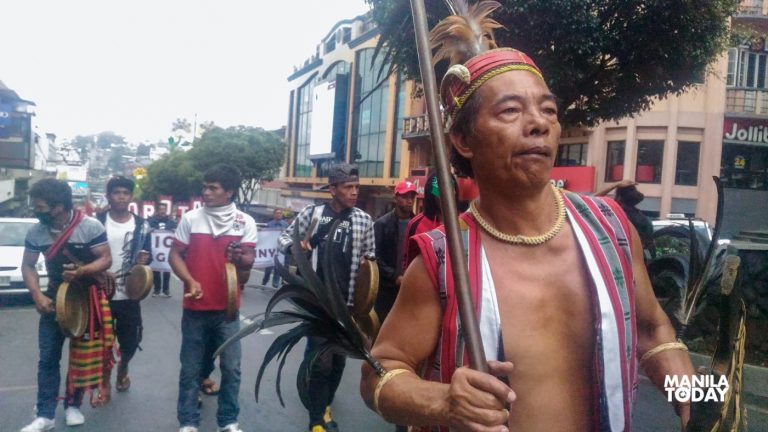
Indigenous group Cordillera Peoples Alliance (CPA) and other progressive organizations marched along Baguio’s main streets in commemoration of the 34th Cordillera Day on April 22-25.
With the central call ‘Agkaykaysa a Rupaken Ti Titaniya! Ilaban Ti Karbengan Iti Bukod a Pangngeddeng! (‘Unite to Resist Tyranny! Assert Our Right to Self-determination!), Cordillera leaders held forums aiming to confront the “US- Duterte regime’s tyranny and fascism which worsens the national oppression of Indigenous Peoples (IP) and Moro people”. They ardently condemned the state’s “numerous violations of their right to ancestral land and self-determination”.


Photos by Kevin Paul Aguayon
Intensified human rights violations
According to CPA, there is an increasing number of human rights violations against rights defenders. They cited the case of five women activists in the region that were slapped with trumped-up chargers; the extrajudicial killung of Ifugao environment advocate Ricardo Mayumi; several harassment incidents; and surveillance. There are also cases of bombings of communities and military encampment in indigenous peoples’ communities
“The situation in the Cordillera is no different from other regions in the country. De facto martial law is upon the Cordillera with the intensified militarization,” said Windel Bolinget, CPA chaiperson.
They also cited military operations and offensives of the 81st Infantry Battalion (IB), 24th IB, 54th IB, 77th Cadre Infantry Battalion under the Philippines Army’s 5th and 7th Infantry Divisions (ID) in their region. According to the group, military encampment and operations sow fear and terror in communities.
“The 81st IB is in fact actively filing trumped-up chargers against local human rights defenders. One recent attack is the terror tag by the Department of Justice through the petition to proscribe the CPP-NPA (Communist Party of the Philippines and New Peoples Army) as terrorist groups.
To date, the state’s counter-insirgency program Oplan Kapayapaan has resulted in attacks against legitimate political dissenters, resulting in over 700 extrajudicial killings cases of indigenous peoples and peasants and nearly half a million victims of bombings, threats, forced evacuations, intimidation and political persecution of activities.
Cordillera as resource-base of economic plunder
According to CPA, there are presently 102 pending mining applications covering 649, 230 hectares, the largest of which is from the CEXCI (Cordillera Exploration Company Inc.) The company is a subsidiary of multinational company Nickel Asia. CEXCI joins top mining companies Lepanto, Philex, and Benguet Corporation.
Further, in the energy front, both local and multinational companies Hedcor, SN Aboitiz, First Gen, Chevron, Pan Pacific Renewable Power Philippines, San Lorenzo, Asia Pacific and Quadriver threaten their rivers and mountains with destructive hydropower and geothermal projects.
The group also protests the Chinese loan to build the Chico River Irrigation Project that is reminiscent of the World Bank-funded Chico Dam project during the Marcos dictatorship.
“We condemn the National Commission on Indigenous People (NCIP) that remains instrumental in facilitating the entry of these destructive projects,” Bolinget said.
He added that the NCIP must be abolished for the reason that they are manipulated and corrupted the Free, Prior, and Informed (FPIC) of communities and for having done nothing about the extrajudicial killings, forced displacement of militarized indigenous communities, and attacks against IP and human rights defenders.
CPA group also criticized the House Bill (HB) 5343 also known as An Act Establishing the Autonomous Region of the Cordillera, filed in the 17th Congress last 2017.
“The HB are continuing efforts of the state at bogus regional autonomy, compounded by the regime’s push for federalism,” he said.
Bolinget expressed that they are firm in their position on Genuine Regional Autonomy (GRA) predicated on the genuine respect of their collective right to ancestral lands and self-determination within a truly democratic and sovereign Philippines.
They also deplore their position on Charter Change which, for them, further consolidates the administration’s tyrannical rule that will worsen national oppression of IP and the over-all violation of people’s rights, national freedom, democracy and will intensify plunder and exploitation of ancestral lands.
“False promises of wealth and pro-people governance are being harped by the proponents of federalism while in truth are giving way for political dynasties and big local bureaucrats to further entrench and consolidate their power,” Bolinget disclosed.
Cordillera Day is annually commemorated for the martyrdom of staunch Cordillera leader Ama Macliing Dulag who was killed by government soldiers on April 24, 1980.
The post IPs celebrate 34th Cordillera Day vs tyranny appeared first on Manila Today.
Investors organize 1st branch in Davao
The Filipino Inventors Society, Inc. (FIS) has launched its Davao-Mindanao Chapter.
Beleaguered Salmonan residents ask PCUP, Pres. Duterte to stop demolition
As the Holy Week of Ramadan is fast approaching, Moro residents of the contested land in Barangay 26-C Salmonan here appealed to President Rodrigo Duterte to halt the demolition.
Ang pamamaril sa mga magsasaka ng Sto Domingo, Nueva Ecija
Ni Jek Alcaraz, Radyo Natin-Guimba Nagko-cover ako ng kilos protesta ng mga magsasaka sa Baloc, Sto Domingo, Nueva Ecija noong Miyerkules, Abril 25. Umaga pa lang, mga 9 am, nasa munisipyo na ako para i-cover ang pakikipagharap ng mga magsasaka sa mayor ng Sto. Domingo at hepe ng pulisya. Inireklamo nila ang gabi-gabing pagpapaputok ng baril […]