Home Blog Page 706

Leloy McCarthy

Since US President Donald Trump’s visit in early November, Philippine President Rodrigo Duterte has escalated his government’s attacks against the Philippine Left, whose support he tried to court in his 2016 presidential bid and the early part of his presidency. Indications show that he is unleashing the dirty tactics of his notorious “war on drugs” – a class war on the poor which has killed more than 10,000 suspected drug addicts and pushers – against the Left, the most vocal critic of his drug war and other policies.

It is in this context that academic and historian Lisandro “Leloy” E. Claudio discussed what he called “Responsible Anti-Communism” in his recent column. By “Communist,” he is rightly referring to the underground Communist Party of the Philippines which leads the National Democratic Front of the Philippines and the New People’s Army. In his column, he echoes Duterte and revives McCarthyist tactics in insisting that the label “Communist” should also refer to legal organizations being tagged as the CPP’s “legal fronts.”

The past few days saw tarpaulin banners calling the CPP, NPA and NDF “terrorist” proliferating along major thoroughfares in Metro Manila. This is part of a concerted effort to try to condition the public for more attacks against the said groups, as well as legal activist organizations. On social media, especially among the educated middle classes, Claudio’s most recent column functions as the counterpart of those tarpaulin banners.

For Claudio, “responsible anti-Communism” means being firmly against Communists but standing up for their human rights against the State’s attacks. It means harshly criticizing Communists while taking a stand against their “extermination” and the violation of their rights by the government.

He states only one reason for upholding Communists’ human rights: that “responsible anti-Communists” should not “sink to the level of the bloody dictators that [Communists] idolize.” This reason is most flimsy because he accuses “Communist dictators” in other countries of killing millions of people. Surely, “responsible” Filipino anti-Communists cannot sink that low, even if they support the killing of many Filipino Communists.

More importantly, his essay expounds on anti-Communism – on the supposed “bloody history” of Communism, which has been used to try to justify the killing and suppression of Communists and suspected Communists – more lengthily than on defending Communists’ human rights. Out of his 18 paragraphs, only three discussed upholding the human rights of Communists.

He may be on record opposing the killings and violation of Communists’ human rights, but he does more to incite the State to carry out such killings and human-rights violations. His essay is a thinly-veiled, or thinly-sugarcoated, death wish on Communists. He wants to hate on Communists, but he wants a clean conscience, too.

And Claudio is not unaware of the immediate context of his column: he cites Duterte’s cancellation of the peace talks with the NDFP and declaration that the CPP and NPA are “terrorist organizations.” He knows that the latter “augurs violence” and “can trigger repression reminiscent of the butcher Jovito Palparan.” (sic)

Despite his earnest posturing, he deserves no peace of mind. Make no mistake about it: distributed among top military officials, his essay will inspire them to kill and repress Communists, not respect the latter’s human rights.

Claudio tries to make his doctrine sound newfangled but it comes across as a poorly executed application of some US manual for Cold War propaganda. He says Communism is a “violent ideology” with a “bloody history,” that Communist leaders are “mass murderers” and “bloody dictators,” and so on and so forth. It comes as no surprise that he at some point would equate Communism with Nazism itself.

Nazism, however, aimed to elevate a group of people, the Germans, through a “reckoning” with, or elimination of, Jews and other people deemed inferior. It is, in its essential principles, violent. Communism, however, aims at the elimination of private property – from which monopoly of the means of production and therefore class division and exploitation spring. It recognizes the need for the violence of the oppressed classes in response to the violent defense of private property by the ruling classes led by the bourgeoisie and monopoly bourgeoisie. And the latter has never ceased being violent.

That means that violence for Communists is not directed at the working classes and the people. As Bertolt Brecht says in his “In Praise of Communism” [1932]: “It’s sensible / anyone can understand it / It’s easy. / You’re not an exploiter, / so you can grasp it.” When it comes to class, interest trumps ideas; the ruling classes cannot be convinced to surrender their wealth and power, their monopoly of the means of production and State power.

This does not, however, mean that violence will be used wholesale against all members of the ruling classes, either. Only people who will use violence against the revolution will be themselves targeted for violence. It is worth remembering that Pu-Yi, China’s last emperor, was later on recruited as a member of the Chinese Communist Party after the latter came into power.

The equation of Communism with Nazism and their presentation as enemies of democracy are common themes in anti-Communist thought. These are also present in “Duterismo, Maoismo, Nasyonalismo,” the essay contributed by Claudio and his mentor, the academic and historian Patricio N. Abinales, to the recently-published A Duterte Reader [2017]. They even applied this schema to the country’s experience with Martial Law, depicting the CPP and Ferdinand Marcos as both enemies of the country’s “liberal democracy.”

Claudio and Abinales present themselves as historians but are ahistorical, even anti-historical, when analyzing Communism, Nazism, and so-called democracy. To use an old-fashioned vocabulary, they fixate on the synchronic (the supposed general and common characteristics of Communism and Nazism) to the detriment of the diachronic (how Communism and Nazism emerged and interacted with each other in history). They embrace the simple-minded equation between two political philosophies which are seen as justifications for dictatorial rule.

Before Communism and Nazism, however, there was so-called democracy, which actually rests on the economic bedrock of capitalism and later on imperialism. It is the exploitation, poverty, hunger, wars, deaths and destruction caused by capitalism-imperialism which gave birth to Communism and hastened the latter’s increase in strength. It is also imperialism that bred fascism and Nazism, and it used the latter to try to destroy Communism.

In War and Revolution: Rethinking the Twentieth Century [2015] and other works, the intellectual Domenico Losurdo, who actually does historical research, provides many bases for this reading. He showed how the major imperialist countries of the 20th century supported the rise of fascism in Europe and Nazism in Germany, and how they hated Communism more than Nazism. How Germany’s concentration camps and other repressive measures drew inspiration not from Bolshevik Russia, but from European and American colonialism. How Nazism saw itself as an enemy of what it called “Judeo-Bolshevik conspiracy” – and for good reason, because Communism was animating and supporting the struggles of what Nazis called “inferior nations.”

Anti-Communists like Claudio and Abinales love to cite the Hitler-Stalin pact, or the German-Soviet Non-aggression Pact of 1939 as proof of the supposed blood ties between Communism and Nazism. The truth is that the Soviet government led by Stalin, hated by imperialist governments friendly to the Nazi regime, had to try to split its enemies. It tried to buy time in order to prepare for Nazi Germany’s inevitable and impending attack. And its tactical gamble paid off: when Germany attacked the Soviet Union in 1941, the latter was more prepared. It was the Soviet Union, not the US or any European country, which defeated Hitler’s army, at the cost of millions of lives.

The same schema is also true in the case of the Philippines. The crisis of the semi-colonial and semi-feudal system and its elite democracy helped the local Communist movement to grow. Marcos’ Martial Law, also a spawn of that system, was an attempt to weaken and destroy that movement – and it is that movement which sustained and led the struggle against Martial Law. It is no less than historical revisionism to depict Marcos and the CPP as engaged in some conspiracy against “liberal democracy” in the Philippines, the existence of which also needs further proof.

Instead of criticizing the fascism of the US-backed Duterte regime, Claudio chose to highlight the “bloody history” of Communists, the regime’s target. Beyond his essay’s “timing,” however, the greater problem lies in his one-sided and ahistorical understanding of killings supposedly done in the name of Communism. One-sided: he did not at least study how Communists and even some academic historians explain these deaths and instead simply parroted the US Cold War line on these. Ahistorical: he did not locate these supposed crimes and excesses in their proper historical contexts.

First, he fails to situate the struggles for Communism that he cites in the context of underdevelopment, people’s suffering and war. Second, he also fails to situate governments adhering to Communism in the context of the state of siege imposed by the US and other Western powers through wars, embargo, sabotage, and other measures. Imperialist policy on Communist governments is reflected by the order of then-US Secretary of State Henry Kissinger to weaken the democratically-elected socialist government of Salvador Allende in Chile in the early 1970s: “Make the economy scream.”

Let us be clear: these contexts do not excuse the deaths that occurred under the name of Communism, but they provide a better understanding of these. There were deaths that were committed by Communists in error, but it would be erroneous to remove all deaths in the Communist movement and Communist-inspired governments from their historical contexts and present them as evils of Communism.

Third, Claudio fails to recognize how Communist movements drew lessons and learned from errors committed in the past that resulted in the death of many. Fourth, if the number of deaths caused by a political and economic system is the standard by which it should be measured, then Claudio should have examined the immensely more numerous killings committed in the name of “liberal democracy” and imperialism – which include those who were killed in many a bloody anti-Communist campaign. Alas, Claudio always prefers the caudillo over the cadre.

He cites Robert Francis Garcia’s book To Suffer Thy Comrades [2001] as proof that local Communists are also murderous. The fact that the killings discussed in the book were committed in a small fraction of the Philippine Left’s more than 50-year history shows that the context of those killings is important.

Again, Claudio does not present that context: military adventurist errors committed by the NPA, heightened government intelligence and attacks, and errors in the NPA’s handling of alleged infiltrators. The fact that the said errors have not been repeated is proof that such killings are not integral to the principles of Communism. It is also proof that local Communists can sum up their experiences, correctly derive lessons from these, and hold on to those lessons in practice.

When Claudio says “It is the moral obligation of the historian in the Philippines to speak about Communism’s bloody history,” he wants that history extracted from its wider historical context. He refuses to study and engage with the best explanations that Communism has to offer for its own history, instead contenting himself with US Cold War propaganda.

It is telling that Claudio claims that Communism’s central principle is “from each according to his abilities, to each according to his needs.” This is central, but secondary to the abolition of private property. He betrays his failure to study Communism itself – in fact, its basic text, The Communist Manifesto – and his reliance on ready-made Cold War propaganda.

It is uncanny that Claudio speaks in terms of “moral obligation” when in the same essay he joins the chorus of the government and the military in tagging legal progressive organizations as “Communist fronts.” The government and the military will not listen to his faint appeals for Communists’ human rights, but their repressive campaign – already in motion carried out by dominant forces in society – will benefit from his demonization of Communists and alleged Communist fronts. It seems that for Claudio, historians and academics also have the moral obligation to lend a hand to the government and the military’s drive to kill and suppress suspected Communists.

Claudio always speaks with the arrogance of someone who thinks that he stands for democracy while his enemies, the Communists, stand for dictatorship. He even calls the CPP a “dictatorial organization.”

The strict equation that Claudio makes between democracy and liberal democracy exposes his ignorance. Wendy Brown clarifies: “liberal democracy, Euro-Atlantic modernity’s dominant form, is only one variant of the sharing of political power connoted by the venerable Greek term. Demos + cracy = rule of the people and contrasts with aristocracy, oligarchy, tyranny, and also with a condition of being colonized or occupied… The term carries a simple and purely political claim that the people rule themselves, that the whole rather than the part or an Other is politically sovereign [“We are all democrats now…,” 2011].

More importantly, in class societies, “Democracy and dictatorship are two sides of a coin,” said Francisco Nemenzo, Jr. [“Questioning Marx, Critiquing Marxism,” 1992]. In capitalist democracies, the democracy enjoyed by big capitalists is imposed as a dictatorship on workers and the people, whose only democratic participation is voting during elections. Socialist democracy is the dictatorship of the proletariat imposed on the big bourgeoisie, and since it is enjoyed by the majority beyond regular elections, it is a democracy that is deeper and more real.

In the end, Claudio’s anti-Communism coheres with the strategy summarized by American Marxist Fredric Jameson: “The substitution of politics for economics was always a key move in the hegemonic struggle against Marxism (as in the substitution of questions of freedom for those of exploitation) [“Sartre’s Critique, Volume 2: An Introduction,” 2009].”

Instead of fighting to change the exploitative, unequal, unjust and violent ruling system, anti-Communists like Claudio fight the very Communists who are risking life and limb for such change – using Communism’s “bloody history” as bogeyman. In more arrogant moments in his essays and social media posts, Claudio celebrates US influence over the country, the Philippines’ “liberal democracy,” and the Yellow faction of the ruling classes.

It is in this precise sense – anti-Communism defending the status quo and attacking those who want genuine change – that we can say: anti-Communism can never be responsible. It is always irresponsible. So are the academics and historians that peddle it.

14 December 2017

Featured image: From ‘Agraryo Marksismo’ by Federico Boyd Dominguez

Para sa Mabuting Anak


(para kay Jo Lapira at sa lahat ng mga kasamang napaslang)

Ipinagluluksa kita, anak, ipinagluluksa kita.
Ipinagluluksa’t ikinararangal,
pagkat mabuting supling ng bayan.

Inihahabilin kita kay Mebuyan, diyosa ng mga Bagobo,
diyosang maraming suso,
tagapagkalinga ng mga sanggol
na sa gatas ay gutom.
Inihahabilin kita, anak, pagkat sa maaga mong pagyao,
nais kong may ina rin na maghahatid sa iyo
sa dako pa roon, may tatanggap
sa katawan mong duguan, at may itim na ilog na maghuhugas,
sa iyong mga sugat.

Ipinagluluksa kita, anak, ipinagluluksa kita.
Ipinagluluksa’t hinahangaan,
ang iyong husay, ang iyong tapang.
Ang prinsipyong buong-buo mong niyapos,
Ang buhay na inihandog, sa lubos-lubusang paglilingkod.

Sa gitna ng hinagpis, sa ibang bahagi ng mito ako bumabalik.
Si Mebuyan, nagngangalit.
Niyuyugyog niya ang puno, hanggang ang mga bunga
ay mahulog sa lupa.
Itinuturo nito sa ating lahat,
na ano man ang ibanta ng pasista,
ano man sa atin ang ibansag o isumbat,
Hindi tayo kailaman, kailanman maduduwag.

Ipinagtitirik ka namin, naming lahat ng kandila,
at inuulit-ulit ang iyong ngalan at aming pagpugay
sapagkat walang kasama na nabubuwal nang mag-isa.
Anak ka na hindi ako ang nagluwal,
Ngunit wala sa dugo ang pagkamagulang.
Higit pa sa tali sa pusod ang sa atin ay nagbibigkis.
Supling kita, mahal kong kasama’t, kapanalig.
pagkat naging katuwang, sa ating himagsik.


Joi Barrios-Leblanc, BAYAN Women’s Desk
Ika-7 ng Disyembre, 2017

Batas militar, ikalawang kabanata

Matapos ang isang taon at limang buwan, mistulang nasa sukdulan na ang kalagayan ng mga Pilipino sa ilalim ng pamumuno ng “pasistang” presidente na si Rodrigo Duterte.

Mula sa presidenteng nagsasabing may malasakit siya sa mga mamamayan at bukas ang isipan sa progresibong mga reporma, ang Pilipinas ngayo’y pinamumunuan ng lider na itinuturing na pasista at diktador na tumalikod sa pangangailangan ng mga mamamayan upang mapagbigyan ang interes ng iilan.

Kung tutuusin, simula’t sapul, ayon sa grupong pangkarapatang pantao na Karapatan, nariyan na ang senyales ng pasistang tunguhin ng rehimen: ang madugong giyera kontra droga, at pagpapatuloy ng programang kontra insurhensiya ng nakaraang mga rehimen.

Bago pa man ikansela ang usapang pangkapayapaan, ilang paglabag na sa karapatan pantao ang naganap magmula sa hindi makaturang pag-aresto at ilang mga pagpatay ang naitala ng Karapatan. Umigting ito noong tuluyan nang ianunsiyo na wala nang usapang sa pagitan ng National Democratic Front of the Philippines (NDFP) at ng gobyerno ng Pilipinas at itinuturing na raw ng gobyerno na “terorista” ang New People’s Army (NPA) at Communist Party of the Philippines (CPP).

Batay sa mga aksiyong ito ni Duterte, para sa mga progresibo, tuluyan nang namili ang pangulo kung saang panig, kung kaninong alyado at kung anong bihis ang ipapakita nito. At malinaw sa kanila na hindi ito para sa mga mamamayang Pilipno.

Masaker sa masa

Umpisa pa lang ng termino ni Duterte, dugo na ang bumalot sa mga eskinita at kakalsadahan sa Pilipinas dahil sa kanyang Oplan Tokhang sa pangunguna ng Philippine National Police (PNP).

Naging talamak sa programang giyera kontra droga ang brutal na pagpaslang sa maraming pinaghihinalaang tulak at gumagamit ng droga ng ilang kapulisan at di-kilalang armadong indibidwal.

Sa tantiya ng Karapatan, mula 4,000 hanggang 14,000 na ang naiulat na biktima ng giyerang ito.

Hindi rin nakaligtas ang maraming kabataan sa kalupitan ng giyerang ipinapatupad ng gobyerno. Base sa pagsusubaybay ng Children’s Rehabilitation Center (CRC), higit na sa 31 kabataan ang napapaslang kaugnay ng isinasagawang operasyon ng kapulisan.

Sina Kian delos Santos,17, Carl Arnaiz, 19, at Reynaldo de Guzman, 14, ay ilan lang sa kabataang brutal na pinaslang ng kapulisan. Sa kabila ng matibay na mga ebidensiya na nagpapatunay laban sa PNP, patuloy pa rin ang brutal na pagpaslang sa mga biktima.

Pampulitikang pamamaslang

Nitong Dis. 3, muling nagimbal ang madla sa balita: Patay ang isang pari matapos itong pagbabarilin ng hindi pa nakikilang indibidwal sa Jaen, Nueva Ecija.

Napagalamang dating pari ng Guimba at coordinator ng Rural Missionaries of the Philippines sa Gitnang Luzon na si Fr. Marcelito “Tito” Paez ang biktima ng nasabing pamamaril. Bandang alas-otso ng gabi nang pagbabarilin si Fr. Paez sa kanyang sasakyan. Naisugod pa ito sa ospital ng San Leonardo ngunit kalauna’y binawian rin ng buhay.

Ayon sa Karapatan, tumulong pala ito sa pagpapalaya ng bilanggong pulitikal at organisador ng magsasaka na si Rommel Tucay.

Samantala, isang araw bago paslangin si Fr, Paez, patay rin sa pamamril ang isang pastor na si Lovelito Quiñones, 57, habang pauwi ito sa kanilang tahanan. Hinihinalang elemento ng Regional Mobile Group (RMG) na noo’y nakikipagsagupaan sa NPA ang pumaslang sa pastor. Pinagbibintangan ng 203rd Brigade ng Army na miyembro ng NPA si Quiñones. Agad naman itong pinasinungalingan ng pamilya ng biktima.

Samantala, hindi rin nakaligtas sa mainit na gatik ng gatilyo ang maraming magsasaka at ilang tagapagtanggol ng karapatang pantao.

Nitong pagpasok ng Nobyembre, sunud-sunod ang pagpaslang sa mga lider-magsasaka ng ilang elemento ng militar at di-kilalang mga indibidwal. Halos lahat ng biktima’y pinaghihinalaang miyembro ng NPA, kundi man sumusuporta sa mga ito.

Tumataas din ang bilang ng mga bilanggong pulitikal sa bansa. Ayon sa Karapatan, higit 121 na ang inaaresto sa ilalim ng administrasyong Duterte dahil sa gawa-gawang mga kaso. Sa kabuuan, mayroon nang 449 na mga bilanggong pulitikal. Kabilang sa kanila ang matatanda, may sakit at mga menor-de-edad.

Sukdulan na rin ang kinakaharap ng maraming katutubong Lumad sa Mindanao. Lumala na ang militarisayong nagaganap sa kanilang lugar na naging dahilan upang muling magbakwit nila. Dumadanas din sila ng pandarahas sa mga militar at maging ang mga donasyong bigas at pagkain ay hindi hinayaang makaabot sa mga bakwit.

Nitong huling dalawang linggo, lalong tumindi ang mga atake. Dis. 3, pinagbabaril ang walong katutubong T’boli at Dulangan na pawang mga magsasaka ng pinaghihinalaang mga miyembro ng 27th at 33rd Infantry Battalion ng Army sa probinsiya ng Saranggani.

Bandang ala-una ng hapon, dapat sana’y mag-aani ng kanilang mga pananim ang mga Lumad nang pagbabarilin sila. Kinilala ang mga nasawi na sina Victor Danyan, Victor Danyan, Jr., Artemio Danyan, Pato Celardo, Samuel Angkoy,To Diamante, at Bobot Lagase, Matend Bantal. Samantalang sina pawang sugatan naman sina Luben Laod at Teteng Laod. Kabilang ang mga napaslang sa grupong lumalaban para sa kanilang lupang ninuno na inagaw ng kompanyang Consunji/DMCI sa mahabang panahon.

Nagsimula na ring magbakwit ang ilang B’laan (Lumad) mula sa ilang barangay sa Saranggani dahil sa walang humpay na pag-atake ng mga militar. Tinatayang nasa 210 na pamilya ang nagbakwit.

“Hindi nila pinapayagang makapasok ang mga pagkain mula sa ilang nagbibigay-tulong kahit kasama namin ang ilang opisyal ng gobyerno. Hindi rin nila pinapayagang makapasok ang mga estudyante at guro sa kanilang lugar kung saan matatagpuan ang evacuation center,” ani Chad Booc, boluntaryong guro ng Alternative Learning Center for Agricultural and Livelihood Development Inc. o Alcadev sa Surigao del Sur.

Samantala, sa kabila ng paghupa ng labanan sa Marawi sa pagitan ng gobyerno at sinasabing mga miyembro ng grupong Maute, nananatiling nawawala ang libu-libong residente—hindi matukoy kung lumipat sila sa ibang lugar o nasawi sa mga pagbomba at labanan.

Palit-kulay

Sa maikling panahon ng panunungkulan, mabilis na nagpalit kulay ang dating administrasyong Duterte. Mula sa ultimo’y kulay puti dahil sa magagandang pangako para sa bayan, biglaang bumuhos ng mala-dugong kulay sa kalsada, bukid at kabundukan.

Ang mga sunud-sunod na hindi magagandang pangyayari sa hanay ng katutubo, magsasaka, at maralitang lungsod ay naghudyat ng pagkaalarma ng ilang grupo lalo na’t nakaamba ang pagpapahaba ng basta militar sa Mindanao at pagpapalawak ng implementasyon nito sa buong bansa.

Sa pagdeklara rin ni Duterte na mga “terorista” na ang mga nagrerebolusyong kasapi ng CPP-NPA-NDF, pinangangambahan ang pagtindi ng mga atake sa mga sibilyang komunidad at indibidwal. Samantala, sa pagdeklara rin ng Pangulo ng crackdown sa legal at sibilyang mga organisasyong masa, mistulang tumtutungo na ang bansa sa mala-batas militar na hayagang pagsupil sa karapatan ng mga mamamayan.

“Maraming aktibista, progresibong organisasyon, at mga target na komunidad ay alam ang brutal at mapangabusong kakayahan ng Estado, at at kami ay nangangamba na rito,” ani Cristina Palabay, pangkalahatang kalihim ng Karapatan.

Pero ipinapakita ng karanasan ng bansa sa batas militar noon na sa harap ng mga panunupil ay lalakas lamang ang kilusang masa, lalakas lamang ang boses ng mga mamamayan na gumigiit ng pambansang kalayaan at demokrasya.


The Shoot-in-the-Vagina Order is a Macho-fascist Lecherous Inanity Without Balls – NUPL Women Lawyers

NUPL News Release | 13 February 2018

Women members of the National Union of Peoples’ Lawyers (NUPL), joined by their male colleagues, called the latest tirade of President Duterte addressing his soldiers to shoot female NPA rebels in their vaginas as a “vicious, violent and vile attack against all Filipino women by a macho-fascist President who has no balls to address the root causes of poverty and the fundamental problems of the country.”

In a strongly-worded statement, the women human rights advocates further stated that instead of properly addressing the basic ills confronting the nation, “the President has descended to a lowlife when he shoots his mouth but cowardly hides behind his army and his police to cover up the fact that his promise of real fundamental change has failed miserably.”

The women lawyers of NUPL likewise warned that the President’s statement “incites and legitimizes violence against women and is an open invitation and license to perpetrate intensified human rights violations against women – whether civilians or combatants – in complete derogation and violation of local and international laws.”

It is also a grave violation of international humanitarian law as it affords impunity to military forces in brazen contempt of established rules of war including its principles of necessity, proportionality and distinction.

The subsequent “public reminder” by his fellow pseudo macho Atty. Harry Roque saying that the recent chauvinist order should not be taken “literally” but has to be taken “seriously” only proves that the man in Malacanang is a misogynist human rights violator rolled into one.

We hark back on the President, as a colleague in the legal profession, that it is a basic rule, so basic even a struggling freshman in lawschool would already know, to protect lives, human rights and dignity, be it in times of peace or war.

To order state security forces to take this bigoted order from the Palace “seriously” would definitely lead to a tidal wave of state-sponsored abuses and violence against women.

History has taught us that misogynist leaders who act, speak and act like god-kings eventually get emasculated and deserve their comeuppance. ###

Women’s Committee
National Union of Peoples’Lawyers (NUPL)

Atty. Geobelyn Lopez-Beraye | Atty. Maria Kristina Conti | Atty. Josalee Deinla | Atty. Cris Azarcon-Heredia | Atty.Minnie Lopez | Atty. Kathy Panguban | Rea Penol | Atty. Cathy Salucon | Atty. Sylvia Patricia DC. Sarmiento | Grace Saguinsin | Atty. Maria Sol Taule | Atty.Sarah Villamor | Atty. Maria Cristina P. Yambot | and many others

Reference:

Atty. Kathy Panguban
NUPL National Office
‭+63 977 733 6961‬

Atty. Maria Kristina Conti
NUPL NCR Chapter
‭+63 929 820 7000‬

Atty. Maria Cristina P. Yambot
NUPL PIO/Spokesperson
+63 917 847 0301

Ombudsman dismisses Gwen Garcia

0

THE Office of the Ombudsman ordered the dismissal of House Deputy Speaker Gwen over the purchase of the 24.9-hectare Balili property in 2008 and a contract to develop it in 2012.

Ombudsman Conchita Carpio Morales dismissed Garcia from public service after she found the former Cebu governor guilty of grave misconduct.

The dismissal order carries the accessory penalties of perpetual disqualification from holding public office, cancellation of eligibility and forfeiture of retirement benefits.

The ombudsman also directed House Speaker Pantaleon Alvarez to implement the dismissal order, but the latter said it would be unconstitutional to do so. Deputy Speaker Garcia also questioned the timing of the dismissal order, considering her active role in the hearing of an impeachment complaint against Supreme Court Chief Justice Maria Lourdes Sereno (See related story).

In the decision dated Jan. 15, 2018, the ombudsman ruled that Garcia couldn’t show proof that she had been authorized to enter into a contract to acquire filling materials for the former resort property.

For housing, port

On June 11, 2008, during Garcia’s second term as Cebu governor, the Province acquired the 24.92-hectare Balili property in Tinaan, Naga for P98.926 million. It was supposed to be intended for the Capitol’s housing and seaport projects.

However, an investigation showed that 19.67 hectares of the property were underwater and unsuitable either for human settlement or a port project.

In April 2014, the Court of Appeals nullified the ombudsman’s decision that found Garcia liable for an administrative case of grave misconduct.

It pointed out that Garcia’s reelection as governor in 2010 meant that she couldn’t face any administrative liability for the 2008 purchase.

Filling materials

In April 2012, the Cebu Provincial Government conducted a public bidding “for the supply and delivery of back-filling materials and other incidentals of its submerged and mangrove portions.”

The Capitol eventually awarded the contract to Supreme ABF Construction, whose price was P248.75/cubic meter.

Records from the provincial treasurer showed the Provincial Government released a total of P24,468,927.66 to the winning contractor.

But the anti-graft office said that Garcia had no authority from the Provincial Board when she entered into contracts with Supreme ABF Construction.

Allocation, not authority

“While this office finds merit on her assertion that the P50-million allotment for the airport/seaport and other economic enterprise site development program was a valid source of appropriation for the Balili project, such appropriation did not validly confer authority to respondent Garcia to enter into a contract with ABF Construction for the Balili project,” read part of the decision.

The ombudsman said that Garcia violated provisions of the Administrative Code of 1987 and the Government Auditing Code.

Provincial Accountant Emmanuel Guial was also found guilty of simple neglect of duty for certifying documents for disbursement vouchers despite the lack of authority from the Provincial Board.

The ombudsman suspended Guial for three months without pay. If he has left office, the punishment shall be converted into a fine equivalent to Guial’s salary for three months.

The ombudsman dismissed for want of evidence the administrative cases against Bids and Awards Committee chairperson Marivic Garces; vice chairperson Bernard Calderon; members Manuel Purog, Emme Gingoyon, Ma. Junelene Arenas, Cristina Giango, Rosalinda Jao; and acting provincial treasurer Roy Salubre.

8 areas under signal no. 2 due to Tropical Storm Basyang

0

More than two dozen other areas are also under signal no. 1 as Basyang (Sanba) approaches Mindanao

Published 11:35 PM, February 12, 2018

Updated 11:35 PM, February 12, 2018

What’s the weather like in your area? Report the situation through Rappler’s Agos or tweet us at @rapplerdotcom.

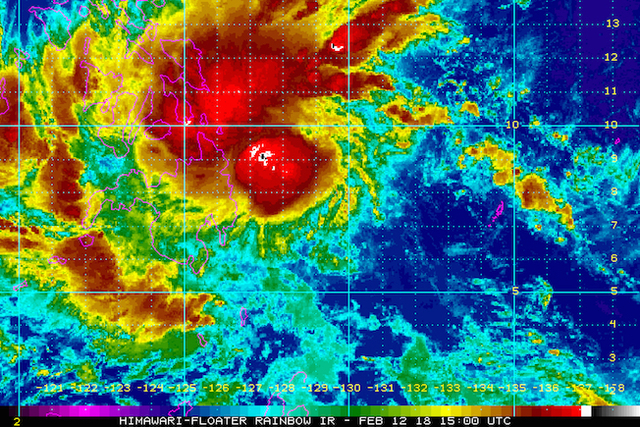
Satellite image as of February 12, 11 pm. Image courtesy of NOAA

Satellite image as of February 12, 11 pm. Image courtesy of NOAA

MANILA, Philippines – Tropical Storm Basyang (Sanba) maintained its speed and direction late Monday evening, February 12, as it continued to head for the northeastern part of Mindanao.

In a bulletin issued 11 pm on Monday, state weather bureau PAGASA said Basyang is already 300 kilometers east southeast of Hinatuan, Surigao del Sur, moving west northwest at 25 kilometers per hour (km/h).

The tropical storm continues to have maximum winds of 65 km/h and gustiness of up to 80 km/h. In a news briefing late Monday morning, PAGASA had said it is unlikely that Basyang would intensify further into a severe tropical storm.

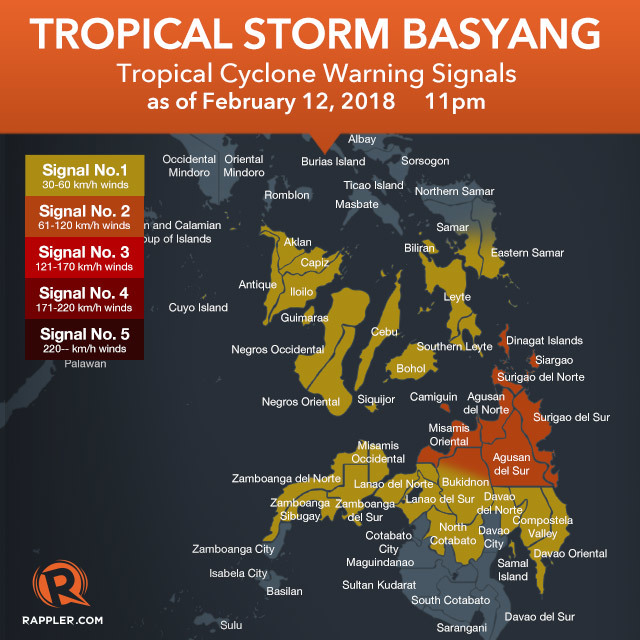
Signal number 2 is now raised in:

  • Dinagat Islands
  • Surigao del Sur
  • Surigao del Norte
  • Agusan del Sur
  • Agusan del Norte
  • Camiguin
  • Misamis Oriental
  • northern part of Bukidnon

Signal number 1, meanwhile, is up over:

  • Cuyo Island
  • Aklan
  • Capiz
  • Antique
  • Iloilo
  • Guimaras
  • Negros Occidental
  • Negros Oriental
  • Siquijor
  • Bohol
  • Cebu
  • Leyte
  • Southern Leyte
  • Biliran
  • southern part of Samar
  • southern part of Eastern Samar
  • Zamboanga del Norte
  • Zamboanga del Sur
  • Zamboanga Sibugay
  • Misamis Occidental
  • Lanao del Norte
  • Lanao del Sur
  • southern part of Bukidnon
  • North Cotabato
  • Compostela Valley
  • Davao del Norte
  • Davao Oriental

PAGASA warned areas under signal number 1 and 2 to expect moderate to heavy rain within the next 24 hours. Residents should watch out for possible flash floods and landslides.

Basyang is expected to make landfall in Caraga on Tuesday morning, February 13. After hitting land, it will cross Caraga as well as Northern Mindanao and Palawan.

“Expected kasi na pagtama bukas (Tuesday), siguro around before noon, doon pa lang magsisimula ‘yung malalakas na ulan sa area, then within 24 hours after landfall, medyo delikado po ‘yung area ng Northern Mindanao as well as ‘yung Visayas, dahil po doon sa pagtahak niya… So ngayon pa lamang po sinasabihan na natin ‘yung mga kababayan natin sa area na sana mag-ingat, maghanda,” said PAGASA Assistant Weather Services chief Robert Sawi in the news briefing.

(We expect that when Basyang makes landfall around before noon tomorrow, that’s when heavy rain will begin in the area, then within 24 hours after landfall, the areas of Northern Mindanao and the Visayas would face risks as the tropical storm crosses… So as early as now we are telling our countrymen to be careful, to prepare.)

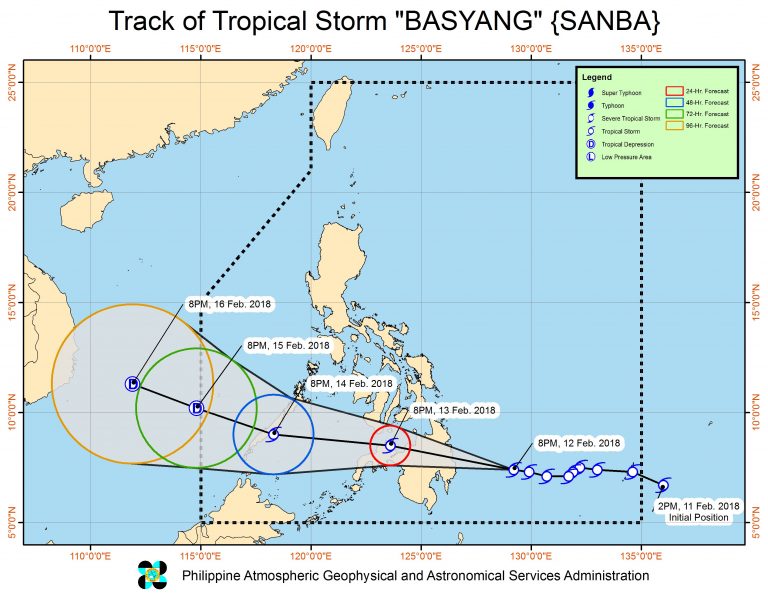
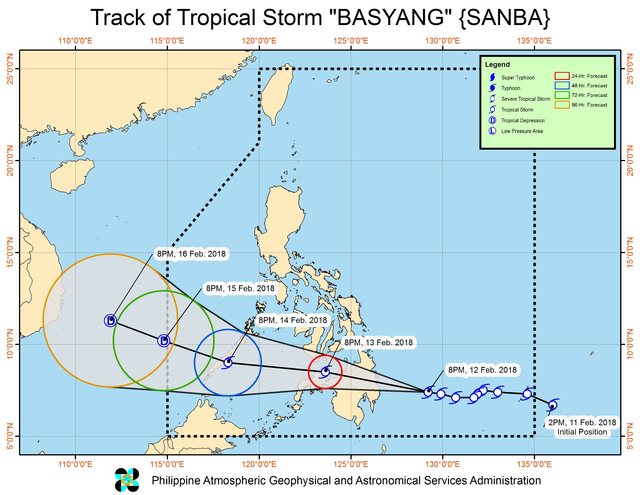
Based on its latest forecast track, Basyang will leave the Philippine Area of Responsibility (PAR) on Thursday, February 15.

Forecast track of Tropical Storm Basyang as of February 12, 11 pm. Image courtesy of PAGASA

Forecast track of Tropical Storm Basyang as of February 12, 11 pm. Image courtesy of PAGASA

Sea travel is risky in areas under signal numbers 1 and 2, the seaboards of Northern Luzon and of the Visayas, the eastern seaboards of Central Luzon, and the eastern and southern seaboards of Southern Luzon due to Basyang and the surge of the northeast monsoon.

Hundreds of passengers have been stranded in the Visayas and Mindanao, according to the Philippine Coast Guard (PCG).

Meanwhile, the northeast monsoon will continue to bring scattered rainshowers to the regions of Cagayan Valley, Cordillera, and Ilocos, as well as the provinces of Aurora and Quezon, but PAGASA said there will be “no significant impact.”

The rest of the country, including Metro Manila, will only have localized thunderstorms. (READ: FAST FACTS: Tropical cyclones, rainfall advisories)

– Rappler.com

Senate panel seeks arrest warrant vs ex-Comelec chief Bautista

0

Senate banks committee chairman Francis Escudero slams former Comelec chief Andres Bautista for repeatedly skipping hearings on his alleged ill-gotten wealth

Published 12:10 PM, February 12, 2018

Updated 1:16 PM, February 12, 2018

SUBPOENA. Former Comelec chairman Andres Bautista skips the Senate hearing on his alleged ill-gotten wealth for the 3rd time and asks the panel to recall the subpoena against him. File photo

SUBPOENA. Former Comelec chairman Andres Bautista skips the Senate hearing on his alleged ill-gotten wealth for the 3rd time and asks the panel to recall the subpoena against him. File photo

MANILA, Philippines – Senate banks committee chairman Francis Escudero is seeking an arrest warrant against former Commission on Elections (Comelec) chairman Andres Bautista for repeatedly skipping hearings on his alleged ill-gotten wealth.

On Monday, February 12, it was the 3rd time Bautista skipped a Senate hearing. He was earlier issued a subpoena to attend Monday’s hearing, but to no avail.

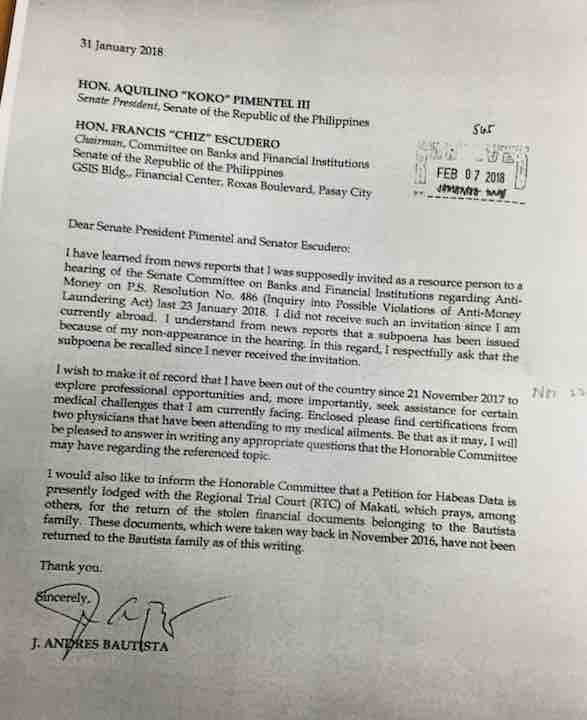
Instead, Bautista submitted a letter addressed to Senate President Aquilino Pimentel III and Escudero, claiming he never received any previous invitation from the chamber.

“I understand from news reports that a subpoena has been issued because of my non-appearance in the hearing. In this regard, I respectfully ask that the subpoena be recalled since I never received the invitation,” Bautista said in his letter.

Photo by Camille Elemia/Rappler

Photo by Camille Elemia/Rappler

Bautista told the panel that he has been abroad since November 21 last year to explore career opportunities and seek medical assistance. He said he would be open to answer the committee’s questions in writing but did not give any forwarding address.

Bautista also sent copies of two medical certificates from doctors supposedly attending to his condition.

“I wish to make it of record that I have been out of the country since 21 November 2017 to explore professional opportunities and, more importantly, seek assistance for certain medical challenges that I am currently facing,” he said.

This did not sit well with Escudero, who said Bautista is clearly trying to evade the Senate probe. He said he would ask Pimentel to sign an arrest warrant against Bautista if and when the former Comelec chief arrives in the Philippines.

“The [committee] chairman considers his non-attendance as contemptuous. If he is indeed genuine in participating, he should have at least given us an address. That he did not give any is clearly an attempt to stifle the proceedings. It is contemptuous insofar as the chair is concerned,” Escudero said.

“Magpapadala ka ba naman ng sulat na ni walang address nakalagay kung saan galing ang sulat? Tapos hihilingin mo na magpadala kami ng mga katanungan at sasagutin niya via a letter? Taliwas ito sa binibitawan niyang salita noon na haharapin niya anumang alegasyon sa kanya,” Escudero also said in an interview after the hearing.

(Why would you send a letter without stating your address? And then you’ll ask us to send questions to you so you can respond via a letter? This is contradictory to his previous statement that he would face any allegation against him.)

“You were a former Comelec chair, a former chair of a constitutional commission, ni wala kaming mahanap na legal at pormal na address sa ‘yo, ‘di naman ata normal ‘yun (but we can’t find your legal and formal address, that’s not normal),” he added.

Is Bautista really abroad?

Escudero also questioned the accuracy of Bautista’s claim that he has been abroad since November 21 last year.

Citing records from the Bureau of Immigration (BI), Escudero said Bautista’s last departure from the Philippines was on October 21, 2017. His return was on November 1, 2017.

“I direct the committee to confirm this record. As claimed by Chairman Bautista, he left November 21 but no such record appears with the BI,” Escudero said.

Escudero earlier said that the panel repeatedly sent invitations to Bautista’s 3 different addresses but to no avail. He also said that the subpoena was duly served as it was received by Bautista’s household help.

Bautista, Escudero said, would not face an arrest warrant if he signs a bank secrecy waiver with his siblings Susan Bautista-Afan and Martin Bautista. The two are his co-depositors at the Luzon Development Bank.

Meanwhile, the former Comelec chairman’s estranged wife, Patricia Paz Bautista, attended the hearing with her lawyer Lorna Kapunan.

Bautista earlier faced an impeachment complaint over allegations of his wife that he illegally amassed nearly P1 billion.

But before the complaint could prosper, Bautista resigned and was replaced by Sheriff Abas. – Rappler.com

PCSO’s 2017 revenues: P52.9B

0

34% REVENUE GROWTH NOTED

The Philippine Charity Sweepstakes Office (PCSO) collected P52.9 billion in revenues in 2017 which is a 34 percent increase as compared to the P32.5 billion revenues collected in 2016.

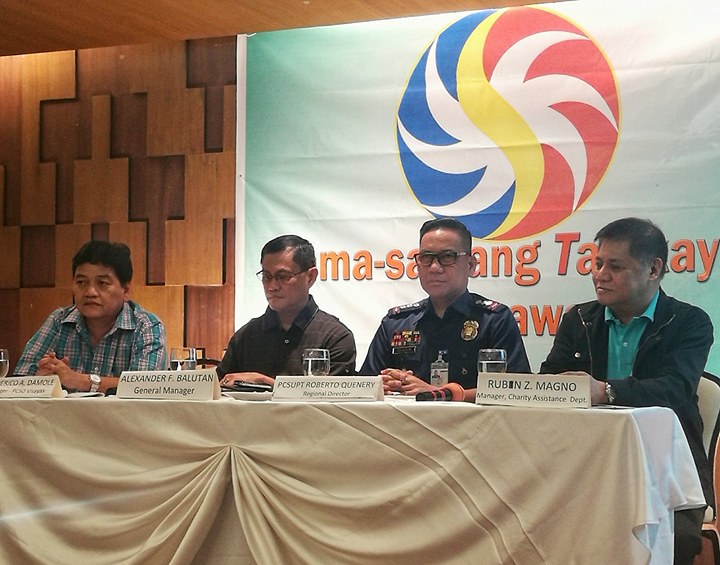
“Ito po yong pinakamalaki na generate ng PCSO,” said Jerusa Corpuz, acting PCSO Manager for Corporate Planning Department during a press briefing in Cebu City on Sunday.

Corpuz cited lotto games contributed P31.8 billion in sales or retail receipts from the 2017 revenue collections, followed by Small Town Lottery (STL) with P15.7 billion; Keno which contributed P5.3 billion, and Sweepstakes with P22.5 million.

According to the PCSO, they collected P10.8 billion in the Visayas last year from 20 Authorized Agent Corporations (AACs) for STL.

For his part, Federico Damole, PCSO Visayas Department Manager, said that STL revenues grew by 65 percent or P2.9 billion as compared to the 2016 revenue collections of only P1 billion.

Damole said that the fund, that was generated last year, had helped the medical needs of about 51,669 patients, which benefited from the P685 million distributed under the PCSO’s Medical Assistance Program (IMAP) Allocation.

“Ito po yong tulong ng opisina ng PCSO to our less fortunate members of our society coming from the different branches in the Visayas,” he said.
He added that a P3.2 million allocation was Imap’s share to be distributed to the indigent patients in the Visayas daily.

He also said that 54 ambulances, from a P42.9 million share from the PCSO fund, were distributed last year in the the Visayas regions and provinces.
Despite the higher sales collection from lottery games, PCSO General Manager Alexander Balutan said that they had still problems in deterring the prevailing illegal numbers games, whose operators would not pay taxes to the government.

“What the PCSO wants is that all (those involved in the) illegal numbers game must migrate to the legal numbers game such as STL,” Balutan said.
Meanwhile, Cebu City Police Office (CCPO) Director Joel Doria said that they had intensified their campaign against illegal gambling as part of the Executive Order No. 13 signed by President Rodrigo Duterte.

The Order states about “strengthening the fight against illegal gambling and clarifying the jurisdiction and authority of concerned agencies in the regulation and licensing of gambling and online gaming facilities,”

Based on the CPPO report, 1,853 were caught in Cebu City, between Jan. 2017 to Jan. 2018, operating illegal gambling operations.