Home Blog Page 73

Dutch missionary red-tagged and deported by Duterte gov’t returns to NL to a warm welcome from Filipino migrant workers, dutch solidarity activists and fellow countrymen

0

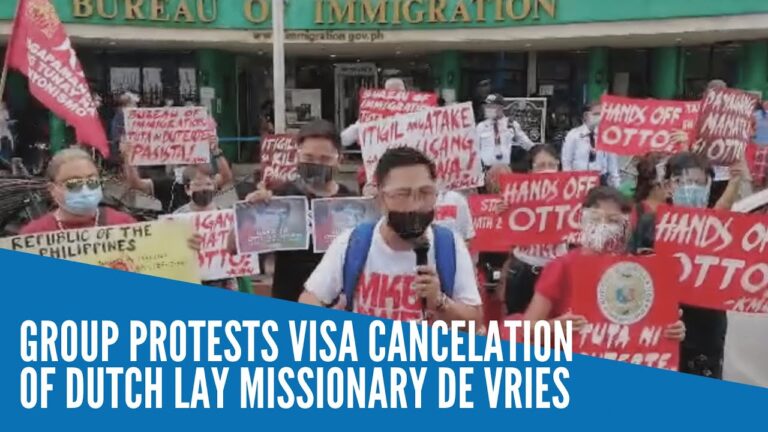
Otto de Vries, a Catholic lay missionary from the Diocese of Rotterdam, who has done pastoral work among the workers and urban poor in the Philippines for three decades, has returned to the Netherlands after being red-tagged and his permanent visa revoked by the Duterte government.

The Philippine Bureau of Immigration (BI) in February canceled de Vries’ permanent resident visa and was ordered to leave the country. The BI order, according to church colleagues, was based on the false and malicious allegations made by the National Intelligence Coordinating Agency (NICA) accusing the Dutch missionary of engaging and actively “participating in protest rallies of Communist-Terrorist Groups (CTG) front organizations.”

Upon arriving in Schiphol airport in Amsterdam, he was warmly welcomed by several Filipino migrant workers, representatives from the Dutch-Filipino Solidarity group (NFS) and Dutch friends.

“Otto is a person with a pure heart and a great compassion for the poor and workers in the cities. Labeling Otto and the institution he works for as terrorists is a desperate act of a government that is slowly becoming isolated from its people,” stated one of many warm messages of support he received upon arriving.

“Anyone can imagine how painful it must be to fall victim to red-tagging and to be forced to leave the country which has been his home for so long, where he had so many friends and where he did very valuable work for the most vulnerable for the past 30 years of his life,” said another message.

De Vries went to the Philippines in May 1991 on the invitation of the late Bishop Julio Xavier Labayen, OCD, Prelature of Infanta, to do pastoral work.

“For almost three decades Mr. Otto lived in slum areas around Metro Manila in order to immerse himself in harsh conditions of the workers and urban poor. He worked as a welder, electrician, and maintenance of a steel factory in various factories. His experience in these workshops opened his eyes to the dehumanizing circumstances of contractual workers who receive below minimum wage and work in unsafe working environments,” related Bishop Gerardo A. Alminaza, chairperson of the Church-Workers Solidarity.

“Contrary to the allegations made by NICA, organizing workers’ associations and unions and educating them about their rights and welfare does not constitute acts of terrorism,” he said in a statement released February 21, after the BI order for De Vries to leave the Philippines was made public.

Alminaza also said the 62-year old Catholic missionary from the Netherlands has “exemplified, concretized, and lived out the mission of the church to become a Church of the Poor.” 

In a statement, De Vries said: “In all those years, I regularly reported about my mission to Bishop Labayen, including the worsening situation of the workers. I continued doing so with his successor, Most Rev. Rolando J. Tria Tirona, OCD, DD, and presently with Bishop Bernardino Cruz Cortez. They have consistently stressed the importance of such a mission for the Church, not only sharing the experiences, but also the involvement with their struggle for social justice. This motivated me to continue.” (PAbrod)

LIST: Initiatives of kindness around the world during the COVID-19 pandemic

0

May 3, 2021, Hannah Dayan

Manila, Philippines

If the Philippines has community pantries, other countries have soup kitchens and food banks that have fed people during the COVID-19 crisis

People from all over the world have done what they can to address the ongoing pandemic. Some have doubled their efforts in feeding the poor through soup kitchens, while others have provided free assistance to isolated patients to help provide for their needs. 

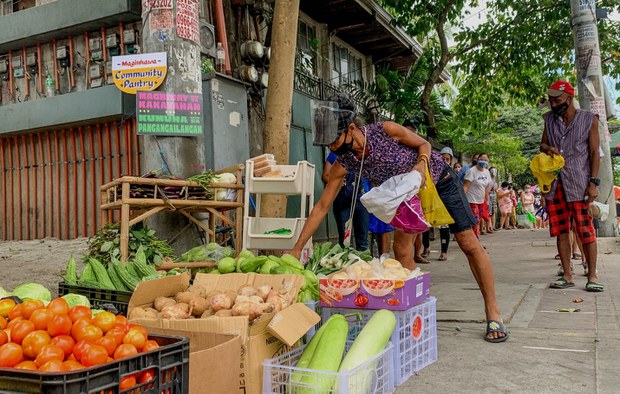
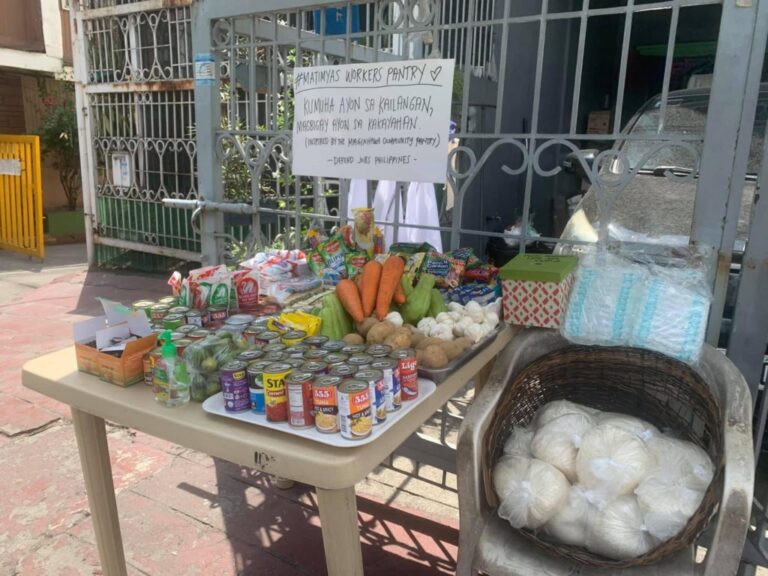
In the Philippines, the Maginhawa Street community pantry began operating on April 14, when 26-year-old Ana Patricia Non displayed her bamboo cart filled with basic necessities like canned goods, vegetables, vitamins, and face masks.

On top of the bamboo cart was a sign that read, “Magbigay ayon sa kakayahan, kumuha batay sa pangangailangan (Give what you can, take what you need).”

The Philippines was not alone in setting up community initiatives during the coronavirus pandemic. Several community programs sprang all around the globe, some even before the pandemic. These show how kindness, rather than hate, is innate in humans. 

Here are some community projects in other countries during this pandemic:

Ravinda Birari’s free haircuts, India

With salons and barber shops closing down during the lockdown, Ravinda Birari started giving free haircuts to underprivileged children in a district in Mumbai, India.

Since June 2020, Birari catered to them once a week after having to close down his own salon in Bhandup due to COVID-19.

“It is more than two months of lockdown; all salons are closed. Poor children who live on the road cannot go anywhere to get their hair cut, so I am giving a free haircut to them,” Birari told ANI News.

One of the kids Birari gave a haircut to said, “Uncle is very good. Nobody has been coming here since the lockdown. However, he comes here and gives us a free haircut.”

Isolated assistance postcard, United Kingdom

In the United Kingdom, Becky Green in March 2020 created a PDF file of a postcard for isolated COVID-19 patients who were in need of assistance, such as getting groceries, posting mail, and getting urgent necessities. 

Her husband, Jonny Green, posted Becky’s postcard on Twitter for others’ reference.

Providence Soup Kitchen, USA

Providence Soup Kitchen is run by the Daughters of Saint Mary of Providence to feed the less fortunate in Chicago. Although 30 years old, the kitchen braved through an unprecedented challenge when the coronavirus came.

When COVID-19 was declared a pandemic in March 2020, Providence’s distribution of meals dropped compared to pre-pandemic times. Due to the strain, less volunteers showed up at the soup kitchen due to fears of catching the coronavirus. They operated at a 10-person capacity weekly.

Volunteer coordinator Roberta Shepherd said, “Our volunteers on Mondays were in their nineties. On Wednesdays, their eighties. All those people went home. And then you had people who were just scared to death.”

Damien Copening was one of the people provided with meals by Providence. Due to COVID-19, Copening lost his job at a pizza place as it was forced to close, and he lost his apartment as he was unable to pay for it.

“Sometimes, you have to laugh to keep from banging your head against a wall,” Copening said. “It’s just insane with all the stuff that’s going on.”

The Food Bank, Singapore

Siblings Nichol and Nicholas Ng built Food Bank Singapore in January 2012 after working in a food distribution business. The siblings believed Singapore needed a food bank, which stepped up operations during the pandemic.

Now backed by several charities and organizations, the 9-year-old food bank aims to tackle food insecurity among Singaporeans who have little to no access to food. They also accept donations of excess produce from supermarkets, farms, and other producers to slowly address food waste. 

Before COVID-19, Food Bank Singapore did not provide cooked meals to the less privileged. But in March 2020, the organization started distributing at least 2,000 meals per day. This later grew to 13,000 donated meals.

In an interview with The Global Food Banking Network, Nicholas Ng said, “We are only seeing the tip of the iceberg in terms of the real need on the ground. As most know, food is the litmus test to those who are really in need. If someone cannot feed themselves, it’s a reflection of the greater problem behind the real crisis.” – Rappler.com

Hannah Dayan is a Rappler intern. This article was done under the supervision of Rappler staff and her copy was vetted by editors.

Press freedom, a public good to be protected

0

May 3, 2021, Audrey Azoulay, Maria A. Ressa , Gwen Lister

‘Being able to access information is not enough; we must also be able to assess it critically’

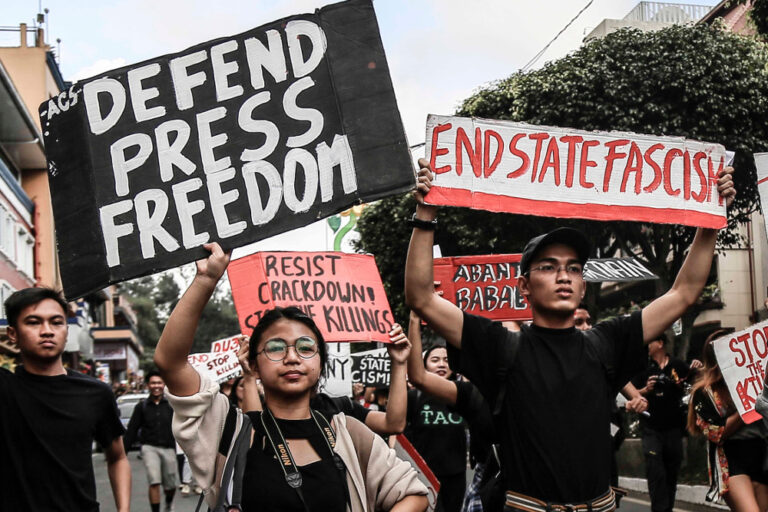
This year, World Press Freedom Day comes at a difficult time, characterized by ongoing attacks on journalists, the viral spread of false information online, and the weakening of the media – all of which have been exacerbated by the COVID-19 pandemic. Beyond the necessary actions which should be taken by governments to protect this fundamental right, every individual can also defend press freedom on a daily basis.

Thirty years ago, in Windhoek, Namibia, African journalists drew up a historic text which then became a universal declaration calling for a free, independent, and pluralistic press. However, since 1991, the world has changed considerably. Back then, the digitization of the production and distribution of information was in its infancy. Now, the Internet and online actors play a key role in providing access to information. An updated declaration is necessary to keep pace with changing times. 

Firstly, digital technology has affected the economic viability of independent media and their diversity, since access to such media depends on the platforms which support them, and they are often reluctant to pay. This question has become acute in the context of the pandemic, which has resulted in decreased revenues for nearly 90% of media outlets. For independent media, these losses have reached $30 billion globally, according to the Reuters Institute. Like theaters, museums, and performing arts venues, independent media are often financially fragile businesses – they have been hit hard by the pandemic, and we are all suffering the consequences.

Secondly, the growing clout of a small number of global social media platforms also raises questions, because even if they do not create content, they help determine what is seen, read, listened to, and shared. For much of the world’s population, these platforms are the dominant source of information, making them unprecedented echo chambers for rumors and conspiracy theories. A study by the Massachusetts Institute of Technology showed that false information is 70% more likely to be shared than verified information, and it spreads six times as fast. In this context, the moderation policies and algorithms of platforms take on decisive importance – and there is currently no transparency in this area.

Training individuals so they can use their critical judgment in assessing this flood of information is therefore of vital importance. Being able to access information is not enough; we must also be able to assess it critically. This is an essential skill for today and tomorrow, and it is what Media and Information Literacy is all about. In this field, which is new in many respects, UNESCO is developing curricula for teachers, to equip them with the necessary educational tools and resources.

Over the past 30 years, digital technology has opened up new horizons for freedom, giving voice to emancipation movements. It has also exacerbated the dimensions of pre-existing problems. In addition to the concerns about journalist safety in the field, for example, online harassment is increasing. This is a real scourge for women journalists, as shown by a recent UNESCO survey on online violence. The figures are striking: in 2020, 73% of women journalists worldwide reported having been victims of online violence. One in five women journalists had been physically assaulted. This comes in addition to other crimes against journalists, which, in 9 out of 10 cases, go unpunished. 2021 is no exception to the rule: 17 journalists have already been murdered around the world since January, and nearly a hundred since the start of the pandemic.

These issues are economic, ethical, and political. They are also the subject of our discussions today in Windhoek, Namibia, as the World Press Freedom Conference, organized by UNESCO and the Government of Namibia, gets underway. The transparency of digital media, the safety of journalists, the viability of media outlets, and the development of critical thinking – all of these subjects are essential to the health of our democracies. – Rappler.com

Audrey Azoulay is Director-General of UNESCO.

Maria Ressa is a journalist and the 2021 laureate of the UNESCO/Guillermo Cano World Press Freedom Prize.

Gwen Lister is a journalist, historical press freedom champion, and co-chair of the 1991 Windhoek conference.

Why Is the Philippines Suddenly Standing Up to China?

0

Mario Alvaro Limos, Esquire Philippines, 29 April 2021

China was probably surprised when the Philippines unleashed a barrage of diplomatic protests from March to April when the former occupied Julian Felipe Reef. Imagine its surprise when the Philippines sent its most advanced warships to challenge its presence in the West Philippine Sea. 

China might have been a little impressed, too. 

In recent weeks, top Philippine officials have released strong statements on the West Philippine Sea, the latest being the Department of National Defense (DND) practically telling China to, well, get the eff outta there. 

ALSO READChina Backs Away as Philippines and U.S. Send Impressive Fleet to West Philippine Sea

When China told the Philippines to stop holding exercises in the West Philippine Sea, the DND fired back and told China they will continue to hold exercises and that China should leave. 

So, what changed? Why is the Philippines suddenly standing up to China very vigorously when it comes to the West Philippine Sea?

Dennis C. Coronacion, chair of UST’s Political Science Department and an expert on geopolitics, weighs in on the subject.

Why the Philippines’ Stance on the West Philippine Sea Shifted

“From a very complacent and tolerant stance toward the aggressive behavior of China in the West Philippine Sea, there was a sudden 180-degree shift in our foreign policy,” Coronacion tells Esquire Philippines. “Domestic factors and external or international factors are at play.”

According to Coronacion, foreign policy is usually dictated by domestic politics. 

“One of the domestic factors that has something to do with that shift is the public’s opinion. For several days before this shift happened, the public has been criticizing the government’s lack of action toward the Chinese occupation of Julian Felipe Reef. My view is that the recent actions by the Philippines is the response of the government to the critical public opinion.”

“Secondly, I think the rumored loss of trust of the military to the government also played a role. To my view, there might be some truth in it.”

A few weeks ago, there were reports of the existence of Viber group among some military generals who were supposedly feeling restless about inaction on the West Philippine Sea and wanted to withdraw support from the government.

ALSO READGenerals Deny Viber Plot Vs. Duterte Over China Row

“Maybe, what motivated some members of the armed forces was also the seeming lack of action of the government toward the West Philippine Sea. You know our military very well, they take pride in their duty in protecting the country,” said Coronacion.

The U.S. Played a Crucial Role

Coronacion says the United States played a crucial role, too. 

“In terms of external or international factors, the United States is now more serious about asserting its presence in the West Philippine Sea. The Biden administration is more serious, more determined, about making its presence felt in the West Philippine Sea than the past two administrations, Trump and Obama.

“The moment Biden took office, his Defense Secretary immediately issued a statement regarding issues in the West Philippine Sea. That, to me, was an early indication of how serious the Biden administration is.”

The political science expert added that the Biden administration is different from the Trump and Obama administrations, which seemed to have played it safe on issues concerning the West Philippine Sea. 

“Biden is bolder,” said Coronacion. “They are saying any attack on Philippine vessels, even if it occurs in disputed waters, will trigger their obligations under the Mutual Defense Treaty. This is more proactive than reactionary. I really think that motivated the Philippine government in stepping up against China. Without a clear support from the U.S., hindi naman maglalakas ng loob ang Pilipinas na magpadala ng military naval ships to challenge China.”

What’s So Special About Julian Felipe Reef

The Philippines reacted so vigorously when Julian Felipe Reef was in danger, considering it allowed China to occupy several reefs in the past. What merited such a strong response from the Philippines?

“Actually, it has nothing to do with Julian Felipe Reef. What’s actually the case is the Duterte administration is not willing to give away any island,” said Coronacion. 

“So even if that’s not Julian Felipe Reef, the president wouldn’t allow it to be militarized by China. I think he does not want to be likened to the past administration, which is being blamed for allegedly giving away some of our islands. That’s the rhetoric of the president now: at least they didn’t give away any of the islands, unlike the past administration, which supposedly lost so many.

“What’s ironic about that is how the president saw the need to check the actions of China in Julian Felipe Reef, and at the same time, he would like to placate China with kind words.”

E.U.’s Support for the Philippines is Very Valuable

The European Union (E.U.) recently voiced its support for the Philippines in the West Philippine Sea when it called on all countries to respect the 2016 arbitral tribunal ruling in favor of the Philippines.

“The European Union’s support is very valuable in the sense that it legitimizes our claims on the West Philippine Sea and the other disputed islands. It refutes the claims of China, especially its Nine-Dash Line. The E.U.’s statement of support is a political advantage for us because now, we earn the support of the international community. In a way, it discredits China’s claim on the West Philippine Sea. 

ALSO READ: China’s International Reputation Takes a Beating as E.U. Stands Up for the Philippines

“Whenever there’s a Chinese incursion in the West Philippine Sea, we can immediately expect the support of these countries, the Western countries, particularly the E.U.,” Coronacion explains.

West Philippine Sea: A Battle of Perception

According to Coronacion, the issue in the West Philippine Sea is hardly a military battle than a PR battle. 

“The battle over the West Philippine Sea is a battle of perception,” said Coronacion.  “Which one has a legitimate claim, which one is playing equally in accordance with the rule of law? European countries have a set of norms that puts primacy on international law. As much as possible, they would like to avoid power politics. Ayaw nilang daanin ang issues sa brasuhan o palakasan. Ang gusto nilang masunod, international law and rule of law. I think pogi points yan for us which we should capitalize on.”

Dennis C. Coronacion, PhD, is chair of the Political Science Department at the University of Santo Tomas. He teaches Foreign Policy and International Relations.
Carpio: Duterte main problem in WPS

0

By: Marlon Ramos – Reporter / Philippine Daily Inquirer / May 01, 2021

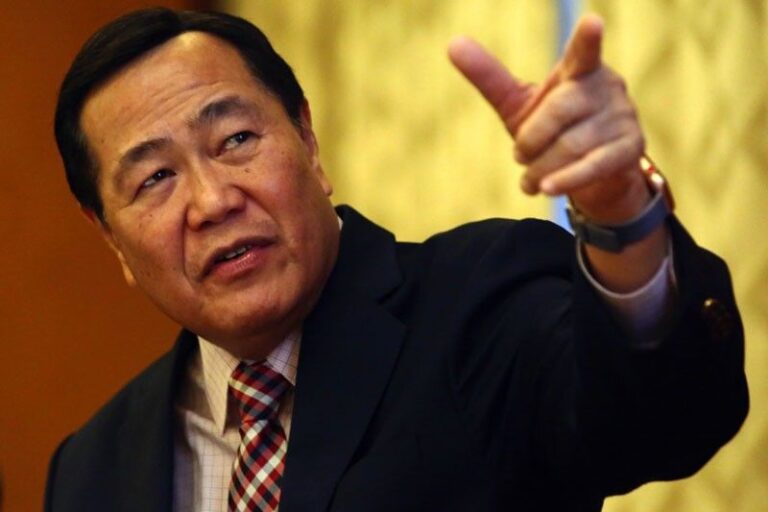
President Duterte himself has become one of the obstacles to the enforcement of the Philippines’ victory in the arbitral court by spreading his false notion that China is in control of the West Philippine Sea (WPS), said retired Supreme Court Associate Justice Antonio Carpio.

In a stinging rebuke of the President’s latest remarks on the maritime dispute, Carpio called on the public to rouse Duterte from his “deep sleep” by reminding him that the Philippines is the sole owner of the resources within its 370-kilometer exclusive economic zone (EEZ).

“The Filipino people must correct the false mantra of President Duterte that ‘China is in possession of the West Philippine Sea … Shout out to President Duterte that China is not in possession of [that area],” Carpio said on Friday in a webinar sponsored by the Philippine Bar Association.

During his weekly televised address on Wednesday night, the Chief Executive spoke highly of Beijing anew, insisting that Filipinos “owe [China] a debt of gratitude” for providing vaccines against COVID-19.

25M bought vs 1M donated

But while China indeed donated 1 million vaccines to the country, the Philippines also placed an order for 25 million doses from Chinese pharmaceutical firm Sinovac Biotech, but only 10 percent has been delivered.

Carpio said that while it was natural for China to reject the 2016 arbitral award, it was “totally unexpected” that the Philippines’ highest leader would pose challenge in implementing the country’s landmark victory.

The retired magistrate noted that the President had previously announced that he would “set aside” the arbitral court decision in exchange for up to $24 billion in investments and loans from China.

“But less than 5 percent of these loans and investments have materialized and nothing more is expected since Duterte’s term of office will expire in June next year,” he said.

Self-inflicted blows

Moreover, Duterte also prevented the Philippine Navy from conducting patrols in the country’s EEZ and said he had a verbal agreement with Chinese President Xi Jinping that allowed the Chinese to fish in Philippine waters.

“All these challenges to the enforcement of the [arbitral] award, coming from President Duterte himself are, of course, grave and serious self-inflicted blows on the national interest of the Philippines,” he said.

Carpio, whose legal expertise was a key factor in the Philippines’ victory in the arbitral tribunal, suggested that the Philippines enter into an agreement with four other Association of Southeast Asian Nations (Asean) member-states that also have claims in the South China Sea—Vietnam, Indonesia, Brunei and Malaysia.

He said the Philippines should urge Indonesia, Malaysia and Vietnam to bring their own separate complaints against China in the arbitral court in The Hague contesting China’s claim to “traditional fishing rights” in their respective EEZs.

“These Asean states will have their own rulings that will be binding on China. These rulings will fortify and reinforce the award [to the Philippines],” Carpio said.

Thousands mark May Day with rallies in France, Spain and Germany

0

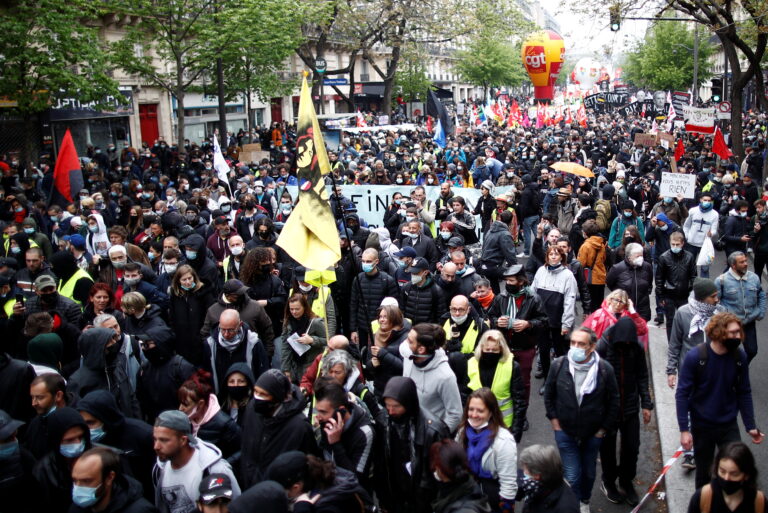
The Guardian online, May 1, 2021 (AFP) – Thousands rallied on Saturday across France and Spain to hold May Day rallies in the midst of the Covid-19 pandemic as police scuffled with protesters in Paris and fired teargas.

A police source told AFP that far-left “black bloc” protesters had repeatedly tried to block the trade union-led march in the French capital, with 34 people detained.

Some protesters smashed the windows of bank branches, set fire to dustbins and threw projectiles at police, who responded with volleys of teargas and stingball grenades.

About 5,000 police were deployed in Paris, a police source said.

The CGT union said nearly 300 May Day protests were planned around the country. It later claimed a total national turnout of 170,000, with 25,000 rallying in the French capital.

The French interior ministry put the national figure at 106,000 and the Paris turnout at 17,000.

The crowds held placards with different demands, ranging from the end of the night-time curfew in place as part of coronavirus restrictions to a halt to unemployment reforms due to come into force in July.

“We have many reasons to come and rally – the health and social situations and the general impoverishment of society,” said Ivan Gineste, 50, who works in a high school in the south-eastern city of Lyon.

Members of the yellow vest anti-elite movement, which rocked Emmanuel Macron’s presidency two years ago before largely fizzling out, could also be spotted at protests up and down the country.

“There are so many motivations for a revolt that are building up – the management of Covid, the so-called reforms that are going to take away people’s ability to live, job-seekers who are going to lose their benefits,” said a pensioner who gave her name as Patricia.

“We absolutely need to express ourselves,” the 66-year-old said.

Thousands also rallied in more than 70 cities across Spain in the first Labour Day demonstrations since the pandemic began.

Wearing masks and observing social distancing, demonstrators marched through the streets waving banners, although in many places numbers were capped to ensure anti-Covid measures were respected.

The main demonstration in Madrid, which was limited to 1,000 people, began at midday under the slogan “Now it’s time to deliver” with the participants marching from the town hall to the city’s Puerta del Sol square.

Seven government ministers attended the march, including the labour minister, Yolanda Diaz, as well as representatives of the three leftwing parties running in Tuesday’s regional election in Madrid.

At the rally, union leaders urged the government to honour commitments delayed by the pandemic, such as repealing a controversial labour reform, raising the minimum wage and approving a law on equal pay.

Addressing the march, Diaz said employment was key for overcoming the crisis.

“The crisis has made us face up to an outdated labour model, based on casual work, seasonal employment and inequality … which is exactly what the labour ministry has started to change,” she said.

In Berlin, about 5,000 people rallied according to police following a call by left and far-left groups.

About 5,600 police were deployed in the city where more than 20 rallies were scheduled to be held over issues ranging from rising rents to Germany’s immigration policy and opposition to coronavirus curbs.Advertisement

Meanwhile in Belgium police fired water cannon and teargas to clear a crowd of several hundred gathered in a park to protest anti-virus lockdown rules.

The defiant, mainly young crowd had assembled for the “Boum 2” protest, organised online, as a follow-up to an action that was broken up last month.

The prime minister, Alexander de Croo, had urged the crowds to stay away, and hundreds of officers were deployed before the order to clear the park was given.

AFP reporters in the Bois de la Cambre, a large park in the city, saw fireworks set off and some missiles thrown before police moved in.

As the clearance operation began there was little immediate sign of violent resistance from protesters but a dustbin was set on fire as the crowd retreated.

Meanwhile in Turkey the BBC reported that police had arrested more than 200 people in chaotic scenes in Istanbul for holding unauthorised protests.

The office of Istanbul’s governor said 212 people had been arrested after they broke away from the annual May Day march and tried to enter Taksim Square, a symbolic area of protest.

Solon says Parlade, Badoy pose ‘serious threat to public’

0

By: Krixia Subingsubing, Nestor Corrales – Philippine Daily Inquirer / April 26, 2021

MANILA, Philippines — Saying that a gag order is not enough, Gabriela Rep. Arlene Brosas wants Lt. Gen. Antonio Parlade Jr. and Lorraine Badoy, undersecretary for communications, both spokespersons of the government’s anti-communist task force, dismissed from their posts

Brosas said on Sunday that Parlade and Badoy should be immediately relieved from their posts and barred from holding any public office as they are “a serious threat to the public.”

“Badoy and Parlade have always been and will always be a danger to the public. Many ordinary people have become their victims and their lives were put in danger because of the endless Red-tagging and harassment against them,” Brosas said in a statement.

She renewed her call for the government to abolish the National Task Force to End Local Communist Armed Conflict (NTF-Elcac) and divert its P19-billion fund for cash aid to poor families during the COVID-19 pandemic.

Use P19B as cash aid

Bayan Muna Rep. Ferdinand Gaite also said the gag order on Parlade and Badoy was “just damage control, too late, too soft.”

“Their Red-tagging days must be put to an end. Rechannel the P19-billion funds of the NTF-Elcac to cash aid for the poor,” Gaite said on Twitter.

Fellow Bayan Muna lawmaker, Rep. Carlos Zarate, agreed with Brosas that Parlade and Badoy “should be booted out for their reckless, dangerous, [and] warped statements.”

Gag order

Parlade and Badoy had earlier linked organizers and volunteers of the community pantries in the country to communist rebels.

National Security Adviser Hermogenes Esperon Jr., who also chairs the NTF-Elcac, has issued a gag order on Parlade and Badoy following their controversial and reckless comments against organizers of community pantries.

Lawmakers have threatened to defund the NTF-Elcac and sought an audit of its funds following Parlade’s and Badoy’s Red-tagging gaffe, which led to the closure of some community pantries due to safety concerns for some organizers.

Vice President Leni Robredo on Sunday also called out the “misplaced, irresponsible” Red-tagging of community pantry volunteers, particularly 26-year-old Ana Patricia Non, who was accused by the task force of being a member of an underground organization.

In her weekly radio show, Robredo said the government should instead be thankful to Non, whose humble pantry in Maginhawa Street in Quezon City where people lined up for food aid quickly snowballed into hundreds of pantries across the country—a symbol for mutual aid.

“The pantries are a big help because these ensure that communities are able to eat at least once a day,” Robredo said. “But it’s being vilified by many, for which I don’t understand.”

In particular, she called out Parlade and Badoy, for “wasting their time” trying to demonize a grassroots movement.

Bakit takot ang gobyerno sa community pantry?

0

Apr 26, 2021, Rappler.com

Ano’t ano man ang kahihinatnan ng community pantry, isang malinaw na indikator ito ng nalulusaw na pagsandig sa gobyerno

Good virus nga ang ideya ng community pantry – na mula sa isang kariton sa Maginhawa Quezon City, ngayo’y 250 na at umabot na sa Visayas at Mindanao.

Nagdilang-anghel pa nga ang editoryal namin nang nakalipas na linggo, kung saan itinanong natin kung “kating-kati na ba ang daliri ni Heneral Antonio Parlade Jr na tumipa sa kanyang computer at i-red tag ang mga organizer ng mga community pantry?”

Sa loob ng isang linggo, sumugod na nga ang mga kampon ng kakitiran ng isip tulad ni Parlade at isa pang undersecretary na kulang sa pansin. Ano ang kakatwang mensahe? Masama ang tumulong. Komunista ang ideya ng pamamahagi ng libre.

Banat pa ng undersecretary, ang fundraiser site daw ng organizer na si Ana Patricia Non ay dolyar ang kalakaran – kaya’t naku, ito’y kontrolado ng mga dayuhan. (‘Wag ‘nyo nang tanungin kung saang kuweba siya nakatira at walang alam sa digital transactions. O nagmamaang-maangan at mema lang.) Lalo tuloy bumilis ang pasok ng donasyon, at madaling naabot ang target nila Non.

May isa ngang opisyal ng University of the Philippines na matabil ang dila, “death by community pantry” daw ang nangyari sa isang namatay sa pila. Ginoong Ted Herbosa, sino ba ang nagkait ng trabaho sa namatay sa pila? Sino ang nagtaingang kawali sa kanyang hinaing? Salamat naman at nag-resign ka mula sa puwesto mo sa UP.

Sabi ng kolumnista ng Rappler na si Atty John Molo, “It resonates because we were all taught that to give even when it hurts (not just out of excess) is real sacrifice.”

Umaalingawngaw daw ang panawagan ng community pantry dahil marami sa mga nagbibigay ay mga taong hindi naman nakaaangat, at sakripisyo ang magbigay kung ika’y kapos na.

Hindi ito maihahalintulad sa pagbibigay ng isang kompanyang may budget para sa CSR o “corporate social responsibility” na tax deductible. Hindi ito fundraising ng mayaman para sa hampaslupa. Habang totoong maraming maykayang dumagsa sa Maginhawa upang tumulong, malinaw na ito’y diwa ng bayanihan at hindi ipokritong pakikipagkapwa-tao lang.

Sa buod nito, ang community pantry ay tulungan ng magkakapitbahay upang makapagbahagi ng abot-kaya, at kumuha ayon sa masidhing pangangailangan. 

Bakit takot ang gobyerno sa community pantries? Dahil ine-expose nito ang kainutilan ng gobyernong puro kuda, pero walang imahinasyon o kahusayang lumaban sa COVID-19. Palpak ang contact-tracing, palpak ang daily tallies ng mga nagkakavirus, at palpak ang pagpapalakas sa health system upang kayanin nito ang dagsa ng nagkakasakit lalo na sa panahon ng surge.

Sa gobyernong Duterte, isang malinaw na mensahe ang paabot ng taumbayan: Walang pulitika dito, pero tumabi kayo diyan kung hindi kayo magiging bahagi ng solusyon. Realidad na namin ang kainutilan ‘nyo, pipigilan ‘nyo pa kaming makipagkapwa-tao?

Huwag hamakin ng administrasyong Duterte ang lalim ng poot at dalamhating kumukulo sa bayan.

Dahil ngayon, para kang nagbukas ng obituary page ‘pag tumingin ka sa iyong social media feed – kaliwa’t kanan ang mga nagbibigay-pugay sa mga yumaong kaanak dahil sa COVID-19.

Kung merong dapat ma-obituary, ‘yan ay ang budget ng National Task Force to End Local Communist Armed Conflict o NTF-ELCAC na ginagamit sa kasamaan ng red-tagging. Uulitin natin, pera natin ang ibinabalahura ng task force na walang magawa kundi maghasik ng poot at kabobohan.

Sabi ni Dan Songco, isang civil society leader, “The community pantry is the new form of ‘People Power.’” 

Ilang dekada rin bago sumulpot ang isang ideya, ang isang kilusang sobrang simple at napakamakapangyarihan. Hindi ito pinamumunuan ng isang monolithic na organisasyong tulad ng kilusang komunista. Tulad ng “People Power” noong dekada ’80, sumulpot ito nang ispontanyo, at may potensyal na naman itong sagasaan ang 35 anyos na national democratic movement.

Ang sikreto ng community pantry laban sa kilusang may ideyolohiya: kaya nitong yumakap ng lahat ng tao – mayaman at mahirap, dilaw, puti, o maging supporter ni Pangulong Rodrigo Duterte.

Katibayan ng appeal nito ang pagsulpot ng iba pang community pantry para sa ibang aspeto ng buhay – halimbawa’y ang pantry ng libro, tsinelas sa Marikina, at maging pantry ng mga parts ng bisikleta.

Marami nang nagbibigay taning sa buhay ng community pantries dahil daw hindi ito sustainable at numero unong kalaban nito ang donor fatigue. Maari. Pero kapag nagpatuloy ang media na ipakita ang mga pila ng mahihirap sa mga pantry, baka humaba ang buhay nito. Kapag nagpatuloy ang word of mouth sa kabutihan nito – baka hindi ito magaya sa ibang NGO kung saan napagod na ang mga nagbibigay donasyon.

Sabi pa ni Songco, bahagi ng henyo nito ang hindi nito pagkompronta sa gobyerno. Sa halip ay iniikutan pa nga ito. 

Kaya galit ang gobyerno dahil malinaw ang mensahe, “Kaya namin ito nang walang gobyerno.” Aray. Canceled.

Hindi naman susulpot ang community pantry kung maaasahan natin ang serbisyong gobyerno. Ang meron tayo ay isang “strongman” kuno na sa totoo’y mahina, marupok, inutil, at balat-sibuyas sa harap ng batikos.

Ano’t ano man ang kahihinatnan ng community pantry, isang malinaw na indikator ito ng nalulusaw na pagsandig sa gobyerno, at senyales ng panunumbalik ng pag-asa sa aksyong komunidad. Sa bandang huli, nasa komunidad ang solusyon. – Rappler.com