Home Blog Page 81

With ‘Sarong Revolution,’ women in Myanmar defy coup and patriarchy

0

Mar 12, 2021, Thomson Reuters Foundation

The movement, dubbed the “Sarong Revolution” by feminists, plays on a belief that deems it bad luck for men to walk beneath women’s clothing, and highlights women’s fears of losing the gains on gender equality

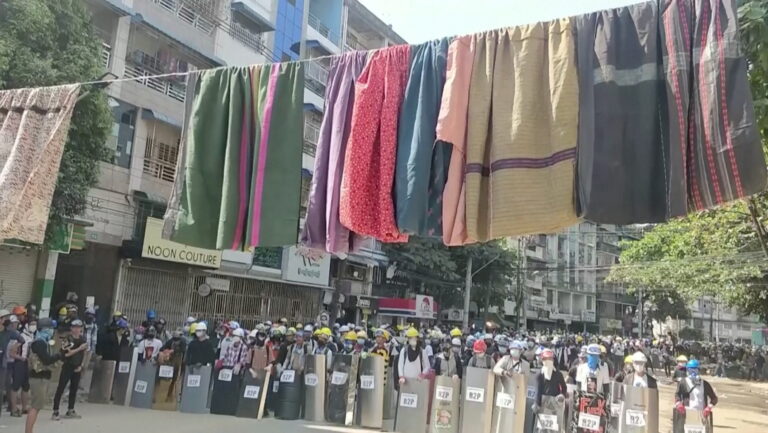
As women take a frontline role in anti-coup protests in Myanmar, some have found an inventive way of defying military rule – hanging traditional sarongs, underwear and even sanitary pads in the streets to spook superstitious policemen and soldiers.

The movement, dubbed the “Sarong Revolution” by feminists, plays on a belief that deems it bad luck for men to walk beneath women’s clothing, and highlights women’s fears that the February 1 coup could roll back hard-won gains on gender equality.

“The htamein (sarong) has become our tool at the protests,” said Naw Esther Chit, 28, an ethnic Karen activist who has been tear-gassed at several protests against the ouster of Aung San Suu Kyi’s elected government.

“Women’s items are used because of the belief that men would be seen weaker if they walk beneath the htamein … police have to take them down and it gives us time to run for safety,” she told the Thomson Reuters Foundation by phone.

The unusual movement’s nickname echoes the “Saffron Revolution” – pro-democracy protests led by Buddhist monks in 2007 that helped pave the way towards democratic reforms.

During weeks of unrest since the coup, police have fired tear gas, rubber bullets and stun grenades to disperse protesters, and women have not been spared.

One of the most striking images from the protests was a young woman wearing a T-shirt that read “Everything will be ok” before she was shot dead, one of about 70 people who have been reported killed since the demonstrations began.

The junta has said it is acting with utmost restraint in handling what it describes as demonstrations by “riotous protesters” whom it accuses of attacking police and harming national security and stability.

‘Fight for democracy’

It is not the first time that women have played a prominent role in pro-democracy protests in Myanmar, which started a decade of democratic reforms in 2011 after nearly half a century of rule by successive military juntas.

“Women have been a backbone in Myanmar’s fight for democracy, not just in 1988 but they have been fighting since the British colonial rule,” said Tanyalak Thongyoojaroen, an associate with Fortify Rights, a Bangkok-based regional human rights group.

Women including university students turned out in force in a 1988 uprising against the military – the protests that first brought Nobel laureate Suu Kyi to prominence.

Suu Kyi’s party won a 2015 election and established the country’s first civilian government in 5 decades. She was re-elected in November before the military seized power last month, saying the poll was marred by fraud – an assertion rejected by the electoral commission.

In the latest turmoil, women including nurses and teachers have taken to the streets and social media to protest, with some worried that women’s rights could be rolled back by the male-dominated junta, based on its previous record.

“What’s different this time is that women are not only fighting for democracy and condemning the coup but at the same time they’re also calling for an end to the patriarchal military and fighting for gender equality,” Thongyoojaroen said.

Despite their visible presence in anti-coup demonstrations, women in Myanmar – except for Suu Kyi – are largely absent from leadership roles in the country, where gender inequalities are widespread and domestic violence is not outlawed.

It is ranked 114 out of 153 countries on the World Economic Forum’s 2020 Global Gender Gap Index, after scoring poorly on women’s political empowerment and economic participation.

Anger over such entrenched inequality spurred Su Su, a 22-year-old filmmaker, to take to the streets.

She has been tear-gassed on numerous occasions and her hand was struck by a police baton, but she said she was determined to continue defying the military junta and fighting for women’s rights.

“I joined the protests because of the injustices,” she said. “I want equality for all.” – Rappler.com

‘Impunity will be the legacy of Duterte,’ says rights advocates

0

AFTER A CYBERATTACK ON PH.GOV AS A FORM OF PROTEST


By: Gabriel Pabico Lalu – Reporter/INQUIRER.net / March 11, 2021

MANILA, Philippines — “Impunity will be the legacy of President (Rodrigo) Duterte.”

Thus, was the declaration of human rights advocates who hacked the government’s online portal Wednesday as a form of protest against the purported “worsening human rights situation in the Philippines.”

Cyber PH for Human Rights said they would hold their cyberattack on PH.gov for a full 24 hours or until 4:00 p.m. of March 11.

“We intend to continue the cyberattack until 4 p.m., 11 March 2020, a full twenty-four hours of protest against the worsening human rights situation in the Philippines,” Cyber PH for Human Rights said in a statement Thursday.

“Presidential spokesperson Harry Roque has made remarks today that impunity has no place in the Duterte administration, but for as long as the President Rodrigo’s top henchmen […] continue their bloody full-court press against unarmed civilians in the guise of search warrant implementation, impunity will be the legacy of President Duterte,” it also said.

Earlier, the National Bureau of Investigation (NBI) confirmed a cyberattack has crippled the national government’s main website.

According to Cyber PH for Human Rights, the takedown was initiated through a Distributed Denial of Service (DDoS) attack – the same attack that affected Amazon Web Services in 2019.  However, they noted that the Amazon site was just down for eight hours. A check by INQUIRER.net showed that PH.gov was still out as of 7:30 p.m. Thursday.

“This new form of protest is now upon us. Mr. Duterte and his government should watch out for more,” the group warned.

Cyber PH for Human Rights has previously denounced the killing of nine activists during alleged simultaneous police operations in the Calabarzon region on March 7, which has since been dubbed as “Bloody Sunday.”

The Philippine National Police (PNP) has maintained that the operation was legitimate and that the activists killed tried to resist arrest by fighting it out. Earlier Thursday, PNP said at least 37 firearms and other explosives were seized from the scene after the serving of the search warrants.

Bloody Sunday has also earned the government and its forces widespread rebuke that even international organizations like the United Nations and European Union expressed their concerns over the attacks.

4 million Filipinos jobless in January

0

Louise Maureen Simeon (The Philippine Star) March 10, 2021

MANILA, Philippines — Unemployment in the country rose to 8.7 percent in January, accounting for four million jobless Filipinos due to the pandemic, the Philippine Statistics Authority (PSA) reported yesterday.

This is steady from the October rate of 8.7 percent but higher than the 5.3 percent unemployment recorded in January 2020, still reflecting the relatively slower pace of economic recovery in the country.

Malacañang said the government would reopen the economy to address unemployment.

“Providing aid is not among the options. What we will do is first, reopen the economy; second, expand the age group that can go out and third, increase the modes of transportation,” presidential spokesman Harry Roque said.

Roque said the government has adopted a three-pronged strategy for economic recovery that involves the reopening of the economy without compromising health standards, implementation of the recovery package under the Bayanihan 1 and 2 and the 2021 national budget as well as the vaccination program.

The January unemployment rate is the third highest recorded since 2005. The first two were recorded in April and July 2020 at 17.6 percent and 10 percent, respectively, both at the height of the pandemic.

The PSA said the country’s labor force population or Filipinos aged 15 and above rose to 74.73 million in January from 74.3 million in October last year.

The labor force participation rate improved to 60.5 percent of the total working age population from 58.7 percent. The January 2021 participation rate is the fifth lowest recorded since 2005.

This is equivalent to around 45.2 million economically active Filipinos, whether employed or looking for work.

This means that while more people searched for livelihood as quarantine restrictions were eased, the number of jobs generated failed to match the supply. Overall, 1.4 million jobs were restored during the period.

The biggest improvement was recorded in Metro Manila where some 269,000 jobs were restored, with the unemployment rate declining to 8.8 percent from 12.4 percent.

In a joint statement, the finance and budget departments and the National Economic and Development Authority said the smaller progress in the past quarter suggests that there is still a need to address the remaining restrictions before the economy could get closer to normal.

“As we further reopen the economy, we continue to see signs of recovery. The results are promising as it tells us that we are on track to getting back most of the jobs we have lost due to COVID-19 and the lockdowns,” the economic managers said.

They pushed for the gradual and safe relaxation of community quarantine, expansion of the age group allowed outdoors and the further reopening of public transport. – Alexis Romero, Delon Porcalla

‘Kill’ rhetoric from highest places enabling killers, says Leni

0

Published March 9, 2021
By JOAHNA LEI CASILAO, GMA News

After referring to “a murderous regime” in a statement that condemned the killings of activists in Southern Tagalog, Vice President Leni Robredo on Tuesday appeared to step up her criticisms of the administration this time in the context of the death of Calbayog City Mayor Ronaldo Aquino in an alleged shootout with policemen.

In a statement, Robredo referred to an incitement of violence and death from what she called “the highest offices.”

“It should not be treated as normal that mayors, community organizers, lawyers, judges, journalists, children, and even victims of the drug trade are murdered in our streets or in their homes,” Robredo said.

“We must connect the dots between these gruesome deaths and see the web that enables and emboldens these killings: Impunity, the normalization and incitement of violence, and the kill, kill, kill rhetoric coming from the highest offices,” she added.

Aquino, his driver, and his security aide were killed after suffering multiple gunshot wounds while their van was crossing a bridge in Calbayog City.

Police investigators said it was the mayor’s group who first opened fire at car that they reportedly thought was following them and which was carrying policemen.

Aquino’s son Mark has expressed doubt over the police’s version of the story. He said his father and their family had been targeted to be linked to illegal drugs.

Malacanang said the killing could have been a case of political violence with the elections just a little over a year away.

“Dalangin at panawagan ko ang pagkagising ng ating bansa.  Hindi normal ang pagpaslang na ito,” Robredo said.

Robredo said that such an incident would have shocked many before and would have been the focus of the media.

“Pero nasa panahon tayo ngayon na tila naging manhid ang marami sa karahasan at kultura ng pagpatay,” Robredo said.

“We call for a clean, competent, and independent investigation into Mayor Ronaldo Aquino’s death, and for his murderers to be brought to justice,” she added.

A special investigation task group has been formed to probe the shooting incident that led to the death of Aquino.

Robredo on Monday condemned what she called the “massacre” of nine activists in Calabarzon, exhorting the people not to be afraid in standing up against a “murderous regime.”

“There is no other way to describe this: It was a massacre. And it came just two days after the President himself ordered state forces to ‘ignore human rights,’ kill communist rebels, and ‘finish them off,’ in his rant before the National Task Force to End Local Communist Armed Conflict,” Robredo said.

Nine people were killed and 15 arrested during the raids in Southern Tagalog.

The incident came two days after Duterte — whose controversial drug war has cost thousands of lives — repeated an order for security forces to “ignore human rights” and kill communist rebels. -NB, GMA News

Good News: 5.6% Average Salary Increase Projected for Filipino Workers This Year

0

By Paul John Caña, Esquire Philippines  

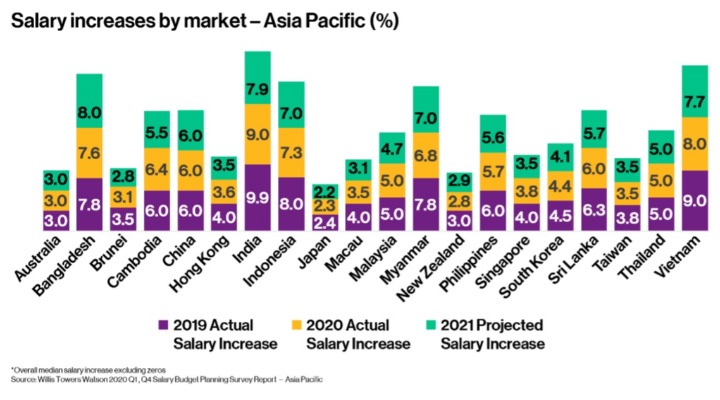
Employers in the Philippines are projected to give pay rises this year at an average of 5.6 percent, reflecting the overall optimism despite no clear end to the scourge of the pandemic. In addition, as much as 82.4 percent of companies in the country will implement salary increases. 

According to the Salary Budget Planning Survey report of Willis Towers Watson, a global advisory, broking and solutions company, this year’s average pay hike is a slight increase from the 5.5 percent in 2020, which itself was a drop from 2019’s 6.0 percent of actual salary increase. That was the lowest average salary increase for the Philippines in more than a decade. In Asia Pacific, companies in 13 out of the 20 markets have also decreased their 2021 average salary increase forecasts.

Employers in the Philippines are projected to give pay rises this year at an average of 5.6 percent, reflecting the overall optimism despite no clear end to the scourge of the pandemic. In addition, as much as 82.4 percent of companies in the country will implement salary increases. 

According to the Salary Budget Planning Survey report of Willis Towers Watson, a global advisory, broking and solutions company, this year’s average pay hike is a slight increase from the 5.5 percent in 2020, which itself was a drop from 2019’s 6.0 percent of actual salary increase. That was the lowest average salary increase for the Philippines in more than a decade. In Asia Pacific, companies in 13 out of the 20 markets have also decreased their 2021 average salary increase forecasts.

Photo by Willis Towers Watson.

In Asia Pacific, the Philippines is right in the middle of projected salary increases per country. Employers in Japan project the lowest pay hike at 2.2 percent, while Bangladesh and India are projecting the highest increaes at eight percent and 7.9 percent, respectively.

Fewer companies—about 13 percent—will announce salary freezes this year, compared to 28 percent last year, the report added. About 82.4 percent of companies are expecting to conduct a salary review in 2021, versus 61 percent in 2020. 

The pay hike is most likely in more optimistic industries, reflecting their differing fortunes during the pandemic. The most optimistic industries are Pharmaceutical and Health Sciences, High Tech, Electronics Manufacturing and Business Support Services, including Business Process Outsourcing, with a 2021 salary budget increase forecast of five percent or more. According to the report, these industries will continue to see an increase in demand for talent as employers in these sectors prepare for growth and development opportunities in 2021.

“After a difficult year for employers and employees—battling lockdowns, employee safety issues, working from home and declining revenues—many employers are finding ways to handle the crisis better, manage their businesses and help their employees with a more focused work and reward strategy,” said Patrick Marquina, Head of Talent and Rewards, Philippines, at WTW.

“While there is certainly more optimism this year in both employers and employees alike, the recovery for many hard-impacted businesses would not be smooth sailing,” he added. “Companies will continue to experience smaller salary budgets this year. Therefore, it is important for employers to differentiate their allocation of pay rises, so that they can provide meaningful salary increases for their best and most valuable talent, and prioritize spending on jobs that are likely to contribute the most to the success or survival of their businesses”, added Patrick.

WTW’s Salary Budget Planning Report is based on a survey conducted online in October and November 2020. The surveyed covered over 18,000 sets of responses in over 130 countries worldwide. In the Philippines, a total of 233 companies participated across different industries.

CHR asked to probe killings of 9 activists

0

By: Delfin T. Mallari Jr., Krixia Subingsubing, Maricar Cinco -Philippine Daily Inquirer / 05:00 AM March 08, 2021

Nine activists were killed, most of them in their own homes, and at least four others were arrested in police and military raids early on Sunday.

Six were killed in Rizal province, two in Batangas, and one in Cavite, said the police in the Calabarzon region.

The simultaneous raids were carried out by the Philippine National Police together with the Armed Forces of the Philippines to serve search warrants for loose firearms and illegal possession of explosives, according to Lt. Col. Chitadel Gaoiran, spokesperson for the Calabarzon police.

“We will not be silenced, and we call on all Filipinos to condemn these raids and to stand with us in the struggle for justice and in defending people’s rights,” Cristina Palabay, Karapatan national secretary general, said as her group urged the Commission on Human Rights (CHR) to investigate the raids and “ensure that justice and accountability is served for the victims of state terror and fascism.”

The police have not immediately released the names of the fatalities, but human rights advocacy group Karapatan identified five of them as Emmanuel “Manny” Asuncion, a Bagong Alyansang Makabayan (Bayan) coordinator in Cavite who was killed in a police raid in his home in that province; Mark Lee Bacasno and Melvin Dasigao, both members of the urban poor group San Isidro Kasiglahan, Kapatiran at Damayan para sa Kabuhayan, Katarungan at Kapayapaan (SIKKAD K-3), who were killed in Rodriguez, Rizal; and Ariel Evangelista and his wife, Chai Lemita Evangelista, activists who advocated fishermen’s rights, who were killed in their home in Nasugbu, Batangas.

According to Karapatan, the Evangelistas’ 10-year-old son survived the raid by hiding under a bed.

The group also claimed that the police who raided the Evangelista home took away the bodies of the couple, which Chai Evangelista’s mother, Inday Lemita, later found at the John Paul funeral home in Nasugbu.

As for Asuncion, Kobi Tolentino of Anakbayan-Southern Tagalog said the Bayan coordinator was with his wife, Lizelle, and another associate in the couple’s home at Salitran village, Dasmariñas City, when about 30 policemen barged in and ordered Asuncion’s wife and associate to step out.

“Then they heard about 10 shots,” Tolentino said. “After that, they saw [Asuncion’s] body being dragged down the stairs. There was not even a stretcher.”

Fishermen’s group Pamalakaya said Asuncion was one of the staunchest champions of fishermen, joining them in denouncing projects that affected Cavite’s coastal areas.

Arrests

Asked who were the targets of the police-military operations, Brig. Gen. Felipe Natividad, the Calabarzon police director, said on Sunday he would still have to check with the other “operating units.”

In Laguna, Karapatan said labor leader Esteban Mendoza of Kilusang Mayo Uno and Bayan-Laguna spokesperson Elizabeth Camoral were arrested in separate raids in Cabuyao City.

A member of Karapatan, Nimfa Lanzanas, was also arrested in Calamba City.

Arrested in Rizal was Eugene Eugenio of the Confederation for Unity, Recognition and Advancement of Government Employees (Courage).

According to Gaoiran, there were nine others who eluded policemen serving the warrants for illegal possession of firearms and explosives.

Describing the raids as “bloody Sunday,” Palabay compared the police-military operations to last year’s mass arrest of activists in Negros Oriental where 14 peasants were also killed.

Palabay also cited the arrest on Thursday of Arnedo Lagunias, an activist affiliated with the Lakas Manggagawang Nagkakaisa sa Honda and the Alyansa ng Manggagawa sa Enklabo, and Ramir Corcolon, secretary general of Water System Employees Response and a national council member of the Confederation for the Recognition and Advancement of Government Employees. Lagunias was arrested in Santa Rosa, and Corcolon, in San Pablo City, Laguna.

Order

In a statement, Bayan pointed out that the attacks followed on the heels of President Duterte’s order on Friday to the police and the military to “kill them (communist rebels)” during the launching in Cagayan de Oro of community projects led by the National Task Force to End Local Communist Armed Conflict.

Bayan Muna Rep. Ferdinand Gaite also said “these highly condemnable incidents are the result of President Duterte again egging state forces to kill, kill, kill.”

“These [state] forces do not distinguish between armed rebels or activists, they just kill then say ‘they fought back’ then plant firearms and explosives [on the scene],” he said.

Phil Robertson, Human Rights Watch deputy director for Asia, asserted the same point, saying: “The fundamental problem is this campaign no longer makes any distinction between armed rebels and noncombatant activists, labor leaders, and rights defenders. It is not a coincidence that these deadly raids happened two days after President Rodrigo Duterte ordered police and military to ‘kill all’ communists and ‘don’t mind human rights.’”

—WITH REPORTS FROM NESTOR CORRALES AND JEANNETTE I. ANDRADE INQ


Despite reforms, abuses vs OFWs in Middle East still difficult to stop — DFA official

0

By: Christia Marie Ramos – Reporter / INQUIRER.net / March 08, 2021

MANILA, Philippines — A foreign affairs official on Monday admitted that it was difficult to stop the abuse towards overseas Filipino workers (OFWs), particularly in the Middle East, as a senator flagged thousands of maltreatment cases among the OFWs in 2020.

“The problem begins with the practice…In the Middle East, there are sectors, for example, the household service workers, even if there’s a bilateral labor agreement [with the host country], even if everything is in place, we could the not control the abuses because they happen in the homes,” Department of Foreign Affairs (DFA) Undersecretary Sarah Lou Arriola said during a hearing of the Senate labor committee on bills to create a separate department for overseas Filipinos.

Furthermore, she noted that domestic workers are usually excluded from labor laws in Middle Eastern countries.

“We cannot control the culture. While there are a lot of reforms in the Middle East, especially starting March 12, Saudi Arabia will have reforms on the kafala system and labor mobility, this still does not include the household service workers,” Arriola said.

READ: Saudi labor reforms start March 2021

Under the kafala or sponsorship system, workers cannot transfer to other jobs without the consent of their employers. Many human rights groups have criticized this, likening it to “modern-day slavery.”

“Anywhere in the Middle East, the household service workers are always the last to be included in the abolition of exit visas  and everything else,” she said.

“So, we, at the Department of Foreign Affairs would like to flag that to the legislators that even if the country of destination has complied with our requirements, there is always a disconnect between the practice and what’s on paper,” the DFA official added.

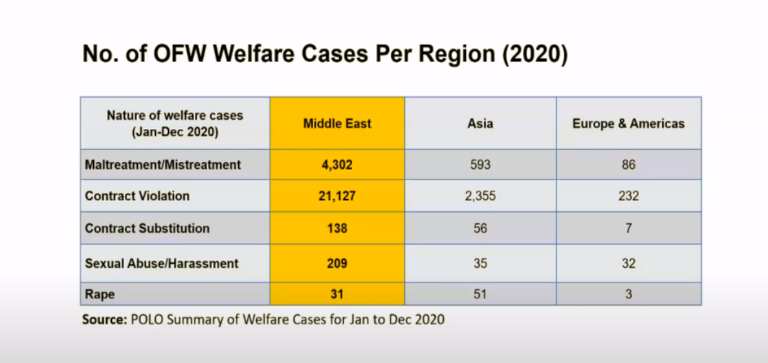
During the hearing, Senator Joel Villanueva, chair of the committee, cited a summary from Philippine Overseas Labor Offices which showed there were 4,302 cases of maltreatment among OFWs in the Middle East alone in 2020.

The data also showed that there had been 209 cases of sexual abuse and 31 cases of rape among Filipino migrant workers there.

Arriola then stressed that countries in the Middle East are “doing all they can to do reforms” which she said have been met with “resistance from some of the population.

“The resistance comes from the business sector because kafala, the abolition of kafala will entail loss of income. There are steps really being taken by most of the countries but we have to realize that it will be really difficult for any agency to be able to stop the abuse since it will take time…for all the countries, all households to uphold the rights of their household service workers,” she said.

Filipino domestic worker shows the positives of life in Lebanon using TikTok

0

Reuters/March 07, 2021

BEIRUT — There is almost nothing Raquel Barrion doesn’t know about the two Lebanese children she has looked after since they were babies. But one day, the Filipina domestic worker decided to find out how much they knew about her.

Barrion, 39, was pleasantly surprised when – by means of a light-hearted quiz game – one of them got her birthday right and both knew her favorite color as well as he best-loved food.

Many families across the Middle East and beyond might struggle to answer such questions about the live-in workers who cook for them, clean, and care for their children.

The quiz game is one of many upbeat experiences recounted by Barrion on video sharing app TikTok as a way to tell the rarely heard stories of migrant domestic workers in Lebanon, where an economic crisis and COVID-19 have highlighted cases of abuse.

By posting daily videos, which have garnered more than 600,000 likes in a year, Barrion said she hoped to give a voice to Lebanon’s often-neglected domestic workers and a humanizing glimpse into their hidden lives.

“It’s a simple message, we’re domestic workers and work at home, but we’re also human. We need our freedom,” she told the Thomson Reuters Foundation, in a phone interview.

Several hundred thousand migrant domestic workers from countries including the Philippines, Ethiopian, Sri Lanka and Bangladesh live in Lebanon, where the coronavirus pandemic has compounded financial woes.

As the crisis intensified last year, scores of employers dumped live-in domestic workers on the streets, saying they could no longer afford monthly wages often as low as $200.

Reports of inhumane treatment and horrific abuse under the country’s kafala employment system, likened by rights groups to modern-day slavery, spread across the world.

‘Like family’

Barrion, however, said her 11 happy years in Lebanon showed domestic work could benefit both the worker and their employees, and bring positives for the host country too.

She gets paid what she considers a fair wage, $700, gets regular time off, and said her employers treat her “like family”.

It was the start of Lebanon’s first lockdown last March when Barrion started posting videos to TikTok because she was forced to spend her days off at home.

She began posting quirky behind-the-scenes videos including tips on how to remain positive, dancing and bread-making.

As time went on, she started to add commentary on the regimented lifestyle that housekeeping work entails, or the difficulties of dating as a domestic worker.

In one, she holds her month’s pay in her hand before setting aside the lion’s share to send home to her family, keeping the little that is left for her monthly allowance and savings.

In another, she gives a tour of her humble living quarters -consisting of a narrow bed, shoes stacked in their boxes and a small altar adorned with images of Lebanese saints.

Comments from Barrion’s mostly Lebanese followers are overwhelmingly positive, and she said the pandemic had motivated acts of kindness towards hard-hit migrant workers.

As thousands of Lebanese emigrated during the crisis, foreign maids also left the country on repatriation flights organized by their home countries last year, including hundreds from the Philippines.

“I felt so sad, I had a neighbor who went back and I’m alone here now when I go out,” Barrion said.

At the height of the lockdown crisis, she and some friends got together to buy groceries for domestic workers who had been kicked out of their homes or fled abusive employers, fondly recalling how her Lebanese employees had chipped in.

“Most Lebanese and the new generation have a good heart,” she said. “They can just be very shy to show it.”