Home Blog Page 83

Stars, influencers get paid to boost Duterte propaganda, fake news

0

Feb 27, 2021, Camille Elemia Gelo Gonzales

MANILA, Philippines

(UPDATED) EXCLUSIVE: Internal documents from Twinmark Media Enterprises, the agency banned by Facebook for coordinated fake behavior, show how the power of celebrities is used for money and disinformation

At a Glance

  • Stars and influencers amplify, either knowingly or indirectly, questionable websites and posts containing government propaganda and false information in exchange for money
  • Rappler obtained and verified internal documents of digital marketing group Twinmark Media Enterprises, which showed that several celebrities and influencers were paid hundreds of thousands to millions of pesos for 2017 and 2018, before Facebook banned the agency.
  • Celebrities lend legitimacy to the questionable sites and boost fake networks that breed disinformation.
  • As Twinmark still operates on the platform despite the ban, some stars and influencers continue to amplify its questionable, viral, false, or clickbait content.
  • These schemes could be used in the upcoming 2022 elections

Filipino celebrities and influencers earn hundreds of thousands to millions of pesos by amplifying – either knowingly or indirectly – government propaganda, false information, and fake networks that breed online disinformation, a Rappler investigation showed.

Celebrities’ endorsement of questionable content – done via sharing on their verified and official Facebook pages – is sinister, as it lends credibility and legitimacy to websites and pages that are out to pollute the online environment and spread disinformation. Such practice also lacks transparency, as posts appear as if they were organic or unpaid for.

Such is the case with digital marketing group Twinmark Media Enterprises, which Facebook banned in January 2019 due to coordinated inauthentic behavior. Twinmark assets also actively promoted government propaganda and disinformation, especially against government critics. (READ: PH company banned by Facebook spread lies, used fake accounts)

The strategy: Twinmark pays stars and influencers, as well as several popular meme and celebrity fan pages, to share content from Twinmark-owned websites to increase engagement.  The agency also has its own pages.

Facebook users that follow the celebrity, celebrity-linked, or popular pages get to see the posts, then be led to the Twinmark websites, and be served money-generating ads, false information, or propaganda. It’s a lucrative sport for everyone in the network.

In a legal document seen by Rappler, Facebook told the agency in January 2019: 

“It has come to our attention that your company, Twinmark Media Enterprises, Inc., has developed a network of Facebook pages and accounts that you exploit for financial gain through the use of multiple fake accounts working together to mislead people about the origin of content. Your accounts and pages post and share misleading content designed to induce users to visit your external websites that exist primarily to serve advertising. Moreover, you sell Facebook Pages and posts, enabling  the spread of unwanted spam content. Your activities are illegal and unauthorized and must stop immediately.”

Oftentimes, too, Twinmark-linked pages suddenly shift their identities and content – say, from entertainment to politics – usually to promote a politician or push out propaganda during an election season. A former Twinmark employee told Rappler they had several local and national politicians as clients.

What better way to spread their (dis) information than to use popular idols on mainstream and social media?

Celebrities and public figures have millions of followers and reach, often topping those of fact-checkers and news media – an imbalance that had most been felt during the coronavirus crisis.

Oxford’s Reuters Institute found that while public figures were only responsible for spreading 20% of false claims about the coronavirus, their posts accounted for 69% of total social media engagement. 

Based on internal Twinmark databases and documents obtained and verified by Rappler, the digital agency paid “advertising fees” to celebrities and influencers in 2017 and 2018 – the years before the Facebook ban – ranging from P10,000 to more than P250,000 monthly. In those two years, several celebrities and personalities earned over a million pesos.

Mocha Uson’s page earned over P1 million in 2017

As early as 2017, Rappler found that the network was among the primary vectors for the spread of government propaganda and disinformation – with the constant help and shares from former Presidential Communications Operations Office assistant secretary Mocha Uson. (READ: What is Mocha Uson’s top source of news?)

One of Uson’s favorite sites then was Twinmark’s Trending News Portal (TNP), known for posting viral and false claims. Uson’s blog has at least 5.8 million followers to date. (READ: The success, influence of Trending News Portal)

TNP was regularly given a boost by Uson, as well as several celebrity, fan, and pro-Duterte pages. The content of TNP and other Twinmark websites was shared on partner pages with the same caption and at almost the same time.

Internal documents obtained by Rappler showed that Twinmark paid Uson’s page at least P1.08 million in 2017. The agency deposited payments to the bank account of Lord Byron Cristobal, commonly known as Banat By, one of the co-administrators of Uson’s page.

The agreement, as indicated in the database obtained by Rappler, was for Uson’s page to share 4 TNP posts daily from February to July 2017, and 4 daily posts from netcitizen.co, another Uson favorite, for the whole month of October. There was no information about the deal during the other months but Twinmark content was still shared on her page.

Paulo Avelino’s official, verified page got over P2 million in 2 years

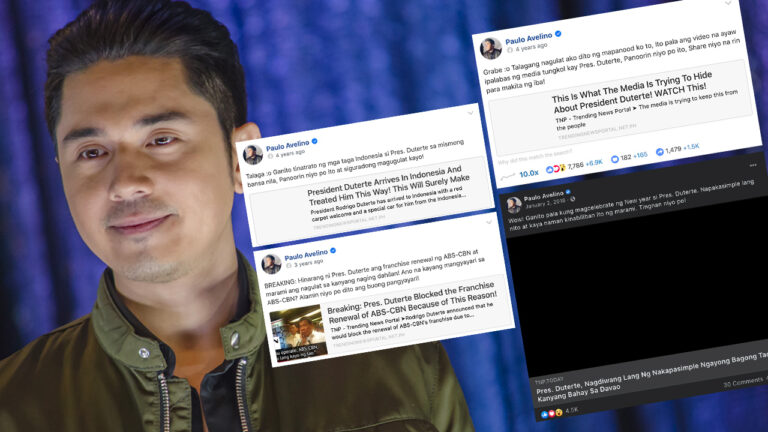
It wasn’t just Uson’s page that was a mainstay of Twinmark’s network. The verified page of actor Paulo Avelino was among the consistent partners. Avelino’s official page was paid a monthly fee of P105,000 in 2017 and 2018, totaling at least P2.2 million for these two years, according to the internal documents. 

Around that time, Avelino shared TNP content containing propaganda about President Rodrigo Duterte and, at times, even false information.

According to the documents obtained by Rappler, the deal between Avelino’s page and Twinmark was for the page to regularly share posts from 3 websites, including TNP. 

The check payments were deposited to the bank account of a certain Michael Balondo.

In response to Rappler’s questions, JJ Henson, Avelino’s handler, said Balondo is the president of Avelino’s fans club. 

“Thank you for alerting us. We are not aware of it. A lot of fan pages were set up. Paulo is aware of that but he is not aware of every single one they’ve made and that they used it for those purposes,” Henson told Rappler in a phone call.

But for them to not know about the deal is arguable, as Avelino’s Facebook page was a verified one – meaning it underwent a verification process. According to Facebook, a verified badge means that the company confirmed that “this is the authentic page or profile for a public figure, media company or brand.”

Henson also admitted that they have known and worked with Balondo for years but denied that the management and Avelino knew about the Twinmark deal.

It is also unlikely for a digital company like Twinmark to pay a monthly fee of at least P100,000 if the page was only a fan page.

The same internal documents obtained by Rappler showed that such amount was usually reserved for verified pages of popular influencers and celebrities. The internal files also showed that many of these payments were sent either straight to the bank accounts of the talents or to their managers.

Rappler asked Henson why the verified Facebook page has been sharing Avelino’s endorsements, as well as the celebrity’s posts on his Twitter and Instagram accounts. 

In reply, Henson said he would sometimes ask Balondo to post Avelino’s endorsements on the page, as Facebook exposure is usually part of the celebrity’s contract.

Rappler repeatedly reached out to Balondo, who said he would comment, but still hasn’t as of posting. We will update this story once he responds.

Jasmine Curtis-Smith, DJ Chacha

Another famous celebrity who was on Twinmark’s ad payroll was Jasmine Curtis-Smith.

Internal documents showed that the actress was paid a total of at least P405,000 for half a year in 2017. A quick search on her official verified page also showed that she had been sharing Twinmark-linked websites as early as October 2016. 

Curtis-Smith’s posts contained a mix of clickbait articles, showbiz-related content, Duterte propaganda, and false information.

Her page even posted a Twinmark article falsely claiming that Angelina Jolie said “America needs a president like Pres. Rodrigo Duterte” – an absurd claim that was rated false by Vera Files, Facebook’s third-party fact-check partner alongside Rappler.

Her page also posted another misleading content by a known Twinmark site, which said that USA Today wrote an article about how Duterte already fulfilled his promises in just two weeks.

What USA Today wrote, however, was: “In that short span, he has left a bloody trail of drug world executions that is drawing alarm from human rights groups and opposition politicians.”

Radio personality DJ Chacha was also on Twinmark’s payroll from March 2017 to May 2017. She was paid P30,000 per month. She mostly shared socialpees.com and filcommunity.com, questionable sites known for their clickbait, misleading, or false information.

Rappler e-mailed her on February 16 to ask for comment but she hasn’t replied as of posting.

According to documents obtained by Rappler, the payments to Curtis-Smith and DJ Chacha were sent to the bank account of their management, Vidanes Celebrity Marketing (VCM).

Elizabeth “Betchay” Vidanes, founder of VCM, confirmed to Rappler that they indeed had an engagement with Fernando Hicban, one of the brother-owners of Twinmark, in September 2016 “for social media marketing purposes to promote health-related, positive-vibe articles.”

At the time, she said VCM was not aware of any violation.

“When we reviewed the website of Mr. Hicban, with whom we met for the engagement, we did not find any trace that his website was ever involved in improper or offensive activities such as faking accounts or publishing questionable government propaganda, its contents were just health-related and wholesome stories, which is why we accepted the engagement,” she said in an e-mail to Rappler.

Clearly, however, the posts were not “health-related, positive-vibe articles.”

VCM later on decided to end the deal when the posts their talents were asked to share were no longer “consistent” with the artists’ images. The nature of these posts, though, were not clarified.

“When we later received requests to post articles that, to our judgment, are no longer consistent with our talents’ brand image, we already distanced from Mr. Hicban and the company he represented, and ended our social media marketing engagements with them.”

Other celebrities paid to share propaganda or boost network

The other celebrities who received payment from Twinmark, according to documents obtained and verified by Rappler, were the following:

Sam Pinto

Documents showed the model was paid at least P400,000 in 2017 and a whopping P1.5 million in 2018. Her monthly fee from August to December 2018 was P250,000.

The payments were deposited not to her account, but to that of a certain Paolo Esteves Santos.

Moymoy Palaboy

The comedic duo was paid a total of at least P1.6 million for 2017 and 2018. Most of the payments were sent to Rudolf Filomeno Macasero, one of the brothers in the duo. They still share content from dubious sites and pages.

Bugoy Cariño

Rogel Cariño in real life, the former child star still shares content from the revived websites of Twinmark. Documents showed that payments in 2017 and 2018 were sent to either bank accounts of Cariño or his partner, volleyball player Ennajie Laure.

Social media influencers

The verified page of the former YouTube couple JaMich regularly received payments from Twinmark, amounting to at least P965,000 in 2017 and at least P1.27 million in 2018.

The verified page, with at least 7.7 million followers, claims “to be a tribute fan page run by admins.” But Twinmark documents showed that the agency deposited the payments for the page to Mich Liggayu, the other half of JaMich.

In 2017 and 2018, Liggayu also received separate payments from Twinmark for sharing content on her own verified page, amounting to at least P3.9 million. Rappler sought Liggayu’s comment but she has yet to respond. We will update this story once she does.

Other influencers cited in the documents were: Lance Julian, the owner of the Senyora Santibañez page and a known Duterte supporter; UFC ring girl Rovilyn “Red” dela Cruz; and Yexel Sebastian.

Given their power and influence, celebrities should be accountable to their viewers and followers. They should find out and know who hires them, in the same way they do so for brand endorsements.

“It is a question of what to do with the power/status that they have: Will they be instruments of truth or a contributor to the pollution of the information ecosystem? And this question should be answered both by celebrities and us, their audience,” sociologist Prince Aldana, who teaches at UP Los Baños, told Rappler.

This scheme is not unique to Twinmark, after all. The dangers have more far reaching consequences as the Philippines nears the 2022 elections, where the battlefield shifts online due to the coronavirus pandemic.

It’s a testament to these celebrities’ reach, highlighting their role in contributing to disinformation whether wittingly or unwittingly, willingly or not, by selling their content space to the highest bidder. – with reports from Don Kevin Hapal/Rappler.com


Philippines offers nurses in exchange for vaccines from Britain, Germany

0

Feb 23, 2021, Reuters

MANILA, Philippines

The Philippines has relaxed a ban on deploying its healthcare workers overseas, but still limits the number of medical professionals leaving the country to 5,000 a year

The Philippines will let thousands of its healthcare workers, mostly nurses, take up jobs in Britain and Germany if the two countries agree to donate much-needed coronavirus vaccines, a senior official said on Tuesday, February 23.

The Philippines, which has among Asia’s highest number of coronavirus cases, has relaxed a ban on deploying its healthcare workers overseas, but still limits the number of medical professionals leaving the country to 5,000 a year.

Alice Visperas, director of the labor ministry’s international affairs bureau, said the Philippines was open to lifting the cap in exchange for vaccines from Britain and Germany, which it would use to inoculate outbound workers and hundreds of thousands of Filipino repatriates.

Nurses are among the millions of Filipinos who work overseas, providing in excess of $30 billion a year in remittances vital to the country’s economy.

“We are considering the request to lift the deployment cap, subject to agreement,” Visperas told Reuters.

Britain is grappling with the world’s sixth-highest coronavirus death toll and one of the worst economic hits from the pandemic, while Germany has the 10th most infections globally.

While the two countries have inoculated a combined 23 million people, the Philippines has yet to start its campaign to immunize 70 million adults, or two-thirds of its 108 million people. It expects to receive its first batch of vaccines this week, donated by China.

The Philippines wants to secure 148 million doses of vaccines altogether.

The British embassy in Manila did not immediately respond to a request for comment, while calls to Germany’s mission went unanswered.

In 2019, almost 17,000 Filipino nurses signed overseas work contracts, government data showed.

While Filipino nurses have fought to lift the deployment ban to escape poor working conditions and low pay at home, the workers-for-vaccine plan has not gone down well with some medical workers.

“We are disgusted on how nurses and healthcare workers are being treated by the government as commodities or export products,” Jocelyn Andamo, secretary general of the Filipino Nurses United, told Reuters. – Rappler.com

Catriona Gray: Capacity to lead not dependent on gender but on character, skills

0

Feb 23, 2021, Rappler.com

MANILA, Philippines

‘I don’t think your capacity to be a leader is determined by your gender,’ says Catriona in response to President Duterte’s statement that the presidency is not a job for women.

Miss Universe 2018 Catriona Gray said that one’s capacity for leadership is not determined by gender but by character and skills.

Catriona said this in a live interview with G3 San Diego on Monday, February 22, when she was asked about President Rodrigo Duterte’s remark that women are not suitable to be president because they are emotionally different from men.

“I don’t think your capacity to be a leader is determined by your gender. I think it’s defined by the capabilities, skills, and talent that you have – your experience, your character,” she said.

“I think all of those play part to be a good leader. It is not dependent on one’s gender at all,” she added

In a speech last January 14, Duterte said that women are not cut out for the job of being president of the country as people urged his daughter, Davao City Mayor Sara Duterte, to run for the highest post in 2022.

The President has also repeatedly belittled the capability of Vice President Leni Robredo to succeed him, claiming that the opposition leader is “weak” and not fit to seek the presidency.

Over a week before Catriona was asked to weigh in on the President’s remarks, Miss Universe Philippines 2020 Rabiya Mateo also responded to the same question during an interview with pageant site Missosology.

In the interview on February 13, Rabiya said that while she respects the President, she totally disagrees with his statement.

“In our country, we already have two female leaders, and by doing that, women are capable as men in handling a nation, ” Rabiya said, referring to the late president Cory Aquino and former president Gloria Arroyo.

Rabiya also cited New Zealand Prime Minister Jacinta Adern, who is rearing a newborn while leading a nation in the middle of a pandemic.

She said that she believes having the heart of woman contributes to her leadership skills.

Duterte is known for making sexist remarks and has directed misogynist remarks directed against Robredo.

Robredo earlier has also called out Duterte for his statement, saying that his remarks were “deflating” the campaign for gender equality in the country. – Alexa Villano/Rappler.com

Lockdown Is Actually Making You Less Handsome

0
During COVID-19 our cortisol levels are at an all-time high.

By Murray Clark

Lockdown ennui is written all over your face. The pale skin. The listless gaze into the void of another Zoom. The sudden breakouts. You can explain it all away by reasoning that this is winter, and this is what winter likes to do – and you’d be right. It’s a time of year in which life feels like one long album by the xx. But the usual not-so-new year crash has been compacted by the fact that this February belongs to coronavirus – another month in yet another lockdown.

The long-term effects are beginning to reveal themselves. A study carried out by the Mental Health Foundation found that more than eight in 10 British adults had experienced increased stress throughout the pandemic. Across the pond, the figures were even more alarming: the Centers for Disease Control and Prevention noted a 31 percent increase among Americans reporting symptoms of anxiety or depression. These numbers are a huge cause for concern. The forecast grows grimmer still as young men continue to battle an ongoing mental health crisis that exploded long before reports of a respiratory virus in Wuhan.

The tell-tale signs of anxiety and depression are not only felt mentally, but seen visibly as the effects wreak havoc on your skin, hair, nails, weight – pretty much everything. You can blame a naturally occurring steroid hormone by the name of cortisol.

“We have all sorts of stress hormones and cortisol is one of them, and it’s really intricately linked with our physical health and our psychological health. We know that brain and body, of course, impact one another,” says Beth Anfilogoff, psychological therapist at The Recovery Centre, a London-based integrated therapeutic clinic. “Persistently high levels are bad for physical and mental health as it suppresses the immune system, and that of course encompasses skin, hair, and nails.”

It’s not just your palms that get sweaty. Cortisol can stimulate an overproduction of sebum (the science-y word for natural oils) which can clog the pores. This means brand new spots and breakouts, but also flare-ups of old, existing conditions. A 2013 study by the research group Acta Derm Venereol found that psychological stress could exacerbate eczema and atopic dermatitis, lending credence to a long-held view that poor mental health can compromise skin health. Increased cortisol has also been linked to sensitivity and dryness, with one 2014 study reporting signs of advanced aging in subjects with high levels of stress. “The exact mechanism of how stress impacts skin aging is still quite elusive but recent research has provided evidence that suggests the proteins collagen and elastin are impacted by stress,” says Victoria Hiscock, medical communication manager at science-driven skincare company AlumierMD. “This can lead to lines, wrinkles, and skin laxity. We also know more about the relationship between inflammation and aging which has led to a new term in cosmetic dermatology: ‘inflammageing’.”

Which is as scary as it sounds. Increased cortisol hampers the body’s ability to absorb the essential nutrients that keep us looking nice and handsome. “Healthy hair and nails need vitamins and minerals such as zinc, iron, magnesium, and protein,” says Hiscock. “As stress can impact our appetite and the body’s repair system, it can lead to thinning hair, hair loss, and brittle nails. Furthermore, hair pulling and nail biting during stressful periods is common, which can further impact hair and nail health.”

Cortisol isn’t an out-and-out bad guy. Considered to be the human body’s natural alarm system, the stuff works with the brain to regulate mood and thus activates the ‘fight or flight’ mechanism when and where appropriate. It also regulates blood pressure, reduces inflammation, and modulates sleep patterns. “It naturally rises in the morning and gets us out of bed,” says Anfilogoff, going on to say that, in small doses, it’s also linked to confidence and extroversion. But, when your brain encounters a dangerous situation every single day – let’s just say, oh I don’t know, during an unprecedented global pandemic – your body reacts like there’s a tiger lurking in the shadows all day, every day. The resulting surplus of cortisol is where things start going wrong.

Getting rid of it, unsurprisingly, requires thorough de-stressing, which is far easier said than done when every day is book-ended by Huw Edwards reeling off death counts. In fact, cortisol levels aren’t “something you can control,” says Anfilogoff. “It’s a natural response that is unfortunately unhelpful when it’s out of sync with the ‘threat’ we are facing. Constant deadlines and notifications on our phones don’t require the fight or flight response our body can go into. We can think of anxiety as a fire alarm – useful if there’s a fire, but you don’t want it going off when you’re only making toast.”

For those who’ve suffered increased anxiety throughout lockdown, Anfilogoff suggests a few moments of respite. “Relaxation is really important here. Do things you enjoy. It doesn’t particularly matter what, you just need a break and it’s worth making time for. Try something creative or gentle exercise. This is of course harder in lockdown, but research has shown nature is really beneficial for mental health.” Acknowledging the anxiety can also help, with Anfilogoff recommending regular communication with a trusted individual to alleviate added stress. Or, if it’s really impacting your life, “reach out to professionals via your GP, or private organizations through professional bodies like the BACP.”

Certain products will also abet the R&R, for a one-two punch that soothes the skin on the outside of your head as you calm the stress spikes on the inside. “Retinol could be the best tool in your anti-aging toolkit, second only to daily SPF,” says Hiscock. “It can help reduce the appearance of lines, wrinkles, and uneven skin tones. It’s a very active ingredient and can cause a good amount of dead skin to shed at first so the advice is start low, and go slow.” Exfoliation and hydration are just as important too, with Hiscock recommending salicylic acid-based products as a way to “deep clean” pores during times of stress.

For all the benefits of a bigger grooming kit though, the Zoom calls never lie. Well, not unless you’ve got the beauty slide turned up to max. And if that’s your solution to greying skin and stress-related breakouts, then perhaps it’s high time you take a hard pass on the next two-hour conference call entirely.

This story originally appeared on Esquire.co.uk. Minor edits have been made by the Esquiremag.ph editors. (image from Dreamstime.com – PA)

Shifting to MGCQ a short-sighted and desperate move without containing pandemic

0

By IBON Communications

Research group IBON said that lifting COVID-related restrictions to boost the economy is a short-sighted and desperate move amid continuing failure to contain the pandemic. The group agreed that the government’s excessive quarantine restrictions since last year are behind the economy’s unprecedented and continuing collapse. IBON however said that easing restrictions will not spur recovery without a real fiscal stimulus while risking the more rapid spread of COVID-19.

Economic planning secretary Karl Kendrick Chua recently advised Malacañang to put the entire country under modified general community quarantine (MGCQ). The ‘less restrictive’ MGCQ will supposedly allow the resumption of business activities previously limited under the pandemic lockdown.

IBON pointed out that the proposal to ease restrictions comes while the number of COVID-19 cases has been increasing since the start of the year. The 9,161 cases in the first week of the year increased to 10,741 so far in the week February 4-10. Data for this most recent week may even still be incomplete because of delays in reporting. The group asked where the optimism that the coronavirus is contained is coming from.

IBON stressed that the administration needs to greatly improve its measures to contain COVID-19 instead of relying on its favored blunt instrument of protracted community quarantines. The group enumerated the measures needed as better testing, more aggressive contact tracing, selective quarantines of possible cases, and speedy isolation of confirmed cases. With the number of cases still increasing, easing restrictions without these measures in place risks COVID-19 spreading even faster.

At the same time, IBON added, shifting to MGCQ may not even spur the economy all that much because the government still refuses to spend on any real fiscal stimulus. The group stressed that significantly higher levels of government spending are needed to make up for the lockdown-driven collapse in consumption and investment. This is more so given the now record joblessness and widespread loss of incomes and savings.

Government first of all needs to contain the pandemic better, IBON said. On top of this, it simply has to spend more to help households and small businesses cope with record jobs and income losses and to recover from the economic shock, stressed the group.

The group pointed out how the record 9.5% contraction of the economy in 2020 was substantially due to how the Philippine government refused additional spending last year. In the first 11 months of 2020, its disbursements only increased by 11.6% which is not just below the originally programmed 13.6% increase for the year but even lower than the average 12.9% increase in spending over the period 2017-2019. 

IBON also highlighted how spending even slows this year with the Php4.5 trillion 2021 national budget just a 9.9% increase from the 2020 budget. As it is, the Philippine COVID-19 response is the smallest of the major countries of Southeast Asia at just 6.3% of GDP according to the Asian Development Bank (ADB).

IBON proposes the following to address people’s urgent needs and stimulate the economy:

  1. Php10,000 monthly emergency cash subsidies to 18 million poor and low-income families (poorest 75% of families) or Php10,000/month for up to three months or Php5,000 for six months. This amount comes to Php540 billion.
  2. Php100 emergency wage relief for workers (towards eventual implementation of a Php750 national minimum wage). Micro, small and medium enterprises (MSMEs) can be supported to give this for three months with a Php101 billion fund.
  3. Php40.5 billion cash-for-work programs for the unemployed.
  4. Php78 billion financial assistance (zero/low interest rate and collateral-free loans) for informal earners.
  5. Php200 billion in financial assistance (zero/low interest rate and collateral-free loans) prioritizing Filipino-owned and domestically-oriented MSMEs.
  6. Php220 billion in agricultural support to increase the productivity of farmers and fisherfolk.
  7. Php200-billion COVID-19 health response and Php113-billion distance education to ensure quality education.

The group also stressed that the government can finance these if it really wanted to. IBON identified a universe of at least Php3.9 trillion in funds from which realignments can be made, Php1 trillion in emergency bonds and other government securities, Php391.9 billion in immediate revenues from progressive taxes especially a wealth tax, and at least Php333 billion more from a land value tax. # (from Kodao.org, February 21, 2021)

Congress to pass vaccine indemnification bill today

0

Paolo Romero (The Philippine Star) February 22, 2021

MANILA, Philippines — Senators are hoping there will be no more further delays in the Duterte administration’s rollout of the COVID-19 vaccination program after Congress passes today the bill that provides for an indemnification fund and an expedited process for local government units (LGUs) and private institutions to procure vaccines.

The provision for an indemnification fund – P500 million as proposed in Senate Bill 2057 – was reportedly required by vaccine makers to recipient nations under the COVAX facility – to shield them from damage suits as the inoculations have yet to hurdle Phase 3 trials, and are all being distributed under emergency use authorization (EUA).

The bill also exempts from taxes all activities related to the vaccination program including the procurement, importation, transportation, of vaccines and related equipment from January 2021 to Dec. 31,2023.

It also seeks to allow LGUs and the private sector, in cooperation with the Department of Health, to make advance payments for vaccines and other equipment needed for vaccination.

“Like many others, I’m also concerned, and we also want this (vaccination program) to be fast. And I’m happy with that we’ll have supply agreements signed this February so we’re looking forward to this, and hopefully, there’ll be no more snags,” Sen. Sonny Angara, chairman of the finance committee and principal sponsor of the bill told dzBB.

Angara was referring to the statement of National Task Force (NTF) chief and vaccine czar Carlito Galvez Jr. that he expects the government to be able to sign firm supply contracts with manufacturers and the mass vaccination would start within the month or by March.

The country was supposed to start receiving the vaccines under the COVAX initiative last week but Malacañang rushed the Senate and the House of Representatives into passing the bill.

This left several senators wondering why the NTF did not ask for it sooner when the chamber held an exhaustive hearing on the vaccination program as task force officials were already in the thick of negotiations with the World Health Organization to acquire the serums.

Senate President Vicente Sotto III on Saturday told dwIZ the government may be able to save some money by letting private insurance firms to shoulder bulk of the cost of the indemnity fund or tap the huge contingency fund of the Philippine Health Insurance Corp.

Sotto said insurance companies can bid for the indemnity fund even as he noted that based on the latest studies and projections, those who may suffer serious adverse effects from vaccinations would be miniscule or in the case of the Philippines, 350 individuals out of 70 million.

Senate Majority Leader Juan Miguel Zubiri, who is also an author of the bill, said there will be no other agenda in the session this afternoon except for the measure that still has at least three senators wanting to raise questions on it.

After interpellations, the writing of amendments and approval on second reading will follow. Being a certified measure, the Senate can dispense with the mandated three-day gap in approving bills, and pass the bill on third and final reading.

Zubiri said he hopes the Senate and the House would have just have a short bicameral conference committee meeting to reconcile any conflicting provisions in their respective versions of the bill so the measure can be sent to Duterte’s desk for signing within the week.

There could be a possible snag, however, at the resumption of deliberations on the bill over a provision in the measure to require the issuance of a vaccine passport for those who have been inoculated.

A possible course of action for the chamber is to remove the provision and reintroduce it in a separate bill to address objections posed by some senators to the vaccine passport section. Angara said the document could be renamed to address issues associated with the word passport.

Sen. Aquilino Pimentel III, during the deliberations last week, cautioned that the vaccine passport proposal could have some implications on certain constitutionally guaranteed rights.

“COVID-19 vaccine passport program with all those benefits and implications should be the subject of a separate and independent bill because the current measure is about making vaccination procurement and administration easier,” Pimentel said.

Sen. Joel Villanueva also shared Pimentel’s reservations, saying the passport might be perceived as forcing the vaccination program on the people.

“Because when you talk about passport, it’s mobility. This might have some misconception in the end,” Villanueva said.

Too early to recommend easing quarantine restrictions — health experts

0

By: Maricar Cinco – Reporter / Philippine Daily Inquirer / February 22, 2021

Health experts on Sunday cautioned the government against easing to the lowest level coronavirus curbs throughout the country, especially in Metro Manila, after an independent research group last week reported a slight upward trend in COVID-19 cases in the metropolis, with a variant of the virus possibly causing the spike.

Metro Manila and much of the country are under strict general community quarantine, but the National Economic and Development Authority (Neda) has recommended downgrading the curbs to modified general community quarantine to allow the reopening of up to 95 percent of the economy and pull the country out of recession caused by the coronavirus pandemic.

Health experts on Sunday cautioned the government against easing to the lowest level coronavirus curbs throughout the country, especially in Metro Manila, after an independent research group last week reported a slight upward trend in COVID-19 cases in the metropolis, with a variant of the virus possibly causing the spike.

Metro Manila and much of the country are under strict general community quarantine, but the National Economic and Development Authority (Neda) has recommended downgrading the curbs to modified general community quarantine to allow the reopening of up to 95 percent of the economy and pull the country out of recession caused by the coronavirus pandemic.

2,400 new cases a day

Last week, OCTA warned that new coronavirus infections in Metro Manila could increase to more than 2,400 a day by late March if the restrictions were lifted prematurely.

Healthcare Professionals Alliance Against COVID-19 (HPAAC) maintains that protective measures and a population able to protect itself must be in place before the government eases the restrictions.

“It shouldn’t be a case of black and white, close or open, but the question must be, ‘Are we ready?’” said Dr. Antonio Dans, spokesperson for HPAAC.

He said HPAAC last week met with Transportation Secretary Arthur Tugade to discuss better public transportation and the opening of more bike lanes in the city.

The group also advocates for leisure in open-air places like parks rather than reopening closed commercial places like movie houses and shopping malls.

Dans said the group would send a letter to Malacañang on Monday to lobby for an executive order that would allow internet providers access to satellite connection.

“Businesses, [people] working from home, education, and even for [the] health [sector] to improve contact tracing… we need a better internet connection [before] we open up,” he said.

Restoration of production

But Acting Socioeconomic Planning Secretary Karl Kendrick Chua insisted on Sunday that placing the entire country on modified general community quarantine would bring back nearly all the economic activities that existed before the pandemic struck last year.

The pandemic forced the government to place the country on hard lockdown, preventing an explosion of coronavirus infections but stopping 75 percent of the economy. The result was a contraction of 9.5 percent, the worst performance of the country’s economy in decades.

Chua, who also heads Neda, proposes freeing more public transport and lowering age restriction to complement the restoration of production.

Children, according to him, were a major consumption driver before the pandemic, as most families dined out or shopped with kids in tow.

But his predecessor, former socioeconomic planning chief Ernesto Pernia, objects to full-country easing of curbs.

“For me, [it] should be selective. It shouldn’t be imposed in all areas,” Pernia said in a television interview on Sunday.

“There are still high-risk areas. The restrictions should be kept in place in these areas,” he said.

With reports from Ben O. de Vera and Katrina Hallare

Filipina nurse in UK Romalyn Ante also making waves through poetry

0

By: Eunice Barbara C. Novio – INQUIRER.net/February 22, 2021

Our fixation for everything imported, success stories, and more are oftentimes focused on the Filipinos who “made” it in America.

Even in the literary scene, our “it” girls and boys are always Filipino Americans. So where are the Filipinos in other parts of the world? Say, the United Kingdom?

The name Romalyn Ante does not ring a bell. At least if you do not subscribe to The Guardian, a British daily newspaper with an online edition.

In preparation for the forthcoming Anthology of Essays For Filipino Nurses, Balanggiga Press organized an online talk with Ante, a registered nurse, and a celebrated poet in the UK over the weekend.

Balangiga’s founder Rogelio Braga is also an award-winning playwright and the first Filipino recipient of the prestigious Yellow Earth Theater Professional Writers Programme 2020 in the United Kingdom.

The zoom session was moderated by Angela Fabunan, (also an award-winning Fil-Am poet) and this writer.

The session was attended by students and prominent authors in the Philippines including Rowena Festin, Allan Derain, Nicollo Vitug, Jehu Laniog, and Maryanne Moll.

Dr. Christina Juan of SOAS University of London and Honorable Amir Mawallil were also present.

Ante is the author of the Antiemetic for Homesickness published by Penguin in 2020, talked about growing up in the Philippines, being a nurse, and getting past  the heavily guarded literary gate in the UK.

Her straightforward answers and bubbly personality charmed us. She was devoid of pretensions.

Anyway, antiemetic is a drug used in treating nausea and vomiting.

Family of healers

Ante grew up in Batangas. A “left-behind” child, her mother, worked as a nurse in Oman and later in the UK.

Her family was just getting by and could not afford books then.

Yet, her literary influence sprung from her grandparents’ storytelling about Philippine mythologies.

In 2006, at 16, Ante and her siblings emigrated to the UK. Like her mother, she took nursing because it would give her a secure job.

Ante prided herself from being a part of the family of shamans, healers, arbularios, midwives, social workers, and nurses.

She is one of the 40,000 nurses at the National Health Services (NHS). They are in the frontlines. To date, the Filipino nurses have also the highest death rate due to Covid-19 according to a report by the Nursing Times in June 2020

Her experiences as a nurse and her family background stood out in some poems from her book like “The Shaman, The Servant” for her grandfather.

In the poem, she placed herself and the grandfather in different positions, different times, and situations but with the same goal- easing the pain and suffering of others.

The grandfather as a shaman uses “langis ahas” while muttering incantations, and she as a nurse, inserting needles on a patient’s arms, mentioning gauze and medicines.

“Nursing has taught me how to pay attention to colors, observing the pain, body language which is similar to poetry. We have to pay attention to the world,” Romalyn says.

As a child of a migrant worker, and now a migrant, Romalyn knows the pain of losing a country, a part of herself, and her culture.

But she also recognized the pains of her mother and all the migrants in the diaspora who have lost their families, their countries, and their cultures to be able to survive in their host countries.

Despite the longings, Ante is thankful for the opportunities in her second country despite being “ubiquitous yet invisible”.

“If we had a choice we would not leave (the Philippines). But we only had one choice – to leave for security,” Romalyn said.

Literary grants

Ante’s interest in literature was always there. In Mabini, Batangas where she studied, she mentioned that she wrote poems in Tagalog and posted some of these in the school’s corridors.

As a nursing student, she chose not to join creative writing class because her money was enough. But the love for reading never hindered her. She used her library card to immerse herself in books.

Soon enough, literature got her hooked. It was like an IV drip that sustained her throughout her nursing career.

Ante started writing extensively and later joined several workshops.

She learned about Shakespeare and traditional poets while taking GCSE (General Certificate in Secondary Education), she appreciated it because it provided her knowledge on the meters and rhythm in poetry.

But it was the poetry book Rose by Li-Young Lee, a Chinese American poet that she realized that migrant stories or perspectives can be read by anyone.

It also influenced her to navigate away from the traditional writing in poetry which has meters and rhymes.

“It contributed to gate-keeping if we always focus on the stories of people who are always in the spotlight,” she said.

Ante was appointed Poet-in-Residence at Shakespeare Birthplace Trust/ Hosking Houses Trust in 2019.

Recognition

She is the first East-Asian to win both the Manchester Poetry Prize in 2017 and in 2018 the Poetry London Prize 2018.

Her debut pamphlet, Rice & Rain (VPress), received the 2018 Saboteur Award for Best Poetry Pamphlet. She has been featured in and commissioned by several organizations such as Southbank Center, Book Week Scotland, Harper’s Bazaar, Vogue UK, Birmingham Literature Festival, and Verve Poetry Festival, and ran several poetry workshops including those for The Poetry School, Royal College of Nursing, UniSlam, and Writing West Midlands.

Ante is a Poetry Ambassadors 2021mentor. She is also long-listed for the 2021 Dylan Thomas Prize.

Her book Antiemetic for Homesickness is available at https://www.penguin.co.uk/books/111/1117727/antiemetic-for-homesickness/9781784743000.html and Amazon worldwide.

For submission at Balanggiga Press, please click https://balangigapress.com/2021/02/01/call-for-submission-essays-from-filipino-nurses-in-the-united-kingdom/