Home Blog Page 86

One wrenching year later

0

Philippine Daily Inquirer/February 05, 2021

On Jan. 30, 2020, the Philippines had its first confirmed case of the novel coronavirus: a 38-year-old woman who had traveled from Wuhan, China, and arrived in the country nine days earlier. On Feb. 1, 2020, the country reported its first COVID-19 death: that of the 44-year-old male companion of the woman from Wuhan.

Since then, some 370 days after that first case, the number of COVID-19 cases in the Philippines has ballooned to 530,118 cases as of Wednesday. According to data from the Department of Health (DOH), at least 14,393 medical workers have since contracted the virus, with fatalities at 83 and active cases at 303.

After one wrenching year of COVID-19 and its devastating impact on the country, where is the Philippines now?

For starters, at 79th place out of 98 countries when it comes to pandemic response, according to Australian think tank Lowy Institute. The index scores were based on each nation’s confirmed COVID-19 cases, deaths, and testing rates.

Health Undersecretary Maria Rosario Vergeire has said it is “unfair” for the Philippines to be compared to other countries that have “better health systems” and more resources. Her words, though, are belied by the country ranking well below its neighbors with similar economies like Vietnam (which placed second), Myanmar, Thailand, and Sri Lanka. The last two countries also landed in the top 10.

A full year since our first case, and the Philippines is in a mad scramble for vaccines already being used widely by other countries, and still in the throes of what has been described as the toughest, longest lockdown in the world.

It was an erratic, hit-and-miss affair from the very beginning, when the President himself first flippantly dismissed the problem, threatening to “slap” the virus in February and declaring that it “will die a natural death.” The government took its time banning flights from China, the source of the virus, as well as conducting mass testing, saying it was “unrealistic” to test the entire populace.

Through 2020, the President displayed a jarring lack of basic knowledge about the pandemic, spreading misinformation that didn’t help the health crisis any. (At one time, he insisted that face masks could be washed with gasoline if people couldn’t afford other disinfectants.) When a total lockdown was imposed on the country on March 16, the administration turned the health crisis into a military exercise. Police and soldiers patrolled the streets, arresting, heavily fining, and sometimes cruelly treating curfew and quarantine violators, most of them workers stranded by the ban on public transport. Meanwhile, government appointees and officials such as Sen. Koko Pimentel, police chief Debold Sinas, and presidential spokesperson Harry Roque were let off lightly despite their violations of health protocols.

The severe lockdown would force thousands of small- and medium-sized businesses to close down, leaving millions of workers jobless and sinking the country’s economy to its lowest level since 1947. The country’s gross domestic product contracted by 9.5 percent in 2020—the worst economic dive in Southeast Asia.

In December, around the time the President said he had just “realized” the importance of mass testing despite public clamor for it as early as March, news came that COVID-19 vaccines developed in record time had become available. But the government quickly botched public confidence in a mass immunization program first by blithely excusing the shocking lawbreaking of people around the President who helped themselves to smuggled Sinopharm vaccine shots from China, and then by appearing to favor another China-made vaccine, Sinovac, for mass rollout. Top health and Malacañang officials themselves led the drumbeat for Sinovac despite international reports of its disappointing efficacy rate at just over 50 percent. The result? Majority of Filipinos are reluctant at this time to have themselves inoculated, according to surveys, even as millions of other citizens in other countries—among them Myanmar, Nepal, Bangladesh—have had a head start in mass vaccination and getting their lives back on track. The delay, warned global observers, means that the Philippines will have the slowest economic recovery in the region.

The monumental misdeeds and blunders and missed opportunities of the past year, let alone the immense suffering that has been inflicted on the people, would have humbled any administration capable of introspection. But there was the much-criticized health secretary on Jan. 29, still obliviously casting such criticisms as political bellyaching and point-scoring. “Our detractors will have a talk on all the things that we have accomplished, but the scores, the numbers, the data can speak for themselves,” said Francisco Duque III.

The first step in solving a problem, it is said, is acknowledging that there is a problem in the first place. By that measure, the Philippines is in a dim place, a long way off from deliverance.

Pandemic scars: More Filipinos to remain poor, unemployed even by 2022

0

Feb 4, 2021, Ralf Rivas

MANILA, Philippines

The Philippines’ poverty and unemployment rates will remain elevated even after President Rodrigo Duterte steps down from office, as the pandemic scars the labor market

Philippine state economists see unemployment staying elevated and more people remaining below the poverty line until 2022, as the coronavirus pandemic leaves scars on the economy.

The country’s poverty rate is projected to average between 15.5% and 17.5% in 2021, likely near the 16.6% posted in 2018, officials of the National Economic and Development Authority (NEDA) said on Thursday, February 4, during the launch of the updated Philippine Development Plan (PDP).

Before the pandemic, the government’s economic team aimed to reduce poverty to 14% of the population by 2022. The target was for the Philippines to be classified as a middle income country.

NEDA also noted that joblessness will remain elevated at around 7% to 9% by 2022.

This is roughly the same as the 8.7% unemployment rate posted in October 2020, and much higher than the pre-pandemic target of 3% to 5%.

Acting Socioeconomic Planning Secretary Karl Chua said there will be a surge of young people sending out job applications by 2022, as the first batch of K to 12 graduates and also college graduates are expected to look for work by then.

Game plan

NEDA Undersecretary for Policy and Planning Rosemarie Edillon said that with more people expected to remain poor, hungry, and jobless, there is a need to support the poor through social protection measures like cash assistance.

Note, however, that the 2021 budget does not have provisions for financial aid, should a second wave of COVID-19 infections occur.

While social services, labor, and agriculture got increases from last year’s appropriations, lawmakers earlier questioned if these would be enough in the context of the pandemic.

The government is aiming to rev up the economy through infrastructure projects, as well as retooling workers to fit the demands of the labor market. (READ: Philippines plans to build its way out of pandemic)

The updated PDP also puts emphasis on expanding access of startups, small businesses, and cooperatives to the digital economy, as well as infrastructure specific for agricultural needs.

Chua noted as well that tax cuts for companies, amid foreign investments hitting a record low, are poised to attract investors.

He noted that the tax reform measure should be appreciated in the context of other legislative measures, such as the proposed easing of foreign restrictions on businesses.

President Rodrigo Duterte’s term ends in June 2022. His successor, who will be elected in May 2022, will have to address the lasting impact of the pandemic on the economy. – Rappler.com

Media orgs, groups blast Parlade for threat vs INQUIRER.net reporter

0

GENERAL’S REMARKS REVEAL PERILS OF ANTI-TERROR LAW

By: Gabriel Pabico Lalu – Reporter/INQUIRER.net /February 04, 2021

MANILA, Philippines — Several media organizations and other groups have denounced Southern Luzon Command chief Lt. Gen. Antonio Parlade Jr. for his comments against INQUIRER.net reporter Tetch Torres-Tupas over her story on Aetas who filed a petition before the Supreme Court (SC).

The National Union of Journalists in the Philippines (NUJP) said in a Facebook post on Thursday that Parlade’s remarks about Torres-Tupas’ story on the Aetas’ claim of torture under the hands of the military — that she may be sued for aiding terrorists — attests to the dangers of the Anti-Terrorism Act of 2020.

Torres-Tupas’ story, entitled “Tortured Aetas seek SC help against anti-terror law,” was a story on the Aetas’ petition that the Anti-Terrorism Act be declared unconstitutional, which was filed as SC heard oral arguments of those against the said law.

“Torres-Tupas was simply writing about the fact that the petition was filed and recounting the allegations made in that petition,” NUJP said in its statement.

“The government has repeatedly issued reassurances that the law will not be used to stifle dissent or to clamp down on the press. But actions and statements by people like Parlade, who will be tasked with implementing the Anti-Terrorism Law, speak louder than those press statements,” it added.

JUCRA demands apology from Parlade

The members of the Justice and Court Reporters Association (JUCRA), which Torres-Tupas is a member, also released their own statement condemning Parlade’s tirades.  According to the group, Parlade should apologize to the journalist, especially as she was only doing her work.

JUCRA also asked whether the rest of the members should await a similar threat from Parlade, especially since the story was written and published by most, if not all, of their members.

“Parlade did not only red-tag Tupas, but he also threatened her with prosecution just because he did her job, which all of us in JUCRA do every day.  JUCRA members also reported the Aetas’ petition for intervention, based on the same Supreme Court pleading.  Should we all await for a threat from Parlade too?” the statement read.

“Is the general suggesting that justice reporters are supporters of terrorists? […] Parlade’s cluelessness notwithstanding, we demand the general to apologize to Tupas,” it added.

In his post, Parlade questioned whether Torres-Tupas’ sources were allegedly propaganda machinery of the Communist Party of the Philippines (CPP).

Parlade, also an official of the National Task Force to End Local Communist Armed Insurgency (NTF-ELCAC) further said in the comments section, when asked whether a case can be filed against the reporter, that she could be held liable for “aiding the terrorists by spreading lies.”

The military general was referring to a story on two Aetas who were supposedly tortured and fed with feces after being arrested.  But 7th Infantry Division Public Affairs Office chief Maj. Amado Gutierrez maintained that no incident happened during the August 2020 incident.

READ: CHR to probe allegations Aetas forced by soldiers to eat human feces 

NUPL: Parlade’s ‘grotesque way’

Lawyer’s group National Union of People’s Lawyers (NUPL), on the other hand, said that Parlade’s actions only validate fears and criticisms against the Anti-Terrorism Act.

“In a grotesque way, he is actually reinforcing and validating the myriad of objections and criticisms against the ATA. This is a big favor he is giving us, which is awfully unwelcome and outrageously unacceptable. Thanks, but no thanks,” NUPL president Edre Olalia said.

Cristina Palabay, secretary-general of rights organization Karapatan, on the other hand, warned that this might have an effect not only against Torres-Tupas but also on every other journalist covering sensitive topics like human rights.

“And while it could’ve been easy to laugh off Paralde’s trollish Facebook posts, his threats against INQUIRER.net reporter Tetch Torres-Tupas — especially in him posing the possibility of charging her through Duterte’s terror law for her report — is a serious and perilous threat not only against her but also against each and every journalist covering human rights issues and concerns,” Palabay said.

“It also, rather clearly, shows the true intent of the terror law: to clamp down on our freedoms and to threaten anyone that stands in the way of this fascist regime,” she added.#

INQUIRER.net stands by its journo

INQUIRER.net / February 04, 2021

INQUIRER.net continues to recognize the role our valiant men and women in the armed forces play in protecting our country. But we condemn the threat of Lt. Gen. Antonio Parlade Jr. to sue our reporter Tetch Torres-Tupas for her report on the petition filed at the Supreme Court entitled “Tortured Aetas seek SC help against anti-terror law.” In the Facebook post of Parlade on Feb. 3, 2021, he accused our reporter as a propagandist.

INQUIRER.net takes vigorous exception to the apparent red-tagging of our reporter and expresses alarm over Parlade’s attempt to sow fear, stifle dissent and curtail her right to make truthful and objective reports. We unequivocally support our reporter and uphold her integrity.#


Family says slain OFW Mary Anne Daynolo gave ‘no signs of danger, threats’

0

Feb 3, 2021, Michelle Abad

Manila, Philippines

(3RD UPDATE) ‘I don’t want my sister to become just a statistic,’ says Mary Anne Daynolo’s brother, Cedric

Other than sharing about her work-related stress, slain overseas Filipino worker Mary Anne Daynolo did not give any indication to her family that she was in danger or faced any kind of threat in their last conversation before she went missing in the United Arab Emirates (UAE) last March 2020.

UAE police found Daynolo dead 10 months later, on January 19, after the suspect – Daynolo’s colleague – led them to her remains. The family Daynolo left behind wants justice for the 29-year-old receptionist.

In a phone interview with Rappler. Daynolo’s half brother Cedric Madrigalejo shared what he and her sister talked about in what was to be their last chat via social media.

“I didn’t see signs of danger, threats, or her asking for help. Wala. Sobrang casual lang na asaran and kamustahan (Nothing. It was very casual, we were teasing and catching up with each other),”

Daynolo made plans to come home and surprise the family in July 2020, and treat them to a trip to Baguio, Madrigalejo said. She never did, and was flown home in a box 10 months later.

The Philippine government has expressed its “deep sadness” over Daynolo’s death and vowed justice. Her mother Merlita Madrigalejo met with Labor Secretary Silvestre Bello III on Wednesday, February 3.

The Department of Labor and Employment offered the family burial and livelihood assistance. The National Bureau of Investigation is conducting an autopsy on Daynolo’s remains to confirm her identity and cause of death.

“We’ll leave no stone unturned for justice,” Foreign Secretary Teodoro Locsin Jr said in a February 2 tweet.

The siblings’ last conversation

Madrigalejo’s last conversation with Daynolo was on the day before her sisted went missing. He said the conversation was “unusual,” since he rarely had long conversations with her about how she was doing. They would usually interact through simple reactions on social media posts.

This time, she confided in her brother at length, telling him how exhausted she was with her work.

Next thing the family knew, she was reported missing on March 6, 2020.

Lack of updates

In the months of Daynolo’s disappearance, Madrigalejo said the family exhausted all possible efforts to track her down. She went missing just as the coronavirus pandemic began and the Philippines started imposing hard lockdowns.

They emailed the Department of Foreign Affairs (DFA), the Overseas Workers Welfare Association (OWWA), and even politicians like Senator Bong Go, but none replied, Madrigalejo said.

The family was in constant communication with relatives in the UAE, who also followed up with police handling her case abroad. The case was made known to the Philippine Overseas Labor Office (POLO) and the Philippine Embassy. All they could report was that they, too, were waiting for updates from law enforcers.

In those months, there were no updates that gave them hope.

Yung mga first weeks…may nakapulot ng phone niya, may nagbalik sa hotel. Pero yung mga leads, suspects, walang ganoon (In the first weeks there was an update that someone found her phone and brought it to the hotel. But with regard to leads, suspects, nothing),” said Madrigalejo.

Kasi ‘yun din yung shine-share sa ‘min ng relatives na, iba ‘yung batas, iba ‘yung regulations ng offices sa UAE. Doon, kept talaga siya and dapat lahat ng involved sa kaso, kahit mga family members, hindi sila dapat magshare basta-basta ng unconfirmed details or else baka puwede silang makasuhan or something like that,” he added.

(Our relatives told us that the laws, regulations in the UAE are different [from ours]. There, unconfirmed details are really kept, and they could not share them with even family members or they could be sanctioned.)

When asked, Madrigalejo said that the DFA had asked the family what assistance they needed, and agreed to extend legal assistance as the family pushed for the resolution of Daynolo’s case.

‘Independent, low-key caring’

Before flying to the UAE in February 2018, Daynolo worked as a receptionist in a condominium in the Philippines. Madrigalejo said she decided to work abroad because she was frustrated with the working conditions in the Philippines.

The asthmatic Daynolo had to deal with a horrible commute, and low wages when she worked here.

Madrigalejo said she was a sister who was very decisive, independent, and did not want to share her problems with the family. 

“She doesn’t really say I love you. She only says, ‘Alam mo na ‘yun (You know that already).’ She doesn’t talk about her problems to us, to our mom. Our mom believes ayaw ni Ate magpabigat (she doesn’t want to be a burden),” he said.

Daynolo spent some years of her childhood away from her half siblings, but eventually returned to her mother and the Madrigalejo siblings. She was the eldest of 3 who remained extremely close despite some years spent apart.

Madrigalejo said Daynolo was not expressive as a sibling but she loved to joke around the most among the 3 of them. He fondly recalled a prank she once pulled – she took their phones and filmed them as they slept – acts that made their familial bond stronger.

He said her last wish was a request for prayers to “get what she deserves.” As the family awaited updates on the murder case from the UAE, they are, in a way, again praying for Daynolo’s last wish to be fulfilled – that she gets the justice she deserves.

Ang hiling ko na lang siguro, itong kaso na ‘to hindi mag-die out lang na ganito lang. I don’t want my sister to become just a statistic. I want something out of this na, ‘yung truth, and ‘yung justice para sa kanya,” Madrigalejo said.

(My wish is that this case doesn’t fade away just like that. I don’t want my sister to become just a statistic. I want something out of this – the truth and justice for her.) – Rappler.com

(Editor’s note: An earlier version of this story said Mary Anne Daynolo was reported missing since March 24, 2020. This has been corrected to March 6, 2020.) (PA)

Myanmar doctors stop work to protest coup as UN considers response

0

Feb 3, 2021, Reuters

Yangon, Myanmar

(UPDATED) ‘We refuse to obey any order from the illegitimate military regime who demonstrated they do not have any regards for our poor patients,’ says the protest group

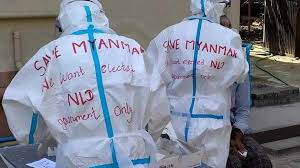
Staff at 70 hospitals and medical departments in 30 towns across Myanmar stopped work on Wednesday, February 3, to protest against the coup that ousted elected leader Aung San Suu Kyi, the newly formed Myanmar Civil Disobedience Movement said.

A statement from the group said the army had put its own interests above a vulnerable population facing hardships during the coronavirus pandemic. The virus has killed more than 3,100 people in Myanmar, one of the highest tolls in Southeast Asia.

“We refuse to obey any order from the illegitimate military regime who demonstrated they do not have any regards for our poor patients,” said a statement from the protest group.

Four doctors confirmed they had stopped work, but did not want to be identified.

“I want the soldiers to go back to their dorms and that’s why we doctors are not going to hospitals,” one 29-year-old doctor in Yangon told Reuters. “I don’t have a time frame for how long I will keep on this strike. It depends on the situation.”

Student and youth groups have also joined the civil disobedience campaign.

Reuters was unable to reach the government for comment on the doctors’ action.

The army seized power on Monday, February 1, cutting short an unsteady transition to democracy on the grounds of fraud in last November’s general election, which Suu Kyi’s National League for Democracy (NLD) won in a landslide.

The coup drew condemnation from the United States and other Western countries as the ruling generals detained Suu Kyi and dozens of other officials.

Consolditating its hold, the junta unveiled a new governing council including eight generals and headed by army chief General Min Aung Hlaing. It resembled the ruling appartus under previous juntas that had ruled Myanmar for nearly half a century until 2011.

Nobel Peace laureate Suu Kyi, 75, remains in detention despite international calls for her immediate release. An NLD official said he had learned she was under house arrest in the capital Naypyidaw and was in good health.

In the biggest public protest against the coup so far, people in the commercial hub of Yangon chanted “evil be gone” and banged on metal pots late on Tuesday in a traditional gesture to drive away evil or bad karma.

UN considers response

The latest coup is a massive blow to hopes the impoverished country of 54 million people was on the path to stable democracy.

At the United Nations, the world body’s Myanmar envoy Christine Schraner Burgener urged the Security Council to “collectively send a clear signal in support of democracy in Myanmar”.

The council is negotiating a possible statement that would condemn the coup, call for the military to respect the rule of law and human rights, and immediately release those unlawfully detained, diplomats said. Consensus is needed in the 15-member council for such statements.

But a diplomat with China’s UN mission said it would be difficult to reach consensus on the draft statement and that any action should avoid “escalating the tension or further complicating the situation.”

US President Joe Biden has threatened to reimpose sanctions on the generals who seized power.

US Army General Mark Milley, chairman of the Joint Chiefs of Staff, tried but was unable to connect to Myanmar’s military following the coup.

The Biden administration had determined the power-grab constituted a coup d’etat, triggering restrictions in foreign assistance. Humanitarian aid, including to the stateless Rohingya Muslim minority, and programs that promote democracy or benefit civil society would continue.

The International Monetary Fund said it had little hope of recovering $350 million in cash it gave to the Myanmar government days before the coup, part of a no-strings-attached emergency aid package to help the country battle the coronavirus pandemic.

Rohingya concerns

Suu Kyi endured about 15 years of house arrest between 1989 and 2010 as she led the country’s democracy movement.

The military had ruled from 1962 until her party came to power in 2015 under a constitution that guarantees the generals a major role in government.

Her international standing as a human rights icon was badly damaged over the expulsion of hundreds of thousands of Rohingya Muslims in 2017 and her defence of the military against accusations of genocide.

UN diplomats say they are concerned for the future of the Rohingya minority still in Myanmar as well as hundreds of thousands of refugees in neighboring Bangladesh.

“If we go back now, there is no security for our lives and property. We need help from the UN. We can’t go back alone,” said Rohingya refugee Absarul Zaman at a camp in Bangladesh. – Rappler.com (PA)

Diliman Commune: The Historic Barricade That Surrounded UP 50 Years Ago

0

Fifty years ago from February 1 to 9, 1971, students and faculty of the University of the Philippines built barricades around the campus, in response to the three-centavo increase in oil prices in the Philippines. But it was more than just about oil prices. It was the culmination of years of unrest due to social inequities happening around the country and also a response to Ferdinand Marcos’ looming lust for power and his witch-hunting for communists. The event is now known as the Diliman Commune.

‘Raise High the Barricades!’

It was the rallying call of the Philippine Collegian, the student publication of UP, on February 4, 1971. Days prior to this editorial, various universities in Manila called for the erection of barricades around their campuses to show their support for striking jeepney drivers. UP was among the schools that heeded the call to erect barricades. 

The peaceful assembly turned bloody when a UP Mathematics professor named Inocente Campos tried to disperse the students and shot Pastor “Sonny” Mesina Jr. This enraged the students, resulting in a massive walkout from their classes to join the barricades.

Fifty years ago from February 1 to 9, 1971, students and faculty of the University of the Philippines built barricades around the campus, in response to the three-centavo increase in oil prices in the Philippines. But it was more than just about oil prices. It was the culmination of years of unrest due to social inequities happening around the country and also a response to Ferdinand Marcos’ looming lust for power and his witch-hunting for communists. The event is now known as the Diliman Commune.

‘Raise High the Barricades!’

It was the rallying call of the Philippine Collegian, the student publication of UP, on February 4, 1971. Days prior to this editorial, various universities in Manila called for the erection of barricades around their campuses to show their support for striking jeepney drivers. UP was among the schools that heeded the call to erect barricades. 

The peaceful assembly turned bloody when a UP Mathematics professor named Inocente Campos tried to disperse the students and shot Pastor “Sonny” Mesina Jr. This enraged the students, resulting in a massive walkout from their classes to join the barricades.  ADVERTISEMENT – CONTINUE READING BELOW

The University of the Philippines described the details of what happened: 

As he (Campos) entered the first checkpoint on University Avenue, he slowed down but was not blocked by human barricades. Someone recognized him and soon pillboxes were thrown in the direction of his car. He continued driving but since a tire had been damaged, the car stopped. As students started advancing towards him, he went out of the car, put on a vest, got his shotgun from the back seat, and tried to fire to scare the students, but the gun was jammed and did not go off. He then got his .22 caliber rifle and started firing it, then drew his revolver and fired some more.

As a result of the Campos incident, a student, Pastor Mesina, Jr. was seriously wounded. He was taken to the UP Infirmary and later transferred to the Veterans’ Memorial Hospital. He died four days later.”

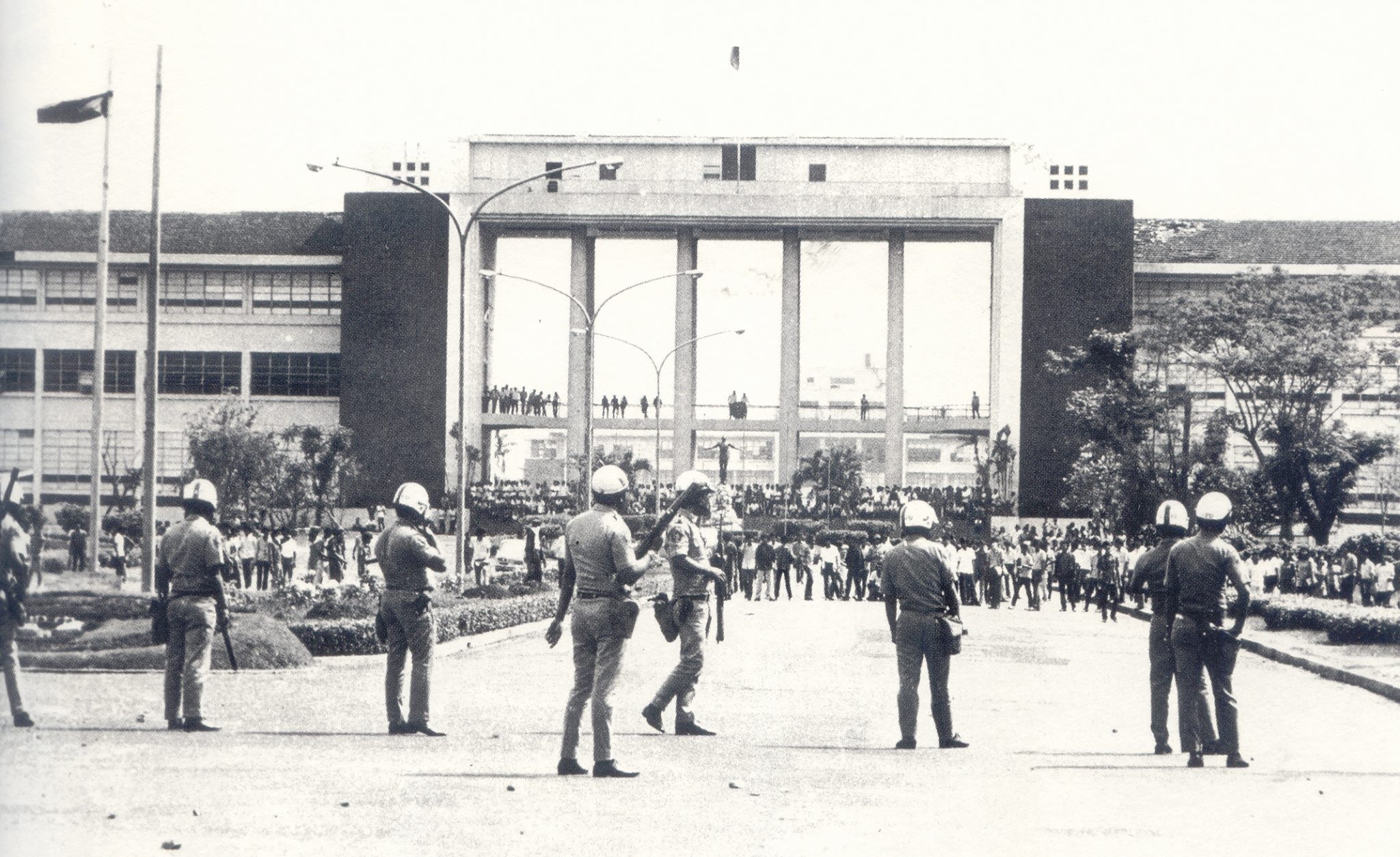
As events escalated, the Philippine Constabulary decided to intervene. They used sticks, shields, and guns to disperse the students. It was useless, as members of the faculty joined the barricade to protect their students. Professors and students raised their barricades even higher by hauling tables and chairs from their classrooms. Improvised Molotov cocktails, pillboxes, and rockets were also used to deter police from entering the University.

Raid on Sampaguita Residence Halls

The following day, on February 2, the police swiftly raided Sampaguita Residence Halls, a UP dormitory for women, after hearing reports that some of the barricaders were hiding there for refuge. It was a violent event, with defenseless students being arrested without warrants. 

According to the Collegian, dozens of students were wounded during the raids, with at least 60 suffering injuries. 

More than just a protest against rising oil prices

Days following the violence, it became clear the barricades were not merely a fight for the survival of jeepney drivers, but a fight for academic freedom and the right of peaceful assembly. 

Realizing this, students and faculty through the radio broadcasts declared UP as a liberated area from state forces. They took over the campus radio station DZUP and the UP Press to make known their demands. They also renamed the school “Malayang Komunidad ng UP Diliman” (“Free Commune of UP Diliman”).

Fifty years ago from February 1 to 9, 1971, students and faculty of the University of the Philippines built barricades around the campus, in response to the three-centavo increase in oil prices in the Philippines. But it was more than just about oil prices. It was the culmination of years of unrest due to social inequities happening around the country and also a response to Ferdinand Marcos’ looming lust for power and his witch-hunting for communists. The event is now known as the Diliman Commune.

‘Raise High the Barricades!’

It was the rallying call of the Philippine Collegian, the student publication of UP, on February 4, 1971. Days prior to this editorial, various universities in Manila called for the erection of barricades around their campuses to show their support for striking jeepney drivers. UP was among the schools that heeded the call to erect barricades. 

The peaceful assembly turned bloody when a UP Mathematics professor named Inocente Campos tried to disperse the students and shot Pastor “Sonny” Mesina Jr. This enraged the students, resulting in a massive walkout from their classes to join the barricades.  ADVERTISEMENT – CONTINUE READING BELOW

The University of the Philippines described the details of what happened: 

As he (Campos) entered the first checkpoint on University Avenue, he slowed down but was not blocked by human barricades. Someone recognized him and soon pillboxes were thrown in the direction of his car. He continued driving but since a tire had been damaged, the car stopped. As students started advancing towards him, he went out of the car, put on a vest, got his shotgun from the back seat, and tried to fire to scare the students, but the gun was jammed and did not go off. He then got his .22 caliber rifle and started firing it, then drew his revolver and fired some more. CONTINUE READING BELOW Recommended Videos

As a result of the Campos incident, a student, Pastor Mesina, Jr. was seriously wounded. He was taken to the UP Infirmary and later transferred to the Veterans’ Memorial Hospital. He died four days later.” ADVERTISEMENT – CONTINUE READING BELOW

As events escalated, the Philippine Constabulary decided to intervene. They used sticks, shields, and guns to disperse the students. It was useless, as members of the faculty joined the barricade to protect their students. Professors and students raised their barricades even higher by hauling tables and chairs from their classrooms. Improvised Molotov cocktails, pillboxes, and rockets were also used to deter police from entering the University. 

Police Officers Prepare to Face Off with UP Faculty and Students in 1971 

Photo by Courtesy of the University of the Philippines.

ADVERTISEMENT – CONTINUE READING BELOW

Raid on Sampaguita Residence Halls

The following day, on February 2, the police swiftly raided Sampaguita Residence Halls, a UP dormitory for women, after hearing reports that some of the barricaders were hiding there for refuge. It was a violent event, with defenseless students being arrested without warrants. 

According to the Collegian, dozens of students were wounded during the raids, with at least 60 suffering injuries. 

More than just a protest against rising oil prices

Days following the violence, it became clear the barricades were not merely a fight for the survival of jeepney drivers, but a fight for academic freedom and the right of peaceful assembly. 

Realizing this, students and faculty through the radio broadcasts declared UP as a liberated area from state forces. They took over the campus radio station DZUP and the UP Press to make known their demands. They also renamed the school “Malayang Komunidad ng UP Diliman” (“Free Commune of UP Diliman”). ADVERTISEMENT – CONTINUE READING BELOW https://4a323ff20d96ed7bc8968d61ae76a75d.safeframe.googlesyndication.com/safeframe/1-0-37/html/container.html

It was through the university radio and press that the name Diliman Commune came to be known. It was inspired by the Paris Commune of 1871, a socialist-led insurrection of Paris against the despotic French government from March 18 to May 28, 1871. That year was the 100th anniversary of the Paris Commune. 

A year after the Diliman Commune, Marcos declared martial law. 

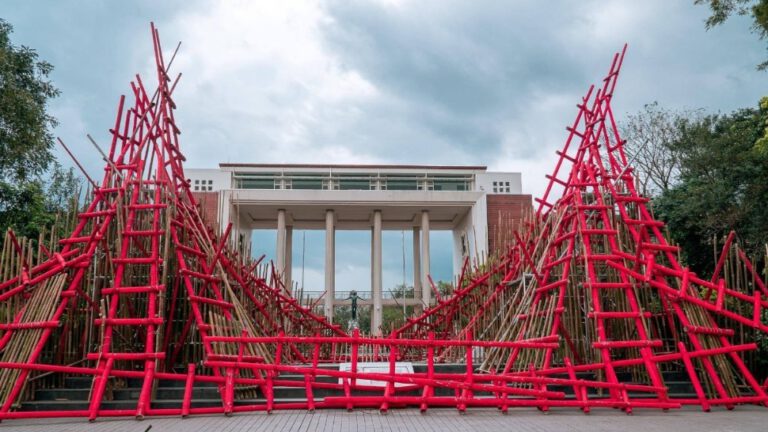
Barricades Recreated

Visual artist Toym Imao recreated UP’s barricades in commemoration of the 50th anniversary of the Diliman Commune. The materials used for the sculptures are made from repurposed materials and condemned furniture. (PA)

Why Mayor Benjamin Magalong’s Resignation Matters

0

By Paul John Cana, Esquire Philippines, 1 February 2021,

On a trip to Baguio organized by the Department of Tourism last November, I experienced firsthand how the city took stringent health protocols seriously. A negative antigen test 24 hours before your scheduled arrival, a health check on the city’s outskirts, another one in a holding area within the hotel premises (The Manor at Camp John Hay), and another one just before you enter the hotel itself—the process of getting there was the very definition of long and tedious. And masks and shields were required all throughout and wherever we went.

Clearly the city wasn’t taking any chances with the virus, despite the fact that it was one of the first to reopen its borders to tourists. 

The trip gave me a glimpse of what Baguio City’s Mayor Benjamin Magalong was trying to achieve—a delicate balance between protecting citizens from the health scare and spurring the economy to help struggling local businesses that depend so much on earnings from visitors.

That Mayor Magalong was named to an important post in the government’s Inter-Agency Task Force (IATF) against COVID-19 in July 2020 only validated his administration’s better-than-usual efforts in curbing the virus. The mayor understood what needed to be done and was clearly on top of the situation.

Which is why hearing about his involvement in that controversial party at The Manor involving a celebrity and influencer last week was surprising and incredibly disappointing. The good mayor was caught committing glaring lapses in established health protocols, lapses that he should’ve known better than to commit. After all, he was the person tasked to lead efforts that could literally spell the difference between life and death.

Taking responsibility

Almost as soon as news of the infraction made its way through social media and traditional media outlets, Magalong took responsibility for his actions and acknowledged his shortcomings.

“In hindsight, being a senior officer of the Task Force, I should have done an immediate spot correction of the errors that I witnessed during that time,” Magalong wrote in a letter addressed to IATF chief Carlito Galvez Jr.

But the mayor took it one step further and tendered his resignation from the IATF as contact tracing czar.

“Much as I have given my best to discharge my duties for the task force, this is a reminder that a higher standard is expected of me,” he said.

Malacañang has said the IATF is not accepting the resignation, but Magalong is adamant. His decision is irrevocable, he said.

To anybody following local politics, this is an unusual development. After a bungled operation, allegations of wrongdoing, or any headline-grabbing controversy, the typical next step for involved government leaders and civil servants is vigorous denial and defensive posturing. No matter the weight of evidence, pressure and admonishment from other, more senior public officials, and the crushing impact of public bashing on social media, the person in the center of the firestorm will often insist on innocence and point to political enemies as the source of the “smear campaign.” The person will cling to power tighter than a sloth clings to a tree branch.

Setting an example

This is precisely why Magalong’s decision to resign from the IATF is such a big deal. In a culture of impunity, where high-ranking officials caught committing crimes or violating ordinances and rules can not only escape punishment but actually have the gall to hold on to their posts, the Baguio City mayor is demonstrating the moral and ethical implications of being a public official. It’s not just about wielding power and enjoying the attention and respect of your constituents—it’s about setting an example for the people that look up to you.

Yes, public officials are only human, and are therefore prone to making mistakes. But what the mayor said in his statement is true: They are held to a higher standard than everyone else. When that sacred trust is broken—whether it’s due to willful negligence or a momentary lapse in judgment—a sincere apology is the least people can expect. And the truly honorable thing to do is to offer to resign in order to reinstate the integrity of the position.

And that’s exactly what Mayor Magalong did. “Mukhang may kakulangan ako (Apparently, I had shortcomings), so it’s all about accountability,” he said. It takes guts of steel to admit a slip-up; and it’s even more impressive when you’re prepared to back up that admission with a concrete step to try and repair the damage your actions caused.

After months of reports of officials and personalities allegedly breaking protocols but not being punished enough beyond a slap on the wrist, it’s honestly refreshing to hear of someone who still knows what it means to be a man of principle.

To be fair, it wasn’t just Mayor Magalong who offered to resign as a matter of courtesy and moral obligation, and not just because they were accused of any offense or misconduct. Last year, National Economic Development Authority Secretary Ernesto Pernia, Department of Information and Communications Technology (DICT) Undersecretary for Operations Eliseo Rio, and officials from the Philippine Health Insurance Corporation (PhilHealth), led by anti-fraud legal officer Thorrsson Montes Keith, all quit, citing various reasons but all somewhat related to dissatisfaction and internal conflict within their respective agencies. (In the case of Philhealth, it was because of alleged “widespread corruption” within the state health insurer).

But sometimes, it just seems like the other list—of those who ought to resign for actual transgressions—is much longer, and it’s enough to make us throw our hands up in defeat, and, well, resignation. (PA)

PETA Wants You to Stop Saying ‘Hayop Ka,’ Then Provides Alternative Insults

0

By Mario Alvaro Limos , Esquire Philippines, 29 January 2021

“You’re a pig!” That’s just one of the statements you should stop using, according to the People for the Ethical Treatment of Animals or PETA. Pigs have feelings too.

According to PETA, it is not right to use animals to refer to human behavior that is usually frowned upon by society. 

“Anti-animal slurs degrade animals by applying negative human traits to certain species,” PETA said in a statement. “Calling someone an animal as an insult reinforces the myth that humans are superior to other animals and justified in violating them.” 

PETA described the animal slurs as “supremacist language” by humans. It also referred to the language as “speciesism.”

Stop using pigs as an insult.

Of all the animal slurs, being called a pig is one of the most used phrases around the world. It is used to refer to perverts, people with poor hygiene, or anyone who’s an object of disgust. 

“Pigs are intelligent, lead complex social lives, and show empathy for other pigs in distress,” said PETA in a tweet. 

The same goes for snakes. “Snakes are clever, have family relationships, and prefer to associate with their relatives,” said PETA.

“PETA urges everyone who believes in equality and justice to take a look at their personal beliefs and the language they use, and break free of this outdated mindset that denigrates other animals.”

Other animals who are victims of slurs include monkeys (unggoy ka) birds (You’re a chicken / bird-brain), and crocodiles or alligators (buwaya sa kongreso).

PETA came up with a list of words to use when referring to negative human traits.


What’s the takeaway from all this? “Always be kind and consider not using insults at all,” said PETA. (PA)