Home Blog Page 102

Taal Basilica seen in whole new light

0

Following its recent restoration, 142-year-old church gets architectural lighting treatment for Christmas, highlighting its dignity and splendor

By: Marge C. Enriquez, Philippine Daily Inquirer / November 25, 2020

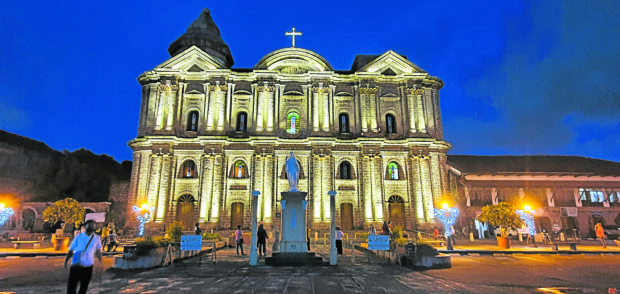
Before sunset, Taaleños eagerly gathered around the patio of the Minor Basilica of San Martin de Torres. By dusk, darkness shrouded the basilica’s silhouette to reveal the warm lights that enhanced the pillars and the roofline. When the Madonna and Child lanterns, the string lights around the topiary bushes, lamp posts with wreaths and the basilica’s giant star were illuminated, the locals clapped and cheered.

This was the first time in the 142-year history of the Taal Basilica, as it is commonly known, that the patio was decked tastefully with Christmas decorations. It’s the second time since 2015 that architectural lighting design has been used to highlight the basilica’s importance to the community.


Architectural lighting designer Georgina “Mia” Protacio was tasked by the Taal parish to customize lighting systems that would create an elegant building at night, enhance an environment conducive to worship and highlight symbolic details.

Parish priest Fr. Manuel Guanzon explained that the lighting design and the Christmas décor were offshoots of the basilica’s recent restoration by the National Historical Commission of the Philippines.

“There is joy in the Basilica’s renewal and we wanted to convey this through the lighting,” he said.

Lighting hierarchy

For Protacio, the Taal Basilica is a prestige project as it is Asia’s largest Catholic Church which can accommodate 1,500 parishioners. Standing on a hilltop, the bell towers, the dome and gables are visible from different directions. When lit at night, they become like beacons of glory for Taal.

Trained in Sweden and London, Protacio draws from the rich tradition of heritage churches in Europe. She learned that the lighting design must exercise prudence in giving the right amount of emphasis and support without becoming bold or glaring.

“The church is a sacred ground so the design should be discreet yet dramatic and uplifting,” said Protacio.

LED lights are used not only for their economy but because they also highlight textures such as the adobe bricks of the façade. The play of light and shadow at night focuses on the façade’s important details. The uplighting, light projected upward, emphasizes the majesty of the pillars, while the shadows suggest the humble character of the Basilica.

Protacio explained that nocturnal lighting must be symbolic. “At 5:30 p.m., you see light at base of the pillars. As it darkens, you see more light. Highlighting the pillars emphasizes their height. Shadows are important because they add depth of space. The idea is to show the dignity and splendor of the basilica.”

She pointed out that the cavernous interiors of the basilica produced uneven lighting even at daytime. The design plan enhances the natural light and augments the dark corners. The lighting of the ceilings and walls are indirectly lit by hidden lighting sources. “The experience of the space must be soothing not glaring,” she said.

During daytime, the lighting draws attention to the altar. It also helps the churchgoers to focus on the liturgy while the priest can also see the audience’s faces without the glare.

“The artificial lighting should look as natural as daylight. It likewise showcases the exquisite trompe l’oeils,” said Protacio.

At night, the light and shadow emphasize the rhythm of pilasters, the shallow rectangular columns projecting from the wall, to accentuate the basilica’s grandeur. The sanctuary of Our Lady of Casaysay, Taal’s guardian, glows in the darkness as if to represent hope.

Security

More than ever, the Taal Basilica’s role has become more important to the community.

“We were only closed for a few days when we cleaned up the ashfall from the Taal Volcano eruption,” said Father Guanzon. Fortunately, the basilica was spared from the volcanic flare-up last January.

During the lockdown, Taal Basilica continued its daily Masses with physical distancing despite reprimands from the local goverment.

“We can’t stop the devotion of the people. The church is a place of refuge for them especially in these difficult times. They should not be barred from entering House of God,” said Father Guanzon.

Upon the ease of restrictions, Taal Basilica has been holding regular services following the government-sanctioned 30-percent capacity. That’s an average of 500 people or three for each pew on a Sunday or a wedding.

The lighting has likewise provided security around the grounds. In the past, couples were caught canoodling on the benches and dark corners. Today, the basilica’s brightened patio has become like a plaza. Taaleños enjoy leisurely strolls, take selfies or walk their dogs. A family once had a picnic in the car, replete with pots of rice and viands and paper plates.

The lighting design has fulfilled the basilica’s requirements while enhancing the Baroque architecture and the religious art, said Father Guanzon.

“Lighting inspires. It is a reference to God as Light. A well-lit church makes one feel His presence and the people become alive,” he said. —CONTRIBUTED INQ

More heritage bridges under threat

0

‘Important cultural properties’ in Tayabas, Quezon, could become casualties of road widening project

By: Edgar Allan M. Sembrano, November 23, 2020

Tayabas, the former capital of Tayabas (now Quezon) province, is the only area in the country where a large concentration of extant Spanish colonial bridges is found.

In all, there are 21 puentes and puentecitos (big and small bridges) in the city, half of which are declared National Cultural Treasures (NCT) by the National Museum.

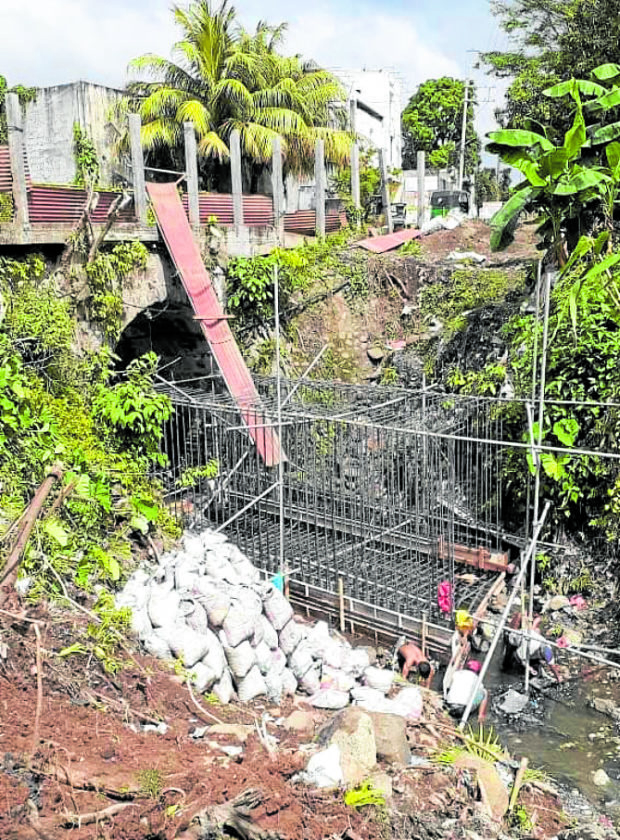
However, these bridges are subject to road widening projects by the Department of Public Works and Highways (DPWH) which affect the visual and structural integrity of these bridges by constructing new concrete right beside the old ones such as Puente de Gibanga in Barangay Gibanga in 2017, Puente de Ese in Barangay Camaysa in 2019, Puente de Princesa in Barangay Ibas in 2019 and Puente de Baawin in Barangay Baguio this year.

This is despite the enactment of the National Cultural Heritage Act of 2009 and the DPWH circulars on the protection of heritage sites and structures from road widening projects.

These are Department Order No. 138 by then Public Works Secretary Rogelio Singson in December 2014, Memorandum Circular No. 2 in April 2018 by Public Works Secretary Mark Villar, and Department Order No. 12 series of 2019 in February that year also by Villar.

Unfortunately, even more heritage bridges are under threat today due to a road widening project along the Tayabas-Sariaya Road.

Seven mostly unnamed bridges are to be affected, two of which still have their parapets intact. These are located in Barangays Baguio, Malaoa, Potol and Kalumpang.

Cultural properties

These bridges, according to local historian Ryan Palad are presumed important cultural properties under the heritage law and included in the Philippine Registry of Cultural Property of the National Commission for Culture and the Arts (NCCA), and thus must be protected from modification and demolition.

He criticized the “desecration” of these bridges despite their historical, cultural and architectural significance.

“When we got the NCT declaration for our bridges, we were made to believe that these bridges and the visual settings and fabric will forever be protected and will remain as authentic, as original as possible,” he said.

Unfortunately, much had been sacrificed in the past plus these additional seven which were built sometime in the 1850s, he added.

Despite their importance, he said, it is saddening that “these are still subject to expansion, desecration and destruction.”

In a statement, the local government’s heritage arm, Oplan Sagip Tulay (OST) Tayabas Heritage Group Inc., assured the heritage sector and the public in general the protection of the city’s cultural patrimony which includes these bridges.

“We are with you in the continued care, protection and maintenance of Tayabas’ cultural treasures,” said OST president Michael Vincent Pabulayan in Filipino.

Pabulayan also said that it is important that the heritage structures are declared by national cultural agencies so that their protection and conservation are assured, adding that the group supports the declaration of other structures in the city such as the Spanish-era stone crosses, chapels and the small bridges.

“Our colleagues in the heritage sector know that the heritage law and local ordinances are not enough in preventing those that would like to destroy a cultural property.”

He called for coordinated efforts among stakeholders in the protection and conservation of Tayabas’ heritage properties, not just its famed bridges.

He likewise stressed the need for incentives for heritage owners for protecting and maintaining their properties just like what other cities did such as San Fernando in Pampanga and Silay in Negros Occidental which give a hundred-percent tax relief for heritage owners.

Heritage base map

A recent online discussion attended by local stakeholders and heritage professionals was organized by the Tayabas studies and creative writing center Atagan and Tuklas Tayabas historical society for the purpose of having a collective move on the protection of the city’s built environment.

In the program, Michael Manalo of the National Committee on Monuments and Sites of the NCCA shared that coordination between the latter and DPWH is underway regarding the creation of heritage base map that the latter can use to overlay their plans.

Manalo said the purpose of this move is to protect the nation’s national patrimony, such as bridges, from road widening projects which have affected a number of structures in recent years.

In the same online event, Tayabas resident and retired teacher Fredeswinda Carillo said she hopes the discussion and the situation of the city’s heritage would “arouse the feelings” of pertinent agencies and authorities especially the DPWH and the local government for these to act in the preservation and conservation of the historic edifices of Tayabas. —CONTRIBUTED


Spanish as language has waned in PH, but can make comeback

0

Reflections on the upcoming 500th anniversary of Philippine-Spanish relations in 2021

By: Virgilio A. Reyes Jr., November 23, 2020


When I was growing up in Manila in the 1960s and ’70s, the Spanish language was no longer as vibrant as it had been in the prewar era, when Filipino poets such as Jesus Balmori or Fernando Maria Guerrero reigned.

Hardly anyone spoke Castilian in the streets or in the halls of Congress. I was later told that it was still spoken in Malacañang up to the time of President Diosdado Macapagal (1961-1965).

Spanish was cultivated in elite social circles and schools favored by the Filipino Hispanic mestizos like De La Salle College, San Juan de Letran or San Beda College for boys and Assumption Convent and St. Scholastica’s College for girls. The stronghold of the Hispanistas was in the venerable University of Santo Tomas, run by Spanish Dominicans.

There was a clear cultural divide between these “old school” institutions and the vanguard of the Jesuit Ateneo de Manila (Rizal’s alma mater now run by Americans) and the University of the Philippines or Silliman University in the south, both founded during the American era. In these latter schools, English was king, which represented everything that was modern, progressive and up-to-date. Those who mastered English were also sure to succeed in these schools as well as in their later careers.

Relentless campaign

Though there were still some Spanish newspapers like El Debate, these were not as widely distributed or as read as the English newspapers like Manila Chronicle, Manila Bulletin, Manila Times or the Herald or even the Tagalog publications like Taliba or local comic books.

Filipino films in Spanish had disappeared. Young men and women entering journalism were more likely to hone their expertise in the English language rather than the idiom spoken by their grandparents. Rare were those writers like Carmen Guerrero-Nakpil and her brother Leon Ma. Guerrero, who were fluent in both languages. In other words, the relentless campaign that the Americans had led during their dominance from 1898 up to 1946 (with the Japanese interregnum of 1941-1945) to establish English as the primary medium of communication had succeeded, at the cost of Spanish (formerly the lingua franca) and the local languages.

Though in theory Philippine independence had been granted in 1946, America’s soft power was still exercised through the educational system and the media, which echoed much of the trends occurring in the American mainland. If there was any doubt about this, there were still the messages supplied by the powerful American military bases on Filipino territory and the Catholic private schools run by foreign orders, who supported the use of English as a medium of instruction.

Native patois

The war had devastated the physical centers where Spanish had been spoken in Manila such as Intramuros, Ermita and Malate. Curiously, a native patois had developed there, a mixture of Spanish and Tagalog called lengua de tienda.

Caught up in the rebuilding of their newly established nation and dependent on American support, Filipinos—who were now more conversant in English than in Spanish—could hardly be expected to fight for the preservation of a language associated with their former colonizer, which had itself been relegated to a second-class status.

In addition, Spanish suffered from the reputation of being a “snob language” spoken by elitist people (later labeled the “coño kids”) who did not wish to rub elbows with the masses. Filipinos did not know that in Latin America, Spanish was a street language and even a revolutionary one.

On my paternal side, my great-grandparents had spoken Spanish in school and at home. My great-grandfather Don Eduardo Reyes (whose brother Jose had been known as Pepeng Kastila) had been gobernadorcillo or town mayor of Maragondon, Cavite, and his mother, Romana Arguelles, was a full-blooded Spaniard from Cadiz. Records of their births, marriages and deaths are still extant in elaborate Spanish in the archives and in the parish church documents of this historic town, where the hero Andres Bonifacio was tried in our ancestral home.

On my mother’s side, mainly from the old districts of Binondo and Malate in Manila, my great-grandfather Felipe Tempongko (who was of Chinese Malay origin) and his part-French wife Leocadia Lheritier had been schooled in Spanish and spoke this alongside Tagalog with their children. The next generation, studying in public and sectarian schools, was now more at ease with English.

My mother had spoken Spanish as a child (making up her own words such as “bicicletar”) but had switched to English when she entered school. She remembered that her Lola Leocadia mostly read penny novels in Spanish and was delighted to say the occasional English word like “fish.” She spoke with her grandmother in Tagalog.

I spoke English and Tagalog at home and was vaguely aware of Spanish, spoken at times by older people like my grandmother, Esther Tempongko-Alcantara, and her cousin, Flora Ongpin-Heras. These ladies had experienced the full splendor of Spanish as a dynamic language of Manila in the 1930s and ’40s.

At De La Salle College, where my brother schooled, and at St. Scholastica’s, frequented by my cousins, the Spanish mestizos would loudly share answers to quizzes with each other in their exclusive tongue. The unfortunate offshoot of all this was the impression that Spanish was a tongue only for the rich and the privileged.

That was a world that we did not seem to share until one day, on my own at age 14, I began to explore Intramuros and determined that I should learn the language. It was around this time that Nick Joaquin’s stories had also begun to make an impression on me.

My grandmother Esther (or Eya, as we called her) was the first person with whom I could begin to speak this language. Tellingly, a maternal aunt was annoyed that I would try out my Spanish on her, as if I was putting on airs. I remembered stories from a paternal aunt who said that she and her siblings found it a silly and laughable venture when a Spanish tutor was hired by their father to teach them the language. It was the equivalent of being taught a few bars of piano music, to be conveniently forgotten at the first instance.

Weight of centuries

All told, Spanish was badly taught at academic institutions. A law which required college students to study 24 units of Spanish, equivalent to a full semester out of eight required to graduate, proved to be ineffectual. Generations of students so taught were unable to complete the most fragmentary of sentences or to comprehend simple stories or anecdotes. The minimum that most students ended up with were a few stanzas of Jose Rizal’s “Mi Ultimo Adios.” Unlike before the war, there were no Spanish films in the cinemas, no radio programs (let alone television) or theater in Spanish and few cultural centers or libraries for Spanish books. This was a natural consequence of the waning of the Hispanic presence in the Philippines, which had been supplanted by the American one.

For a budding enthusiast such as myself, such a situation was only remedied by self-study and by the encouragement of dedicated teachers in college (by which time, the requirement to study Spanish was reduced to only 12 units).

This would lay the groundwork for my studies after graduation in Instituto de Cultura Hispanica in Madrid as well as my assignments as a career foreign service officer in Mexico and in Chile. Coinciding with my Latin American stints and the celebration of the Centenary of the Philippine Revolution in 1998, I wrote and published a book in Spanish titled “La Revolucion Filipina: El Nacimiento de Una Idea.” (Santiago de Chile, 1998)

My knowledge of Spanish not only helped me in my diplomatic career but enabled me to pick up French and especially Italian since I would end my 35-year tenure as Philippine ambassador to the Italian Republic. Having been assigned as well at the Philippine Mission to the United Nations in New York, I knew how Spanish could be a bridge to the Latin American nations at this international body. This continued in my assignments in other countries, where the Hispanic link to Latin America proved to be valuable.

Spanish today in the Philippines no longer carries the weight of centuries of colonization. It is regarded as one language among many that can mean revenue for those who work abroad or in the call centers that are one mainstay of our economy.

For students no longer required to study it, Spanish opens a door to those who might wish to understand its culture better, whether in the arts, architecture, heritage or cuisine. A lecture at Instituto Cervantes in Casa Azul in Intramuros now draws young crowds spontaneously.

With the advent of social media and the ease of international travel prepandemic, learning Spanish and communicating with Hispanic speakers across borders is now painless and economical. Filipinos with their variegated culture and broad international exposure may yet prove to be the bridge between the Hispanic and Anglo worlds in this era. Notably, a Miss Philippines was chosen to be Miss Latin/Hispano America in a beauty contest, setting a new trend.

My own hope is that a new generation of Filipinos may be motivated on their own to learn to feel the ardor of “El Himno Nacional de Filipinas” in the original Spanish and to recite “Mi Ultimo Adios” with full awareness of what Jose Rizal meant in his original words. That is when the Philippines will no longer be “Nuestro Perdido Eden.” —CONTRIBUTED

The author is a career diplomat of 35 years, serving as Philippine ambassador to South Africa and Italy. He is now retired, engaged in writing, traveling and pursuing cultural heritage projects. He is launching two books today and tomorrow, “Nuestro Perdido Eden” (a novella) and “A Memory of Time” (a collection of essays).

Philippines aims to vaccinate 60M-70M people in 3 to 5 years

0

Nov 25, 2020, Pia Ranada

MANILA, Philippines

The government has identified 35 million Filipinos who will be given the first batch of COVID-19 vaccine doses

Once a COVID-19 vaccine is approved by Philippine authorities, the government aims to vaccinate around 60 million to 70 million of its citizens in 3 to 5 years, said the country’s vaccine czar Carlito Galvez Jr.

“More or less 60 to 70 million [people], we will do this in a 3- to 5-year period,” he said in a virtual press briefing on Wednesday, November 25.

This number of people corresponds to roughly 60% to 70% of the country’s 107 million population.

The government is capable of vaccinating only 20 million to 30 million Filipinos a year, he added.

Going by the government’s “best case scenario” estimate that a vaccine will become locally available by April to June 2021, it would mean that 60% of the population should have been vaccinated by 2024 to 2026.

But Galvez’s “worst case scenario,” which he also termed as the “realistic scenario,” is that the government’s vaccine distribution will start late 2021 or early 2022.

35 million Filipinos in ‘priority list’

With this schedule in mind, the coronavirus national task force has already come up with a list of 35 million people who will get the vaccine first.

“We have a list of more than 35 million Filipinos who are in the priority list. That was given by the DOH (Department of Health), based on the guidance of our President,” said Galvez.

Advertisement

The list includes healthcare workers, frontliners like police, soldiers, and essential workers of the social welfare and education departments, poor households, and indigents, he added.

President Rodrigo Duterte previously said he wanted to foot the bill of COVID-19 vaccination for all Filipinos. But Finance Secretary Carlos Dominguez III only announced a funding target of P73.2 billion to inoculate 60 million people.

Preparations for cold storage

Galvez said the task force is negotiating with a consortium of companies that can provide ultra cold storage facilities required to distribute some vaccines, like those being developed by Pfizer and Moderna.

The next 6 months, he said, would be spent preparing the logistics of this equipment, as well as storage facilities for vaccines that would need only 2 or 8 degrees Celsius to keep.

What the task force is busy with is ensuring that there is adequate funding for vaccination logistics.

Galvez said the task force is asking lawmakers to include P150 billion for logistics and distribution in the 2021 national budget, which is now being threshed out in the Senate. This P150 billion amount was first proposed by Senate President Pro Tempore Ralph Recto.

“We spoke with Congress and the Senate. It should be included there because the P2.5 billion initial [fund] is just for an initial 3 million vaccines for essential health workers,” said the vaccine czar.

The Philippine Food and Drug Administration is now waiting for countries like the United States, China, and India to approve the vaccines being developed by their firms. Only then can the FDA also issue emergency use approval, as ordered by Duterte.

While the government is securing supply for priority sectors of the population, private companies are also moving to secure doses for their employees. It’s likely that Filipinos willing to pay for vaccination could get inoculated even before the government’s vaccination efforts reach them. – Rappler.com

Government response to typhoons, pandemic leaves students up in protest

0

(Philstar.com) – November 23, 2020

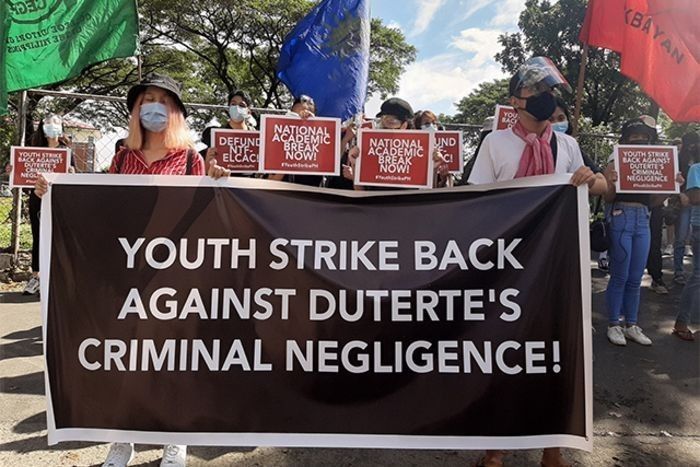
MANILA, Philippines — Ateneo de Manila students on Monday called for a nationwide academic break as part of its demands to hold government accountable for its response to the recent typhoons and the coronavirus pandemic that has hit the country, describing the situation as a result of the “criminal neglect of the State.”

“We do not strike as a way to exempt ourselves from academic life, for it is precisely to fight to return its value,” the strike manifesto read. “We invite our fellow youth nationwide. Together, in our collective action, we strike for not just our education, but a country that we can be proud of.”

Apart from an academic break, other demands include schools easing the workload for both students and faculty in the wake of the typhoons, as well as providing alternative learning resources for those far-flung areas without stable internet connection. 

And as for the pandemic response, the Ateneo students called for an end to “military-centric” solutions to a health crisis, such as putting medical experts instead of military officials in charge of dealing with the situation at home. 

Signatories, which had reached at least 500, vowed to begin the strike beginning Wednesday, November 25 followed by protests come November 30 if their demands are not met. 

“We believe in the power of students,” the manifesto read. “It is because of the continuous government negligence in disaster relief, because of their wanton disregard for human life and dignity, and because of their disastrous education policies that we strike.”

They also called on the school administration to back their call, after the Jesuit-run university over the weekend disowned the recent protests as school-sanctioned.

Government had since rejected calls for a nationwide, let alone an academic break in Luzon that now finds itself under a state of calamity, with Palace spokesperson Harry Roque warning that signatories are only bound to fail. 

The cost of damage from Typhoon Ulysses, the recent to hit the island, was pegged at P12.9 billion, Super Typhoon Rolly with P17.8 billion and Quinta with P4.2 billion. The storms that made landfall in just a short period of time, had left scores dead and millions displaced, with provinces submerged. 

In the University of the Philippines, students and faculty have petitioned for an immediate end to the semester, citing the “unjust workload and mental burden on top of the anxieties that the pandemic has inflicted.”

“With only three weeks left to finish the semester, discounting the time needed to recover by those affected by the recent typhoons, the pressure to finish the remaining days of the semester has exacerbated to the point of inhumanity,” read the petition with over 270 faculty members signing. 

Commission on Higher Education Chairman Prospero de Vera last week bucked the possibility of this, suggesting that universities instead extend the duration of the first term to early next year. 

Recently, the student council of the University of Santo Tomas also joined a growing chorus for an academic break, as well as urging government to better its disaster response and for President Rodrigo Duterte to step down. 

“The president’s persistent failures to fulfill his duties are more than a call for aid and assistance; it is a gross manifestation of his clear inability to lead the country,” said the council in a statement. “It is a call for him to resign, with what little dignity he has left.”

The threat of an academic strike has stirred a national conversation over the past week, especially with the matter apparently getting airtime in the president’s weekly public address, where he threatened to defund UP despite the initiative coming from Ateneo. 

While Palace had since sought to clarify that Duterte may have mistaken this, lawmakers have shot down the possibility, saying state universities and colleges are “no-cut zones.” — Christian Deiparine

Hunger crisis in Philippines may worsen — Nograles

0

Alexis Romero (The Philippine Star) – November 23, 2020

MANILA, Philippines — The hunger problem may worsen because of the effects of the coronavirus pandemic and the successive typhoons that battered the country, a Palace official said over the weekend.

“Because of COVID and Typhoons Rolly and Ulysses… I won’t be surprised if there are no improvements when the SWS (Social Weather Stations) conducts its survey this coming December,” Cabinet Secretary Karlo Nograles told radio station dzRH in Filipino last Friday.

An SWS poll indicated that the proportion of families who experienced involuntary hunger at least once during the third quarter has reached a new record-high of 30.7 percent or about 7.6 million households. The figure surpassed the previous record of 23.8 percent in March 2012.

Citing United Nations data, Nograles said 690 million people were experiencing hunger worldwide before the pandemic. The number may rise by 83 million to 132 million because of the impact of COVID-19, he added.

Nograles, the head of the administration’s hunger task force, noted that the Philippines ranked 69th out of 107 countries in the Global Hunger Index with a “moderate” hunger level.

“This is urgent. We have to do something to solve the problem of hunger,” he said.

Nograles said government agencies and private groups are working together to address the problem.#

COVID-19 vaccine: The next steps

0

Nov 21, 2020, Agence France-Presse

WASHINGTON, DC, USA

Here are the next steps in the approval and distribution process for a coronavirus vaccine

With US pharmaceutical giant Pfizer and its German partner BioNTech applying for an emergency use authorization in the United States for their coronavirus vaccine and US biotech company Moderna expected to do so soon, here are the next steps in the approval and distribution process:

Evaluation begins right away

The US Food and Drug Administration (FDA) will immediately begin evaluating the results of the COVID-19 vaccine clinical trials conducted by Pfizer/BioNTech.

They will concentrate on the safety of the vaccine and its effectiveness, which has been billed at 95 percent by Pfizer/BioNTech.

FDA commissioner Stephen Hahn said the approval process will include a public meeting of the FDA’s vaccine advisory committee, which includes experts in infectious diseases, pediatrics, biostatistics and industry representatives.

The committee’s recommendations are not binding, however, and a final decision on whether or not to authorize the vaccine will be up to the scientists at the FDA.

Green light: December

The FDA could provide emergency authorization as soon as the first two weeks of December, according to Moncef Slaoui, the chief scientist for “Operation Warp Speed,” the US government initiative to develop a COVID-19 vaccine.

It would be a conditional approval in the context of the global health crisis and would restrict distribution of the vaccine to certain members of the population.

Children, for example, would not be included because Pfizer has not yet conducted widespread testing of the vaccine among those under the age of 18.

Another US government agency, the Centers for Disease Control and Prevention (CDC), would determine the order of priority for distribution of the vaccine.

Front-line medical workers and elderly residents of nursing homes would probably be among the first to be inoculated.

In Europe, Britain, Canada, Japan and Australia, the process is slightly different and regulators there have been constantly reviewing the data from clinical trials being conducted by several manufacturers.

The European Union could give a green light to a vaccine as early as the second half of December, according to European Commission president Ursula von der Leyen.

Distribution: Late December

Pfizer/BioNTech said doses of the vaccine would be ready for distribution “within hours” after US authorization, which could mean shipments beginning in the second half of December.

They would initially be provided by a US factory in Kalamazoo, Michigan, and a Belgian plant in Puurs.

The vaccine must be stored at -70 degrees Celsius (-94 degrees Fahrenheit), temperatures much colder than those of a standard freezer.

Pfizer would distribute the doses to vaccination centers in containers filled with dry ice which should keep the vaccine at the required temperature for 15 days.

Next vaccines: Early 2021

The Moderna Covid-19 vaccine could be ready for distribution soon after that of Pfizer/BioNTech and could be followed by February by that of Johnson & Johnson, according to Slaoui, with AstraZeneca/Oxford also expected in the next few months.

While high-risk groups will be the first vaccinated, the US government hopes that there will be enough vaccines by April 2021 to offer it to the broader population and provide high coverage by the summer. – Rappler.com

Ulysses is another wake-up call

0

Opinion, Bworldonline.com

VANTAGE POINT by Luis V. Teodoro

The fourth in the month of November, Typhoon Ulysses was aptly named. Like the hero of Homer’s Odyssey, it meandered through a vast expanse of land and sea. Its broad rain band deluged almost a third of the Philippine archipelago, and as it crossed Luzon its winds destroyed crops and left entire provinces and regions in ruins, while the floods its waters brought cost thousands their homes and belongings and even took the lives of, at the latest count, 73 Filipinos.

Whether flood, earthquake, fire, or volcanic eruption, every disaster swells the ranks of the poor and makes the already needy even more destitute. Typhoon Ulysses was even more devastating than its predecessors in the number of deaths it left behind, its adding to the numbers of the poor in these islands, and making the already desperate straits of thousands even worse.

It left little doubt that the lives of hundreds of thousands have been devastated by its power. But it is not only the destruction it wrought and how this or that government agency claims to be responding to it that should occupy the populace in its aftermath. As the fourth typhoon to smash into the Philippines during this month of uncertainty, Ulysses and its severe weather antecedents are another wake-up call among many others for government to address the urgent need to improve its disaster preparedness beyond rescuing survivors, counting the dead, and enumerating how many are in evacuation centers and receiving food packs.

Even more urgent is cutting the number of casualties and limiting the economic consequences of calamities by proactively making sure that there will be fewer or no deaths the next time, and that the livelihoods and property of the populace are protected enough so fewer survivors add to the already burgeoning legions of Philippine poor.

There have indeed been other reminders of the urgency of that need. There was Typhoon Ondoy in 2009. Last year, six earthquakes and two mega-typhoons cost the Philippines hundreds of deaths and the loss of billions in the agricultural sector and in infrastructure damage. Thousands became poor and poorer from those catastrophes, and added their number to the already huge total of Filipinos — estimated at some 21.9 million — already in dire need.

These catastrophes won’t be the last. It is not only because the Philippines is home to 24 active volcanoes and is in the Pacific Right of Fire, but also because of the increasing frequency of typhoons’ making landfall and their growing intensity that global warming is generating.

In 2017 the government’s own National Anti-Poverty Commission (NAPC) warned that from 50 to 60 million more people could be suddenly impoverished by the loss of employment, the death of a breadwinner, a serious and costly illness, or — as the next months after typhoons Rolly, Siony, Tonyo, and Ulysses will be demonstrating — the vagaries of nature.

Some of these perils can be mitigated by sound public policy. The impact on families of the sudden loss of employment many have experienced because of the COVID-19 pandemic, for instance, could have been eased by government aid, but that supposed policy has been erratically implemented, with thousands complaining that they have not received the promised assistance. In addition to that predicament is the loss of homes and belongings from flooding that has mostly afflicted the poor and disadvantaged.

Sound public policies can help prevent the economic and social catastrophes that further impoverish the poor. But natural disasters cannot be prevented and are a fact of existence in this country. The Philippines is ninth in the world among the countries most at risk from natural disasters. Not only is 70% of its population likely to lose homes, crops, kin and even their own lives to them. It is also among the most likely, as Ulysses and company have proven, to suffer the effects of global warming. But even more powerful typhoons will endanger the population, say climatologists, and parts of the Philippine landmass, if not all of it, can even go underwater as the polar ice caps melt and sea levels rise.

That global warming can be remedied only by the worst polluter countries’ reining in the greed of their corporations, their consumption of fossil fuels and their use of coal does not mean that nothing can be done by countries like the Philippines that do not have the same economic power as China and the US. Their impact on people’s lives and society as a whole can be mitigated by a coherent, well thought-out national disaster mitigation plan.

Such a plan can be crafted only by an interdisciplinary, multi-sectoral commission of environmentalists, climatologists, hydrologists, communication specialists, economists, social welfare experts, political scientists, engineers, and other authorities in their respective fields. If it is to succeed, the commission cannot be composed of ineffectual bureaucrats in office solely for their services, closeness to, and collaboration with power. It is equally necessary to provide sufficient funds not only to enable the government to provide disaster victims assistance but also to allow the commission to complete and implement its disaster mitigation strategy.

That strategy could include the construction of the permanent, earthquake- and flood-proof evacuation centers that have long been proposed by climatologists in the country’s most disaster-prone areas such as Eastern Luzon, the Bicol region, Eastern Samar, and Leyte. Levees and dikes could also be erected along the country’s major rivers, those rivers dredged, and a system of offshore water gates to mitigate the impact of storm surges built.

Environmentally destructive activities such as logging and quarrying should be stopped. Government infrastructure projects like dam-building in critical areas must be abandoned, and raising the capacity of existing dams seriously considered. Because information is vital during emergencies — some residents in affected areas complain that they had no access to free TV and radio and were therefore unprepared when Ulysses smashed into their communities — the commission should recommend, and work for, the reorientation of government policy away from its present anti-free expression and press freedom focus to the protection of those rights.

Rather than spend millions on such Department of Environment and Natural Resources (DENR) follies as the crushed dolomite beach project in Manila Bay, as proposed by the University of the Philippines Marine Science Institute (UP-MSI), the Bay periphery could be planted to mangrove to rejuvenate its waters and help reduce the impact of the storm surges that usually flood Manila’s, Batangas’, Cavite’s and other areas’ shorelines.

The country can no longer afford the reactive, patchwork, often delayed and limited response of the government. The number and increasing power of the calamities that struck the country this year and their undeniably widespread impact should provide proof enough of both the inadequacy of the P15-billion disaster response budget for 2020, and of the need for a proactive response to the Philippine manifestations of the global warming threat to all of humanity.

In recognition of their all too obvious limitations, the officials of this government can best serve the nation by engaging experts in the tasks of disaster mitigation and in developing a comprehensive national plan to address calamities. They can also funnel to its crafting and implementation the trillions in locally-sourced funds and the billions in foreign aid and loans that every year are dissipated on infrastructure and other projects that are of little benefit to the people. Ulysses’ wake-up call shall have then served its purpose.

Luis V. Teodoro is on Facebook and Twitter (@luisteodoro).

www.luisteodoro.com