Home Blog Page 106

Not only Marikina and Rizal: Isabela submerged, too; appeals for aid

0

By: Gabriel Pabico Lalu – Reporter INQUIRER.net / November 13, 2020

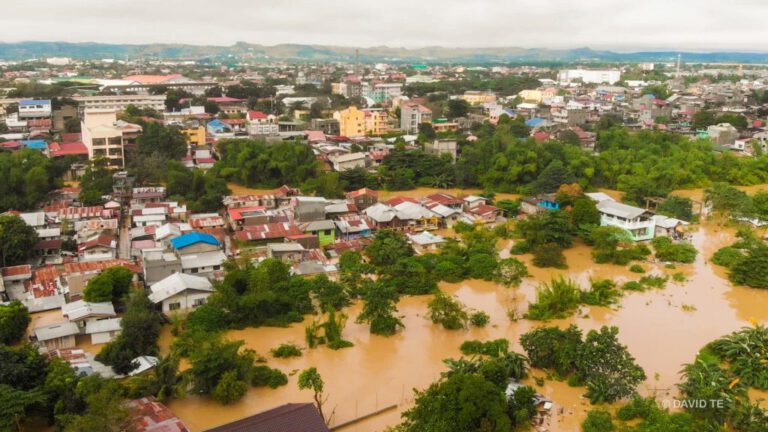
MANILA, Philippines — Residents of Sta. Maria town in Isabela province have called on the government for assistance as they also experienced massive floods due to Typhoon Ulysses.

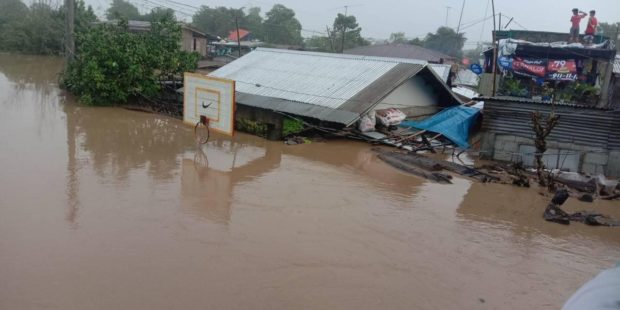
Photos sent to INQUIRER.net by Ronald Gatan, a resident of Barangay Quinagabian in Sta. Maria showed waters already reaching up to the second floor of their house, forcing them over the rooftop where they might spend their Friday night.

Gatan, however, said he actually thinks his family is doing better because they can stay on the rooftop; he thought of neighbors whose single-story houses were completely inundated by the flood.

Still, he worried because their food supply is running thin.

“As of now, paubos na wala ng stock wala pang nagbibigay ng relief goods,” Gatan told INQUIRER.net.

(As of now, we are running out of stock, they haven’t given any relief goods.)

He said the local government advised them that flooding might occur, but they did not expect such immense flooding — especially that water never reached as high as it did now than in the previous storms.

“As of now, ok na kami dito sa rooftop kasi mataas [naman] dito.  Then ‘yung ibang tao nai-rescue na sila nasa evacuation area na sila,” Gatan explained.

(As of now, we are doing better than others because we are on the rooftop and this is quite high. Other residents were rescued and brought to evacuation areas.)

“Pero ‘yung mga mababa ang bahay lahat ng gamit lubog na sa baha. May abiso naman sila kaso hindi expected ganito kalaki ang tubig,” he added.

(But for other low houses, all of their things were submerged. The government issued a warning but they didn’t expect that the flood would be this huge.)

Reports of flooding in Cagayan Valley, particularly in Isabela, comes amid reports that flood has started to recede in other areas like Southern Luzon, Central Luzon, and Metro Manila, including Marikina and some parts of Rizal province – all of which received Ulysses’ violent winds and torrential rains.

Some residents believe that the flooding was caused by the release of water from the Magat Dam, which was forced to the spilling level due to rains brought by Ulysses.

Magat Dam is situated on the Magat River, a major tributary of the Cagayan River.

Data from the Philippine Atmospheric, Geophysical and Astronomical Services Administration (Pagasa) showed that seven of Magat Dam’s floodgates have been opened to discharge water.  Pagasa said Magat Dam’s outflow was the highest among the country’s dams at 5,073 centimeters.

Despite the large amounts of water released from Magat Dam — from just 989 centimeters on Thursday to 5,073 centimeters on Friday — the dam’s water level only receded to 192.7 meters.

This is only 0.30 meters shy of the dam’s normal high level.

While Ulysses’ wrath covered almost the entire Luzon region, much of the aid appeared to have been focused on Marikina and Rizal as some of its areas are densely populated.#
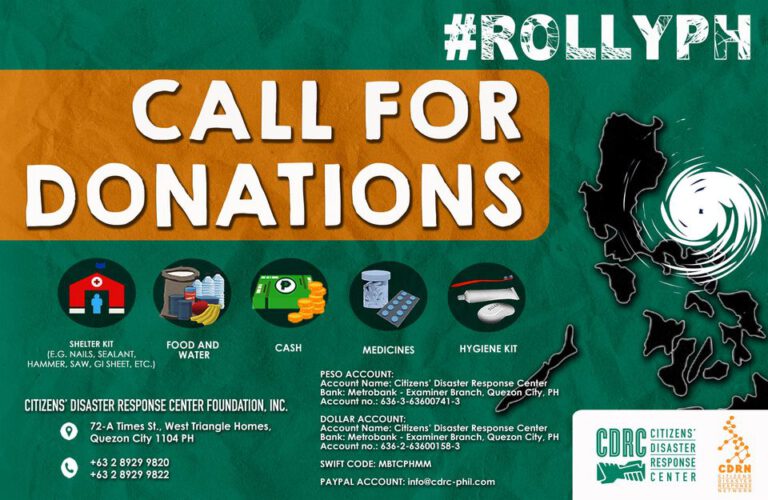
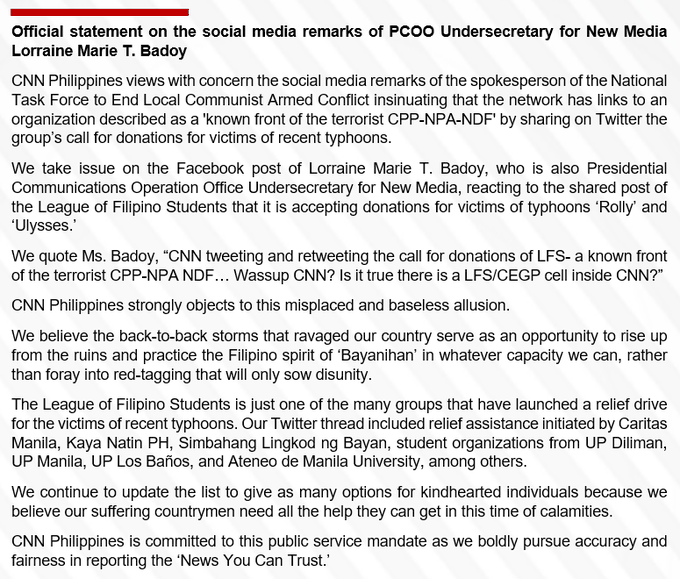
CNN PH ‘strongly objects’ to its being red-tagged by PCOO Usec Badoy

0

By: Consuelo Marquez – Reporter /INQUIRER.net / 12:53 AM November 15, 2020

MANILA, Philippines —  CNN Philippines “strongly objects to the misplaced and baseless allusion” of Undersecretary Lorraine Badoy of the Presidential Communications Operations Office (PCOO) to its alleged links to organizations that are “known fronts” of the Communist Party of the Philippines, the New People’s Army, and the National Democratic Front — usually referred to collectively as the CPP-NPA-NDF.

CNN issued a statement on Saturday in reaction to Badoy’s Facebook post on Friday: “CNN tweeting and retweeting the call for donations of LFS- known as the terrorist CPP-NPA-NDF… Wassup CNN? Is it true there is a LFS /CEGP cell inside CNN?”

LFS and CEGP stand, respectively, for the League of Filipino Students and the College Editors Guild of the Philippines.

In reaction, CNN Philippines said:  “We believe the back-to-back storms that ravaged our country serve as an opportunity to rise up from the ruins and practice the Filipino spirit of Bayanihan in whatever capacity we can, rather than foray into red-tagging that will only sow disunity,”

The media outfit pointed out that LFS was not the only group included in its Twitter thread for donation drives.

“Our Twitter thread included relief assistance initiated by Caritas Manila, Kaya Natin PH, Simbahang Lingkod ng Bayan, student organizations from UP Diliman, UP Manila, UP Los Baños and Ateneo de Manila University, among others,” CNN Philippines said.

Badoy, who is also the spokesperson of the National Task Force to End Local Communist Armed Conflict (NTF-Elcac),  has recently clashed with members of the Makabayan bloc in the House of Representatives.

The lawmakers had called for her resignation for red-tagging them.

Badoy rejected the call, saying that she “did not deceive the Filipino people.”#

‘Worse than Ondoy’

0

In a year of one landmark crisis after another, typhoon season in the Philippines in 2020 bids fair to be as hard and unprecedented. Seven weather disturbances have affected the country in only a month, three of which developed into severe storms with catastrophic results on the population.

“Ulysses,” the latest monster storm, killed at least 14, displaced more than 170,000 people, and caused massive floods that brought back memories of “Ondoy” from 11 years ago. Residents of Marikina, which along with Rizal bore the brunt of the flooding in the metro, said Ulysses is an experience “worse than Ondoy”—because this time they also had to worry about the COVID-19 pandemic that could break out in evacuation centers. As residents escaped chest-deep floods—the Marikina River rose to 22 meters by 11 a.m. on Thursday, breaching the 21.5 meters during Ondoy—an overwhelmed Mayor Marcy Teodoro appealed to the private sector to send rubber boats for rescue operations. “Hindi ito kakayanin ng LGU lang, kailangan na ng tulong ng private sector,” he said.

An average of 20 typhoons hit the Philippines every year; Ulysses is the 21st, and three more are expected by year-end. Experts have been warning that such storms will become more severe due to global warming. President Duterte, referring to Ulysses as a “stark reminder of the urgency [for] collective action to combat the effects of climate change,” has called on developed countries to not turn their backs on the “moral responsibility” to finance and invest in innovative solutions. Abandoning this responsibility, Mr. Duterte said in a speech in last Thursday’s virtual opening of the Asean Summit, would be a “great injustice—a double blow to those who bear the brunt of the adverse consequences of their past actions and inactions.”

Yet, considering that, according to the Global Facility for Disaster Reduction and Recovery, 74 percent of the country’s population is vulnerable to natural disasters, the Duterte administration’s disaster response itself has “remained poor,” the research group Ibon pointed out in January. This year, the government allocated only P16 billion for the National Disaster Risk Reduction and Management Council (NDRRMC), a P4-billion decline from P20 billion in 2019. In 2017, the Duterte administration slashed the NDRRMC’s budget by more than half to P15.8 billion from the P38.9 billion in 2016 under the previous administration. “The administration’s budget priorities disregard the country’s longstanding vulnerability to disasters,” Ibon said, noting how intelligence funds for the police, the military, and the President’s office had instead been increased.

The Department of Budget and Management had to top up the NDRRMC’s budget this year by P5 billion due to its already depleted funds, according to executive director Ricardo Jalad. But most of the extra funds would go to the agency’s COVID-19 response, and the remainder to rehabilitation efforts in areas devastated by Tropical Storm “Quinta” and Supertyphoon “Rolly.” Jalad said they have asked for P20-billion funding for next year, which is only P1 billion more than what the National Task Force to End Local Communist Armed Conflict is asking.

The persistent failure of the government to provide long-term solutions to help mitigate disasters and protect the country’s most vulnerable sectors and climate refugees couldn’t have been more evident than last Monday, as residents of Bato, Catanduanes, prepared for Ulysses even as they were still repairing homes and recovering from Rolly, which had flattened the island early this month. “Pagod na pagod na talaga… magaayos tapos maghahanda… may bagyo na naman daw. Mageempake na naman kung saan kami lilipat,” a tearful resident told ABS-CBN.

As Ulysses battered most of Luzon on Thursday, social media was swamped with appeals for help. Rescue operations are still continuing as of yesterday morning. The country is facing immense, extraordinary emergencies on multiple fronts, from COVID-19 to a record economic slump that has seen millions lose their jobs. But there is simply no room for “donor fatigue” at this hour of great need; every bit of assistance from everyone will count.

Let us help through these donation drives: University of the Philippines (GCash/PayMaya 09278692946; NowheretogobutUP Foundation Inc: BPI Account No. 0993-0113-39); ABS-CBN Sagip Kapamilya (ABS-CBN Lingkod Kapamilya Foundation Inc.: BDO 0039302-14711; BPI 4221-0000-27); Caritas Manila Inc. (BDO 000-5600-45905; Metrobank 175-3-17506954-3; BPI 3063-5357-01; RCBC 000-300-090-2216); and the Philippine Daily Inquirer’s own relief drive (Inquirer Foundation Corp., BDO current account 007960018860, email foundation@inquirer.com.ph).

Cagayan reeling from worst flooding, says governor; online cries for help surge

0

By: Kimberlie Quitasol, Villamor Visaya Jr., Yolanda Sotelo – @inquirerdotnet Inquirer Northern Luzon /November 14, 2020

CAGAYAN – Governor Manuel Mamba on Saturday described the massive flooding that inundated large parts of the province province and nearby areas as the “worst in memory.”

In a radio interview, Mamba said Cagayan was  “blindsided” by the floods that already claimed several lives.

Appeals for immediate rescue circulated on social media since Friday evening as residents across the Cagayan Valley region experienced fast-rising floodwaters that forced many residents to the roof of their houses.

The massive flooding was triggered by heavy rainfall spawned by Typhoon Ulysses, which was enhanced by northeast monsoon and the tail end of a cold front.

The hashtag #CagayanNeedsHelp trended on Twitter and Facebook with netizens appealing for help from the national government.

Mamba said rescue operations resumed at daybreak,  but live electric wires in flooded areas electrocuted some residents.

He also asked the National Grid Corporation of the Philippines (NGCP) to temporarily  turn off the power to allow rescue teams to access the flooded areas.

Mamba added that some areas remain  inaccessible by land and that air assets  are needed to rescue displaced residents.

In City of Ilagan, Isabela,  59,636 individuals or 18,634 families were displaced by floods and have sought shelter in evacuation centers.

At least 8,129 families or 28,369 people remained isolated by the flood in the city as of Friday. (Photo from Manila Bulletin)


(Opinion) Absentee leadership in times of crisis

0

Nov 14, 2020, John Molo

A day after Typhoon Ulysses battered the country, the nation reacted with surprise at what was happening in Cagayan Valley. Cagayanons were desperately flooding social media with cries for help as the evening of Friday, November 13 came.

Online reports cited water coming from dams that were bursting. A harrowing video depicted a village swallowed by water at night, the darkness broken only by cries for help.

It took hours before a national, coordinated picture of what was happening could emerge. And for the third time this month, as citizens faced disaster, they looked to the top and found silence. The Vice President thus took the unprecedented route and used Twitter to coordinate rescue efforts. With no real power or money to marshal, she used moral suasion to bring help to citizens on the verge of drowning in the dark. We will never know how many lives were saved by her stepping in during those crucial hours. Still, we are justified in asking why she had to take such an extraordinary move. 

During Arroyo’s and Noynoy Aquino’s time, the days before an approaching typhoon would be met with top-level meetings led by either the President or his/her top lieutenants. Bulletins were broadcast repeatedly to inform citizens ahead of time where to go, and how goods are being pre-positioned. And while both presidencies were sorely tested (Typhoons Ondoy and Yolanda), not even the fiercest Arroyo or Aquino critic can say that when disaster struck, they were sleeping at the wheel.

Confusion in crisis

Top-level leadership matters. 

A day after Ulysses sank Marikina and Rizal, information on the number of fatalities confused citizens with each agency having its own “death count” (Palace vs AFP vs PNP vs DILG). Then, as Cagayan was blindsided by floods, rescuers were stopped by officials invoking regulations like authorization papers, 14-day quarantines, and other protocols.

It was only by Saturday, November 14, that the Department of the Interior and Local Government announced that COVID-19 protocols can be lifted in disaster areas in order for rescue and relief operations to freely enter. A visible and proactive leadership would have been able to anticipate and address these concerns as they happened, not hours or days after. More importantly, super typhoons require an aggregated response.

True, we have individual agencies operating “24/7,” but without a firm hand at the helm, confusion can ensue. And when disaster strikes, precious minutes spent unclogging confusion means precious lives lost.

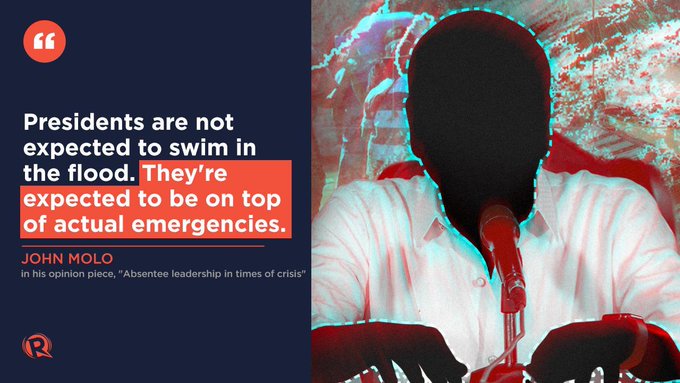
Presidents are not expected to swim in the flood. That would be silly – perhaps as silly as going on “aerial surveys” the day after just to “see” damaged areas and take selfies. One would even call it unnecessary expense. Just like when handlers saw fit to unleash trolls instead of using those funds for relief operations. Reports say a troll gets paid 500 pesos per day. Imagine how many meals a week’s worth of trolling can buy.

Advertisement

And just in case someone pulls out the “wala tayong pera” card, remember that this government decreased the Calamity Fund yet increased the “Intelligence Fund” by billions more. It also defunded crucial resources like Project Noah, while throwing billions elsewhere (“kalderos,” dolomites). And as a citizen pointed out, in 2020 alone, the presidential communications office’s budget was around P 1.6 billion.

Leadership abhors a vacuum

Yet, the Palace found time to accuse the opposition of “politicizing” disasters. What it overlooks is that ALL sides of the political divide were asking the same question. And all sides were working to save as many lives as possible. It is not political for leaders to step up during times of crisis; it’s their job. 

A President so enamored with emergency powers is expected to be on top of actual emergencies. Citizens have a right to ask, “where is the President?,” as Bicol got wrecked, as Marikina and Rizal went under, and as Cagayan got swallowed by floods in the dark. It is a fair question because these are OUR Billions that they spend after all. He who wins the presidency has the power and resources of government at his disposal. In exchange, he is expected to be awake so the nation can sleep soundly. It seems that in the past 2 typhoons only the residents of the Palace by the river slept well.

And if the highest official of the land is nowhere to be seen or felt as the nation is brought to its knees, we should thank God for sending the 2nd highest to fill that role. Leadership abhors a vacuum. There is no law banning the Vice President from helping citizens in distress. In fact, the Greater Law that binds all faiths impels her to do what she can if she sees her country suffering.

This is why the trolls aren’t being as effective as they were. Does it really matter if the Vice President is “epal” or “pasikat”? Those in Cagayan or Bicol certainly don’t mind. And when critics say she didn’t do anything extraordinary, so what? Yes, she “just showed up.” And thank God she did. Can you imagine if she didn’t? As lawyer and journalist Dana Batnag wryly observed, “That happens when you get a flat tire. You use the spare.” – Rappler.com

OFWs demand increased budget for protection and welfare amid Covid-19

Kodao.org, November 9, 2020

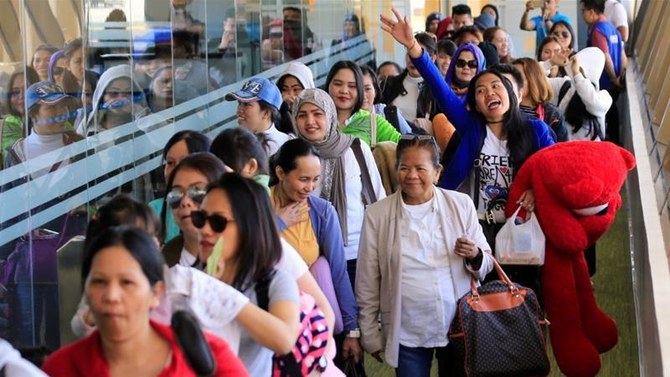
An organization of migrants called on the Philippine government to ensure social protection and welfare services for overseas Filipino workers (OFW), Filipino migrants and their families by increasing funding for these programs in the proposed 2021 National Budget. 

In an online petition on change.org, Migrante International pointed out that in the proposal, only Php 8.6 Billion from the Department of Foreign Affairs (DFA) and Overseas Workers Welfare Administration (OWWA) is allotted to fund programs that seek to assist and support OFWs and migrants in distress. 

The group said that despite the negative effects of the coronavirus pandemic on Filipinos abroad, the proposed 2021 budget of Php1.2B for the DFA’s Assistance to Nationals Program (ATN) and Legal Assistance Fund (LAF) is only the same as in the 2020 budget.

It also said that while the proposed budget for OWWA has significantly increased to Php7.4B, the amount will still be inadequate to serve the thousands of OFWs who remain stranded overseas and awaiting repatriation due to the pandemic.

Migrante International said there are thousands of OFWs who lost their jobs who have yet to receive any financial assistance from the government.

Under the AKAP program, the financial assistance for displaced land-based and sea-based Filipino workers program of the Department of Labor and Employment (DOLE), only 280,000 OFWs were granted financial assistance out of the estimated 1 million OFWs who were displaced in the past seven months. 

“The proposed budget does not take into account the increased support needed for the millions of Filipino migrants who have been displaced and severely affected by the COVID19 pandemic and who are in need of financial and livelihood assistance, welfare support, repatriation assistance and comprehensive health services,” Migrante International said.

“[T]he proposed budget will potentially leave hundreds of Filipino migrants every year who are victims of labor exploitation, human trafficking, illegal recruitment, gender-based violence, and discrimination neglected for lack of adequate funds to support their cases,” the group added.

The group also asked the government to provide immediate financial assistance in the amount of Php10,000 to all Filipino migrants, OFWs and their families affected by the pandemic by allotting an additional Php 7.2B to the DOLE AKAP Program. 

Migrante International said additional funds are also needed for hiring more personnel, legal advocates, interpreters, and other critical resources to effectively improve services and social welfare and protection for vulnerable migrants. 

The group also demanded that the government fully subsidize OWWA services and programs and stop the collection of OWWA membership dues from OFWs.

“To recover from the pandemic, the people, especially overseas and local workers, farmers and the poor need an expenditure program that heals and unites,” Migrante International said. # (Raymund B. Villanueva)

Cordillera by the thread

0

By: Vincent Cabreza – Reporter / @Inquirer_Baguio, Philippine Daily Inquirer /November 08, 2020

Children’s books pass down traditional weaving, indigenous knowledge to young generation

BAGUIO CITY, Benguet, Philippines — Fata’an grew up watching her village elders weave special kinds of garment for the dead in Barangay Can-eo up in Bontoc, Mountain Province.

FOR SUNDAY REGIONS RE CORDILLERA BY THE THREAD / NOVEMBER 5, 2020 Artisans of Ifugao showcase their skills back in 2018 PHOTO BY EV ESPIRITU

Although taught the rudimentary weaving skill at a young age, Fata’an was forbidden from making death blankets and clothing for “kachangyan,” or the community elite.

The elders believe that a young woman who weaves these garments will not bear children. So Fata’an mastered that specialization only after moving to Baguio and raising a family.

Fata’an is a fictional character in “Fata’an and her Tilar” (foot-driven loom), one of five children’s books that will be launched on Nov. 20 during this year’s Third Ibagiw Creative City Festival.

The books and a companion weaving workbook, “Agabel Tayo” (Let Us Weave), provide glimpses of the culture and history behind Cordillera textiles, which are passed down to new generations, said Dr. Raymundo Rovillos, chancellor of the University of the Philippines (UP) Baguio and vice chair of the Council for Baguio Creative City.

Baguio was the first city to join the Creative Cities Network of the United Nations Educational, Scientific and Cultural Organization in 2017. Cebu City was selected in 2019. The network is composed of world cities where art and culture are driving forces, or significant contributors, to their respective economies.

Intertwined

In Baguio’s case, leisure and tourism are intertwined with the industry built by woodcarvers, weavers, silver craftsmen and basket weavers who come from Cordillera communities.

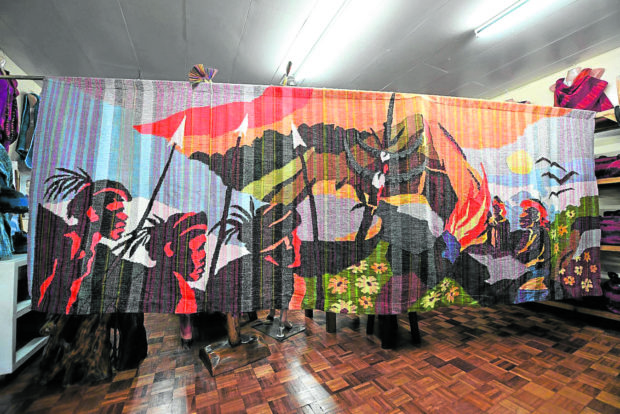
FOR SUNDAY REGIONS RE CORDILLERA BY THE THREAD / NOVEMBER 5, 2020 Tapestry PHOTO BY EV ESPIRITU

Although the Ibagiw festival offers gallery tours and exhibits now that Baguio has reopened its borders to tourists, it also has organized skills competitions and workshops to inspire more artisans to revive their trade and help the economy recover.

One of the tasks of a creative city is to ensure or sustain the system for bequeathing these skills to young aspiring artisans. The children’s books promoted by Ibagiw are a step toward the popularization of the artistry, spiritual nature and talents behind indigenous weaving, according to Rovillos.

The books feature characters like “Aramay” in Gad’dang, “Balitanay” in Kalinga, “Dalipug” in Apayao, “Benita” in Ifugao, and “Fata’an” in Bontoc, who discover how and why weaving and specific textile designs matter to their culture.

FOR SUNDAY REGIONS RE CORDILLERA BY THE THREAD / NOVEMBER 5, 2020

These were authored by Marlon Martin of Save the Terraces Movement in Ifugao, Isnag culture bearer Joypeace Llapitan, Gad’dang weaver Margaret Balansi, Kalinga village official Lyn Albert and UP Baguio anthropologist Analyn Salvador-Amores.

FOR SUNDAY REGIONS RE CORDILLERA BY THE THREAD / NOVEMBER 5, 2020

Inspired by research

Amores heads the UP Baguio’s multidisciplinary Cordillera textiles project (CordiTex), which gathered and analyzed materials on indigenous Cordillera fabrics. The children’s books were inspired or based on the researchers’ findings.

CordiTex combined the disciplines of math, anthropology, history, information and communication technology, and art to help document and preserve the region’s traditional weaving methods.

The project studied extant textile patterns, using oral accounts and archival records, and mathematically reconstituted long forgotten designs on digital graphs so these skills could be reintroduced to weavers through a “paint-by-numbers” paper grid, or digital looms.

It also pursued modern technology to help improve traditional weaving.

Giovanni Malapit and Ronan Baculi, both UP Baguio professors, designed a plasma injection system to coat indigenous fabrics with silver nanoparticles “to restrict the growth of microorganisms [and] prolong the life of textile materials.”

Amores and Jennifer Inovero, another UP Baguio professor, examined the ergonomic discomfort experienced by loom and back-strap weavers.

Illusion movement

The weaving technique, called “binalot,” evokes “the illusion of movement,” according to Amores’ study on “anthropological analysis of Itneg textiles.”

A “binakol” pattern, called “kusikos,” is embedded in Itneg funeral blankets “to confuse malevolent spirits” so they will not cause harm to the deceased’s family, the study said.

The findings found their way to the children’s book “Dalipug and the Isnag Badu” (Isnag garment), where Amores and coauthor Llapitan enumerated patterns like “baleku,” or the scallop pattern, that refers to the Sinulung River, “ahamay,” or a centipede pattern, that serves as protection from bad spirits and the “sinabungan,” or the blossoms of wild rice.

The CordiTex team also tracked down the plants used to create old textile dye, broke down the chemical composition of plant-based pigments and explored substitute ingredients that would approximate the color palates of mountain garments.

In the children’s book, “Balitanay’s Laktob” (festive skirt), Amores and Albert created the character Apo Dumla, who spoke about the discovery of a tree, called “torac,” from where the first Kalinga garments were made.#