Home Blog Page 319

Amendments to Public Services Act removes Constitutional protections on public utilities

0

Research group IBON raised the alarm that proposed amendments to the Public Services Act (PSA) removing Constitutional protections on public utilities will undermine national security and consumer welfare. The group argued that foreign control over important sectors should still be minimized and that natural monopolies should if anything be more tightly regulated.

The Senate identified Senate Bill No. 1754 (SB) amending the PSA as one of the priority bills to be tackled by the upper house before session closes on June 30. The amendments ostensibly update the 82-year-old PSA originally known as Commonwealth Act No. 146. Its counterpart measure House Bill (HB) No. 5828 was approved on third and final reading in September 2017.

The amendments to the PSA significantly narrow the definition of public utilities to only cover the distribution of electricity, transmission of electricity, and water distribution and sewerage pipeline systems unless otherwise provided by law. It also defines the rate of return that investments in public utilities are entitled to.

IBON said that the narrow definition of public utilities seeks to bypass the current Constitutional limits on foreign ownership of public utilities and open up significant parts of the economy to foreign investors. The relaxation of nationality restrictions will mean excessive foreign control of critical telecommunications, power and transport utilities. The significant risks to national security and civil defense include digital surveillance and misinformation, denial and sabotage of vital services, and others.

IBON also said that the PSA amendments ensuring ‘a reasonable rate of return’ institutionalizes excessive profit-making at the expense of consumers. Utilities tend to be natural monopolies and the amendments unfortunately distort so-called regulation towards guaranteeing investor profits rather than consumer well-being. IBON said this reinforces profitability as a condition for delivering public services, notwithstanding their nature as very basic necessities.

As it is, privatized utilities have resulted in expensive water and power that is burdensome especially for millions of low-income consumers. Since water in Metro Manila was privatized in 1997, water rates have increased 879% in areas covered by the Manila Water Company and 574% in those of Maynilad Water Systems, while consumers continue to be hounded by prolonged water interruptions. Meanwhile, power rates in the Philippines are the second highest in Asia at Php8.96/kwh in 2018, next only to Japan’s Php12.31/kwh.

Incumbent senators have said that there is not enough time for Charter change within the remaining period of the 17th Congress. IBON said however that the PSA amendments are in effect a surreptitious way to change the Charter’s foreign ownership provisions for public utilities that has been attempted many times before by past administrations.

Should it pass SB1754, the 17th Congress will affirm itself as a champion of pro-foreign and pro-business measures. It will have liberalized a key section of the 1987 Constitution on top of passing the regressive Tax Reform for Acceleration and Inclusion (TRAIN) and liberalizing rice imports through the rice tariffication law, said IBON. The group also said that vigilance will be more important than ever with the new overwhelmingly administration-dominated Senate to come when the 18th Congress opens.###
Martial law in Mindanao ensured Duterte’s so-called victory in the 2019 elections

0

“The martial law situation ensured the control of the mid-term elections by the Duterte government in Mindanao,” Amirah Lidasan, a Moro and council member of Sandugo said today on the commemoration of the second year of martial law in the southern part of the Philippines.

“Under Martial Law,  the attacks against the national minorities, the Lumad and Moro continued and intensified. Our  communities are bombed,  military operations in Lumad and Moro communities escalated, Lumad schools were forcibly closed, and trumped up charges were filed against the indigenous people’s (IP) leaders. The Duterte government made it easy to coerce the people to vote for administration’s candidates, or not vote at all,” Lidasan said.

“By jailing the likes of Jomorito Guaynon,  also a council member of Sandugo and staunch Higaonon IP leader, many of his tribesmen were intimidated or even failed to freely campaign and vote for candidates based on their character and genuine platform for the national minorities, ” Lidasan said.

Guaynon, also chairperson of Kalumbay (a regional IP organization) was abducted together with peasant leader Irineo Udarbe on January 28, 2019 by elements of the Philippine Army and later charged under Human Security Act. “Guaynon and Udarbe would have led for the campaign Atty. Neri Colmenares for Senator in their region and for partylists under the Makabayan coalition,” Lidasan said.

“The red tagging and defamation of progressive personalities, organizations and partylists instilled fear and a chilling effect among their members, constituents and supporters,” Lidasan said. There were rampant distribution and posting of materials tagging various organizations and individuals as NPA members and supporters before and during campaign period. Named in these black propaganda paraphernalia were  the Makabayan partylists (Act Teachers, Anak Pawis , Bayan Muna, Kabataan and Gabriela Women’s Partylists), the Rural Missionaries of the Philippines Northern Mindanao and personalities like Bp. Antonio Ablon,  Fr. Cris Ablon,  Atty. Czarina Musni and many others. “These organizations and individuals are  supportive to our plight. They support our opposition to  the intrusion of big business in our ancestral lands and territories and  our assertion to the right to self-determination,” Lidasan said.

“Presidential daughter and Davao City Mayor Inday Sara Duterte-Carpio even campaigned against the Makabayan bloc, calling for zero votes for Makabayan,” Lidasan mentioned. “The partylists under Makabayan are the same groups that the Armed Forces of the Philippines, the Philippine National Police, Mayor Sara Duterte-Carpio and even President Duterte baselessly tagged as NPA fronts,” Lidasan said.

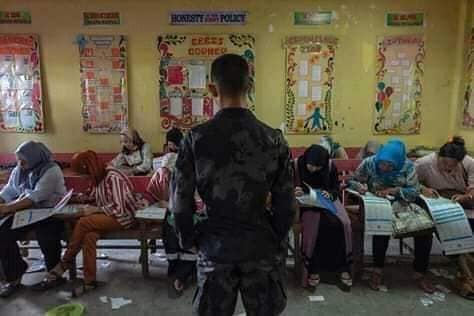
“Even the presence of armed soldiers inside the polling precincts intimidated  voters. How can they comfortably and freely vote when soldiers with high powered rifles are within sight?” Lidasan asked.

Despite the intense repression and various forms of electoral fraud, the  Makabayan bloc won six seats at the house of Representatives. “This manifests a resounding victory of the people against attempts to deny a genuine voice and opposition in Congress. More so, a Lumad woman leader becomes the first genuine Lumad and IP representative in Congress,” said Lidasan.

“The Duterte administration now dominate the Senate and the House of Representatives.  The immediate future looks bleak for the Filipino people. Duterte’s  charter change agenda and other anti-people policies immensely threaten the democratic and civil rights of the Filipino people  and sovereignty of the nation. Clearly, we now have a rubber stamp Congress,” Lidasan said.

“The next three years under Duterte is seen as a prolonged agony. Fascist attacks and repression, deterioration of poverty brought about by anti-people economic programs and plunder will further intensify. The Filipino people must unite and defy this government.   Sandugo pledges to resist these attacks,” Lidasan said.

“Two years of martial law in Mindanao has miserably failed to end people’s legitimate resistance, social unrest and the armed revolutionary movement in the Philippines. Martial law and repression only strengthened the people’s resolve to fight and struggle to end the fascist, corrupt and puppet Duterte government,” Lidasan ended. #

Press Release: May 24, 2019
Reference: Amirah Lidasan, council member

Analysts hope for an independent Senate

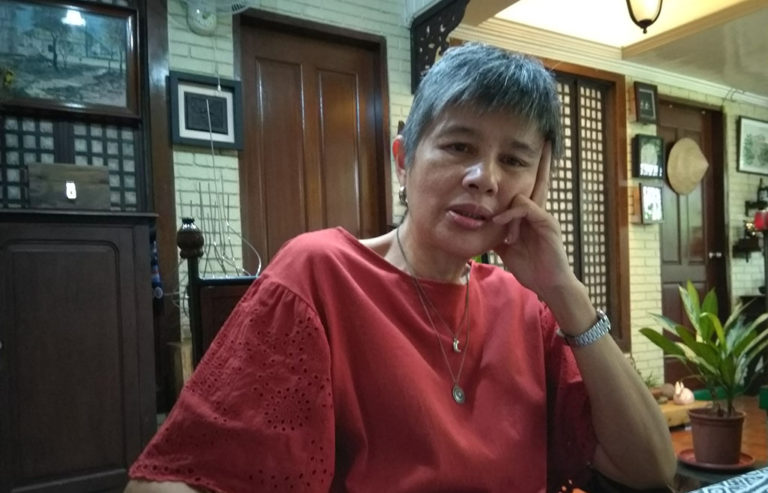
Bayan Chairperson Dr. Carol Araullo says the infighting within the ruling elite is bound to escalate. (Photo by Ronalyn V. Olea/Bulatlat)

“Issues such as China deals, drug war, war against the revolutionary movement, corruption etc. will not go away and these will be the considerations of administration candidates, except for those who are rabid supporters or are unthinking.”

By RONALYN V. OLEA
Bulatlat.com

MANILA — After the Commission on Elections (Comelec) proclaimed the 12 new Senators early this week, concerns have been raised on the Senate’s independence from Malacanang.

Nine of the 12 proclaimed senators were endorsed by President Duterte. During proclamation, only two — Senators Grace Poe and Nancy Binay — refused to do the Duterte fist bump.

In her speech, frontrunner Cynthia Villar vowed, “A strong and independent Senate has always been our goal ever since.” Two of Duterte’s closest allies, Ronaldo “Bato” dela Rosa and Christopher “Bong” Go, also allayed fears that they would be Duterte’s rubber stamp.

What should the public expect?

In an interview with Bulatlat, veteran activist Dr. Carol Araullo, said Duterte’s allies would push for repressive and anti-people legislations such as the Charter change, Human Security Act amendments, lowering the minimum age of criminal responsibility, privatization of public utilities, among others.

Still, Araullo, chairperson of Bagong Alyansang Makabayan (Bayan), maintained that the political and economic crises plaguing Duterte would define the actions of the senators.

“Issues such as China deals, drug war, war against the revolutionary movement, corruption etc. will not go away and these will be the considerations of administration candidates, except for those who are rabid supporters or are unthinking,” Araullo told Bulatlat.

With the rottenness of the system, Araullo predicts Duterte’s popularity ratings would dip in the next three years.

“Duterte’s justification for iron-hand rule is all fake,” she said. “His hankering for strong-man rule did not end the illegal drugs and criminality.”

Therefore, Araullo said, “the capacity to influence or dictate the voting of senators is directly proportional to the president’s political capital.”

Dr. Temario Rivera, who has a doctorate in political science, shares the same opinion.

In a separate interview with Bulatlat, Rivera said that although technically, the administration has the numbers, there are no guarantees that Duterte can fully control the Senate. The national electoral constituency and the six-year term, for instance, are crucial in the decision-making of Senators, he said.

“Senators will decide based on the impact of the bill on their electoral base,” he said.

In particular, Rivera said the China case is divisive and a very contentious issue. “Who would want to be identified with a pro-China policy?” he said.

Rivera added that even administration senators would think twice in passing the second tranche of tax reforms or TRAIN 2 bill. “They are afraid to be another Recto,” he said.

Former Senator Ralph Recto, main author of the Expanded Value-Added Tax (VAT) Law, lost in a bid for reelection in 2007.

“There are institutional differences and dynamics in the Senate that provide a little more independence and flexibility unlike the members of the Lower House,” Rivera said.

Both also factored in the political ambitions of the Senators.

“Would they allow Sara [Duterte] or any Duterte candidate to be the next president?” Araullo said.

Araullo said the Duterte camp wants to ensure that the next chief executive would not hold Duterte accountable for his crimes.

Rivera said alliances for 2022 would compel some senators to distance themselves from the President.

“The infighting within the ruling clique is bound to escalate,” Araullo said.

Role of the opposition, mass movement

As for the opposition, Araullo said, “they have to realize the evilness of the Duterte-Marcos-Arroyo combined, realize their weaknesses, rise above their silly prejudices, and recognize the need for unity against a big, common enemy.”

“I’m hoping that those who ran will not just fade away. They must capitalize on the prominence they gained to expand and organise,” Araullo said.

Araullo said the mass movement plays a key role to prevent the Senate from being subservient to the President.

Araullo said Duterte’s fascist forces are poised to intensify political repression not only of the Left but all groups and individuals critical to the President. “They’re trying to nip it in the bud, all those who dissent — the Left, the Church hierarchy, the media, the opposition, local government,” she said.

“It’s a big challenge for the progressive forces how to be creative and effective in agitating, organizing and mobilizing the masses in the midst of all-out attacks,” Araullo said.

“It’s the law of contradictions. When there is repression, there will always be resistance,” she said. (http://bulatlat.com)

The post Analysts hope for an independent Senate appeared first on Bulatlat.

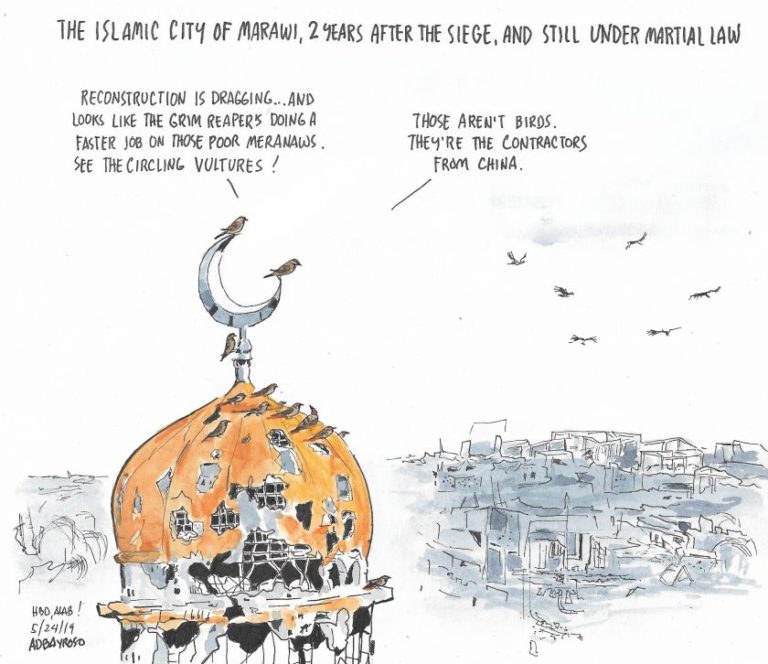
Marawi


By DEE AYROSO
(http://bulatlat.com)

The post Marawi appeared first on Bulatlat.

Rights violations, dire state of Marawi evacuees, plunder of resources and corrupt dealings mark 2nd year ML in Mindanao

0
“May 23, 2019 marks the 2nd year of martial law implementation in Mindanao. The Duterte government has perpetrated several myths about military rule and has intentionally propagated fear to justify the extension and passage of repressive policies. Martial law did not bring about safety, but rather atrocities such as the Patikul massacre of 7 youths in September 2018, the Jolo twin bombings, and corruption and abuses among the ranks of security forces,” said Karapatan Secretary General Cristina Palabay.

read more

Despite the release of detained Reuters reporters, free speech remains under threat in Myanmar

Despite their release, the state of free speech in the country is still undermined by the continued detention and persecution of some artists, journalists, and activists.

PH is losing farmers in the era of climate change, study says

0

The number of farmers in Davao City is decreasing in the midst of high demands on crop production for local and international consumption.

Waste materials from Australia not illegal, says Customs official

0

The close to a dozen container vans that arrived from Australia early this month were not toxic garbage but processed materials which will be used as fuel for a cement company’s manufacturing plants, said the Bureau of Customs (BOC) Thursday.