By: Mae Fhel Gom-os – Multimedia Reporter – CDN Digital | October 28,2021 – 04:47 PM
CEBU CITY, Philippines — Presidential aspirant and incumbent Senator Manny Paquiao said Filipinos should not forget the atrocities that were committed during the martial law years and the Marcos regime.
Pacquaio made the statement on Thursday, October 28, 2021, in an ambush interview right after the wreath laying-ceremony at the marker in Barangay Tisa, Cebu City where Redemptorist priest, Fr. Rosaleo “Rudy” Romano, was abducted.
“Hindi natin pwedeng kalimutan ang mga nangyari kasi kumbaga sa sugat may marka yan. Kahit gumaling yang sugat may marka pa rin yan. So wag’ nating kalimutan, alalahanin natin na pahahalagahan natin ang karapatan ng bawat isa,” said Pacquaio.
(We cannot forget what happened because like a wound it leaves a mark. Even if the wound will heal, a mark will still remain. So we should not forget, we should remember that we should respect each other’s rights.)
The presidential aspirant, however, said that his visit at the commemorative marker of Romano was nothing personal against the Marcoses and the Dutertes.
He said the message there was to fight the right of freedom of speech for the Filipinos, where everyone could freely speak what would be in their hearts without being hindered.
“Nothing personal but ang karapatan ng tao ang pinaglalaban natin dito, karapatan ng bawat isa na malaya tayo na makapagcomment na maihayag natin yung saloobin natin,” said Pacquiao, stressing that it just happened that he was going to a grandmother who will be celebrating her 101st birthday in southern Cebu, which was why they passed by the commemorative marker and offered flowers.
(It’s really nothing personal, but what we are fighting is a person’s right, the right to freely comment what is really inside us.)
“Ang mensahe natin dito na irespeto ang karapatan ng bawat isa, na ang lahat ay may karapatan na maghayag ng kanilang saloobin at malaya tayong mamuhay dito sa ating bansa ng walang takot,” he added.
(Our message here is to respect each and everyone’s right, that each one has the right to say what is inside them and to freely live here in our country without any fear.)
The event reportedly aimed to remind the Filipinos, particularly the Cebuanos of the ‘atrocities that were committed during the martial law years of the Marcos dictatorial regime.
He was joined by former Cebu Provincial Board member Ribomafil “Joey Boy” Holganza Jr., PDP-Laban Pimentel-wing Central Visayas chairman, and his group of supporters, the Manny Pacquiao for President Movement (MPPM) in his visit at the commemorative marker.
Other supporters also flocked near the area upon learning that Pacquiao was set to visit the commemorative marker, causing a bit of traffic there.
Holganza recalled that while Romano was spared from arrest during martial law, but he was later abducted by armed men, who were believed to be members of the military at the corner of San Jose and Katipunan streets in Barangay Tisa sometime in June 11, 1985.
Romano, who was believed to be a staunch critic of the Marcos regime and a human rights defender, particularly for the poor and oppressed, was never found after the incident.
Holganza, along with his father, the late Ribomafil “Dodong” Holganza Sr., were reportedly among the political detainees that were arrested against their will during the presidency of the late Ferdinand Marcos Sr.
The PDP-Laban regional chairman emphasized the importance of the wreath-laying ceremony with the presence of Pacquiao, saying that it would be an added injustice to the survivors, including him, and other affected families of the Marcos regime ‘with the attempt to rewrite history.’
Visiting the commemorative marker of Romano was just among his itineraries in Cebu.
Prior to his visit at the marker, Pacquiao reportedly held a meeting with the officers and members of MPPM at their national headquarters in Lapu-Lapu City.
He also met with senatorial aspirant Raffy Tulfo in Lapu-Lapu City. Pacquiao said he would attend the birthday celebration along with Tulfo after the wreath-laying ceremony.
Other presidential candidates have ‘fake followers’ too.
By Mario Alvaro Limos, esquiremag.ph
Nearly half of presidential candidate Bongbong Marcos’ Twitter followers are “fake,” according to data from analytics tool SparkToro.
Facebook user Marvin Terce posted screenshots from SparkToro’s Fake Followers Audit tool, where people can input the social media pages of anyone for auditing.
Based on Terce’s audit results, 47.4 percent of the 917,000 followers during the time the audit was run on Marcos’ Twitter account were “fake.”
SparkToro defines “fake followers” as “accounts that are unreachable and will not see the account’s tweets either because they’re spam, bots, propaganda, etc. or because they’re no longer active on Twitter.”
Many Twitter Accounts Have Fake Followers
According to SpakToro, as much as 30 percent of followers on Twitter are fake.
“In our research, 5 percent to 30 percent of followers are fake—they’re bots, spam accounts, inactive users, propaganda, or other non-engaged/non-real users. If you rely on follower count as a measure of potential influence and reach, you could be vastly overestimating an account.”
For every audit request, SparkToro takes a sample of 2,000 random followers for any given account and runs diagnostics that correlate with fake followers’ behavior or activity.
But it was not only Marcos who had “fake followers” on Twitter.
According to a Rappler report, the Twitter account of Ping Lacson (@iampinglacson) had 37.5 percent of his 43,997 followers considered fake; Manny Pacquiao (@mannypacquiao) with 32.6% of his 2,682,801 followers considered fake; and Leni Robredo (@lenirobredo) with 13.4% of her 600,134 followers considered fake.
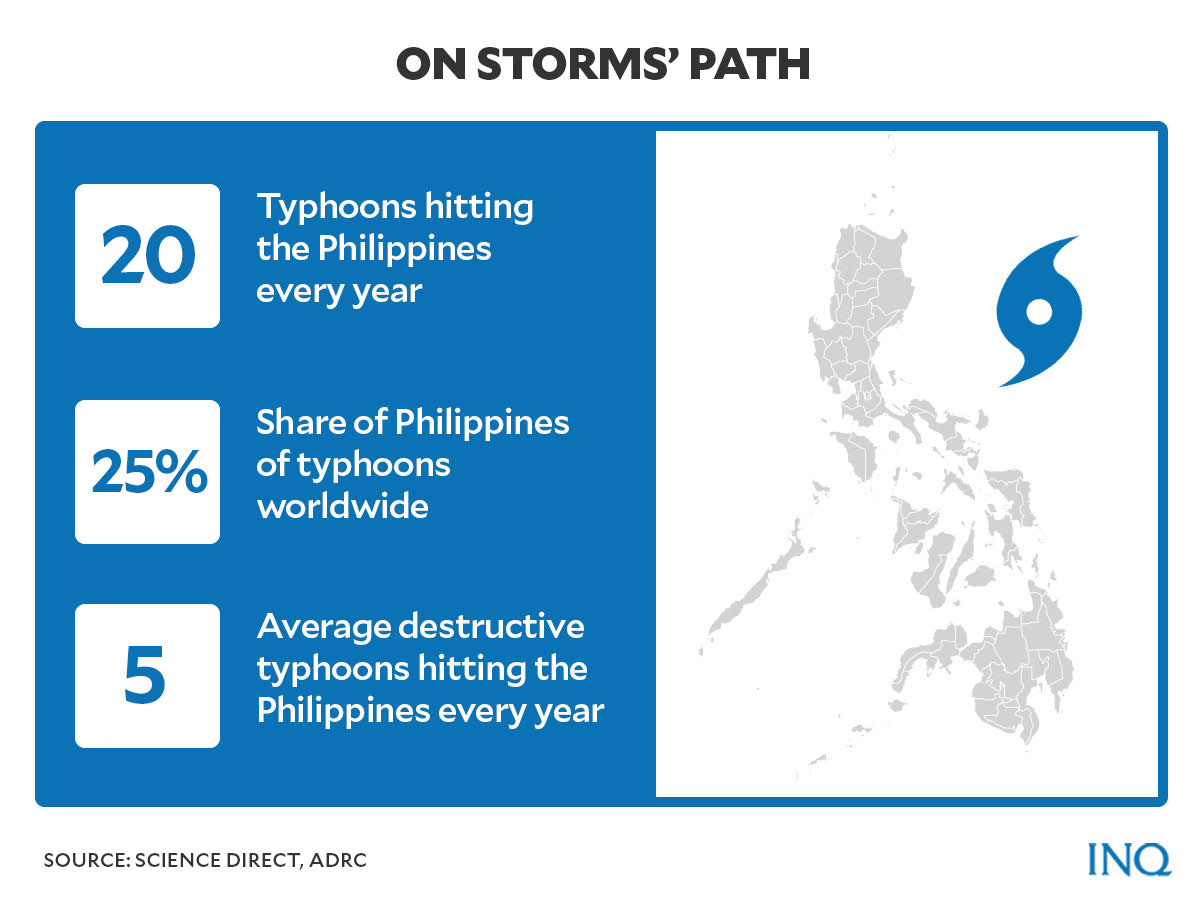
The website Science Direct said that every year, an average of 20 typhoons—25 percent of the total typhoons in the world—barrel their way into the Philippines.
Graphic by Ed Lustan
Out of the 20 typhoons, five are considered destructive while an average of nine typhoons make landfalls, the Asian Disaster Reduction Center said.
The NCBI said that typhoons in 2020 had a devastating impact on an “already poverty-stricken” nation, with the intensifying COVID-19 crisis.
The Asian Development Bank (ADB) said “those burdened most from these impacts are the poor, the marginalized, and the isolated.”
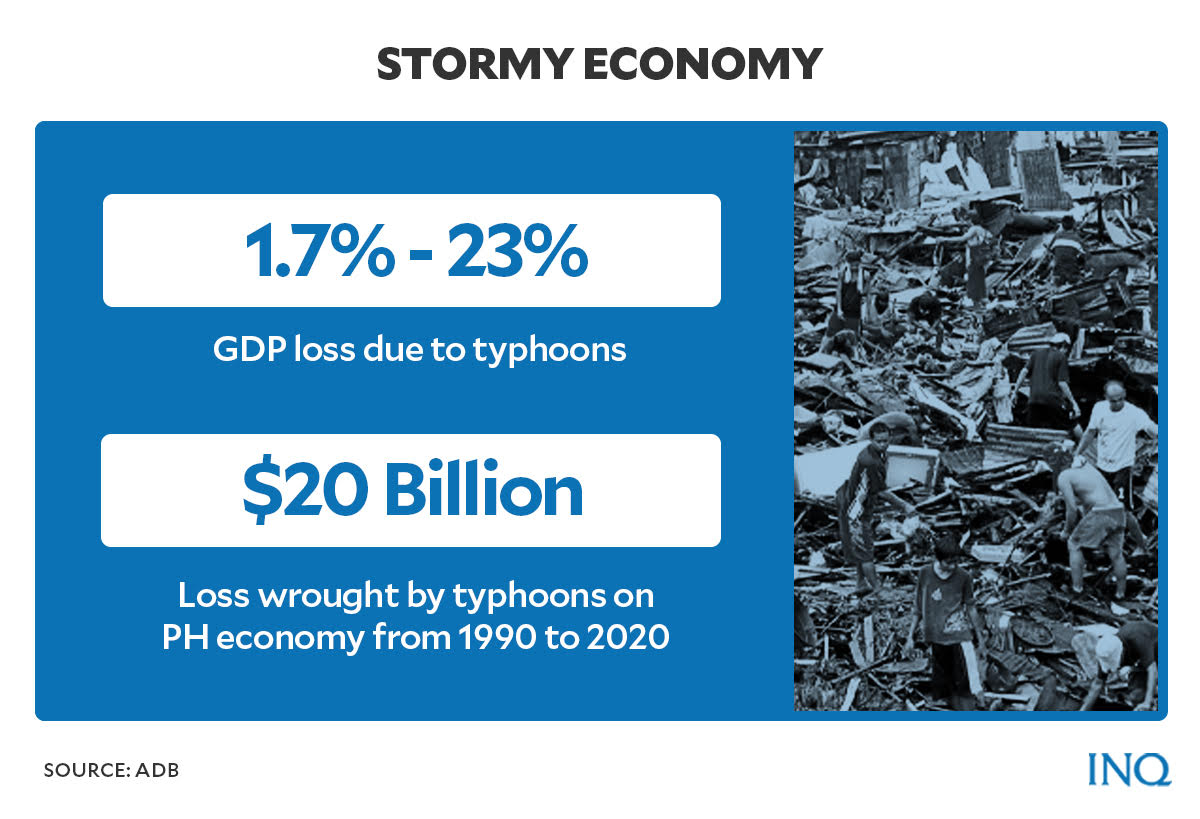
In its report “Disaster Resilience in Asia,” the ADB said that typhoons cost the Philippines some $20 billion in the last three decades (1990 to 2020).
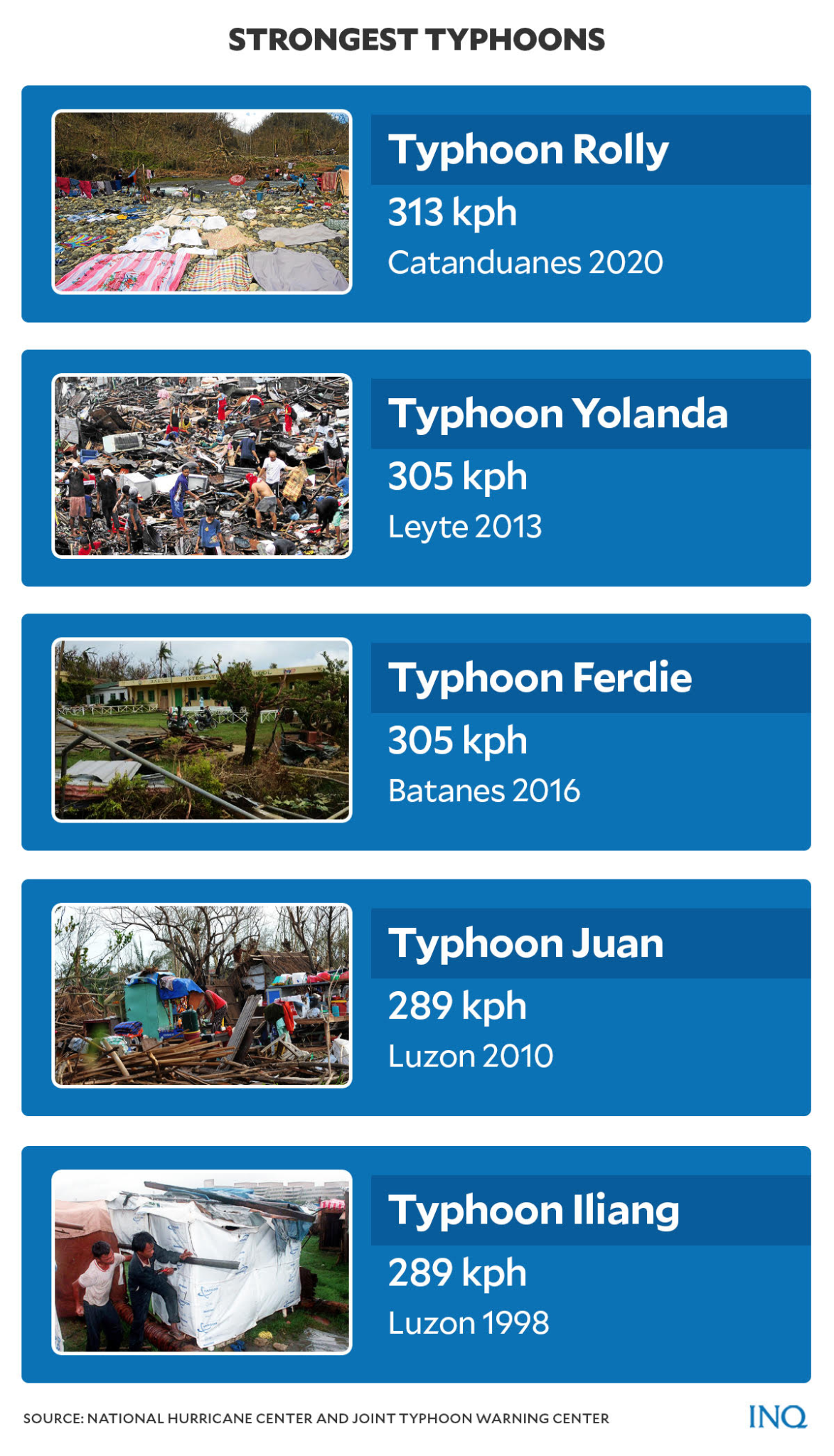
These included the five strongest typhoons that hit the nation, as listed by the National Hurricane Center and the Joint Typhoon Warning Center:
Graphic by Ed Lustan
Typhoon Rolly, 2020: Catanduanes (313 kph)
Typhoon Yolanda, 2013: Leyte (305 kph)
Typhoon Ferdie, 2016: Batanes (305 kph)
Typhoon Juan, 2010: Luzon (289 kph)
Typhoon Iliang, 1998: Luzon (289 kph)
It explained that typhoons in the Philippines can reduce economic activity by an average of 1.7 percent in the year they occur.
“In the most severe cases, losses can be as high as 23 percent,” the ADB said, explaining that typhoons may cost a nation billions.
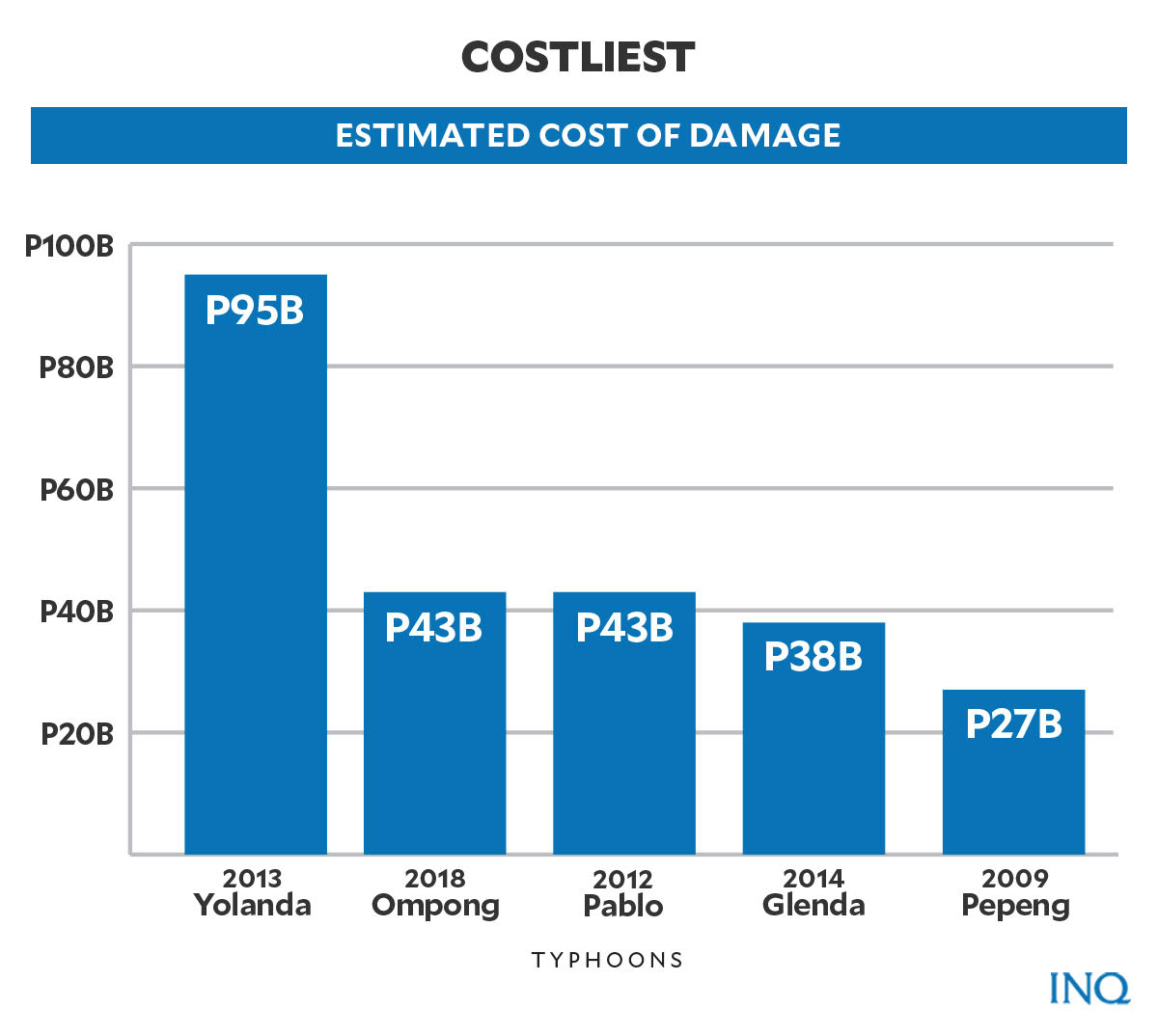
This was evident in how billions of pesos were lost because of typhoons that hit the Philippines with Yolanda leaving the biggest damage.
Graphic by Ed Lustan
Typhoon Yolanda, 2013 (Visayas): P95 billion
Typhoon Ompong, 2018 (Luzon): P43 billion
Typhoon Pablo, 2012 (Mindanao): P43 billion
Typhoon Glenda, 2014 (Luzon): P38 billion
Typhoon Pepeng, 2009 (Luzon): P27 billion
Nightlight intensity
To identify how typhoons affect economic activity in the Philippines, the ADB employed nightlight imagery provided by the Defense Meteorological Satellite Program.
The ADB said nightlights provide data which can help identify “socioeconomic indicators” when no other reliable information exists.
“To this end, we used satellite-derived measures of nightlight intensity as measures of local economic activity,” the multilateral lender said.
It explained that it combined these with damages based on storm tracks, a wind field model and a stylized damage work.
The ADB found that typhoons with a return period of at least five years are likely to cause one percent “short-term” cut in economic activity.
In typhoons with a return period of at least 20 years, economic activity may be cut by at least two percent, saying that these “differ starkly” in regions.
Not resilience
The ADB said while the effects of typhoons in the Philippines were “often short-lived,” the continuation of the economy should not be viewed as resilience.
It said that if nothing is done except the “restoration of activity,” bringing back people to their homes would mean placing them back in the path of danger.
In the coming years, climate change is expected to worsen the intensity and impact of disasters, especially in places considered “at-risk.”
By: Bong Lozada – Reporter/INQUIRER.net / October 24, 2021
MANILA, Philippines—Carlos Yulo’s redemption arc produced its first gold after he captured the gold medal in men’s vault at the 2021 FIG Artistic Gymnastics World Championships Sunday at Kitakyushu City Gymnasium in Japan.
The 21-year-old scored an average of 14.916 boosted by a 15.033 in his second vault after tallying 14.800 in his first.
Yulo, who lost his title in the floor exercise on Saturday due to a costly penalty, goes for a second gold at the world championships when he competes in the men’s parallel bars later at 5 p.m.
Japan’s Yonekura Hidenobu captured the silver after he scored an average of 14.866 (15.000, 14.733) while Israel’s Andrey Medvedev secured the bronze at 14.649 (14.533, 14.766).
Thomas Grasso of Italy landed on the fourth spot of the competition after an average of 14.549 (14.833, 14.266).
South Korea’s Yang Hak-seon, a two-time World champion and the 2012 Olympic gold medalist, settled for fifth as he scored a 14.399 (14.766, 14.033) while the Great Britain’s Courtney Tulloch came in at sixth at 14.383 (14.300, 14.466).
Ukraine’s Nazar Chepurnyi, who was the top qualifier in the event, could not sustain his momentum in the finals after he failed in his landing for his second vault as he settled for seventh at 14.149 (14.866, 13.433).
Canada’s William Emard had a sad run in the finals as he failed to land in both of his vaults for a score of 13.199 (13.266, 13.133) for eighth.
Berry Pelaez-Marfori – The Philippine Star ,January 27, 2013
MANILA, Philippines – Domingo M. Guevara Street, formerly known as Libertad, is one of Mandaluyong’s busiest thoroughfares. It is also the name of a self-made industrialist closely associated with a number of well-known brands in the 60s and 70s and who aspired to see the Philippines become an industrialized country
Guevara founded Radiowealth, a brand of affordable Philippine-made radios, TVs and other appliances that dominated the local market prior to the advent of the Japanese brands. He also assembled Volkswagen vehicles initially in his Libertad, Mandaluyong plant, then made the brand a household name in the Philippines. This experience led him to create the first Filipino designed and fabricated vehicle called the Sakbayan in the late 60s.
At its height, the industrialist’s Guevara Enterprises or Guevent Group was engaged in manufacturing, electronics, communications, agriculture and industrial development, transportation and its own financing company, Radiowealth Finance, which continues to operate to this day through 80 branches all over the country.
He transformed his part of Mandaluyong into a dynamic center of light industry and the cradle of audacious ideas such as manufacturing a Filipino car. A great model for an aspiring Tiger City,Guevara, who passed away in the 90s, would have turned 104 years this January.
The business genius traced his roots to Camarines Sur, where he learned to be a radio technician through a correspondence course. Although fascinated by the radio, he made a living running the family farm. Fortunately for him, a dispute with a neighbor over the farm led him to move to Manila where he eventually set up a radio repair shop and transformed Radiowealth from a one-man, one-door affair to a dynamic manufacturing concern
In the early 60s,which was dominated by gas-guzzling American cars, Guevara identified the need for more fuel-efficient vehicles. He wooed Volkswagen Germany to allow his company in the Philippines to assemble its famous models like the Beetle and the Kombi. In a memoir Guevara wrote: Before DMG (his motor firm formally called Diesel Motors Germany Inc.) came into the picture, nobody had foreseen that the Filipino motorist would go for the small car. And when the demand came, DMG was about the only one ready to serve it with the Volkswagen brand.
As he built up his enterprises, Guevara also made available to the Philippine market a succession of machines and equipment helpful to agriculture, the military and other groups. These machines included various tractor models, diesel trucks of various makes and sizes, radio transceivers, and even computers and digital communications equipment. He also spotted the opportunities provided by new business models like the Avis car rental franchise, which he first established 40 years ago.
Reynaldo Guevara, the first president of Avis and chairman emeritus of Guevent Investments Development Corp., observes: Avis was a natural extension of the Volkswagen business. We started off with Volkswagen cars but have evolved since then.
Alejandrino Ferreria, a former DMG executive and current chairman of Avis Philippines, remembers working with Guevent founder Domingo Guevara: The industrialist’s passion to excel and to succeed later drove him to undertake forward and backward integration.
In addition to pioneering in the manufacturing of TV sets in the country, he also produced components like TV picture tubes and speakers.
National artist Nick Joaquin wrote about the peak of Guevara’s career in the early 70s: The first full-fledged auto manufacturer of the Philippines was selling up to 5,000 vehicles a year, was creating the first Philippine-made car, and was manufacturing picture tubes and other electronic components.
He had brought his country’s economy to a crucial threshold: the point of take-off for a NIC, a Newly Industrialized Country.
Then Martial Law was declared and all of Guevara’s plans were thwarted. Before the Marcos takeover backed up by military rule, Guevara had been elected a delegate of the 1971 Constitutional Convention who sought to promulgate programs that would jumpstart the industrialization of the Philippines. Being the man of principle that he was, Guevara was one of seven delegates that voted against the martial law constitution.
Soon after, Marcos representatives were asking the businessman if they could buy into his companies. Domingo Jr., Guevara’s third son, recalls in his father’s biography: I quoted a price to the emissary and asked if his principle could pay it. And the emissary said no, and that no price would be paid. I said: What do you mean? And he reported that I should feel flattered that President (Marcos) wanted to invest in our company.
When the senior Guevara made it plain that he was not interested in a one-sided partnership with Marcos and his cronies, his firms began experiencing problems with his bankers, and from the Bureaus of Internal Revenue and Customs. What could a businessman do? There was no way of fighting back (under martial law conditions), Guevara recalled in his biography.
He got to the point when he realized how futile it would be to fight for his enterprises. Had he held on, he would still have lost them. And if I let them in, I would lose the business just the same, since they, and not I, would be in control. All these pressures were beginning to affect my health. It became a choice of losing his business or losing his health. Guevara and his wife went into exile in the US.
Joaquin sums up the man’s contributions: In his time, there was a fascination with machinery, the start of a skill in electronics, a growing audacity in enterprise, more and more thrust into manufacturing, and an outright intent to make that great leap forward to industrialization. The Guevara era will remain an inspiration and a viable model for future generations.
In this time of historical denialism, in which politicians and internet trolls try to erase or redraw the historical record, it is necessary to stand by the facts. To allow history to be distorted would be to allow yet more misguided leaders to “rob” us to death.
“You Firipinos are so rucky!” a Japanese diplomat is supposed to have remarked to Filipino friends. “The Marcoses rob (love) you. They rob you reft, they rob you light. They rob you all the time!”
Of course, this is a joke, but the groans and moans with which Filipinos greeted this remark made at the height of martial law were an indication that it had more than a kernel of truth in it.
But, if you ask Sen. Imee Marcos, whose brother Bongbong is the namesake of their father Ferdinand and is now contesting the presidency in next year’s polls, such jokes and other recollections about the Marcos legacy of plunder are simply “corny.” “(They) are so irrelevant at this time,” the senator said in a radio interview, adding that such remarks have become annoying because “we face so many problems … Stop it, stop it, we have to show the way forward that there’s still hope.”
This is all part of the Marcos playbook: Brush aside accusations of plunder and abuse of power, offer no excuses, no explanations, and certainly not an apology. Instead, sound the siren song of “moving on,” and hinge one’s political future on the promise of a brighter future.
Imee was on a roll: “I don’t understand,” she told the interviewer in Filipino. “These issues against my father (took place) one million years ago eh, but are still being raked up.”
Well, the senator exaggerates. The 1986 Edsa People Power Revolution, which succeeded in sending the Marcoses and their allies into exile, was but 35 years ago, ending 14 years of almost-absolute power wielded by the family. And neither were Imee nor Bongbong innocent babes in the woods at the time. They were in their 30s, Imee was head of a national youth organization and Ferdinand Jr. was already governor of their bailiwick of Ilocos Norte when their father was ousted.
After their arrival in Honolulu, papers seized by US customs agents, aided by documents left behind in Malacañang, revealed the extent of the plunder of government coffers. These papers, along with a trove of jewelry, luxury goods, and wads of cash, showed just how much wealth the dictator’s family had amassed amid the poverty into which more than a decade of theft in the final years of their rule had plunged the country. The Philippines lost its standing among international creditors, leaving the country to deal with an onerous, decades-long debt burden.
In the years since, reports have emerged of the role played by Marcos Jr. in brokering arrangements for the recovery of billions of pesos kept in Swiss and American banks and elsewhere, billions which most probably are now being used to bankroll his attempts at a political comeback. These accounts are backed by court decisions here, the US, and Switzerland, and of no less than the Philippine Supreme Court, confirming the theft of government funds by the Marcoses and ordering them to return these to the state.
But against all that, the Marcos siblings and their supporters and apologists continue to lie through their teeth about the money the family owes Filipinos, none of which they have offered voluntarily to surrender, much less acknowledge.
Senatorial aspirant Raffy Tulfo in a TV interview declared: “Kasalanan nung tatay, bakit magiging kasalanan ng anak? Why would he apologize for something that he did not do, na ang may kagagawan ay tatay niya?” Tulfo suggested that the issue was best left to the courts to decide, despite the already extensive judicial record against the Marcoses.
Taking it a step further was presidential candidate (until he steps down to give way to another aspirant?) Sen. Ronald “Bato” dela Rosa. Not only does Dela Rosa dismiss the Marcos crimes, he also declared that the Philippines was “leading by all indicators” in Southeast Asia when the Marcoses were ousted. Objective data easily debunk that claim, but this is how it’s become painless even for so-called lawmakers to spout outright falsities.
At least another presidential candidate, Sen. Manny Pacquiao, has called on the Marcoses to surrender, or at least admit to, the money they had stolen from the government. His running mate, Rep. Lito Atienza, backs Pacquiao’s position, adding that Marcos’ sins against the people are a contentious issue that could make or break a candidate. “You either like Marcos, or you don’t like Marcos,” he said.
In this time of historical denialism, in which politicians and internet trolls try to erase or redraw the historical record, it is necessary to stand by the facts. To allow history to be distorted would be to allow yet more misguided leaders to “rob” us to death.
MANILA, Philippines—National Nurses Week recently gained more relevance as more Filipino nurses resigned and searched for greener pastures overseas out of frustration at being showered with praises but denied better pay and benefits.
More than a year has already passed since the pandemic landed on Philippine shores but the country’s nurses continued to air the same grievances and woes even as they were being hailed by the government as heroes in scrubs.
As the pleas of the overworked and exhausted nurses continued to fall on deaf ears, some are lured to just quit and try their lucks overseas.
‘Exodus’
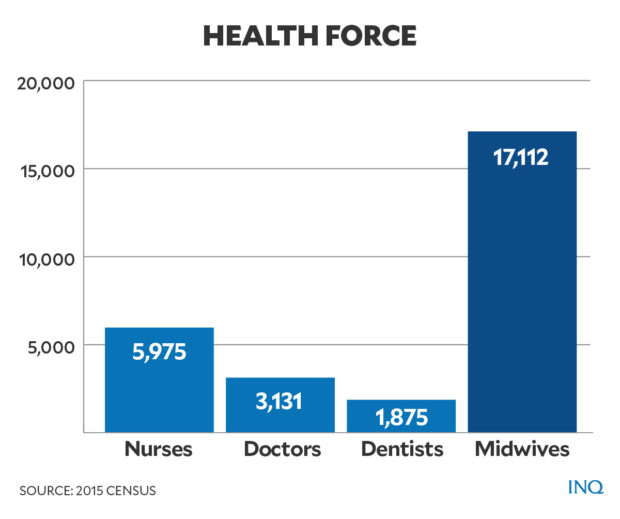
According to the 2015 Census of Population by the Philippine Statistical Authority (PSA), there were around 488,800 total health professionals in the country.
The 2018 National Migration Survey (NMS) noted that of the total health care workers in the Philippines, the majority, or 59 percent, were nurses.
Data in 2017 from the World Health Organization (WHO) said there were 90,308 nurses in the Philippines.
In terms of government nurses, the 2019 Philippine Statistical Yearbook of PSA listed 5,975 total by 2018.
These numbers, however, were pre-COVID.
When the pandemic began, Filipino nurses were among the medical professionals thrust to the frontline of the battle to keep COVID-19 cases from getting out of control.
Underpaid, uncompensated, and overwhelmed by working long shifts, some nurses — as early as June 2021 — decided or were at least tempted to quit their jobs.
The high COVID-19 case count in the country, paired with the slow release of benefits for health workers amid high demand for Filipino nurses abroad have already enticed many to leave.
According to a 2005 study by the International Labour Office (ILO) the migration of nurses, doctors, and other medical professionals can be attributed to several “push” and “pull” factors.
The push factors are: • economics • working conditions • socio-political factors • financial reasons • ‘deteriorating condition’ in the home country Most health workers seeking jobs abroad admit they do it for their children and families.
Until now, the exodus of nurses continues to worry many as it might further strain the country’s health care system that some feared could soon be on the brink of collapse.
“If we don’t stop their departure, maybe in another six months we might run out of nurses and our health facilities and healthcare system will be crippled,” said Dr. Jose Rene De Grano, president of Private Hospitals Association of the Philippines Inc. (PHAPI), at a recent Laging Handa briefing.
De Grano said at least five to 10 percent of private health care workers had already resigned from their jobs to pursue work abroad.
The St. Luke’s Medical Center (SLMC), one of the prominent hospitals in the country, reported last August that its Quezon City branch was lacking 127 nurses.
That same month, 88 health workers in SLMC QC held a mass walkout to protest the government’s delay in disbursing their benefits such as the special risk allowance.
The hospital’s branch at Bonifacio Global City in Taguig was not spared by the mass resignation as the number of nurses in its emergency rooms has declined from 66 to 43 during the same month.
According to Benjie Foscablo, secretary of the nurses’ union at St. Luke’s Medical Center in BGC, aside from jumping to jobs offered abroad, some nurses moved to business process outsourcing companies or as company nurses, where “you earn more and without being on the bedside.”
Some nurses cited exhaustion. As manpower continued to shrink, the remaining nurses are left with 12 to 16 hours of work shift per day.
Nurses, during the celebration of Nurses Week, took to the streets to protest their grievances including delayed benefits from the government.
Unreceived benefits
Republic Act 11494, or the Bayanihan to Recover as One Act, signed and issued September 2020, listed benefits for public and private health care workers in the country including: • Special Risk Allowance (SRA) • Life Insurance • Accommodation • Meal and Transportation Allowance Additionally, Section 21 of the Magna Carta for Public Health Workers mandated hazard allowance for health professionals in government facilities. This should be 25 percent of monthly pay for those in salary grade 19 and below and 5 percent of monthly pay for those in salary grade 20 and above.
In 2020, President Rodrigo Duterte signed and issued Administrative Order (AO) No. 36, granting active hazard duty pay (AHDP) of up to P3,000 per month to all health care workers.
The AO covers allied medical staff and other personnel in the public sector serving at the frontlines during the COVID pandemic. It is also exempted from income tax and will be in addition to any other similar benefits under existing law, issuances, and rules and regulations.
Another AO was also approved granting a special risk allowance (SRA) not exceeding P5,000 per month to public and private health workers directly serving or are in contact with COVID patients.
In June this year, Duterte signed AO No. 43 granting hazard pay of up to P500 per day to government personnel who are physically on duty during the two most stringent community quarantine levels in the Philippines—enhanced community quarantine (ECQ) and modified ECQ.
A P9.02-billion budget allotted for another tranche of SRA for health care workers was already released by the end of June, according to the Department of Health (DOH) and Department of Budget and Management (DBM).
The allotment covered the period Dec. 20, 2020 to June 30, 2021 as mandated by Administrative Order No. 42.
The DOH and DBM, in a joint circular, said that allowances, not exceeding P5,000 a month, will be given to “public and private health workers who directly cater to or [are] in contact with COVID-19 patients.”
The SRA is prorated “based on the number of days that the public and private health workers physically report for work in a month.” This attendance record should be “certified by the head of the hospital, laboratory, or medical and quarantine facility, or his/her authorized representative, reckoned from Sept. 15, 2020 until June 30, 2021,”
However, despite the release of funds and after several orders and issuances, many health care workers protest that they have not yet received the benefits that are due them.
Last August, Filipino Nurses United’s (FNU) secretary general, Jocelyn Andamo, said that 68 percent of nurses had not received hazard pay or SRA from September to December 2020.
In addition, at least 85 percent had not received SRA from December 2020 to June 2021.
The figures, according to Andamo, were based on a survey conducted by FNU with respondents from both public and private health care facilities.
Last September, amid growing protests among health care workers due to unreleased benefits, the health department said it had already disbursed P14.3 billion worth of benefits for public and private health workers.
The disbursed funds cover Sept. 15 to Dec. 19, 2020 (Period 1) and Dec. 20, 2020 to June 30, 2021 (Period 2).
According to DOH, P6.4 billion was released for Period 1, which included:
• Hazard pay for 384,159 health workers • SRA for 306,314 health workers • Meals, accommodation, and transportation (MAT) allowances worth P990 million for 103,096 health workers
On the other hand, DOH said Period 2 covered 2.4 million health workers who received P6.9 billion worth of SRA. At least 32,281 medical personnel were also covered with life insurance amounting to P16 million.
Aside from that, P570 million worth of checks were issued to 24,034 medical front liners as COVID-19 sickness and death compensation.
This was announced by the DOH after the end of the 10-day countdown set by health care workers for the release of their benefits.
Still, Jao Clumia, president of the St. Luke’s Medical Center Employees Association, said there were many nurses and health care workers who have not yet received the benefits that were promised to them.
Big work, small pay
Aside from delayed SRA and AHDP, the mass resignation of health care workers — including many nurses — was driven by small pay for big work.
According to Jossel Ebesate, All-UP Workers Union president and former nurses’ union president at the Philippine General Hospital (PGH), some nurses in private hospitals began resigning in 2020 to transfer to PGH, which offers higher pay.
Nurses in private hospitals and facilities earn minimum wage, around P537 per day. Nurses in public hospitals benefit from the salary standardization law with a higher entry rate.
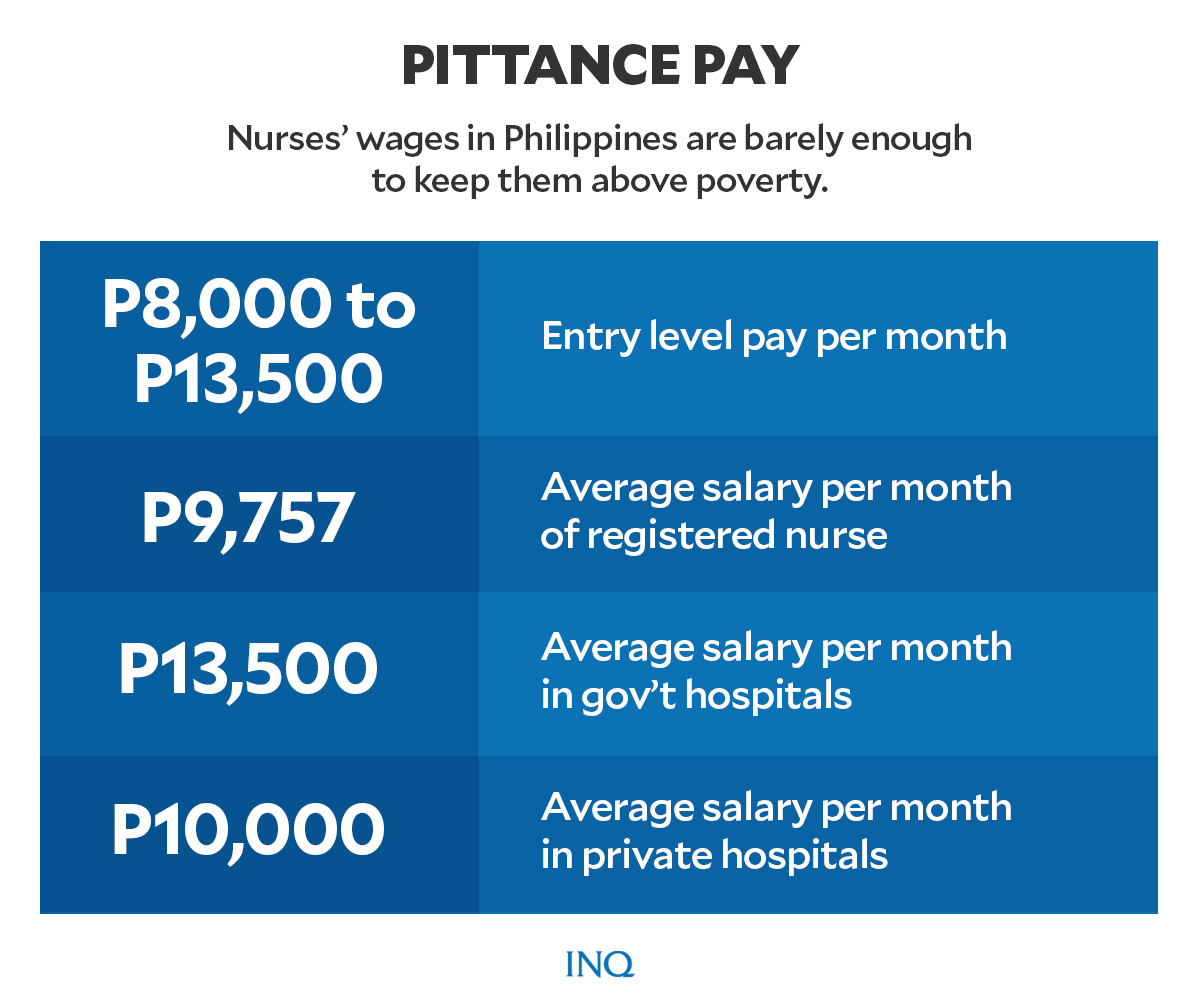
Data from the Department of Labor and Employment (DOLE) showed the following estimated salary or compensation for nurses in the Philippines:
• Entry-level registered nurse — P8,000 to P13,500 per month • Registered nurses hired at a hospital — average salary of P9,757 per month • Average salary in government hospitals — P13,500 per month • Average salary in private sector — around P10,000 per month
While some nurses move to other hospitals that can offer them better pay and secure their benefits, some have decided to work abroad.
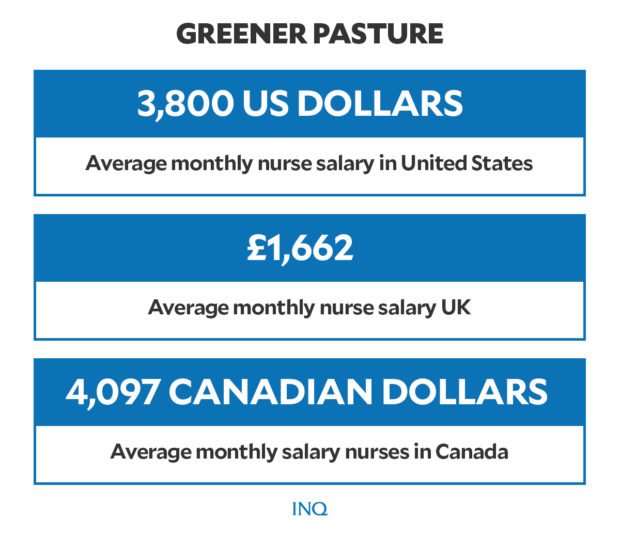
The rate offered for nurses overseas, according to DOLE, are as follows:
Graphic by Ed Lustan
• United States — average salary of P193,083 ($3,800) per month • United Kingdom — around P116,397 (£1,662) per month • Canada — at least P168,177 ($4,097) for entry-level A Reuters report on Sept. 24, 2020 quoted 34-year-old nurse April Glory as saying she was driven by financial need to work in the Middle East and leave her son behind.
“I felt that I was not earning enough,” she said in the report.
Mass resignation, career changes, and deployments were not the only reasons behind the decreasing number of nurses in the country.
As COVID-19 continues to plague the country, many nurses have lost their lives, falling victims themselves to the disease which has no known cure yet.
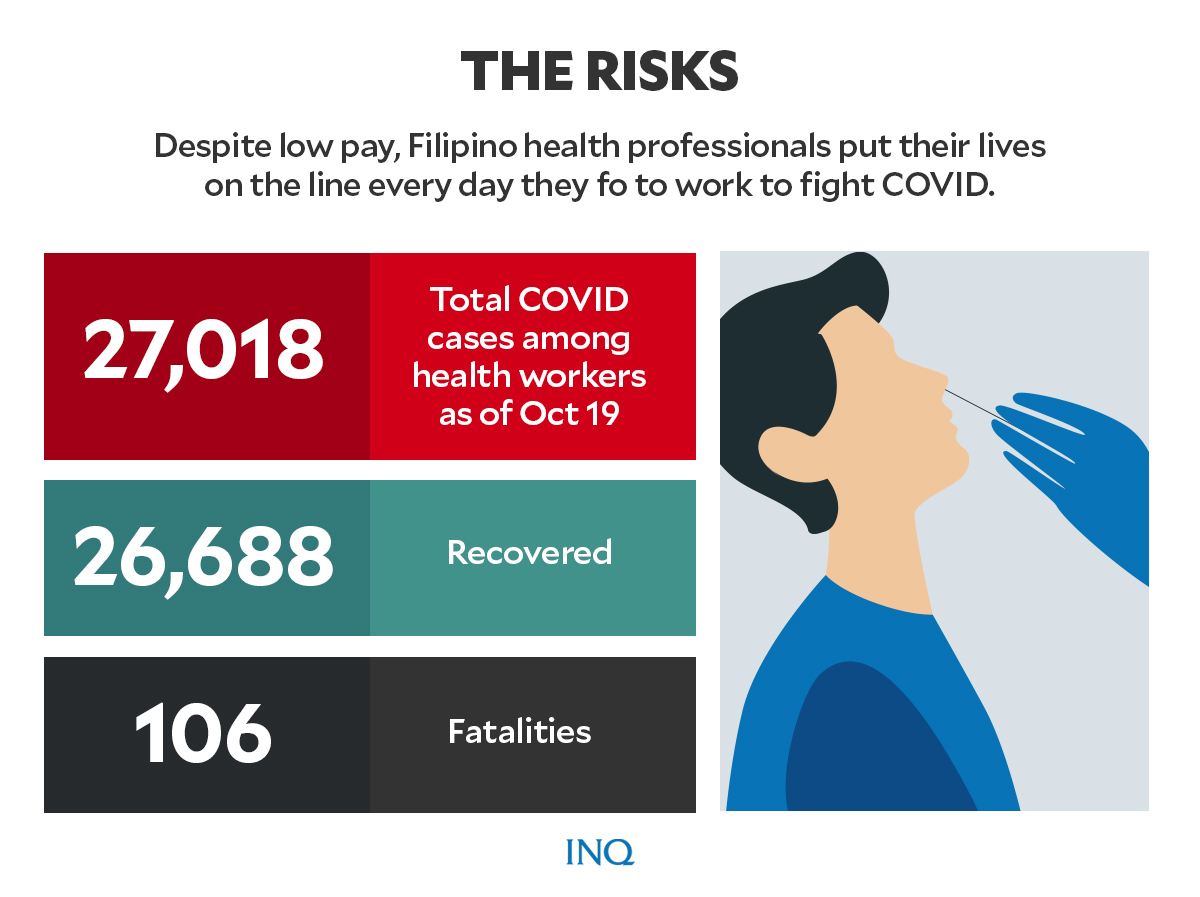
Data from DOH showed that as of Oct. 19, a total of 27,018 health care workers have contracted or were infected with SARS-CoV-2, the virus that causes COVID-19.
Of the sum, at least 224 remained to be active cases. These included:
The Senate blue ribbon committee has released its preliminary report on the Pharmally scandal that appears to have involved billions of pesos of fraudulent government transactions while the country was battling the COVID-19 pandemic, and the report’s conclusions are more than damning. There was a “grand conspiracy” surrounding the deal, said Sen. Richard Gordon, chair of the committee, and the involvement goes all the way up to President Duterte.
“It is clear and categorical to us that this grand conspiracy could never have happened without the imprimatur of the President,” declared Gordon. It was the President “who allowed his friends to bleed this nation’s coffers dry.”
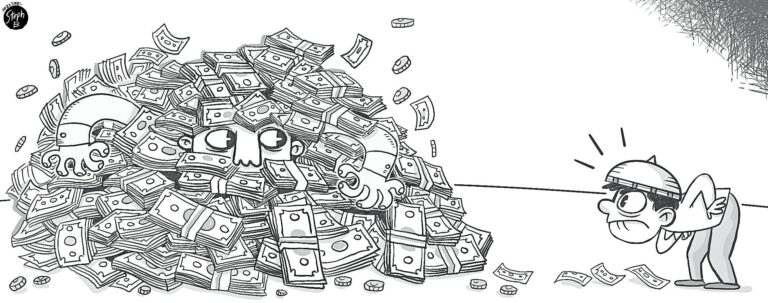
That “bleeding” was to the tune of some P11.5 billion in contracts in 2020 and 2021 that Pharmally, a newly-formed company capitalized at only P625,000, managed to bag from the Duterte administration for the supply of personal protective equipment, face masks and shields, and COVID-19 test kits, among others. It was the Commission of Audit that had first raised red flags about these transactions, but the true breadth and extent of the irregularities—from nonexistent office addresses and missing or spurious documentation to tampering with supply expiry dates and conflicting testimony by company officials—were bared when the Senate proceeded to scrutinize the nature of the deals made between the Department of Health by way of the Procurement Service of the Department of Budget and Management (PS-DBM) and Pharmally Pharmaceutical Corp., a Chinese company whose owners were introduced to Mr. Duterte by the President’s former “economic adviser,” Michael Yang. The Senate’s assessment of the deals? They “were grossly and manifestly disadvantageous to the government.”
That much the public knows by now, and if there was any doubt that the President was somehow linked to this affair, or was invested in some way in the outcome of the controversy, that was quickly dispelled long ago when Mr. Duterte began using his weekly TV addresses to the public not to talk about the COVID-19 pandemic—which has sickened more than 2 million of his countrymen and killed over 40,000 while also devastating the economy and driving millions more to despair and poverty—but to strenuously defend Yang and the executives of Pharmally from the Senate probe. Previous to this, the President had been taking to the airwaves barely more than once a week, usually at the ungodly hours of late Monday night or early Tuesday morning, in already taped and heavily edited broadcasts at that. But the Pharmally revelations appeared to have goosed the President into vociferous action; suddenly he was making twice-a-week appearances on TV, not only to take up the cudgels for Pharmally but, more ominously, to rail and hurl threats at the Senate for its temerity to look into the transactions and backgrounds of private individuals previously seen in Mr. Duterte’s company whose business was now awash in billions of payments from the government.
The President’s astonishing browbeating of a co-equal branch of government appears to have backfired; senators have by and large pushed back at the naked attempt to shut down the investigation and prematurely exonerate Yang and the Pharmally executives. Various sectors, from the country’s organization of lawyers to top business groups and an unprecedented gathering of health experts and leaders, have also denounced the President’s unbridled meddling in efforts to get to the bottom of what the public suspects might be an abominable case of plunder amid great suffering by the people. The latest such statement, from a group that includes former senator Rene Saguisag, former vice president Jejomar Binay, former solicitor general Florin Hilbay, and former legislators Neri Colmenares, Erin Tañada, and Teddy Casiño, expressed the widespread outrage “that the funds intended to strengthen the country’s COVID-19 response appear to have been given to favored officials and companies.”
Presidential mouthpiece Harry Roque has pooh-poohed the Senate’s findings as a “tall tale,” but the inquiry “reveals unconscionable, unabashed, and unethical circumventions of our republican way of governance,” said Gordon, who has become the main target of the President’s broadsides. “We found that those involved prioritized their profits, commissions or kickbacks, instead of coming up with the right way to quell the pandemic.”
The President’s unrelievedly hostile behavior in this case means no serious, definitive effort to pursue the truth will happen from his end. The public can only hope that the Senate will stand its ground and continue to expose the workings of this crooked enterprise, as Gordon has vowed: “We will pursue in the people’s name not only to punish the perpetrators but also for them to return the money they stole from all of us.”