Home Blog Page 60

Writers, for whom do you write?

0

Aug 29, 2021, Michelle Lado

‘I realized that trying to please others only led me to writing pretentious blabber. I might have rubbed elbows with the privileged, but to the hungry, I was irrelevant.

‘The cursor hovered over the folder that read “Poems/Essays/Stories.” I clicked on it. Opening the files and skimming through each of them, I was swept up by memories and emotions. More importantly, though, it was a cringefest.

These were works that I wrote somewhere between 2006 and 2013. I’d like to be kind to myself and say they’re not really all that bad. It’s just that I come from a different standpoint now, and these works simply don’t resonate with me anymore. 

It was around 2013 when my outlook on writing started to change. I became socially aware and began questioning what the point was in writing the way I did, and what my writing meant for the kind of world we live in now. The shift was specifically triggered by the question: Para kanino (for whom)? The question begs to identify the significance of what we do, regardless of what it is. Why do we do what we do? Ultimately, what is the meaning of our life?

When I was younger, my writing aspirations were pompous. I desired validation from peers and prestigious award-giving bodies for literature. I wanted to be part of literary cliques where I would be patronized. I dreamt of seeing my byline on peer reviews and journal articles. At that time, I thought being visible to other writers and getting their nod would seal my fate as a writer.

Thankfully, I got out of that mindset. It didn’t take long before the dots connected: the reason I was self-absorbed was because society had conditioned us to compete against each other and to focus on self-advancement, even if it’s at the expense of others. Eventually, the adage “publish or perish” no longer held water for me. I realized that trying to please others only led me to writing pretentious blabber. I might have rubbed elbows with the privileged, but to the hungry, I was irrelevant.

Nothing is wrong with “shallow” writing. Back in the day, writing about petty things was cathartic for me. They may be cringeworthy to me now, but they are the product of a discipline that taught me to look for my voice in the dark. It’s not unlikely that I would write about these things again in the future. 

No writer was born socially aware; no one writes politically from day one. However, the time will come when we have to prioritize. The time will come when we need to do more than writing fiction and opinion; soon, we will also need to act.

Having the power to communicate through writing, especially amid the crises we are in now, enjoins us to put the spotlight away from the self. At this point in time, the power of writing should be spent more on issues that matter the most. We must harness the influence of our pen to amplify issues bigger than our ego. It’s not about being righteous. It’s not about putting up parameters and controls. When human life is at stake, focusing on relevant writing is not a breach on our freedom of speech. As writers, it’s simply doing what’s decent and necessary.

This is not a debate on niche writing. No one needs a niche to be human. 

Level playing field

However, our role as writers does not end with writing with purpose. 

Talking about what we should write is not enough. That we produce content responsive to the status quo must already be the standard. As writers, what we also need to emphasize is that when we talk about writing for the people, we must also talk about not excluding the people in the process. 

The problem is that accessibility is always lost in the discussion. When we write about state oppression in the hopes of exposing it and getting people to rally against it, who only gets to read that? Are we really empowering the most vulnerable sectors of society when we claim we represent their voice during conversations on our choice of platform? Or are we simply hijacking their misfortune so that we can have content, make ourselves look heroic, and boost our career? 

It’s long been established that relevant writing is urgent. But how do we ensure that we do not fall into the trap of mere sloganeering? How will we be understood by people who are not only alienated by big words, but also do not have access to the spaces where our ideas are expressed? How we will be able to effect change when we only communicate with each other, in a manner and language only we can grasp, and in exclusive venues only we can afford?

The more stakeholders we include at the discussion table, the more policies are swayed in favor of the people. Ordinary folks who are intimidated by intellectual talk on social issues will see that engagement is an affair that actually needs them more than anyone for plans to come to fruition. It is their participation that will render meaning to our work as writers.

Writers are not in a position to look the other way. It’s no longer acceptable to just wax poetic on the talk of the town and project a stand (to appear cool, if not for fear of getting canceled by the woke universe.) We must also be actively instrumental in bridging for others so that they can join the discourse. We have to connect them both to substance and to form. Let our words break down communication barriers so as not to leave people behind. Let’s educate ourselves more so that we can also educate others.

The marginalized can speak for themselves. We are not their saviors. They can stand up for themselves. What they need is a chance at a level playing field.

When you write for and with the people, it is in itself the greatest validation. No other recognition matters. – Rappler.com

Biggest pandemic supplier has links to ex-Duterte adviser Michael Yang

0

Aug 28, 2021 Pia Ranada

MANILA, Philippines

[EXCLUSIVE] Securities and Exchange Commission documents show how Yang is connected to the embattled Pharmally Pharmaceutical Corporation, supplier of pandemic supplies flagged by auditors to be overpriced

(Done in partnership with the Organized Crime and Corruption Reporting Project)

The Philippine government’s biggest supplier of medical goods during the COVID-19 pandemic has links to President Rodrigo Duterte’s former economic adviser Michael Yang, government documents obtained by Rappler show.

The local firm Pharmally Pharmaceutical Corporation bagged a total of P8.68 billion worth of deals – the biggest among suppliers awarded contracts under the Bayanihan procurement, or procurement for pandemic response, in 2020.

The data comes from the Government Procurement Policy Board (GPPB) website, where agencies are required to upload all awarded pandemic-time contracts.

Pharmally Pharmaceutical Corporation leads by a huge margin, with the second top supplier, XuZhou Construction Machinery Group, securing only P1.9 billion worth of contracts.

The Commission on Audit has, however, flagged the Procurement Service of the Department of Budget and Management for failing to post all awarded contracts on the GPPB portal. The data used here represents only the contracts uploaded to the portal.

Pharmally Pharmaceutical Corporation is linked to Yang’s network through one of its owners, Singaporean Huang Tzu Yen, who sits as a director in another company, along with two other associates of Yang.

On March 17, 2017, Yang was in a meeting between Duterte and executives of a related company, Pharmally International Holdings. Publicly-available Malacañang video footage of the gathering – which was also aired at the Senate hearing on Friday, August 27 – confirm Yang’s attendance in that meeting, which included Pharmally International Holdings chairman Huang Wen Lie. He is said to be the father of the Singaporean part-owner of Pharmally Pharmaceutical Corporation, which bagged the PPE contract.

Yang was also among those served a subpoena by the Senate for the Friday hearing, according to Blue Ribbon Oversight Office Management Director-General Rodolfo Quimbo.

The biggest of Pharmally Pharmaceutical’s contracts was worth P3.82 billion for personal protective equipment (PPE) that was eventually flagged by opposition Senator Risa Hontiveros for being overpriced.

According to a copy of the contract from the GPPB portal, Pharmally Pharmaceutical Corporation charged P1,910 per unit of two million PPE sets, for a total contract worth P3.82 billion. This was the biggest supply contract out of the 11 contracts Hontiveros scrutinized in September 2020. Of the 11, only four had Filipino suppliers and the rest had Chinese ones.

The Pharmally Pharmaceutical contract was signed on May 6, 2020, just a few months into the pandemic. It was signed three weeks after the period of March 23 to April 13, when the government imposed a price ceiling of P945 per PPE set. The P1,910-per-unit price of Pharmally Pharmaceutical was more than double the price cap.

The same company also won a P480-million contract to provide test kits, which Senator Franklin Drilon claimed in September 2020 to be overpriced by P208 million.

Below is a summary of all 10 contracts obtained by Rappler, followed by copies of the contracts themselves. The most recent purchase order was signed only in June 2021, with the government paying P774 million for 17,000 RT-PCR test kits. Senator Imee Marcos said an even more recent contract was signed in late June.

Huang and Yang’s associates

Pharmally Pharmaceutical Corporation’s general information sheet, obtained by Rappler from the Securities and Exchange Commission (SEC), shows that the Singaporean Huang owns 40% of the company.

Rappler found out, too, that Huang is also a director in a different firm, Pharmally Biological Company Inc. Huang’s co-directors in this firm are close associates of Yang – they sit as incorporators in several companies led by Yang himself.

Pharmally Biological’s SEC records show that Huang is president and an incorporator, along with two Filipinos – a certain Rose Nono Lin and Gerald Cruz. The two Filipinos are also involved in at least one other company of Yang.

Lin and Cruz are incorporators, too, of a company chaired by Yang, Philippine Full Win Group of Companies Inc., according to the firm’s SEC documents. Yang had previously identified himself as chairman of Philippine Full Win, both in the company’s website and in his business cards.

Yang had even toured Duterte in Full Win’s Xiamen office in 2015. Philippine Full Win is the local counterpart of Xiamen Full Win (Fu De Sheng in Chinese), a Chinese company.

Two incorporators in Philippine Full Win (Rose Lin and Gerald Cruz) are also directors of Pharmally Biological.

Philippine Full Win Group of Companies was registered with the SEC in February 2017. Eight months later, Pharmally Biological also registered with the SEC. Pharmally Pharmaceuticals, the firm with the government pandemic-time contracts, was registered even more recently, in September 2019, or just six months before the start of the pandemic.

Senators on Friday said this should have been a red flag for the Procurement Service of the DBM, which opted to award in May 2020 a multi-billion contract to a newly-incorporated company.

Michael Yang’s meeting with Duterte, Pharmally executives

In the video of the March 2017 meeting at Panacan, Davao City, Yang – all smiles – appears to introduce the executives of Pharmally International Holdings to President Duterte.

Further bolstering a likely connection between the Pharmally network and Yang’s company was the presence at that meeting of Zheng Bingqiang, who was Full Win president and another close business associate of Yang. Zheng was with Duterte and Yang in 2015 when they visited Full Win’s Xiamen headquarters.

Rappler has sought Yang’s side for comment. He has not responded as of posting. We will update this article with his response.

Yang was Duterte’s economic adviser for at least the entire 2018, according to Malacañang contracts exclusively reported by Rappler. After public scrutiny following Rappler’s report, Yang’s term as adviser was allowed to lapse.

Yang has been chummy with Duterte for most of his term. Yang has twice hosted Duterte and top government officials in private gatherings in Hong Kong and China. He was among those given coveted invitations to the Malacañang state banquet held for visiting Chinese president Xi Jinping in 2018.

But perhaps the strongest indicator of Yang’s clout with the Philippines’ most powerful man is how Duterte, in 2018, publicly defended him against intelligence findings that he was involved in the illegal drug trade. – with reports from Lian Buan/Rappler.com

“Billions of requests, thousands of dollars”: Inside a massive cyberattack on a Philippine human rights group

0

Researchers say they traced the month-long DDoS attack back to an Israeli company’s network.

By Peter Guest 25 August 2021 • Singapore

For nearly a month now, Tord Lündstrom has spent his days and nights trying to defend a website on the other side of the world from an extraordinary cyberattack.

On July 29, the site belonging to Karapatan, a human rights organization in the Philippines, was targeted by a sophisticated, well-resourced dedicated denial of service (DDoS) attack. Traffic flooded in from botnets spread across the world, from Ukraine to Indonesia — all aimed at a single folder on Karapatan’s site, which hosts the group’s reports detailing extrajudicial killings in the Southeast Asian country. Karapatan has long been a target of attacks online by supporters of the Philippines president, Rodrigo Duterte.

Since then, the attack has not let up for a single moment, something that Lündstrom, the technical director of the Swedish cybersecurity nonprofit Qurium, said is unprecedented. “Billions of requests, thousands of dollars spent on feeding garbage 24/7, night and day,” Lündstrom told Rest of World. “They just keep going and going and going.”

This week, Lündstrom and his team say they were able to trace IP addresses used in the cyberattack to a network operated by Bright Data, an Israel-based company that offers proxy networks and data services to corporate clients. Bright Data has denied any involvement in the attack.

After the publication of this article, Bright Data reached out to Rest of World again, stating, “Bright Data had absolutely no connection to the reported incident, and the Qurium report is categorically false, unprofessional, and unethical. Qurium approached Bright Data just before they published the false report, and even though Bright Data showed Quirum’s researchers that their report was blatantly wrong, they chose to ignore Bright Data and the facts. Qurium acted recklessly, if not intentionally, without any effort to look into the facts Bright Data presented.”

The nature of the attack means that it was paid for — if not to Bright Data, then to another provider. Based on the amount of traffic that has been directed to Karapatan’s site, and typical rates, Qurium estimates that the attack could have cost at least $260,000, meaning that someone, somewhere, is willing to spend serious money to take Karapatan offline.

“This is not for free. We know that it’s not a kid playing computer games that has decided, you know, to have some fun. This is something different,” Lündstrom said. “You don’t do this for three weeks in a row if you don’t have the resources.”

Karapatan is being targeted by a so-called application layer DDoS attack. DDoS attacks use botnets — networks of infected devices — to flood a site with requests, overwhelming its servers and taking it offline. This attack has been proxied through 30,000 bots in Russia, Ukraine, Indonesia, and China, directing millions of requests to the page karapatan.org/resources, where the organization stores its human rights reports. 

DDoS attacks have become increasingly prevalent over the past few years, due partly to the growth of the internet in poorly-regulated jurisdictions and the proliferation of internet-of-things devices, which often lack security controls and are susceptible to being hijacked to be used in botnets, many of which are available for hire. Netscout’s 2020 internet threat report counted more than 10 million attacks worldwide in 2020. 

The onslaught against Karapatan is remarkable for the volume of requests and the relentlessness of the attack, leaving Lündstrom and his team exhausted as they work around the clock to mitigate them. “Ten years that we’ve been in this space, we have never seen this,” he said. “It’s almost, like, psychotic, you know? It’s almost sick.”

But the scale and duration of the attack has also given Qurium time to try to unravel the infrastructure that the attackers are using. 

Qurium’s team recorded all of the IP addresses sending requests to Karapatan’s site, and determined which of them were so-called “open proxies” — publicly available machines that attackers often use to amplify and mask their attacks — or other commonly-used infrastructure. About two-thirds were, but the remainder couldn’t easily be classified.

They looked into around 8,000 of the 30,000 IPs and realized that they were coming from a small number of places, and that the attacks were coming in a regular pattern. “That is what made us believe it was something bought privately,” Lündstrom said. The traffic was hitting the site in dense bursts, and the IPs were being renewed hourly. Looking deeper at the requests, Qurium said it found that a lot of the proxies had the name “Luminati.”

Qurium has published a technical forensics report detailing their evidence, which appears to show hundreds of IP addresses associated with the Luminati network participating in the attack on Karapatan. Rest of World asked two independent experts to confirm the validity of the methodology, both of whom agreed that it was sound. One said that the findings were “weird, but also plausible.”

Luminati rebranded to Bright Data in March 2021. The company offers proxy networks for other businesses, allowing them to collect data at enormous scale, typically for market research or for targeted marketing campaigns. It achieves this by proxying its customers’ web traffic through mobile networks, data centers, and residential buildings. The company is currently embroiled in a lawsuit in Israel, in which a plaintiff alleges that Luminati is widely used for click fraud. As part of the suit, it was revealed that the spyware company NSO Group was a Luminati client.

This kind of infrastructure is rarely used in DDoS attacks, experts told Rest of World — Qurium has never seen it before — because it’s an expensive way to buy traffic. Between August 10 and August 20, Qurium researchers estimated that around 10 terabytes’ worth of traffic was directed at karapatan.org via Luminati.

Bright Data’s compliance team leader Gal Shechter denied that the company’s networks had been used in the attack

“Bright Data confirms that it had nothing to do with such an attack and the attack did not come from Bright Data‘s network,” Shechter said.

“All our customers are granted access to our products and networks following a very comprehensive compliance procedure. We also keep logs of the networks’ traffic. For this reason, we can verify and check any case thoroughly,” Shechter said over email to Rest of World. “We are happy to offer our expertise and top professionals to support or assist in identifying the actual attackers.”

However, Rest of World has seen correspondence between Qurium and Bright Data, in which the company confirmed that the IPs that Qurium had identified were indeed from within Bright Data’s network. One message read: “We did find customers who were targeting this website.”

Asked to comment on Bright Data’s denial, Lündstrom sent Rest of World a Toy Story meme reading: “Evidence. Evidence Everywhere,” along with screenshots showing the company’s product, in which it offers users proxies on Ukraine’s Kyivstar and Russia’s MegaFon, two of the mobile carriers used in the attack. There’s no practical way, he added, that IPs from inside Bright Data’s network could be involved in the attack unless the company’s infrastructure was being used.

In response, a Bright Data spokesperson said: “We provided Karapatan all details confirming that our networks and products have no connection to this incident. Our compliance team are in direct contact with Karapatan since the second we learned about the incident. Regardless, our team of experts has offered Karapatan free assistance to help identify those responsible for this attack.”

The distributed nature of the cyberattack makes it difficult to prove conclusively where it originated. But Karapatan has been a perennial target for the government of Rodrigo Duterte in the Philippines. The group has documented human rights abuses in the country, including those relating to the government’s brutal “war on drugs,” in which at least 5,000 people have been killed — human rights groups say the number is more like 12,000. In June, the prosecutor of the International Criminal Court in the Hague requested an investigation into whether the killings constitute a crime against humanity. Karapatan’s reports are routinely referenced by international human rights organizations and media investigating abuses.

In response to Karapatan’s documentation of, and campaigning against, human rights abuses under the Duterte administration, the organization has been targeted with online and offline attacks. Its members have been routinely “red-tagged” — falsely “outed” as Communists and terrorists. Several have been murdered. 

In early July 2020, Karapatan, along with two independent news outlets, Bulatlat and AlterMidya, were briefly targeted by a DDoS attack, which Qurium was able to link back to a computer registered to the Philippines Department of Science and Technology, and apparently used by military intelligence. 

Whoever is behind the July-August attack hid their tracks better, but Karapatan Secretary General Cristina Palabay said the timing means there’s only really one suspect. “We see no other actor who would do that with the resources, with the motivation or who will benefit most from our website being taken down, except for [the] government,” she said.

Karapatan launched an online campaign, #StopTheKillingsPH, to draw attention to violence against human rights defenders and journalists on August 16, the anniversary of the killing of one of its activists, Zara Alvarez. On that day, the DDoS attack ramped up a notch. “It has a correlation,” Palabay said. “[Attacks happen] during critical or big campaigns that we have: on Stop the Killings, on political prisoners, or the ICC.”

Palabay said that she’s concerned by the growing frequency of attacks aimed at human rights organizations and independent media in the Philippines. The country holds elections next May, and she fears a double-pronged assault on the truth: pro-government troll networks pushing out huge volumes of disinformation on social media, while cyberattackers take authoritative, verified sources offline. That, she said, could turn the vote into “a cesspool of disinformation, [with] smears, threats not only against activists but against the political opposition.”

The nature of the attack on Karapatan has ramifications beyond the Philippines. Lündstrom expects this kind of event to be even more common, with DDoS attacks becoming increasingly commoditized. Countries with weak regulation and poor network security, including Ukraine, Thailand, and Indonesia, offer huge wells of compromised devices that can be co-opted by attackers for use in botnets. Alongside more publicly accessible botnets, which can be hired for a few hundred dollars for small-scale attacks, there are professional groups offering content removal as a service. “There’s this kind of darker space where powerful people … are willing to pay $10,000, $20,000 for some expert in x, y, z country to take down a website,” Lündstrom said.

This, he warned, creates a dangerous asymmetry, where well-resourced governments or organizations can simply pay to take content they don’t like offline. 

“These [targets] are civil society groups with extremely small budgets. The money invested now to take them down is definitely much, much, much, much bigger than the money they will ever have themselves,” Lündstrom said. “This time, [the attackers] just got unlucky that some Swedish guys who have never been in the Philippines decided to help.”

This story was updated to correct Gal Shechter’s title. This story was also updated with a new statement from Bright Data.Peter Guest is the enterprise editor for Rest of World.

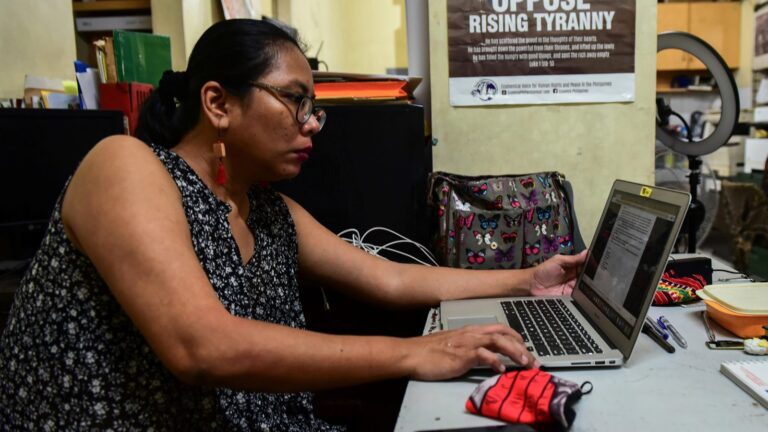
Header photo caption: Cristina Palabay, head of local human rights group Karapatan, on her laptop during an interview with AFP in Manila in 2020.

Kerima Lorena Tariman: She knew ‘the value of people, land, poetry’

0

By: Krixia Subingsubing, Maricar Cinco -Philippine Daily Inquirer / August 23, 2021

MANILA, Philippines — To agents of the state, Kerima Lorena Tariman was a “terrorist” — as the military described the two New People’s Army (NPA) rebels, one of them later identified as Tariman, who were killed in an encounter with government troops on Friday.

But to her comrades, associates, friends, and relatives, Tariman, 42, was committed in everything she did as a mother, journalist, artist, and poet.

Tariman and a comrade of hers identified only as “Pabling” were among the three fatalities in Friday’s encounter between the NPA and soldiers of the 79th Infantry Battalion at Hacienda Raymunda in Silay City, Negros Occidental.

The third fatality, according to a social media post by the 303rd Infantry Brigade, was Private First Class Christopher Alada, who was wounded in the clash and later died at the Silay District Hospital.

According to the Army’s version of the encounter, they were alerted by “farmers and civilians in Hacienda Raymunda [to] the presence of CPP (Communist Party of the Philippines)-NPA terrorists.”

The Army said further, “[A]n encounter transpired…at around 6:00 A.M., …[a]fter which the NPAs scampered in different directions leaving” their two fallen comrades—one of them “a dead female NPA terrorist member believed to be their political officer aka ELLA, …believed to be a native of Albay.”

Juanito Magbanua, spokesperson for the NPA’s Regional Operational Command in Negros Island, said in a statement on Saturday: “The masses of Negros have Ka Ella and Ka Pabling deep in their hearts. They mourn the death of revolutionary martyrs who fought for their liberation from decadeslong feudal exploitation.”

Their deaths were a “sacrifice that reminds us to steel our commitment to the revolutionary cause and fearlessly take on their unfinished tasks until revolutionary victory,”

Magbanua also said.

A world apart

One of three daughters of music critic, journalist and impresario Pablo Tariman, the younger Tariman became involved in a milieu that was a world apart from the concert halls and opera productions where her father thrived.

But Pablo Tariman said he always respected Kerima’s choices and the path she took, saying “I am proud of my daughter. I like the way she lived her life in poetry and commitment. I was ready for this death years back.”

No matter their divergent paths, father and daughter shared an affinity to poetry. In Kerima’s case, she sought to connect poetry with a humanism that friends have come to observe in her regard of the conditions of the Filipino people.

But she also had a lighter side. To close friends, “Kelot,” as they called her, was the regular “chill” girl who played the guitar and laughed at jokes.

On graduating salutatorian from the Philippine High School for the Arts, “She went up the stage barefoot—lapat sa lupa,” recalled professor Rommel Rodriguez of the University of the Philippines (UP).

Rodriguez also remembered Tariman as identifying herself with the “Joey” character in the 1982 film “Moral,” the flirt who awakens to activism as portrayed by Lorna Tolentino.

Like Joey, “she too was quiet but brave,” Rodriguez said. “They were also both very beautiful.”

Community work

Yet there was no denying the depth of her personality in everything she endeavored, from poetry to her political work. Rodriguez said she was a woman of few words, “but her thoughts and writings said a lot more.”

Tariman entered UP in 1996 as a journalism student but later shifted to Philippine Studies. She left the university four years later to become involved in community work.
Friends were not surprised by Tariman’s joining the armed struggle, Rodriguez said.

Tariman had already experienced harassment by the military because of her politics. In 2000, when she was managing editor of the Philippine Collegian, she was arrested and detained while in Isabela province to research about the peasant communities there.

“I was only hoping to gain a better understanding of the peasant situation in that area,” she said in a 2012 interview with fellow activist Sarah Raymundo. “But the whole experience, from living with the peasants to my arrest and detention, is an indispensable lesson on the reality of class struggle.”

When her husband, artist and activist Ericson Acosta, was detained in 2011, she led a campaign that culminated in his release two years later.

‘Finest poet’

Poet Vim Nadera said of Tariman: “Kerima knows the value of people, of the land, and of poetry. As a poet, she also understands the merit of conflict. She sought to make her actions more valuable than words.”

Journalist Len Olea described Tariman as the “finest poet of our generation,” and journalist and filmmaker Ilang-ilang Quijano, paying tribute to Tariman, has done a translation of a poem she wrote, “Salaysay at Kasaysayan” (Narrative and History) from her last published book in 2017, “Pag-aaral sa Oras: Mga Lumang Tula Tungkol sa Bago” (Reflections on Time: Old Poems about the New).

In a farewell poem-tribute to his daughter, Pablo Tariman recalled how Kerima “took to poetry/the way swans took to water.”

Activist Kerima Tariman’s legacy in literature, poetry

0

Aug 25, 2021 Steph Arnaldo

MANILA, Philippines

Loved ones also pay tribute through their own poems and essays

Kerima Lorena Tariman, who died on August 20 in a clash between the New People’s Army and the Philippine military in Negros Occidental, is remembered not just for her revolutionary work, but for her literary works. She was, after all, a poet.

Tariman, 42, was taking up Philippine Studies when she became managing editor of the Philippine Collegian, the student publication of the University of the Philippines (UP) Diliman, from 1999 to 2000. Before this, she was the publication’s culture editor.

While she was doing research on peasant communities, soldiers arrested her in Isabela in Northern Luzon. She was eventually released on bail and then cleared by the court two years later.

Before college, Kerima attended the Philippine High School for the Arts as a creative writing student. Kerima had already been critiquing books and films, sometimes using the pseudonym Marijoe Monumento, for Pinoy Weekly. Her poems also appeared in the Sunday Inquirer, the Manila Chronicle, and Dyaryo Filipino.

In 2017, she published her last poetry collection, Pag-aaral sa Oras: Mga Lumang Tula Tungkol sa Bago (Reflections on Time: Old Poems about the New), which CNN Philippines named as one of the best books by Filipinos in 2018.

Filmmaker Ilang-ilang Quijano translated one of Kerima’s poems, “Salaysay at Kasaysayan (Narrative and History)” from the same collection.

“Someone said that that society itself is the bigger detention cell and that’s the reason I am still struggling to be emancipated,” Kerima once said, as quoted by her father Pablo Tariman on Facebook.

One of Kerima’s published works for the Philippine Collegian included the essay “Talakayang-Buhay o ‘Panitikang Saksi’ ng Pambansa-Demokratikong Kilusan,” which was published on August 3, 1998. The publication remembered Teriman for her work as a “poet, researcher, journalist, and revolutionary, who fought for her husband’s freedom when he was arrested in February 2011.”

Her father, Pablo, shared on Facebook Saturday, August 21, a passage from one of Kerima’s poignant essays. She had written about her harrowing experience fighting for the freedom of her musician-husband, Ericson Acosta, who was a political detainee. The essay was written in 2001 while she was in Ilagan, Isabela.

“The first time I went to the countryside to integrate with farmers, government troopers tried to show me firsthand how fascism, counterinsurgency, and psychological warfare work. As if to make sure I don’t forget, they gave me a minor grenade shrapnel wound, and a major, lingering fear of any man with a golden wristwatch who’d seem to loiter in public places to watch me,” she wrote.

“First to see me in jail was my father, a really anxious Pablo Tariman. Everyone knows he’s never the activist. He could only turn to his Pavarotti records whenever he’s down,” Kerima added.

Kerima’s mother, Merlita Lorena, was also a political detainee during the Martial Law years and among those awarded compensation for human rights abuses. Merlita was also a poet and writer.

One of Merlita’s most notable poems about Kerima is called “Aki Ko,” meaning “Child of Mine” in Bikolano.

Poet Marne Kilates translated this into English:

Pablo also shared a beautiful piece about his daughter, titled “29th of May,” a tribute to the day Kerima was born and the life she led growing up. He also shared a photo of Kerima at two years old.

On August 22, Pablo posted another photo and a piece about Kerima on Facebook, titled “Infant in my Mind,” grieving the death of his second daughter.

The Philippine Collegian also released a 2012 interview between Kerima and Sarah Raymundo, where Kerima said that “when one creates art without being apologetic about its political implications, one is actually being quite ethical.” – Rappler.com

Health workers give DOH until August 31 to release withheld benefits

0

Aug 24, 2021, Bonz Magsambol

MANILA, Philippines

‘We strongly demand more actions than words,’ says Alliance of Health Workers President Robert Mendoza

A health workers group on Tuesday, August 24, gave the Department of Health (DOH) until August 31 to release the withheld COVID-19 benefits due medical frontliners.

“We strongly demand more actions than words. Thus, we are giving the DOH until August 31, 2021 to implement the long overdue COVID-19 benefits to health workers,” said Alliance of Health Workers (AHW) president Robert Mendoza.

“With this deadline, we are all set to hold a series of protest actions this week as many among us got infected and succumbed to COVID-19 already without enjoying these much-deserved benefits,” he added.

On Saturday, August 21, President Rodrigo Duterte directed the DOH and the Department of Budget and Management (DBM) to give the unreleased benefits to health workers within 10 days.

In a statement on Tuesday, the DOH said that it was fast tracking the release of special risk allowance (SRA) to health workers after the President’s order.

“I have also given marching orders to concerned offices to comply with the directives of the President on distributing SRA to our healthcare workers within 10 days,” Health Secretary Francisco Duque III said.

He addedd, “Dapat maibigay ang SRA ng mga healthcare workers natin na hindi pa nakakatanggap nito. Patuloy natin sisiguraduhin na makuha ng ating healthcare workers ang kanilang mga benepisyo na naayon sa ating batas.”

(The SRA of our healthcare workers should be given for those who haven’t received theirs yet. We will continue to make sure that our healthcare workers will receive the benefits due to them in accordance with law.)

Based on a joint circular from the DOH and the DBM, eligible health workers may receive special risk allowance not exceeding P5,000 per month. It would cover the number of days the health workers physically reported to work in a month from September 15, 2020, until June 30, 2021. 

However, there were still a number of health workers who have yet to receive this benefit. Some of them have even died without getting the benefit. – Rappler.com

Flawed warrants laid bare as courts side with law in freeing activists

0

By: Kurt Dela Peña – Content Researcher Writer/INQUIRER.net/ August 23, 2021

“I saw police forces committing a crime but I’m the one who was arrested.”

Still traumatized by what happened to her, this was how Lady Ann Salem described her ordeal in the hands of police who arrested her on Dec. 10, 2020, Human Rights Day.

“It took them three hours to fabricate the basis of my arrest,” Salem told INQUIRER.net.

“Those three hours forced me to go through the pain inside prison for a crime I never committed,” she said.

Salem, editor of the red-tagged publication Manila Today, said she was given a glimpse of the pattern that police, heeding orders from President Rodrigo Duterte, use in persecuting dissenters—use armed undercover agents during dawn raids in searches of activists’ homes that the operatives keep from view of their targets.

Salem was arrested with labor organizer Rodrigo Esparago inside her residence in Mandaluyong City. That day, five union organizers were likewise arrested in a string of police operations—Dennise Velasco, Mark Ryan Cruz, Romina Astudillo, Jaymie Gregorio and Joel Demate.

All seven were taken as operatives served the search warrants issued by Quezon City Executive Judge Cecilyn Burgos–Villavert, whose court, activists said, had become a “warrant factory” for the Duterte administration’s crackdown on the Left.

But the Criminal Investigation and Detection Group (CIDG) said the operation against Salem and many others conducted by police against activists had been in compliance with a directive by the CIDG chief to escalate “operations against loose firearms and criminal gangs.”

Salem and her six co-detainees had been charged with possession of unlicensed firearms, an offense members of leftwing activist groups are all too familiar with. Their relatives described the charge as “fabricated.”

National Union of People’s Lawyers, which offers pro bono legal services to victims of government abuse who can’t afford lawyers, said in 2020 cases of illegal possession of firearms were commonly filed against activists because these were “easier to prove in court.”

According to Salem, when she saw police at her doorsteps, she already knew what would happen—she would be arrested and thrown in jail. She remained hopeful, however, that the court would see through the lies “invented by the government” and give her justice.

Hoping bore fruit for Salem when on Feb. 5, 2021, Judge Monique Quisumbing-Ignacio, of the Mandaluyong Regional Trial Court (RTC) Branch 209 dismissed the cases filed by police against her and Esparago, declaring the warrants issued against them “void.”

Quisumbing–Ignacio’s decision expunged from the record the explosives, pistols and bullets that police claimed had been found during their search of Salem’s house. Phones, laptops and other devices taken from the house were also declared inadmissible as evidence.

The decision, described as “brave”, not only led to Salem and Esparago’s freedom but also inspired other courts to “independently review” the search warrants coming from the sala of Burgos-Villavert and to “stand for what is right.”

In her ruling, Quisumbing-Ignacio said one of two search warrants from Burgos-Villavert did not “specify with sufficient particularity the laptop and cellphone to be seized,” declaring it “void for vagueness” and saying that the police cannot seize items that were not listed or described in the warrant.

“Not knowing which cellphone and laptop they were supposed to seize, they took all that they found,” said the ruling.

“This clearly shows that the search warrant suffered from vagueness. They undertook a ‘fishing expedition to seize and confiscate’ any and all cellphones and laptops they found in the premises,” it said.

Quisumbing-Ignacio, in her ruling, also pointed out inconsistencies in the testimonies of an informant and two police officers, saying they contradicted each other.

For instance, Patrolman Ernie Ambuyoc said in his sworn affidavit on Dec. 3, 2020 that he saw Salem taking photos of the firearms before these were encoded in her laptop. But during the court hearing, he said it was Esparago who took the pictures and Salem encoded these.

“All told, there being numerous inconsistencies and contradictions, the testimonies of the foregoing witnesses cannot be given full faith and credence,” wrote Quisumbing-Ignacio in her ruling.

“And since the sole basis of the issuance of the search warrants were their sworn statements and testimonies, the court finds that probable cause was not sufficiently established,” said the ruling.

“There were not enough facts and circumstances which would lead a reasonably discreet and prudent man to believe that an offense has been committed and that the objects sought in connection with the offense are in the place sought to be searched,’” it added.

Since Feb. 5, 2021, amid a growing clamor against the crackdown on legitimate dissent and the use of fabricated evidence against activists, search warrants issued by Burgos-Villavert had also been declared “invalid” by other courts, including those in Manila and Bacolod.

‘Incredulous’ claims

Burgos–Villavert’s warrants, which led to the arrests of activists, had been assailed as “based on lies.” Earlier this year, lawmakers asked the Supreme Court (SC) to take a look at how lower courts issue search warrants that are being “weaponized” by the government to escalate the crackdown on activists.

Last Aug. 13, Judge Ferdinand Baylon, of the Quezon City RTC Branch 77, granted the motion to quash filed by counsel from the Public Interest Law Center (PILC) for couple Alexander and Winona Birondo—both consultants in peace talks between the government and National Democratic Front of the Philippines which Duterte had already ended.

“The evidence recovered pursuant to these search warrants are deemed inadmissible as evidence,” said Baylon in his ruling.

This, rights group Karapatan said, showed that there were factual problems that put warrants issued by Burgos-Villavert in doubt.

“How come she issued these warrants given the inconsistent and unreliable —if not obviously fabricated—testimonies of the police’s so-called witnesses and informants?” the group said.

Lawyer Rachel Pastores said the Birondo spouses were taken on July 23, 2019 in Quezon City and were charged with obstruction of justice as they allegedly blocked the arrest of a certain Rolando Caballero.

The two were brought to Camp Karingal, the headquarters of the Northern Police District just hours before a search warrant was issued and served in the evening. Police announced the discovery of firearms and explosives in the couple’s residence.

It was said that police applied for a search warrant the same day through the sworn statement of a witness who happened to be the cleaner at the complex where the two were staying. However, Baylon said this was “incredulous.”

The witness said in his affidavit that he saw an explosive, but when he gave his testimony, he said he only saw firearms. He likewise said he wasn’t certain of the identity of the man cleaning the firearm when he saw it.

“The testimony that he saw a grenade appears to have been spoon-fed to him when he was reminded of what he stated in his sworn statement,” said Baylon in his ruling.

“The witness appears to have been led to state that he saw a grenade, together with the firearm. He was only made to affirm what he stated,” said the ruling.

“One could easily see the probability that the firearm and ammunition which he allegedly saw could have been owned by any of the unidentified persons he saw inside the unit on July 21 and 22 and were brought there by these persons,” he added.

The court also raised questions regarding the identity of the witness who started working only in the month when the Birondos were arrested.

“This was not explained, thus, leaving a semblance of incredulity to the happenstance that the witness just happened to be seen by the police at an opportune moment when they needed someone to provide information regarding that unit, not to mention the serendipitous fact that the witness just happened to start his stint as a garbage collector of the apartment units in the same month the accused signed their lease of contracts,” said Baylon’s ruling.

In granting the Birondos’ motion, he said the “questions left unanswered and the inconsistencies not clarified belies the existence of probable cause which justify the issuance of the search warrants.”

His decision also added to doubts that evidence obtained through the search warrant from Burgos–Villavert were admissible.

‘No particularity’

Last Feb. 18, Judge Ana Celeste Bernad, of the Bacolod RTC Branch 42, dismissed the case of illegal possession of firearms against John Lozande, Karina de la Cerna, Cherryl Catologo, Prosedo Qiatchon, Albert de la Cerna, and Noli Rosales—all activists in Negros Occidental.

The case was dismissed as Bernad “voided” the search warrant issued by Burgos–Villavert that led to the arrest of 57 individuals, including 13 minors, in Bacolod City and Escalante City on Oct. 31, 2019. At least 44 were charged but 31 were released a week after.

The court said in issuing search warrants, based on Section 2, Article 3 of the 1987 Constitution, the warrant should specifically describe the place to be searched.

“This constitutional right is the embodiment of a spiritual concept: the belief that to value the privacy of home and person and to afford its constitutional protection against the long reach of government is no less than to value human dignity, and that his privacy must not be disturbed except in case of overriding social need, and then only under stringent procedural safeguards,” said Bernad in the ruling.

The search warrant from Burgos–Villavert failed to describe “with particularity” the place to be searched as it simply authorized a search of No. 222, Ilang Ilang Street, Barangay Bata in Bacolod City—an address with three structures.

“The said address, however, upon entry is made up of three (3) structures that can be seen inside the compound containing a lot area of three hundred seventy five (375) square meters or more or less,” Bernad’s ruling said.

“It would seem that the warrant gives the raiding team unbridled and thus illegal authority to search all the structures found inside the above-stated address,” Bernad said.

“There was, therefore, in this case, an infringement of the constitutional requirement that a search warrant particularly describes the place to be searched; and that infringement necessarily brought into operation the concomitant provision that the Constitution guarantees the right of the people to secure in their persons, houses, papers, and effects against unreasonable searches and seizures,” she said.

‘Activists win’

For Pastores, the quashing of the search warrants used against activists “vindicates” claims that these were illegal.

“There is a strong campaign and public opinion created by the unjust issuance of the search warrants. Because of these, I think the judges became strong in their decision to be independent and objective in reviewing,” she said.

The dismissal of the cases against Salem and Esparago, the Birondos, and the six Bacolod activists is part of a string of legal successes that were described by the NUPL as “legal pushback.”

“We are so glad and relieved that this legal pushback is on a roll and that our courts are stepping up to the plate to assert judicial independence against excesses, shortcuts, abuses and even incompetence of our law enforcement agencies in the dubious legal assault on activism,” the group said.

This year, “fabricated” cases filed against United Church of Christ in the Philippines Pastor Dan Balucio, couple Edgar and Regina Patulombon, youth activists in Metro Manila, Lamberto Asinas and the Capiz tribesmen were dismissed.

Last Aug. 13, Judge Maria Theresa San Juan, of Legazpi RTC Branch 10, cleared Balucio of the charge of illegal possession of firearms and explosives as she voided the search warrant against Balucio because of the police’s “inconsistencies.”

The Patulombon spouses were likewise cleared of the same charge following the decision by Judge Dennis Velasco, of General Santos City RTC Branch 23, to grant the couple’s demurrer to evidence, saying that “infractions” were committed when they were arrested.

In Metro Manila, complaints of human trafficking, violating the rights of children in an armed conflict, and violating international humanitarian law against Anakbayan activists were dismissed by the Department of Justice (DOJ).

“There is nary any evidence to prove that Anakbayan is an armed group or that it recruits minors or children in order to participate in hostilities or armed struggle or to exploit them in preparation of armed confrontation or violence,” the DOJ said.

Store owner Asinas, who had been red-tagged, was ordered released from jail as Judge Wilhelmina Go–Santiago, of the Batangas RTC Branch 14, cleared him of the charge of illegal possession of firearms and explosives.

Go-Santiago, in her ruling, said there were “inconsistencies” in the statement of police in applying for a search warrant, issued by Judge Cynthia Marino-Ricablanca of Laguna RTC Branch 27. The ruling said the informant, whose claim was used as basis for the warrant, did not have any record of living in the area where Asinas lived.

In Capiz, five search warrants used against the Tumandok tribesmen were “voided” by Judge Rommel Leonor of Mambusao, Capiz RTC Branch 21 for failing to satisfy the constitutional requirement of “definiteness or particularity.” Five of the search warrants were from Judge Jose Lorenzo dela Rosa of Manila RTC Branch 4.

Likewise, former Communist Party of the Philippines chairman and New People’s Army commander Rolando Salas was cleared of a charge of illegal possession of firearms by Judge Ramon Corazon Blanco, of Angeles City RTC Branch 58, who said in her ruling that the warrantless search of Salas’ house was “illegal.”

Last July 9, the SC removed from executive judges of Manila and Quezon City the power to issue search warrants outside their “judicial regions.” It likewise promulgated rules on the use of body cameras in the implementation of search and arrest warrants.

Killings in search warrants

Salem said she hoped that other courts will also take a stand for what is right and release activists “illegally imprisoned.”

Karapatan said 76 activists had already been arrested through search warrants issued by Burgos–Villavert, increasing to 489 the total number of political prisoners since 2016.

In many cases, the serving of search warrants, however, end up in the killing of activists nationwide.

Last March 7, 2021, nine activists in Southern Tagalog were killed in simultaneous raids by the police and military who were implementing search warrants issued by the executive judges of Manila and Quezon City.

On Dec. 30, 2020, nine Tumandok tribesmen were also killed by the police and military in Capiz as they served search warrants for illegal possession of firearms and explosives.

“How long will the courts take to discover the government’s lies? We hope that the dismissal of cases against activists will spiral,” Salem said.


PH debt by time Duterte is gone: P13.42 trillion

0

By: Ben O. de Vera – Reporter / Philippine Daily Inquirer /August 23, 2021

MANILA, Philippines—The national government’s outstanding debt will further climb to a record P13.42 trillion by the end of 2022 even as next year’s gross borrowing was expected to be a smaller P2.47 trillion in accordance with the narrower budget deficit program.

Documents on the proposed P5.024-trillion 2022 national budget showed that outstanding debt next year will further rise from the P11.73 trillion programmed by the end of 2021.

Debt-to-gross domestic product (GDP), which reflected a country’s capacity to repay its obligations, was estimated to hit a 16-year high of 59.1 percent by end-2021 and inch up to 60.8 percent in 2022. The share of debt to the economy was projected to ease to 60.7 percent in 2023 and 59.7 percent in 2024.

Debt-to-GDP stood at 60.4 percent as of end-June, slightly above the 60-percent threshold, which credit rating agencies considered a manageable public debt level for emerging markets, as the government borrowed more for its COVID-19 war chest.

The national government’s gross borrowings for 2022 will be smaller than this year’s P3.07-trillion program. Borrowings for 2023 would further decline to P2.31 trillion.

The government will continue to borrow more from the domestic debt market, with a share of 81 percent this year, 77 percent next year, and 75 percent in 2023.

Gross external borrowings sourced from Philippine bonds sold offshore as well as program and project loans extended by multilateral lenders and bilateral development partners would decline to P560.58 billion in 2022 from P581.37 billion this year.

Domestic borrowings mainly from the sale of treasury bills and bonds would also drop to P1.91 trillion next year from this year’s P2.49 trillion.

The budget documents did not specify an amount of short-term loan from the Bangko Sentral ng Pilipinas (BSP) for 2022, but National Treasurer Rosalia de Leon said the national government “did not say there will be no more BSP borrowings—it depends.”

De Leon said the BSP facility was “still available” next year. This year, the national government availed itself of a P540-billion zero-interest loan from BSP.

De Leon attributed the smaller 2022 gross borrowings program to next year’s reduced budget deficit, amounting to P1.67 trillion, equivalent to 7.5 percent of gross domestic product (GDP).

This year, the fiscal deficit was projected to widen to a record P1.86 trillion, equivalent to 9.3 percent of GDP, as revenue collections were expected to remain below the pre-pandemic take in 2019, while government spending on public goods and services will surge to a record P4.74 trillion, or 23.9 percent of GDP, to fight the health and socioeconomic crises inflicted by COVID-19.

To repay ballooning debt, the national government will settle P1.29 trillion in liabilities in 2022, up from P1.28 trillion this year. Debt servicing next year will cover a bigger P785.21 billion in principal amortization plus P512.59 billion for interest payments.

Since the national government borrowed more locally, it will also pay a larger P1.04 trillion to domestic lenders in 2022, while the remaining P253.82 billion will be for foreign debt.

Last week, Department of Finance officials said the Philippines would revert to a more prudent budget deficit and debt similar to pre-pandemic levels by 2024 or 2025 if the next administration adopts the measures to be pitched by the DOF, including possibly new or higher taxes.

Finance Undersecretary Gil Beltran, also chief DOF economist, told reporters that fiscal consolidation, or the return to the pre-pandemic budget deficit of about 3 percent of gross domestic product yearly and debt-to-GDP below 40 percent, would likely be achieved by 2025 “because we expect the economy to surge upward” once stringent COVID-19 lockdowns get dismantled.

The Cabinet-level Development Budget Coordination Committee (DBCC) had projected the budget gap at 5.9 percent in 2023 and 4.9 percent in 2024.

Beltran said the Philippines’ macroeconomic fundamentals remained solid despite the prolonged pandemic. “The factors of production are there. It’s just that they cannot move. Once you remove the restrictions, the economy will boom significantly,” he said.

While the DBCC last week slashed the GDP growth target for 2021 to 4 to 5 percent due to the threat posed on economic recovery by the more contagious Delta variant, it kept the projections for 2022 and 2023-2024 of 7 to 9 percent and 6 to 7 percent.

Beltran said that if the next administration would be “as quick as this administration” in instituting reforms to ramp up revenues and repay debt, fiscal consolidation could come earlier, by 2024.

At the same briefing, Finance Secretary Carlos Dominguez III said the Philippines was “leading—we were among the front-runners” among similarly rated peers, or countries with the same investment-grade credit ratings, in returning to 2019 economic levels.

“This pandemic has not destroyed the factors of production—it’s just in quarantine. Once that is released, we will grow at a very, very healthy pace,” he said.

The DOF was currently preparing what Dominguez had called as a “playbook” of fiscal measures which would be recommended to Duterte’s successor.

Dominguez said he deemed that fiscal consolidation, moving forward, would involve reducing expenditures to keep the budget deficit reasonable while increasing tax and non-tax revenues. “This fiscal consolidation period is going to be rather difficult.”

The Duterte administration had committed to impose no new taxes or increase existing ones due to tougher times wrought by the pandemic. Instead, it was turning to privatization to raise more money to finance the wider budget deficit and repay growing debts.