Home Blog Page 61

Cagayan de Oro pundits to Pacquiao: ‘Fight corruption, next’

0

CAGAYAN DE ORO CITY, PHILIPPINES

‘It’s now the right time for him to retire, focus on his Senate job, and intensify his anti-corruption campaign’

Aug 22, 2021, Lynde Salgados

It’s time for Manny Pacquiao to hang up the gloves, but prepare for his next fight – as an anti-corruption crusader, that is, sportsmen and boxing pundits in Cagayan de Oro said. 

For them, it was just too difficult for a 42-year-old boxer to beat Father Time, and a much younger and stronger opponent like Cuban champion Yordenis Ugas. 

Lacking sting in his punches, Pacquiao bowed out to Ugas on Sunday, August 22, via a unanimous decision loss in what could be the last bout of his illustrious ring career that has spanned nearly three decades.

It took a replacement fighter in WBA super welterweight champion Ugas to remind the world’s only eight-division champion that everything has an end in the physically-exacting sport, where changing of the guards is inevitable in favor of the young.

“It’s now the right time for him to retire, focus on his Senate job, and intensify his anti-corruption campaign which he started before he left for the US,” said Eulogio Suaner, athletic manager of the Northern Mindanao team in the Palarong Pambansa.

Leonides “Jack” Biantan, a local sports columnist, said Pacquiao should move on from his ring defeat, and focus instead on his unfinished business of exposing corruption in government.

Biantan said Pacquiao should immediately return and help in the Senate by looking into the findings of state auditors on how the health department handled some P67 billion in pandemic response funds in 2020.

“Pildi gyud, wala tay mahimo. Balos na lang, uli Pilipinas kulatahon ang mga corrupt ug kunsintidor (There’s nothing that can be done about his loss. But he can return, rechannel his energy, and get even by going after the corrupt and those who tolerate such),” he said.

But Biantan noted that the Filipino boxing icon was still his usual self – brave and in fighting form up to the last round. 

It’s just that, the power that earned him a credible 62-8-2 win-loss-draw slate with 39 knockouts, was no longer there, said 73-year-old former boxing judge Proculo Maslog.

“Against Ugas, it’s obvious that Pacquiao was no longer his old brilliant self,” Maslog observed.

Still, Pacquiao managed to withstand the punches of Ugas, including the left and right straights to the head that often shook the older fighter in their grueling 12-round duke out, said Biantan.

The 35-year-old Ugas, who is four inches taller than Pacquiao, improved his ring record to 27-4 with 12 stoppages, a feat made possible by him being called as last-minute replacement of WBC and IBF belts holder Errol Spence Jr., who suffered an eye injury.

Former Cagayan de Oro congressman Benjamin Jose Benaldo said Pacquiao already gave the country so much boxing glory but it looked to him that the recent fight “was purely for money.”

“Apart from boxing, he’s a public servant and it’s obvious that he needs funds for his 2022 aspirations. But he did this thing past his prime,” Benaldo said.

Lawyer and erstwhile professional boxing promoter Antonio Almirante called Pacquiao the “best voice of the masses” in the Senate now.

Almirante said Pacquiao’s political future depends on the voters, and the effect of his defeat to Ugas can go either way.

“Dili kakumpyansaan, basin malooy ang tao sa iya (He is still a force to reckon with, and people might sympathize with him),” Almirante said.

Henry Lopez, Davao’s multi-titled Paralympics chess hero in the SEA Games, said Pacquiao would be better off quitting to avoid a serious injury in the ring.

“Ugas should be his last dance, and he might as well concentrate on his plans in politics where he  stands a good chance of winning,” added sports organizer Van Halen Parmis. 

Misamis Oriental basketball coach Andy Calingin said he found his family’s househelp, 26-year-old Baby Cariaga, in tears after Pacquiao lost the fight to Ugas. 

Calingin said Cariaga felt sorry for Pacquiao – and she also lost a P200 bet on her boxing hero. – Rappler.com

Lawmakers defend COA after it gets flogged by Duterte over DOH audit

0

By: Julie M. Aurelio, Leila B. Salaverria, Melvin Gascon – Philippine Daily Inquirer / August 18, 2021

MANILA, Philippines — Lawmakers defended the Commission on Audit (COA) on Tuesday after it received a verbal flogging from President Rodrigo Duterte for flagging deficiencies in the use by the Department of Health (DOH) of its allotments and for allegedly implying corruption, particularly in connection with a P67.3-billion fund for pandemic response.

They reminded the president that the COA was an independent constitutional body whose mandate included publicly disclosing expenditures by state agencies.

They said Duterte should investigate the DOH instead of scolding the state auditing body for doing its job.

In his regular televised address to the public on Monday night, Duterte said the deficiencies cited by the COA only concerned the production of documents “to complete the story” of the spending by the DOH.

“It’s impossible for you to steal P67.3 [billion]. To the issue of whether the money has been stolen, that is pure bullshit,” he said.

“Stop that flagging, goddamnit!” Duterte told the COA. “Do not flag and do not publish it (audit report) because it will condemn the agency or the person that you are flagging.”

“The flagging is spelled f-l-a-g-g-e-d. What you are doing is f-l-o-g-g-i-n-g. Flogging, striking,” he said. “And yet you know that when you flag, there is already a taint of corruption by perception.”

The COA, however, did not accuse the DOH or any official of stealing any public funds in its annual report. In a statement last week, it said state auditors did not mention any finding that DOH funds were “lost to corruption.”

Duterte told Health Secretary Francisco Duque III not to resign.

“You did nothing wrong. Why would you resign?” Duterte said.

In its report, the COA said the deficiencies in the handling of the P67.3-billion pandemic response fund were caused by noncompliance with pertinent laws, rules and regulations, and undermined the timely and efficient response to the pandemic last year.

It said the DOH failed to utilize P59.124 billion of its 2020 budget and was unable to use as much as P11.8 billion of the COVID-19 funds, which meant that these “were not translated [into] much-needed health supplies, equipment and services that could have benefited both the health workers and the general public during the critical times of the pandemic.”

Sen. Risa Hontiveros said Filipinos should thank the COA because its reports point out what needed to be corrected in the DOH.

“I thought this administration wants to end corruption? Why would it again harass an agency that is watching over the billions of public funds?” Hontiveros said.

It is the “neglect, irregularities and mismanagement” in the DOH which are being tolerated by Malacañang that is the problem, not the state audit body, said Sen. Francis Pangilinan.

“Why are they now scolding the agency which exposed the failure, instead of holding the officials who fail liable?” he said.

Guide on fund allocation

Sen. Juan Miguel Zubiri said the Senate always respected the COA’s findings and would use them as a guide on fund allocation during budget deliberations.

“Their job is to check and scrutinize whether there is deficiency, inefficiency, misfeasance, malfeasance or government inaction on funding,” he said.

Presidential spokesperson Harry Roque said Duterte was aware that the COA was an independent constitutional body, but his only problem with it was that its report “unnecessarily alarmed” people and created the impression that pandemic funds were not spent when these were actually used.

As for the president’s directive to the DOH to ignore the COA, he said Duterte was just “frustrated because the people’s understanding of the initial observations is that there is condemnation.”

Duque: ‘Unfair, unjust’

At a House hearing on the report on Tuesday, Duque criticized state auditors for making their report public without giving the DOH time to respond.

“This is really unfair, unjust. That this judgment has been handed down clearly without giving the DOH the full 60 days within which we should have given our rejoinder and reported on the actions to their recommendations,” he added.

“You should come here and do our work,” he said, speaking from his office during the online hearing.

Duque said health officials had been “sleepless” due to “shame” as they were “bloodied and bludgeoned with this issue.”

“You destroyed us, you destroyed the honor of the DOH, you destroyed all my colleagues here,” Duque said, his voice breaking with emotion.

But COA Chair Michael Aguinaldo insisted that due process was observed and there were several meetings and an exit conference with the DOH before the report was released.

“So, it’s not correct at all to say that there was no due process. It’s not correct to say that they were not heard and all,” Aguinaldo said.

‘We are partners’

Former COA chief Heidi Mendoza said the independence and mandate of state audit bodies should be respected.

“We are partners of the government, so the mandate and independence of audit institutions should be recognized,” she told the Inquirer in a phone interview.

In a Facebook post following Duterte’s remarks, Mendoza defended the COA staff, saying that they were just “ordinary folk” who had “no personal interest to gain fame or be exploited by politics.”

Mendoza was appointed as COA commissioner in 2011 by then President Benigno Aquino III. In 2015, she became the COA’s officer in charge after the term of then COA Chair Grace Pulido Tan expired.

According to the 2019 COA Citizens’ Charter, the agency has to publish its audit report on the COA website within 15 working days after it submits its audit report to the concerned agency.

Right to information

“The right of the people to information cannot be negated and quashed by invoking that officials should be shielded from ‘corruption by perception,’” said Albay Rep. Edcel Lagman.

“Instead of immobilizing the COA, Mr. Duterte must order the prosecution of the responsible officials of the agencies flagged by the COA and accord them due process,” Lagman said.

House deputy minority leader and Bayan Muna Rep. Carlos Isagani Zarate said Mr. Duterte should be “thanking” COA.

“He said he would fire officials even with just a whiff of corruption. But why is he silencing the agency that guards against corruption, and protecting those who committed irregularities in using public funds?” he said.

Gabriela Rep. Arlene Brosas said the audit findings on the DOH “are beyond one whiff” of corruption as these sent out a “massive stench of underspending, misuse and even tell-tale signs of corruption.”

—WITH REPORTS FROM NESTOR CORRALES AND INQUIRER RESEARCH

‘Mind your own business, chink!’ Filipina nurse racially attacked in New York subway

0

By: John Eric Mendoza -INQUIRER.net / August 17, 2021

MANILA, Philippines — In the latest anti-Asian hate crime to plague the US following the COVID-19 pandemic, a Filipina nurse was racially harassed and attacked after distributing free masks on a subway in the city of New York.

Potri Ranka Manis, a nurse working in New York, said distributing face masks to subway passengers became a routine task in the city for her.

“Marami namang natutuwa sa mga binibigyan ko, (So many appreciate what I do) except for this recent incident,” Manis said over Teleradyo on Tuesday.

The assault, which happened on August 10, began when a couple, together with their child on the stroller, sat next to her. She gave them face masks, but the man grabbed them then threw them away while hurling racial slurs.

“Hinablot ‘yung envelope na may mask sa kamay ko at itinapon at sumigaw sigaw sa akin na (He snatched the envelope containing my mask, threw it away then shouted): ‘Mind your own business, chink! Get out of this train, you Chinese, go back home to your dirty country,’” she recalled.

Potri also said the man attempted to grab her bag, but it could not be done, and the woman began hurting her.

The man snatched her phone while she tried to call 911, she added.

“[Nag-Asian] hate crime na, [may] theft pa,” she noted.

Mistaken identity

Potri said that the attackers thought she was Chinese.

“Eh lahat naman monolithic ang tingin nila sa mga Asian eh at Chinese. Pag Asian ka, Chinese ka na. Ako nama’y mukhang Chinese,” she pointed out.

(They see Asians and Chinese as monolithic. If you are Asian, then you are Chinese. I simply look Chinese.)

In many instances, Filipinos were mistaken for Chinese, thus becoming targets of discrimination, according to Consul General Elmer Cato, of the Philippine Consulate in New York.

“Napagkakamalan lang tayong mga Chinese (we are just being mistaken for Chinese). Chinese, based on statistics, accounted for the most number of hate incidents US-wide,” Cato said.

Filipinos are the third nationality to be targeted by hate crime, after Chinese and Koreans, according to Cato.

READ: Filipino, 3rd nationality to experience most hate crimes in US—PH envoy to NY

Just in New York, 18 cases of hate crimes were reported against Filipinos, Cato said.

As a result of the incident, the Philippine Consulate of New York urged Filipino-Americans to be more vigilant.

READ: How to stay safe amid Asian hate? PH envoy to New York has tips

“Always remain vigilant, especially when taking the subway in view of another incident of anti-Asian hate involving a member of the Filipino-American Community,” it said in an earlier statement over the weekend.

READ: Filipina giving masks in NYC subway attacked; PH consulate calls for vigilance

Violence ‘symptom’ of racism

A member of the Bangsamoro Parliament has condemned the assault on Potri, who belongs to the Maranao ethnic group.

“The rise of COVID-19 cases has fueled anti-Asian rhetoric and xenophobic attacks around the world,” Deputy Speaker Ziaur-Rahman Alonto Adiong said in a statement over the weekend.

“This violence is a symptom of yet another disease called racism, and the pandemic has only made this deeply-rooted problem of hate and discrimination more apparent,” Adiong added.

RELATED STORIES

Fil-Ams suffer from attacks, harassment amid rising anti-Asian violence in US

Hate crimes vs Asians on the rise, PH tells US gov’t

TESDA’s release of P160 million to NTF-ELCAC ‘highly questionable’ – auditors

0

Aug 17, 2021, Lian Buan

MANILA, Philippines

The biggest chunk of the amount went to the vocational training agency’s regional office in Davao

Despite lacking authority, the Technical Education and Skills Development Authority (TESDA) transferred P160 million to the National Task Force to End Local Communist Armed Conflict (NTF-ELCAC) in 2020, an act that auditors found to be “highly questionable.”

“Fund transfers amounting to ₱160,083,401.61 are highly questionable for lack of proper authority/legal basis and the absence of appropriate guidelines as to how this fund shall be utilized, likewise exposing these funds to possible misuse or misappropriation,” the Commission on Audit (COA) said in the 2020 audit report of TESDA.

The audit report did not provide a breakdown of what kind of activities were undertaken, but listed which regional offices the money went to. The vocational training agency’s office in the Davao region, President Rodrigo Duterte’s turf, got the biggest chunk at P41.95 million.

Mindanao regions got the other big shares – the second biggest went to SOCCSKSARGEN at P23.7 million, and the third biggest to CARAGA region at P13.8 million.

‘Ground for malversation’

State auditors said that the appropriation for TESDA in the 2020 budget did not include NTF-ELCAC activities, nor did TESDA receive a Special Allotment Release Order (SARO) from the Department of Budget and Management (DBM).

Auditors added that Duterte’s Executive Order No. 70, which created the NTF-ELCAC, does not give agencies the sole discretion to allot funds if there are no implementing guidelines.

Auditors said TESDA should provide legal authority or basis for the fund transfer, “for this may be a ground for technical malversation of public funds.”

Technical malversation is a crime of corruption, punishable under the Revised Penal Code.

Bulk, or P147.38 million, of the fund transfer was taken out of the agency’s scholarship funds, according to TESDA, as relayed to COA.

According to TESDA, the rules of their scholarship funds is that it can be for “a diverse group of beneficiaries.”

TESDA said the definition of “special clients” under their rules includes “wounded-in-action or killed-in-action AFP (Armed Forces of the Philippines) and PNP (Philippine National Police) personnel and their dependents, returnees, inmates and detainees and their dependents, micro- entrepreneurs and their dependents, members of cooperatives, internally displaced population and other related or similarly situated clients.”

Auditors asked: why transfer to NTF-ELCAC when the scholarship fund rules can already benefit those diverse clients?

“To transfer funds specifically for the implementation of EO No. 70 is questionable since the regular training programs of TESDA can readily cater to the needs of the targeted clients,” said auditors.

‘Questionable activities’

COA said they did an initial review of the fund that went to SOCCSKSARGEN and found that P6 million was spent on “questionable activities,” like meetings, office supplies or materials, communication and transportation allowance, and security.

It was also in SOCCKSARGEN – composed of Central Mindanao provinces South Cotabato, Cotabato, Sultan Kudarat, Sarangani, and General Santos City – where COA found P5 million worth of deficient fund transfers from the Department of the Interior and Local Government (DILG).

The DILG was flagged for transfering P5 million to barangay offices in the region without following the initial program design of the department, non-liquidation, lack of management plan, and lack of supporting documents.

NTF-ELCAC funds are hard to track because these are coursed through many agencies, and some of the funds are intelligence and confidential in nature. This is the reason opposition Senator Franklin Drilon has called for a special audit of these funds, saying it will be a form of  “election giveaway.” 

COA did special audits before of the fertilizer funds, pork barrel, and Malampaya funds. 

TESDA’s response

TESDA Director General Isidro Lapeña on Tuesday, August 17, said the allocation was spent for scholarship and livelihood programs of rebel returnees, residents of “geographically isolated and disadvantaged communities.”

“This fund in question was used in order for them to live a normal life again,” said Lapeña in a statement on Tuesday.

Lapeña said TESDA chairs the poverty reduction, livelihood, and employment cluster of the task force, “that’s why TESDA is actively involved in the various programs of NTF-ELCAC.”

“We also have existing protocols to ensure proper and lawful disbursement of funds and has submitted all the documents to COA to support our disbursements,” said Lapeña. – Rappler.com

Delta is ‘pandemic of unvaccinated’ bigger than breakthrough infections

0

By: Tony S. Bergonia -INQUIRER.net / August 16, 2021

MANILA, Philippines—The spread of Delta, a variant of SARS Cov2, is now considered as a “pandemic of the unvaccinated” which is making vaccination a more urgent measure to fight COVID-19 even if rare infections emerge among those already fully vaccinated.

Scientists are one in concluding that vaccines are highly effective in preventing COVID-19, the disease, but are also in agreement that these scientific interventions are not 100 percent successful in preventing transmission of SARS Cov2, the virus that causes the disease and its mutations.

Viruses are technically non-living things that need living cells as hosts to multiply, according to mutliple scientific studies. In the case of SARS Cov2, the main hosts are humans.

Experts have coined a term for infections among individuals who had already received one or two doses of vaccines—breakthrough.

In the Philippines, health authorities had announced that breakthrough infections represented only 0.0013 percent of 9.1 million fully vaccinated individuals, or those who had already completed two-dose regimens.

The infinitesimal number is consistent with those presented by global studies on vaccine efficacies and the chance of breakthrough infections emerging among the fully vaccinated. It showed, however, a claim of higher success in the vaccination program which was better than in countries with far more bigger vaccine supplies and higher injection rates.

Breakthrough infections are not impossible but are rare and do not mirror vaccine effectiveness against COVID-19, which is caused by SARS Cov2 and its variants, according to international experts.

Context

“Anecdotal and news reports can make it feel like breakthrough infections are happening everywhere we look,” said a report on the website of MITMedical, a century-old institution providing medical care and training to the MIT community.

“But we need to view those numbers in light of the total number of vaccinated people,” it said.

The MITMedical report cited data from the US Centers for Disease Control and Prevention (CDC) showing an estimated 35,000 breakthrough infections per week in the US, which would appear to be a large number. But taken alongside the total number of vaccinated people—164 million in the US by the time of the MITMedical report—the 35,000 breakthrough infections represented only 0.02 percent of the fully vaccinated.

“Breakthrough infections are expected,” said MITMedical. “No vaccine is perfect but it’s useful to consider just how good these vaccines are,” it said.

“Breakthrough illnesses are no fun but a breakthrough infection is unlikely to land you in the hospital—or worse,” said the report on the MITMedical website.

The CDC in a report last July, said only 6,587 vaccinated Americans got sick with breakthrough infections enough to be hospitalized out of more than 164 million fully vaccinated people. This was just a rate of about 0.003 percent, the MITMedical report said.

In the US, at least 1,263 out of 164 million fully vaccinated people had died because of breakthrough infections, or a rate of just 0.0008 percent, according to the MITMedical report.

The New England Journal of Medicine (NEMJ), in an August 2021 report on its website, said breakthrough infections are to be expected.

“Because no vaccine is 100 percent effective, breakthrough infections have been expected from the start of the vaccine rollout,” it said in the report.

Breakthrough infections

Citing data from clinical trials of different vaccines, the NEMJ report said 0.04 percent who had been given Pfizer vaccine was still infected. At least 0.07 percent given Moderna vaccine got infected while 0.59 percent given the one-shot Johnson and Johnson vaccine got infected.

The website LiveScience, which keeps track of pandemic developments worldwide, said in Washington DC alone, more than 299,000 residents had already been fully vaccinated as of Aug. 1, 2021.

At least 151,000 DC residents got Pfizer, 124,700 got Moderna and 24,000 got Johnson and Johnson.

“In this population, the highest rate of breakthroughs was seen in those who got the Johnson and Johnson shot—77 people or 0.32 percent of 24,000 recipients,” LiveScience said.

The second highest breakthrough infection rate, LiveScience said, was among those who got Pfizer—308 or 0.2 percent. At least 162 Moderna recipients, or 0.13 percent, still got infected.

Citing a report by the Oklahoma State Department of Health, LiveScience said in its report that as of Aug. 2, more than 1.5 million people in the state had already been fully vaccinated.

At least 817,000 got Pfizer, 674,000 got Moderna and 102,000 got Johnson and Johnson, the report said. It said that among those who got Johnson and Johnson, the breakthrough rate was 0.21 percent or 215 vaccinated individuals. At least 1,468 Pfizer recipients, or 0.17 percent, got infected still while 831 Moderna recipients, or 0.12 percent, were tested positive for the virus.

In the Philippines, those studying the efficacy of vaccines may need to look at the brands being used in the vaccination program. The predominant is CoronaVac, the vaccine made by Chinese company Sinovac.

According to numbers gathered by Statista, a data research group, at least 17 million CoronaVac doses had been delivered to the Philippines as of July 31, 2021. The next most doses were AstraZeneca with 6.86 million delivered as of the same date. At least 3.24 million doses of Johnson and Johnson had been delivered followed by 3.04 million doses of Pfizer vaccines. Some 500,000 doses of Moderna had arrived and 350,000 of Sputnik.

Efficacy range

The efficacy rate of CoronaVac differed according to various reports.

According to a report in Lancet, a leading medical journal, Coronavac “has been shown to be well tolerated with a good safety profile in individuals aged 18 years and older in phase one and two trials.” In phase three trials conducted in Turkey, CoronaVac also had a high efficacy rate.

Phase three trials of CoronaVac yielded efficacy rates of 65 percent to a little over 80 percent on second doses, Lancet said in its report.

“CoronaVac has high efficacy against PCR-confirmed symptomatic COVID-19 with a good safety and tolerability profile,” said the Lancet report. PCR referred to polymerase chain reaction, a kind of test for coronavirus that is considered to be the most reliable.

In a separate report, World Health Organization (WHO) said its studies showed that CoronaVac “prevented symptomatic disease in 51 percent of those vaccinated and prevented severe COVID-19 and hospitalization in 100 percent” of adults 18 years or older in clinical trials.

But the same WHO studies, according to a report on the BBC website, said CoronaVac efficacy for adults over the age of 60 “could not be determined” because only a few adults in that age range took part in the trials.

A study published on the NEMJ based on CoronaVac trials made in Chile showed efficacy of 87.5 percent in preventing hospitalization and 86.3 percent in preventing death.

“However, there is little data about its effectiveness against the Delta variant,” the BBC report said.

The report on MITMedical said vaccines did not immediately need high efficacy rates to get approval from the US Food and Drug Administration (USFDA).

“To win approval, a vaccine should be shown to ‘prevent disease or decrease its severity’ in at least 50 percent of people who are vaccinated,” the report on MITMedical said of the standard set by the USFDA.

Vaccines save lives

“It might seem like a low bar, but that’s comparable to the annual influenza vaccine, which prevents millions of illnesses and thousands of deaths every year,” said the MITMedical report.

“For example, in 2019, when the flu vaccine had an efficacy value of just 45 percent, the shot is estimated to have prevented 7.52 million illnesses, 3.69 million medical visits, 105,000 hospitalizations, and 6,300 deaths,” the report added.

The MITMedical report said breakthrough infection was too broadly defined by the US CDC to encompass “everyone from completely asymptomatic individuals identified through surveillance testing to people who become severely ill, end up in the hospital, or die.”

“But from the beginning, the COVID vaccine was aimed at preventing illness, not infection,” the report said. “And all available data” show that vaccines are good at illness prevention.

“Vaccinated people are well protected from severe illness,” said the MITMedical report. “As with the annual flu shot, people who become ill with COVID-19 after vaccination generally get a whole lot less sick than they otherwise would have been,” the report said.

“Because the overall efficacy of the COVID vaccines is so much higher than your annual flu shot, they are much more protective against serious illness than your yearly flu shot,” said the MITMedical report. “Even with the Delta variant.”

To highlight the risks of Delta on those who have not been vaccinated yet, the MITMedical report cited the case of the US state of Virginia, which provides separate COVID case totals for vaccinated and unvaccinated individuals. “The unvaccinated,” said the report, “constitute more than 98 percent of hospitalizations.”

Different ways to fight COVID

CoronaVac, the vaccine brand most used in the Philippines, works by introducing deactivated particles of SARS Cov2 into the body to generate immune response without risking serious disease.

Several other vaccine brands work in different ways, according to Yale University in a report on its website.

  • Pfizer-BioNTech. The Yale report said this is a “messenger RNA or MRNA” vaccine which works by introducing minute piece of genetic code from SARS Cov2 to cells in the body, “essentially giving those cells instructions, or blueprints, for making copies of spike proteins (the crown in SARS Cov2).” This activates immune response. Efficacy ranges from 91 to 95 percent.
  • Moderna. According to the Yale report, this works similar to Pfizer. “The immune system will then attack the spike protein the next time it sees one” attached to a real SARS Cov2 virus. Efficacy ranges from 90 to 95 percent.
  • Johnson and Johnson. Described by the Yale report as a “carrier vaccine.” Scientists likened the process by which the vaccine works to that of the Trojan Horse, which was used by the Greeks to enter and conquer the city of Troy. The Trojan Horse process tricks the immune system into responding and generating protection against SARS Cov2. Efficacy ranges from 76 to 82 percent.
  • Novavax. It works by introducing a spike protein from SARS Cov2 but formulated as a nanoparticle that cannot cause disease. “When the vaccine is injected, this stimulates the immune system to product antibodies and T-cell immune responses,” said the Yale University report. Efficacy ranges from 90 to 93 percent.
  • Oxford-AstraZeneca. Considered as the least expensive of all vaccine brands. This works like the Johnson and Johnson vaccine, said Yale. Efficacy ranges from 76 percent for symptomatic disease and 100 percent for severe disease.

Citing a hospital study done in Singapore, the MITMedical report said researchers found that vaccinated individuals carried a smaller viral load than those who are not vaccinated.

“In other words, even if vaccinated individuals are equally infectious early in the course of a breakthrough infection, it appears that they stop shedding virus at least three days earlier on average,” said the MITMedical report.

MITMedical director Cecilia Stuopis was quoted in the report as saying Delta made it everyone’s responsibility to keep communities safe even if the rate of vaccinations in many places was increasing. “To keep our community safe, we need to be willing to add additional layers of protection for now—masking indoors, distancing and avoiding risky situations,” the report quoted Stuopis as saying.

“The virus isn’t going away and we can’t control how it will evolve, but we can control how we respond and that can change the course of the pandemic,” Stuopis said.

Filipino scholars at EU education program among best performing students

0

By: Gabriel Pabico Lalu – Reporter/INQUIRER.net /August 14, 2021

MANILA, Philippines — Filipino scholars at a European Union (EU) educational program are among the best performing students, the EU Delegation to the Philippines revealed on Friday.

Aside from having more than 40 Erasmus+ scholars who have either graduated with honors or those who had their works published in scholarly journals, the EU delegation said that the Philippines has been one of the top 10 countries with the highest number of qualified scholars from 2004 to 2020.

To sum it up, EU’s delegation in the Philippines said that if the Erasmus+ program were an Olympic event, then the country would have bagged the gold medal.

“If there can be an Olympics among the Erasmus+ scholars, Filipinos will be among the gold medalists.  Worldwide, the Philippines has been among the top ten countries, with the highest number of scholars from 2004 to 2020. More than 600 Filipino scholars availed of the Erasmus+ scholarship and mobility (MA and Ph D) programs,” EU Delegation to the Philippines said.

“And these Filipino youth are setting the bar high in the European Union.  An initial survey conducted by the Delegation  of the European Union to the Philippines showed more than 40 Filipino scholars have  either graduated with honors (Cum Laude to Summa Cum Laude) or have their works published in  scholarly journals,” it added.

The Erasmus+, an EU program to “support education, training, youth and sport in Europe,” is an initiative where students from different parts of the world can experience liberal European education from different universities in the Union.

According to its website, EU is pumping around €26.2 billion to the program, which “places a strong focus on social inclusion, the green and digital transitions, and promoting young people’s participation in democratic life.”

Right now, the EU delegation to the Philippines said that two Filipino scholars with the Erasmus+ are finishing their Master’s Degrees with Summa Cum Laude honors.

“This mid-September, Architect and Heritage conservation expert Kenneth J. Tua is graduating with Mention Très Bien. He studied in 7 universities, learned 6 languages, obtained five Master’s degrees and received three online certifications in prestigious colleges.  He is undertaking four research publications,” the EU delegation to the Philippines said.

“Assistant Professor Jay Michael Cordero from the University of San Agustin-Iloilo is graduating this 11 September in KU Leuven, Belgium.  From someone who did not have a thorough background in sports ethics, Jay Michael started to read books and articles in sports ethics three months before the classes started,” it added.

Two other scholars in Graciela Mante and and Erwin Alcasid have already graduated from their respective programs.

Supervising Economic Development Specialist Graciela Mante graduated Cum Laude last September 2020. She is now putting into good use her academic background and is part of the team formulating the National Innovation Agenda and Strategy Document,” the EU delegation said.

“Global Sustainability Manager Erwin Alcasid echoed the aspirations of his fellow scholars […] A Magna Cum Laude graduate, Erwin delivered the valedictory address during his graduation at the Faculty of Bioscience Engineering of Ghent University last September 2020,” it added.

Lawyers pushing for ICC probe as kin of drug war victims see it as last chance for justice

0

By: Gabriel Pabico Lalu – Reporter / INQUIRER.net /August 13, 2021

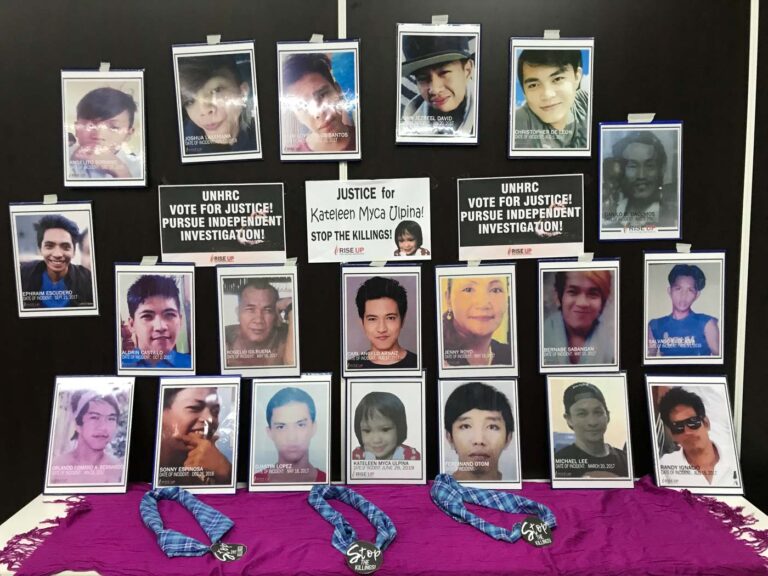
MANILA, Philippines — Lawyers representing the families of drug war victims have asked the International Criminal Court (ICC) to pursue its full-blown investigation into President Rodrigo Duterte’s bloody campaign, claiming that it is the last hope for justice.

According to lawyers Neri Colmenares and Maria Kristina Conti of the National Union of People’s Lawyers (NUPL), if ICC grants the request of the Office of the Prosecutor, it would allow investigators to dig deeper at the deadly incidents to uncover evidence pointing to Duterte.

This statement from NUPL comes on the last day for the victims to submit their views to the International Criminal Court (ICC), about the former prosecutor Fatou Bensouda’s request for judicial authority to do a full-blown probe on the war against illegal drugs.

“Granting the OTP’s request will formally allow ICC prosecutors to more closely investigate the deadly incidents, gather and receive evidence, and to determine accountabilities of persons involved in drug war-related killings and rights violations while Duterte sat as president of the Philippines and as mayor of Davao,” Colmenares and Conti said.

“For many of them, an ICC investigation is their last chance at justice. We exhort other victims of Duterte’s ‘war on drugs’ to submit their own forms before the day closes. The present victim representation stage is an opportunity to be heard directly by the judges sitting in the pre-trial chamber, and a step towards effective and meaningful participation,” they added.

Last June 21, just before she stepped down from office, Bensouda asked the ICC for a judicial authority to investigate claims that Duterte committed the crime against humanity of murder in leading the bloody drug war.

Bensouda said that there is sufficient basis to believe that law enforcers committed extrajudicial killings (EJKs) either directly or indirectly during the drug war — maintaining that information gathered by her office shows that state actors have killed thousands of civilians under the war against illegal drugs. Police officers themselves perpetrated those vigilante-style killings.

There were instances, according to Bensouda, authorities hired private individuals to implement the drug war — leading to a death toll of between 12,000 to 30,000 civilians.

READ: ICC prosecutor asks for judicial authority to probe case filed vs 

President Rodrigo Duterte and his administration have constantly maintained that the ICC is only wasting its time as the international body does not have jurisdiction over the country after it withdrew from the Rome Statute, the international treaty that created the ICC.

Many accuse Duterte of using the drug war as a means of repressing the poor.  As Duterte’s term winds down, there is concern about the administration’s ability to stop the drug trade despite encouraging drug users to surrender.

Many experts, including Bensouda, believe the Philippines remains under ICC jurisdiction. The events mentioned in the complaints drafted by Rise Up and other concerned citizens occurred before the country stepped out of the Rome Statute.

It is still the case, however, that Malacañang will not cooperate with any investigation.

READ: Palace: Duterte gov’t still won’t cooperate with ICC probe 

READ: Not waging a drug war will ‘destroy’ PH, says Duterte as possible ICC probe looms.

However, Colmenares and Conti think Duterte’s answers and statements show he now recognizes the strength of ICC probes.

“Duterte himself may now realize how formidable the ICC can be, which has the ability to order the arrest and detention of heads of state. Recent developments, such as the imminent handover of Sudan’s detained former president, Omar al-Bashir, to the ICC, point to narrowing options for Duterte,” the lawyers said.

“We call on victims and their families, as well as human rights advocates, to unite so we can successfully prosecute President Duterte and his co-perpetrators for their heinous crimes and attain justice for the Filipino people,” they added.

READ: Drug war critics file complaint vs Duterte for ‘crimes against humanity’ 

‘Biggest ever repatriation in PH history’ is ongoing

0

By: Cristina Eloisa Baclig – Content Researcher Writer/INQUIRER.net /August 12, 2021


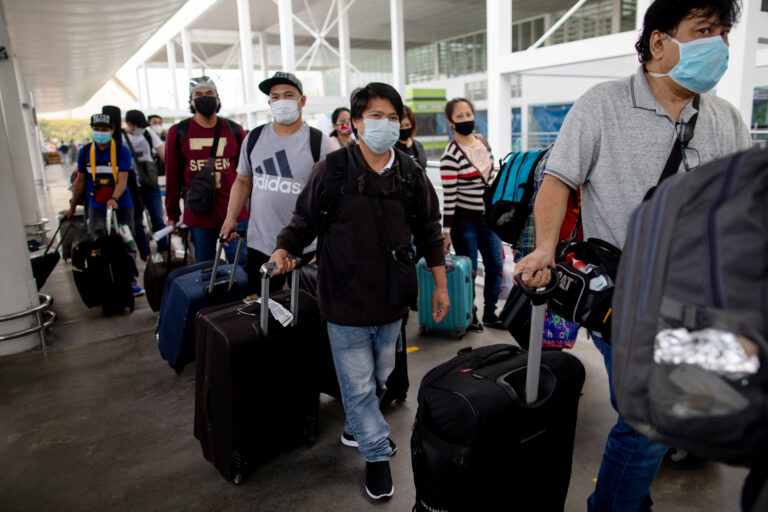
MANILA, Philippines—Foreign Affairs Secretary Teodoro Locsin Jr. was not exaggerating when he described the ongoing repatriation of Filipinos from various countries as the biggest in Philippine history.

The last mass repatriation of this magnitude took place in 1991 when 20,000 to 30,000 Filipinos were brought home from Iraq, Kuwait, Saudi Arabia and other Middle Eastern countries during the first Gulf War.

The numbers are more than 10 times higher in the ongoing mass repatriation of Filipinos largely because of the ongoing COVID-19 pandemic.

“It’s the biggest repatriation ever in our history, possibly the biggest repatriation anywhere, of any country, in the world,” said Locsin on Twitter.

Just last Wednesday (Aug. 11), three chartered flights brought home more than 1,000 overseas Filipino workers (OFWs), mostly from the Middle East, and Filipinos living overseas.

Since 2020, as COVID-19 swept through the world, more than 1 million Filipinos had already been sent home for various reasons, but mainly because of the pandemic.

The Philippine government believes more Filipinos are stranded abroad and awaiting repatriation flights.

Thousands back home

In February 2020, as the world grappled with the pandemic, the Philippine government began the repatriation of thousands of Filipinos that officials classified as either OFWs or overseas Filipinos.

By the end of 2020, the Philippines saw an unprecedented number of repatriation—791,623 Filipinos, according to a study of International Organization for Migration (IOM) United Nations Migration.

Citing figures from the Philippine Department of Foreign Affairs (DFA), IOM said in a report that at least 481,305 repatriated Filipinos had land-based jobs abroad. At least 308,332 had been working on ships. At least 1,986 were brought home from Sabah.

The IOM report said the DFA brought back 327,511 OFWs who had land-based jobs which is 71 percent of total repatriation. At least 95,974 were those who had jobs in 150 cruise ships, oil tankers and other cargo vessels.

According to DFA data, as of Aug. 7, a total of 408,911 Filipinos have been sent home during the pandemic. Of these, at least 105,607 had been working on ships and 303,304 were land-based.

According to data from Overseas Workers Welfare Administration (OWWA), a total of 502,581 OFWs returned to the Philippines either after losing their jobs or for fear of getting stranded by the pandemic or both.

READ: Over 500,000 displaced OFWs repatriated by gov’t, says DOLE

Defense Secretary Delfin Lorenzana gave higher estimates of the reverse diaspora. He said as of June 28, more than 1 million Filipinos had been repatriated or had returned to the Philippines since the pandemic struck.

As of June 28, Lorenzana said a total of 1,237,186 overseas Filipinos have been repatriated—1,005,885 OFWs and 231,301 Filipino residents of foreign countries.

Of the OFWs, 591,956 are land-based and 413,929 are sea-based.

READ: Repatriation biggest ever in PH history

A DFA official said the department was expecting at least 7,000 more stranded Filipinos to be brought home in August.

READ: 7,000 stranded Filipinos to be repatriated

COVID-19

The COVID-19 pandemic has been one of the primary reasons most Filipinos are coming home.

“The COVID-19 pandemic has amplified trafficking dangers, loss of jobs, growing poverty, involuntary servitude of seafarers because of the delay of the deployment of their replacements, illegal recruiters taking advantage of the economic needs of the unemployed,” said Justice Undersecretary Emmeline Aglipay-Villar, who is also the undersecretary in charge of IACAT, at an online press conference last month.

According to a survey by IOM, the return of at least 8,332 OFWs by the end of 2020 was mostly directly related to the pandemic—67 percent.

About a third—30 percent—of those who went home as a direct impact of COVID-19 said their work contracts had expired and not renewed because of the pandemic. At least 16 percent were simply told by employers to “leave the country” where they work also because of the pandemic.

The IOM report said at least 13 percent of those who came home as a direct result of the pandemic could not find work or have lost their jobs. At least 7 percent was worried about their families in the Philippines because of the pandemic.

“The COVID-19 global pandemic, [has] put Filipinos living overseas in a precarious situation, facing unprecedented challenges and leaving many extremely vulnerable,” said the IOM in its study.

“When businesses started to shut down because of the worldwide mobility restrictions, many OFWs found themselves stranded, unemployed and at risk of COVID-19,” the UN agency said.

As of Aug. 9, DFA recorded a total of 21,731 confirmed COVID-19 cases among Filipinos abroad, 3,824 of which were verified by the Department of Health-International Health Regulations (DOH-IHR).

At least 7,849 overseas Filipinos are still undergoing treatment, 12,558 had recovered and had been discharged while 1,325 Filipinos had died of the disease.

Most confirmed cases, according to DFA, were in the Middle East and Africa with 12,332 cases.

At least 4,818 Filipinos in Asia Pacific countries had been infected.

Cases of COVID-19 among Filipinos in Europe reached 3,566 while 1,015 Filipinos in America got sick.

Heroes are victims, too

Before the pandemic OFWs, who had been hailed as the Philippines’ modern day heroes, had already been enduring harrowing conditions abroad.

Those flown home prior to the pandemic were those who had been either maltreated, physically or mentally abused by their employers while some opted to leave their jobs due to poor working conditions or employment contract violations.

According to findings in a study by Alcestis “Thetis” Abrera Mangahas, former deputy regional director of International Organization (ILO) for Asia Pacific, OFWs are vulnerable to risks and predation even before they leave the Philippines.

Among the pre-employment or pre-deployment struggles that OFWs go through, according to a survey conducted as part of the study, are:

  • High costs of recruitment.
  • Illegal recruitment, which can be caused by unlicensed agencies or prohibited practices by licensed agencies.
  • Contract and visa deception, which are often linked with lack of information on contract terms and conditions and misuse of visa provisions.

Mangahas also detailed in her study the eight types of challenges that add to the struggles of OFWs:

  • Contract violation
  • Maltreatment or mistreatment
  • Immigration and document-related problems
  • Contract substitution
  • Health or medical problems
  • Personal issues
  • Sexual abuse that included harassment and rape

READ: OFW burden grows heavier as relief, justice fall through system gaps

Citing data from Philippine Overseas Labor Offices (POLOs), Sen. Joel Villanueva, chair of the Senate labor committee, raised concern at a hearing last March over the plight of at least 4,302 Filipino workers who had been abused in 2020 in the Middle East.

At least 593 cases of maltreatment of OFWs had been recorded in Asia while 86 were reported in Europe and the Americas.

READ: Nearly 5,000 cases of abused OFWs recorded in 2020

Kafala system

Some of the OFWs and overseas Filipinos, who had been repatriated, had also been victims of the kafala system prevailing in many Middle Eastern countries.

Under the kafala system, a migrant worker’s immigration status is legally bound to an individual employer or sponsor, or kafeel, during the contract period.

The migrant worker cannot enter a country, seek other jobs or leave a country without explicit, written permission from the kafeel,

The migrant worker cannot enter the country, transfer employment nor leave the country for any reason without first obtaining explicit written permission from the kafeel, who is the source of abuse.

READ: IN THE KNOW: What’s the ‘kafala’ system?

In his last State of the Nation Address (SONA), Duterte told governments of Middle Eastern countries to dismantle the kafala system which the President described as a form of modern slavery.

READ: Duterte to Middle East nations: Dismantle kafala system or OFWs will be sent home

Revenue impact

Early in 2020, as thousands of Filipinos abroad began to pack up and fly back home, the World Bank predicted a 13 percent annual remittance decline.

However, according to Bangko Sentral ng Pilipinas (BSP), the country registered only a 0.8 percent annual remittance decline in 2020.

From $33.47 billion in 2019, the full-year 2020 personal remittances from OFWs dropped to $33.19.

The remittances accounted for 9.2 percent of the Philippines’ 2020 gross domestic product (GDP) and 8.5 percent of the gross national income (GNP).

READ: OFW remittances down by only 0.8% last year

Citing estimates from the World Bank Bilateral Matrix, the IOM said remittances from the United States saw an increase from January to September 2020, accounting for at least 40 percent of total remittances in the Philippines.

Cash remittances from OFWs continued to pick up as the BSP recorded a 4.9 percent increase to $2.514 billion in March 2021 from $2.397 billion in the same period in 2020.

The BSP noted a 5 percent increase in remittances from land-based workers with $1.948 billion this March, while those from sea-based workers grew by 4.5 percent to $566 million.

According to the World Bank, low remittance fees helped Filipinos overseas to keep on sending remittances despite the economic impact of the COVID-19 pandemic.

READ: WB: Low remittance fees kept Filipinos overseas sending money home

What next?

Uncertainty, however, looms in the horizon for repatriated OFWs as they come home. The biggest question is what jobs are there for them in the Philippines?

According to OWWA Administrator Hans Leo Cacdac, the agency offers a repatriation grant to displaced OFWs amounting to P20,000.

In a separate Senate hearing in 2020, Labor Secretary Silvestre Bello III told senators that the Department of Labor and Employment (DOLE) has long-term programs for the displaced OFWs.

These included the Special Program for the Employment of Students (SPES), an employment recovery program, a reintegration program which entitles grantees a P10,000-financial assistance, livelihood assistance, and education and scholarship programs for their children.

The Department of Social Welfare and Development (DSWD) said it assists distressed OFWs and their families by offering livelihood assistance, in coordination with the other programs of the agency like the Sustainable Livelihood Program (SLP) and Assistance to Individuals in Crisis Situation (AICS).

In June 2021, the DSWD in Central Visayas reported that at least 326 OFWs who had been repatriated have received assistance from the agency.

READ: 326 OFWs get DSWD-7’s help

The Technical Education and Skills Development Authority (TESDA) urged returning OFWs to take up online courses in agriculture.

“It became more difficult to earn this pandemic because many Filipinos have lost their jobs and livelihood especially in the tourism sector,” said Isidro Lapeña, TESDA director general, in a statement last February.

“However, we can also take the courses under the agriculture sector so we can ensure that more of us will know how to produce our own food for our families and loved ones,” he added.

According to TESDA, of the total 1,238,522 who registered for online courses at the end of 2020, 86,100 were OFWs and their dependents.

Data by IOM showed that at least 52 percent of the 8,332 OFWs sent back home in 2020 wanted skills upgrade. At least 93 percent of them were willing to be trained, IOM said.

At least 14 percent of the repatriated OFWs prefer certificate courses while 11 percent want short courses.

At least 45 percent of the repatriated OFWs want to start businesses. At least 35 percent of these wanted to venture in service and sales, 27 percent in food and 14 percent in agriculture, forestry and fishery.

The IOM report said those preferring to venture into food wanted to cook or bake at home, sell products online, acquire food franchise or invest in a small food outlet or restaurant.

Some wanted to set up small retail stores or sell assorted goods like clothes and beauty products, the IOM report said.

But the striking element is that only 27 percent reported having capital to start businesses.

At least 69 percent said there’s no means to acquire capital and 4 percent said the money they had was insufficient.

The IOM report said at least 50 percent of those who said they have no capital would not know how to obtain seed money with more women OFWs saying this.

Recently, the Blas F. Ople Policy Center and Training Institute (Ople Center) said through its partnership with Inter-Agency Council Against Trafficking (IACAT), 596 exploited domestic workers mostly from the Middle East were able to get livelihood training and transition to entrepreneurship.

Partnership with businesses, like San Miguel Corp, also helped 581 domestic workers start their own businesses.

Still, despite these livelihood assistance programs, 48 percent of the repatriated OFWs said they plan to return abroad in the future. Only 34 percent said they want to remain in the Philippines.