Home Blog Page 75

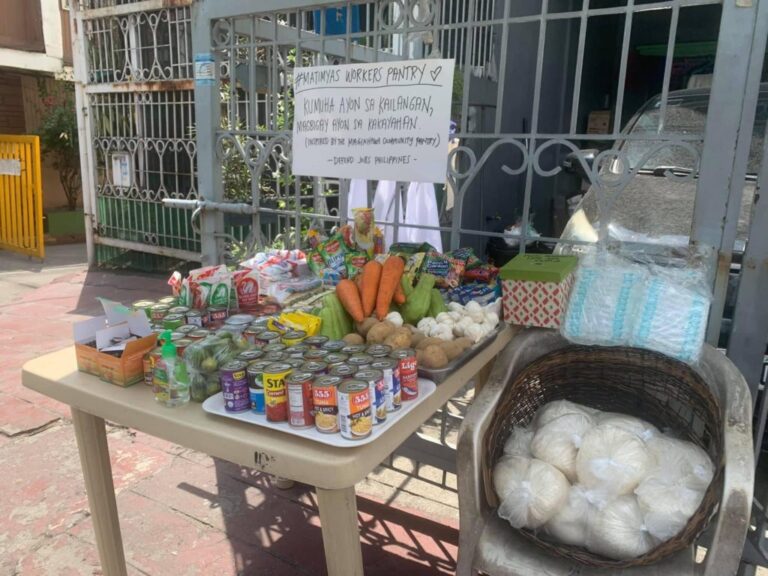
Community pantry: ‘Not charity, but mutual aid’

0

By: Nikka G. Valenzuela – Reporter / Philippine Daily Inquirer/April 18, 2021

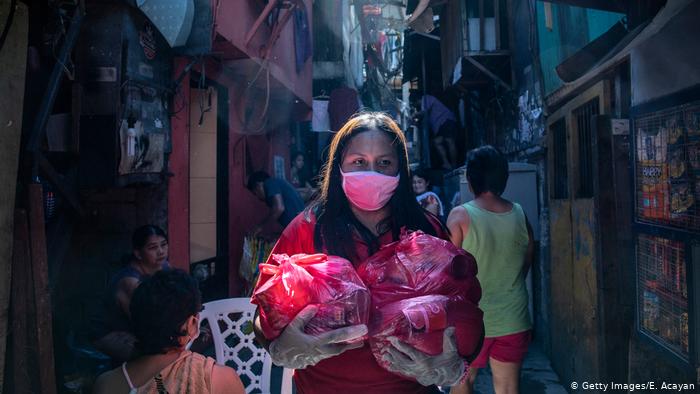
MANILA, Philippines — The Maginhawa Community Pantry is not just a small bamboo cart containing fresh produce and other food, but a powerful idea that has come out during this time of sweeping pandemic when many Filipinos don’t have the means to feed themselves and their families.

It is no wonder that in just four days, the idea had spread far and wide. From Maginhawa Street in Teachers Village in Quezon City, the community pantry has been replicated in Sikatuna Village also in Quezon City and all the way to Sampaloc, Manila, to as far as Bayombong, Nueva Vizcaya.

The community pantries that had sprung up in various neighborhoods all go by the original Maginhawa tenet of “Magbigay ayon sa kakayahan, kumuha batay sa pangangailangan,” or “Give whatever you can, take only what you need.”

The idea is simple enough. People drop off whatever food they could donate — fresh vegetables, sweet potatoes, canned goods, etc. — at a central location in the community and those who can’t afford to buy their own only have to line up to get what they need for free.

The community effort works as simply as its core principle: Everyone is free to donate as much as he can, but no one should get more than what he needs.

The Maginhawa pantry is open from 6 a.m. to 6 p.m. and is restocked throughout the day, either by donors or by Ana Patricia Non, the young entrepreneur who started it.

Around 3,000 served

In less than a week, the pantry served around 3,000 individuals. Ordinary folks have gone to Maginhawa, a street famous for its holes-in-the wall, to help sustain the cart. In other parts of the metro, as well as in the provinces, ordinary citizens have set up similar pantries on tables or just plain cardboard boxes.

“This is not a charity. This is like a mutual aid. We’re all helping each other,” Non told the Inquirer in an interview on Saturday.

Shortly after the two-week enhanced community quarantine (ECQ) was “modified” in Metro Manila and surrounding provinces, Non scouted for a place where she could set up a pantry where people were free to give and take food.

The 26-year-old furniture business owner said she was concerned for the poor like the jeepney drivers and vendors who were struggling under quarantine restrictions and finding it hard to feed their families during the two-week ECQ.

Her own small shop that makes chairs had suffered a two-month slump due to a localized lockdown and the recent ECQ.

When she got permission to use the sidewalk in front of 96 Maginhawa Street, she brought a bamboo cart with some grocery items she had bought, plus the “ayuda” she had received and opened the pantry on April 14.

She posted what she did on social media and immediately received remarkable responses and praises.

‘Acts of resistance’

According to sociologist Athena Charanne Presto, a community pantry is the ordinary citizen’s way of taking action in the face of a crisis.

“Community pantries can be seen as acts of resistance against three things: first, against a government that fails to adequately address citizens’ needs; second, against a biased and discriminatory view of the poor as selfish and greedy; and third, against aid initiatives from institutions that are difficult to trust,” said Presto, who teaches at the University of the Philippines.

Presto said the community pantry is also another form of collective response by the people when institutions fall short in providing aid.

But what is important to point out in the Maginhawa community effort is that many of its supporters are not from rich households, she said.

There were farmers who donated a sack of sweet potatoes all the way from Paniqui, Tarlac, and tricycle drivers who volunteered to repack donated rice.

“It goes beyond the mainstream and elitist notion that in donation drives, only the rich provide for the poor,” she said.

Built on trust

The pantry system is built on trust, and Non believes that people will only take what they need and will be patient enough to stand in line to get it.

“I think that we should integrate with basic masses so that we can get to know them, so it can dispel our preconception that they are greedy (let’s focus on those who are truly self-serving and those who owe the citizenry),” Non said on Facebook in response to concerns that some of the poor would take advantage of the free food and get more than what they need.

She said she saw a homeless man who took only two oranges from the cart despite encouragement from other people to get more. The man told them: “This is all I’m going to eat.”

Two street sweepers who each got one head of cabbage said that was just enough for a sauté for their families.

Non observed that some had taken more than what they appear to need, but she withheld judgment.

Temporary solution

“Maybe we are not in the right position to judge others when we can afford to eat three times a day. Our struggles and privileges may be different. It’s possible that [the person taking more goods] has a big family, or he lost his job, or he doesn’t know where to get their next meal,” she said.

Non said that she’s happy with how her efforts had been appreciated and adopted, and with how people in communities were uniting to help each other.

At the same time, she was sad that such community pantries had to be established in the first place. They are sprouting in other areas because many people are going hungry and need help to get food, she said.

“This community pantry is only a temporary solution for empty stomachs. Food security, services, those are different things and normal citizens do not have the budget to initiate those big projects,” Non said.

Presidential spokesperson Harry Roque said the community pantry was “laudable” and showed that Filipinos could band together during a crisis.

“It exemplifies the Filipino ‘bayanihan’ spirit during this challenging time of COVID-19,” Roque said in a statement.

“As we have said in numerous occasions, we cannot defeat the COVID-19 pandemic alone. We need the support and cooperation of everyone,” he said.

Roque said the government was giving P1,000 cash assistance each to 22.9 million low-income earners affected by the ECQ in Metro Manila, Bulacan, Cavite, Laguna, and Rizal.

Some government critics see the emergence of community pantries as an indication of inadequate government assistance during the pandemic.

Non noted that some cities and villages have set up community pantries and asked for donations. She discourages that as local governments have money to allocate for the food security of their constituents.

“If people shoulder [the cost of] these projects, that would be redundant because we already shoulder the taxes,” she said.

‘Wake-up call’

Non said that the growing number of community pantries was a “wake-up call” that is telling the government about the people’s great need for aid.

The community pantry has been open for less than a week, and Non said that the bamboo cart on Maginhawa Street would stay there as long as there was some food to spare, and someone was in need.

“It can be there every day. Maybe it won’t contain anything for a day, but on the next day, it may have a lot. As long as we have extra food in our homes, I know where I can place that extra food and I know someone who needs it can take it,” she said.

—WITH A REPORT FROM LEILA B. SALAVERRIA 

Community pantries fill gaps amid ‘absent’ gov’t — Ex-VP Binay

0

By: Christia Marie Ramos – Reporter / INQUIRER.netApril 18, 2021

MANILA, Philippines — Community pantries started popping up in different neighborhoods due to the desire of Filipinos to look after one another amid an “absent” government, former Vice President Jejomar Binay said.

“The message behind the rise of community pantries is simple: when government is absent, we can look after each other,” Binay said in a tweet Sunday.

“When the situation seems hopeless, we can lift each other’s spirit. Magtulungan, magtiwala sa isa’t-isa, at manalig sa Maykapal,” he added.

As the country reels from the effects of the  COVID-19 pandemic, Filipinos have extended a helping hand by making food donations to community pantries, which aims to help those in need amid challenging times.

This idea was borne out of an initiative taken by a small Quezon City business owner, who set up the “Maginhawa Community Pantry,” a bamboo cart containing donated food and other essential goods.

These street pantries made their way to other communities as Metro Manila, Rizal, Cavite, Bulacan and Laguna remain under the modified enhanced community quarantine amid the rise in COVID-19 cases in the country.

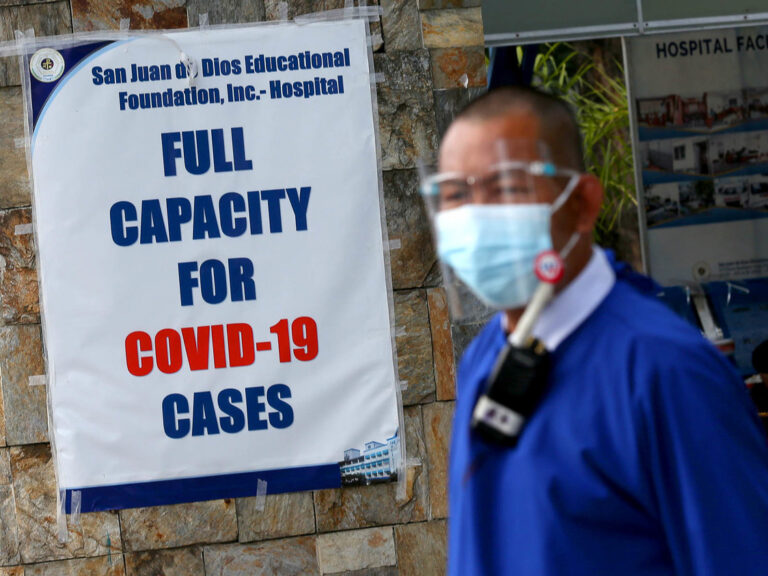
The Philippines’ COVID-19 active cases breached the 200,000-mark on Saturday after the Department of Health reported 11,101 additional infections.

The country’s COVID-19 tally now stands at 926,052, including  706,532 recoveries and 15,810 deaths.

‘Unchristian’

0

Philippine Daily Inquirer / April 16, 2021

How did Harry Roque manage to snag a room at the state-run Philippine General Hospital (PGH) when scores of other COVID-19 patients were desperately waiting in line for one for days on end? Asked that question, the presidential spokesperson turned snarky and gave an astonishing answer: “That is an unchristian question.”

Is it? An expert on Christian matters was quick with a rejoinder: “There (is) nothing unchristian about the question. Government officials should be transparent to the public,” said Bishop Broderick Pabillo, apostolic administrator of the Archdiocese of Manila.

Roque’s refusal to explain the apparently preferential treatment accorded him, even as reports of COVID-19 patients dying or being ministered to in the parking lots of swamped hospitals were all over the news, is the height of privileged, callous behavior. But he was “in bad shape,” with his oxygen level dipping to 90 or below normal, Roque protested; he didn’t jump the line or pull rank to get a bed that could have gone to a more serious case. Then, quickly demolishing his own argument, he admitted that his PGH doctors were his longtime health providers even before he joined government.

Roque’s breezy entry into a hospital that was otherwise refusing further COVID-19 admissions isn’t the only anomaly needing accountability and explanation. Take his supposed two consecutive bouts with the virus in less than a month. Could one be reinfected so soon after recovery? Roque had declined to show to the public his first COVID-19 test result, invoking his right to privacy. Now, just weeks later, he claimed he was sick again. But, despite being supposedly in such “bad shape” that he had to be admitted ahead of everyone else, he was evidently strong and well-composed enough to host two briefings on the same day from his hospital bed.

In dismissing the public’s right to know the truth about his claimed COVID-19 positive status, Roque had demanded: “Why can’t public officials such as the presidential spokesperson be entitled to the presumption of regularity of pronouncement?”

His arrogant “unchristian” answer answers his own question. A public that is lied to as a matter of course, that is made the subject of ritual dissembling, deception, and gaslighting by its public officials, has no obligation to reciprocate with any measure of trust or “presumption of regularity.” In particular, this administration’s unprecedented penchant for secrecy and smoke and mirrors, its inability to talk straight with the public, sets the tone for an environment of mistrust, speculation, and cynicism, further fraying the social fabric and rending confidence in institutions at a time when the country is facing its gravest crisis since the war.

Before Roque’s caper, there was the mystery of the Presidential Security Group (PSG), 45 of whom were said to have been struck down by the virus, leading to the cancellation of the President’s address a week ago as a precautionary measure. At least that was the official story, except that: Weren’t the presidential guards already inoculated last year with the China-made Sinopharm vaccine? The vaccine had yet to get approval from the Food and Drug Administration (FDA) and were then unavailable locally, so they were essentially smuggled goods. The PSG broke the law, but the administration staunchly defended the unauthorized, surreptitious jabs as “compassionate use.” But if, as Malacañang announced last week, PSG members had come down again with COVID-19, is Sinopharm effective at all?

Alas, who would know at this time, when President Duterte had forbidden his men from cooperating with authorities, and the announced probes by the FDA, the health department, and the Senate into the vaccine smuggling have all but fizzled out? Just how efficacious—or dangerous—this vaccine is, which Mr. Duterte himself had expressed preference for? That is crucial, perhaps life-saving information that may never see the light of day, simply because the administration will not come clean on yet another irregularity under its watch.

The latest flap involving the state of health of Mr. Duterte, whose two-week absence from public view amid a raging pandemic stoked rumors of severe illness and possible death, hewed along the same murky lines. On Monday night, Mr. Duterte resurfaced and blithely admitted to staging his disappearing act. “Sinadya ko (I did it on purpose)” to tick off his critics, the President said—and in the administration’s eyes, the boss’ curt words are explanation enough.

No, they’re not. The sheer disregard for a distraught citizenry’s right to information, redress, and fair treatment, in the middle of a national life-and-death struggle that has afflicted so many and left millions more twisted in hunger, is deliberate, casual cruelty.

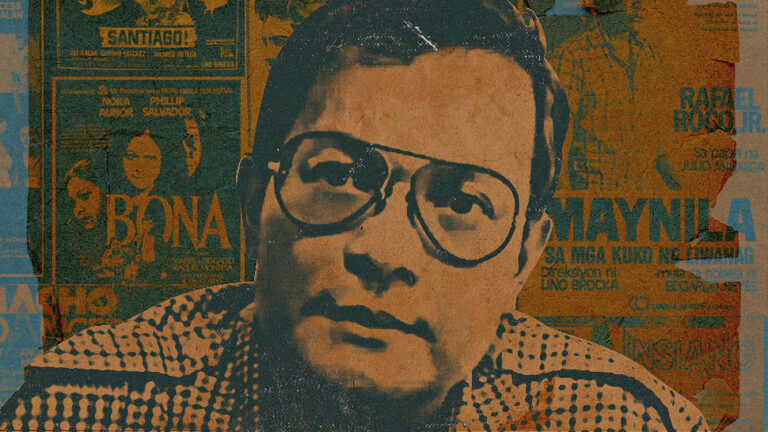
Lino Brocka, the Director Who Scared Dictators With His Camera Lens

0

By Justin Umali, Esquire Philippines, 15 April 2021

Lino Brocka, the maestro of Philippine cinema, championed justice and freedom.

There is little doubt that Lino Brocka is one of the greatest, if not the greatest, Filipino director of his age, or any age. To this day, his films Bayan Ko: Kapit sa PatalimOra Pro NobisMaynila sa mga Kuko ng Liwanag, and others enjoy critical acclaim, both for their artistic quality and social commentary.

A Young Man Who Struggled in Poverty

But Brocka as we know him now wasn’t born overnight. Before he became Lino Brocka, the activist-filmmaker, he was Catalino Ortiz Brocka, a young man who struggled in poverty like millions of his fellow Filipinos.

Brocka was born in Pilar, Sorsogon on April 3, 1939, to very interesting times. In Europe, tensions between Nazi Germany and her neighbors are at an all-time high. The Japanese are making inroads in their invasion of China as Chiang Kai-Shek and Mao Zedong struggle to cooperate in building a united resistance. In the Philippines, groups like the Ganap Party are calling for cooperation with the Japanese while the Communists were calling for a boycott of Japanese products.

There is little doubt that Lino Brocka is one of the greatest, if not the greatest, Filipino director of his age, or any age. To this day, his films Bayan Ko: Kapit sa PatalimOra Pro NobisMaynila sa mga Kuko ng Liwanag, and others enjoy critical acclaim, both for their artistic quality and social commentary.

A Young Man Who Struggled in Poverty

But Brocka as we know him now wasn’t born overnight. Before he became Lino Brocka, the activist-filmmaker, he was Catalino Ortiz Brocka, a young man who struggled in poverty like millions of his fellow Filipinos.

Brocka’s home life wasn’t any less turbulent. Raised in poverty and having lost his father at a young age, he had to work to sustain himself. As a child, he worked as a houseboy for an abusive aunt before running away to live with his mother and brother in San Jose, Nueva Ecija.

He finished high school in 1956 with honors. This allowed him to enter the University of the Philippines as a scholar—at least for a year, before losing his scholarship and ending up as a working student once more.

A Worker in Manila in a Time of Uncertainty

Maybe it was fate or circumstance, but Lino Brocka found himself at the perfect place at the right time. He was a young man working at the heart of Manila—in that strange lull between the end of the Second World War and the turbulence of the 1960s. 

It was a time of post-war anxiety and uncertainty. For young workers like Lino Brocka, it meant having to work back-breaking hours for little pay, while capitalists and business owners reaped the benefits of U.S.-sponsored trade deals. Brocka drifted between odd jobs before finding himself caught in the cultural zeitgeist. At one point, he found himself in Hawaii.

But throughout it all, Brocka absorbed the changes in the weather. He was there when the student movement found its energy through Kabataang Makabayan. He was there when the labor unions went on strike. He saw the decades of poverty and exploitation that had been his life come to a boil and explode in the streets of Metro Manila.

A Director Who Mirrored Social Reality

It was then, in 1969, when Lino Brocka first got his stint as a director in the Philippine Educational Theater Association. In 1970, he directed his first film, Wanted: Perfect Mother. He would direct eight more commercial films before finding his true calling in Tinimbang Ka Ngunit Kulang.

Tinimbang Ka was the first of his many masterpieces, which included InsiangMaynila sa mga Kuko ng LiwanagJaguar, and Bayan Ko: Kapit sa Patalim. As a filmmaker, he created character-driven stories that didn’t shy away from Philippine social reality. His works drifted from the tired commercial formula and drew inspiration from the things he knew: the poverty of his fellow man, the inequality of Filipino society, and the need to change it.

Lino Brocka is and will always be one of the greatest filmmakers in Philippine cinema, because his work elevated Philippine cinema as an art form. Alongside contemporaries like Ishmael Bernal and Mike de Leon, Brocka trained his camera lens inward, toward daily Filipino life, as a method of exploration and a means to critique. His works, more than being aesthetically supreme, were socially aware.

An Artist Who Took Part in the Formation of a Just Society

His decision to stand with his principles sometimes cost him. Although critically acclaimed, winning FAMAS awards and even the distinction of being the first Filipino filmmaker to be invited to Cannes, Brocka also found himself in constant dire financial straits. At one point, the Marcos dictatorship offered to pay him to make films they approved of; Brocka didn’t hesitate to say no.

That was Lino Brocka. He found himself in the company of, and was himself, an artist for the people. He understood that the mission of the artist was “to take part in the formation of a society where freedom and justice reign, a society where the rights of every human being are respected.” 

He eschewed traditional ideas of filmmaking to create a more informed cinema—a legacy that echoes to this day. His ideals were largely shaped by his life: years of hard work and perseverance created Lino Brocka the filmmaker, but decades of exploitation and an unjust system headed by a fascist dictator molded Lino Brocka, the artist.

In the 1980s, Brocka found himself more and more involved in politics as an activist. He rallied his fellow artists and founded Concerned Artists of the Philippines, a mass organization of artists, filmmakers, musicians, and other masters of their craft who shared his views. He found himself with the very masses he showed in his films, and the very masses he was once a part of; this time not to train his lens on, but to stand in solidarity with. He was a fixture in picket lines, rallies, and other mass actions. Once, he was arrested during a transport strike.

His films reflected his newfound activism. Bayan Ko was released in 1984 and was deemed subversive by the Marcos regime. Abroad, it was nominated for the Palme d’Or at Cannes and was an entry for Best Foreign Language Film at the 58th Academy Awards.

By the end of the Marcos dictatorship and the People Power Uprising, Lino Brocka found himself as a veritable force of change. He was invited by the Cory Aquino administration to draft what would become the 1987 Constitution as a member of its Constitutional Commission. 

The Force of Change Who Championed Freedom

It was something he would walk out from in short order, quickly sensing that the Commission was heading toward creating another repressive constitution. He left without signing the Constitution, but not before contributing his part: Article III, Section 4 of the Constitution, which states that “no law shall be passed abridging the freedom of speech, of expression, or of the press, or of the people peaceably to assemble and petition the government for redress of grievances.”

Brocka soldiered on with his principles. As the years went on and the Cory Aquino administration proved itself to be less than savory, Brocka found himself souring on the idea of Cory as President. In 1989, he released Ora Pro Nobis, a sharp critique of the Cory administration’s spotty human rights violations and the rise of state-sponsored vigilante groups across the countryside.

One of the last things Brocka campaigned for was the removal of U.S. bases in the Philippines. He would continue to do so, urging senators and the government to remove U.S. military presence in the country, until his death on May 22, 1991—barely a month after his 52nd birthday.

Brocka sadly would not live to see the removal of U.S. bases in the country. One can only wonder if he was alive today: Would he still be a fixture in protests? What kind of films would he create?

One thing is sure; Lino Brocka inspired an entire generation of artists to eschew commercial traditions and to treat their craft as a mirror of society. Lino Brocka was more than a filmmaker. He was, and still is, an integral part of our nation’s history and democracy.

Filipino business leaders want ‘tyrant’ China out of Julian Felipe Reef

0

Apr 14, 2021 Ralf Rivas

MANILA, Philippines

Eight business groups quote former Chinese statesman Deng Xiaoping, who urged the world over 4 decades ago to overthrow Beijing should it turn into a tyrant

Filipino business leaders urged China to respect the Philippines’ sovereignty and refrain from becoming an “imperial power.”

In a strongly worded joint statement on Wednesday, April 14, 8 business groups joined the government’s call on China to withdraw its vessels from Julian Felipe Reef, which is located within the Philippines’ exclusive economic zone.

The Philippine Chamber of Commerce and Industry, Management Association of the Philippines, Makati Business Club, Bishops-Businessmen’s Conference for Human Development, Filipina CEO Circle, Judicial Reform Institute, Cebu Business Club, and Iloilo Business Club issued the statement.

The Philippine government found at least 240 ships lingering in the West Philippine Sea and has filed diplomatic protests on the matter.

“Julian Felipe Reef is historically and by law undisputed Philippine territory, as was most clearly established in the 2016 ruling based on the UN Convention on the Law of the Sea. Our exclusive right over the Julian Felipe Reef carries with it the utilization of, and the obligation to protect, its economic benefits, such as its rich marine life and mineral deposits, for the well-being of each and every Filipino,” the groups said.

The business groups also quoted statesman Deng Xiaoping, China’s former paramount leader, in reiterating their call.

“In 1974, Deng Xiaoping said, ‘If one day China should change her color and turn into a superpower, if she too should play the tyrant in the world and everywhere subject others to her bullying, aggression, and exploitation, the people of the world should expose it, oppose it, and work together with the Chinese people to overthrow it.'”

The Department of National Defense has ordered an investigation into the recent incident in the West Philippine Sea where heavily armed Chinese ships chased the crew of Filipino TV network ABS-CBN.

The Department of Foreign Affairs also summoned Chinese Ambassador to the Philippines Huang Xilian over the “illegal lingering presence” of Beijing’s ships in the area. – Rappler.com

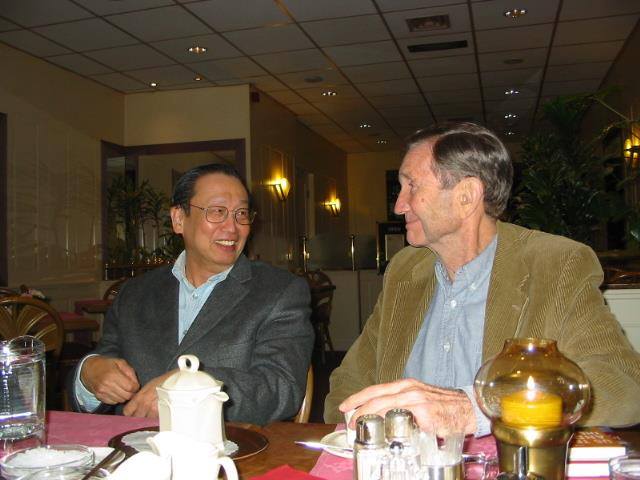
Prof. Sison extols former US Attorney General as a champion of human rights, anti-imperialism and peace

0

(12 April 2021) Former US Attorney General William Ramsey Clark was a champion of human rights, a staunch defender of the people’s right to national and social liberation, a fierce advocate of just peace and a resolute opponent to the imperialist policies and wars of aggression of the US.

Thus emphasized Prof. Jose Ma. Sison, chairperson emeritus of the International League of Peoples’ Struggles in a written eulogy for Ramsey Clark who passed away last April 9. Clark served as US Attorney General during the term of US President Lyndon Johnson.

“While he was US Attorney General under the Johnson administration, he was well known for standing up for civil liberties and civil rights, fighting against racial segregation and discrimination and enforcing anti-trust laws. It was in certain cases involving the US war of aggression in Vietnam that he had to agonize as a prosecutor on behalf of the US government. But after he was out of government, he visited North Vietnam as a protest against the bombing of Hanoi,” Sison related.

Sison also said Ramsey Clark used his knowledge of history, political wisdom and legal expertise to identify the major aggressions which the US committed after World War II. These victimized Korea from 1951 onward, Iran in 1953, Guatemala in 1954, Republic of the Congo in 1961, Vietnam from 1959 to 1975, the Dominican Republic in 1965, Nicaragua from 1981 to 1988, Grenada from 1983 onward, Libya in 1986 and again in 2011, Panama in 1989-1990, the Gulf War in 1991, Somalia in 1991-1992, Iraq from 1993 onward, Yugoslavia in 1999, Sudan in 1988, Afghanistan from 2001onward, Iraq from 2003 onward and Haiti in 2004.

Sison also said Clark publicly defended him and opposed the act of the US government in designating him as “foreign terrorist” in 2002. Likewise Clark opposed Sison’s being named in the EU terrorist list in line with the US precedent. The European Court of Justice in 2009 would eventually remove Sison’s name in the EU “terrorist” list.

Ramsey Clark won the respect of the the people of the world and in 1992 he received the Gandhi Peace Award and the Peace Abbey Courage of Conscience Award for his commitment to civil rights, his opposition to war and military spending and his dedication to providing legal representation to the peace movement. The United Nations awarded him in 2002 its Prize in the Field of Human Rights for his steadfast insistence on respect for human rights and fair judicial process for all.

“Long before his demise, William Ramsey had won the love and respect of entire peoples of the world and received the honors in recognition of his greatness and concrete deeds in the service of the oppressed and exploited people in need of support and assistance.. He will always be remembered and will continue to inspire us to uphold, defend and advance the just cause of greater freedom, democratic rights, social justice, development, international solidarity and peace against imperialism and all reaction,” Sison concluded. (Pinoy Abrod Release)

Use intel, anti-communist funds for cash aid, senators urge gov’t

0

By: DJ Yap – Reporter /Philippine Daily Inquirer / April 12, 2021

MANILA, Philippines — Senators on Sunday pressed the cash-strapped government to scrap “unnecessary items” in the 2021 budget such as the P9.5 billion confidential and intelligence funds and the P19.1 billion anti-insurgency fund and divert the money toward additional aid for poor residents of pandemic-stricken Metro Manila and four nearby provinces.

“What I want to happen is to give enough aid to our people who are suffering under the lockdown … Because of that companies cannot operate. How long will this last?” Senate Minority Leader Franklin Drilon said.

“I don’t understand why they are saying the government has no money for additional aid,” he said in a radio interview, reiterating his call for a special session of Congress to pass the third Bayanihan stimulus package.

Drilon refuted arguments that there was not enough money in the country’s treasury to cover the funding requirements of Bayanihan 3, which would amount to more than P400 billion in both the Senate and House bills.

‘If we only use it right’

“There’s money if we only use it right. There are plenty of allocations in the budget that are unnecessary. For example, our confidential and intelligence fund and our anti-insurgency fund. We can use that,” he said.

Under the recently signed 2021 General Appropriations Act, intelligence funds lodged in the budget of various government offices totaled more than P5 billion, while confidential funds amounted to P4.5 billion.

On the other hand, the budget of the National Task Force to End Local Communist Armed Conflict amounts to P19.1 billion, including P16.4 billion earmarked for the development of barangays supposedly “cleared” of communist influence.

The allocations only total P28.6 billion but Drilon said the rest could be funded by borrowings from other countries or multilateral organizations.

Sen. Francis Pangilinan echoed Drilon’s call for additional financial assistance to pandemic-stricken residents of Metro Manila and nearby provinces facing stricter lockdown.

“Aside from quarantine, our people also need money. Livelihoods are again difficult if enhanced community quarantine is extended,” he said in a radio interview on Sunday. INQ

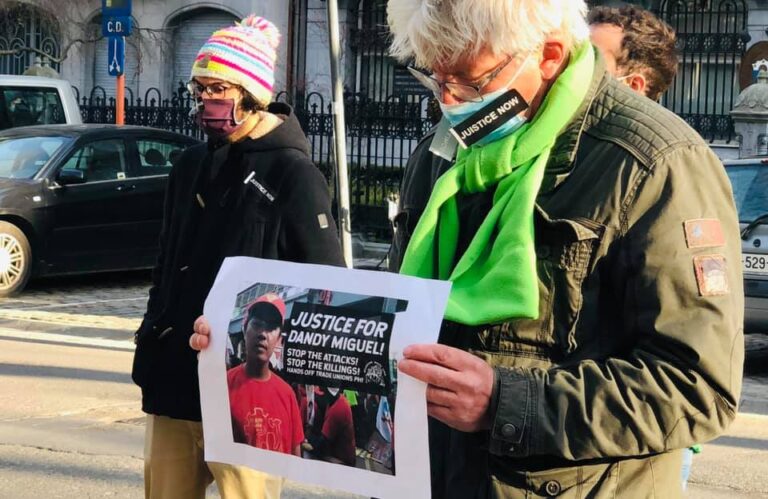
Protest in Belgium vs. killings in Philippines

0

In Belgium, various groups trooped to the Philippine Embassy in Brussels on April 8. They demanded the Philippine government to put an end to extrajudicial killings and attacks on activists and human rights defenders in the Philippines. (Photos by Intal Philippines)