Home Blog Page 108

6 Filipino books that tell our favorite food stories

Written by Anna Bueno, Updated Dec 3, 2019

Manila (CNN Philippines Life) — Whenever there’s food and a group of people huddled around a meal, there is always a good story.

A boatman in Lobo, Batangas, for example, may tell a story about the best goto in town. Our mothers may tell us stories about childhoods marked by the sweetness of merienda, or the brisk and garlicky smell of sinangag in the morning.

These stories are equally told by countless writers, cooks, enthusiasts, wanderers, advocates, and cultural workers who have tirelessly sought to understand the Philippines’ richly diverse culinary traditions. Our food stories have always been about an ongoing conversation on the ingredients, techniques, influences, tastes, and memories that bind us together.

Perhaps this is why the best stories about Filipino food are both deeply personal and universal. Each of us has our own food stories, and each of our stories are part of an interwoven canopy of tales that define what Filipino food culture is: wonderfully varied, satisfying, and ultimately a beautiful thing, the subject of unending marvel and fascination.

CNN Philippines Life lists six essential books that tell compelling stories of Filipino food culture, with the recognition that this is by no means an inclusive or complete list — but only an attempt to start another conversation on why we love food, and which food stories we love hearing over and over again.

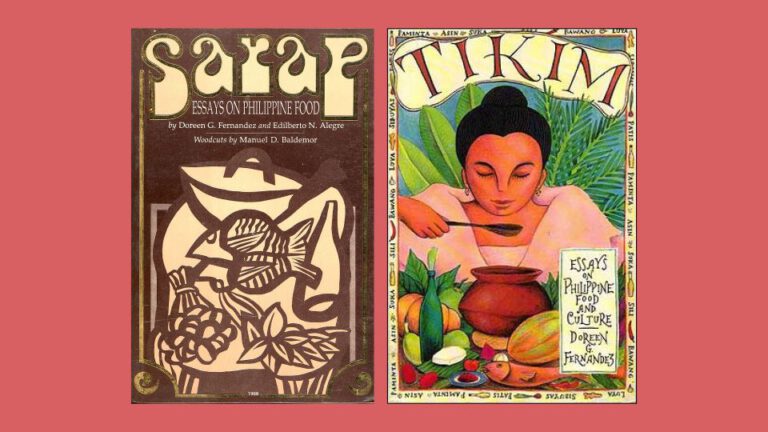
“Sarap: Essays in Philippine Food” (Doreen Fernandez and Edilberto Alegre, 1988); “Tikim: Essays on Philippine Food and Culture” (Doreen Fernandez, 1994)

“Food, like language, is living culture, and as such changes with the times. The old ways are tested and true; the new ways are not necessarily betrayals, if they are appropriate and result in good food.”
– Doreen Fernandez, from “New Ways with Old Dishes,” in “Tikim”

Today’s crop of Filipino food writers and readers owe much to Fernandez, who wrote not just about food, but how we experience it: in the streets, by the sea, in restaurants, during fiestas, as heritage, as history, as memory, as culture.

In “Sarap,” she wrote about the indigenization of Philippine food, a piece that is now widely considered to be required reading for anyone who wants to seriously understand our food culture. In “Tikim,” she gave sage advice on how to write about what eat: “It was about getting the reader to see through the words to the experience. It was choosing the words that echoed, that reverberated — umaalingawngaw. And then it was making the readers hear the silence between the echoes, and themselves load them with memory, sensation, and finally meaning.”

Fernandez’s advice would echo across generations, and itself reverberate to fill the gap she left behind. Celebrated food writers today dedicate their works to her; her words would continue to be spoken and read anew by cooks, anthropologists, journalists, and researchers. Even today she is still considered as Filipino food’s greatest champion.

Her essays continue to evoke secondhand memories, or memories so vivid we might as well declare them our own, as in her essay “Kinilaw Artistry at Old Sagay,” where she writes about the “ethos of freshness” of fishermen who prepare for her crab kinilaw dipped into a sawsawan of vinegar with a few seeds of siling haba. “Absolute heaven,” she wrote. “How do other mortals fare, never having known this?”

Thus in “Sarap,” “Tikim,” and other books and essays thereafter, Fernandez would be found not just in dining room tables, assured by the plate in front of her. She would be out into the world, “ingesting the landscape,” so that she may bring the landscape — and not just the food — to her readers. “If one can savor the word,” she wrote, “then one can swallow the world.”

“Memories of Philippine Kitchens: Stories and Recipes from Far and Near” (Amy Besa and Romy Dorotan; photographed by Neil Oshima, first edition 2006; updated 2012)

“…Filipinos often ask, ‘Is your adobo better than my mother’s?’ And we never take the bait. Of course, your mother’s adobo is infinitely better — everyone’s is!”
– Amy Besa

To ask about a person’s favorite food memories is to delve into a personal, often emotional process of linking food, family, and community. As recipes passed down from generations develop a life of their own, a dish becomes a catalyst, resurrecting memories long forgotten. In “Memories of Philippine Kitchens: Stories and Recipes from Far and Near,” author Amy Besa, as with any gracious host, invites us to make ourselves at home as she shares food stories, collected from friends (as with an “impeccable” begucan, or “pork loin boiled in vinegar and bagoong and fried in its own fat with tomatoes,” made by Susan Calo Medina and as recollected by her son Marc, who hails from Arayat, Pampanga), or culled from memories that are her own, as with her Nanay’s spring rolls. She also co-authored the book with her husband, chef Romy Dorotan.

The book is by no means a complete guide to the food of the archipelago, but is something better: a slow and reflective attempt to account for the authors’ multifaceted food memories, beautifully captured in photographs by Oshima. Each memory is followed by various recipes and interesting tidbits about food origins or family rituals.

Most generous are Besa’s and her husband’s painstaking efforts to give us their personal recipes based both on memories and research, which earns the book’s rightful place in the kitchen — propped up behind the chopping table while the sinigang simmers, perhaps — instead of in the living room as a coffee table book. “Memories” is proof that whenever we eat or cook, we do so as part of a timeless community, sharing in each other’s recipes and unending stories.

“Manga Tutul A Palapa: Recipes and Memories from Ranao” (Assad Baunto with Nash Tysmans and Ica Fernandez, 2018)

“An improperly prepared arowan ends up thrown by Babo in the lake, from whence it came.”
– Assad Baunto

“Manga Tutul A Palapa” (“Palapa Stories”) is a food book for our times. Baunto, who hails from Lilod Madaya, Marawi, pens an extended love letter to his hometown, telling several beautiful stories anchored on recipes from the women in his family. What holds the stories and recipes together is palapa: a condiment, appetizer, and flavoring agent basic to Maranao cuisine.

Published in 2018, barely a year after the siege of the city, the book paints a Marawi deeply beloved by its people. In telling us how to cook piyaparan a manok / pindialokan a manok, Baunto invites us to a movie theater “that provided a perfect cinematic frame on food, cinema, and the comedy of everyday life, a directorial debut vying for a Gawad Urian.” In sharing his Bae’s (maternal grand-aunt’s) recipe for kyuning (coconut turmeric rice), he strongly affirms that cooking brings him closer to home more than anything he has ever imagined.

In the book’s first pages, Baunto writes soberly to his Babo kolay (maternal grandmother) that “Marawi is probably lost but our food is not.” Yet he remains hopeful that people will read the stories and share the recipes within. In “Manga Tutul A Palapa,” one can then make a case for a Marawi fully alive, where food fills the soul, a place of memory never gone — only reimagined and transformed.

“Kain Na! An Illustrated Guide to Philippine Food” (Felice Prudente Sta. Maria, Bryan Koh; illustrated by Mariel Ylagan Garcia, 2019)

“A Philippine meal is incomplete without joy…eating and joy are so tightly linked.”
– Felice Prudente Sta. Maria and Bryan Koh

“Kain Na!” is less a compilation of food stories than it is a collection of Filipino food illustrations, captioned by two of the best authors we have — Sta. Maria (author of “The Governor-General’s Kitchen,” a painstaking collection of vignettes on the Philippines’ culinary history) and Koh (author of “Milkier Pigs, Violet Gold,” an in-depth tome on food traditions in the Philippine archipelago). Behind the illustrations is Garcia, a young artist and painter, whose work graces the book’s 209 pages.

Drawings and illustrations often take a supporting role, if any at all, in most food books published in the Philippines. More often, photos accompany stories. That gap is what “Kain Na!” seeks to fill, as the food drawings here are noticeably the text. Sta. Maria’s and Koh’s descriptions of various Filipino dishes — classified by mealtimes, occasions, functions, and places — tell us briefly about what we need to know, but it is Garcia who tells the stories.

The dishes sampled in the book are almost always depicted to serve large families. Not a groundbreaking observation, but an interesting one nonetheless, especially considering how the book’s title — “Kain Na!” translates to an invitation to eat. Garcia shows us that the act of eating in Filipino culture is largely communal, and food, among others, often functions as a channel for bonding and communication.

Garcia, in using watercolor, also depicts dishes in the context of the home or community. The technique also softens bold colors and lends subtle textures to soups and assorted rich viands. Both are nods to creature comforts and Filipino food’s homemade quality (which may be lost in digital renderings). If anything, Garcia’s drawings lack just a little bit of sheen, for when we’re supposed to be looking at a sizzling sisig or a really oily lechon.

Still, it’s a delight to go over the book as an exercise in whetting the appetite and identifying iconic dishes by color and texture alone. One leisurely goes through “Kain Na” and realizes Filipino food is not just delicious — it has always been a distinctive work of art.

“Makisawsaw: Recipes x Ideas” (Edited by Mabi David and Karla Rey, 2019)

“Let’s change the world with food.” 
– Charlene Tan, “Can We Change the World with Food?”

“Makisawsaw” stands out among the books on this list for many reasons: its 36 food and sawsawan recipes are vegan, its essays explicitly call for a rethink of our unsustainable consumption of resources, and overall it observes how distant we’ve grown from the sources of our food. The book takes cue from the violent dispersal of the condiments factory workers of Nutri-Asia — who went on strike in 2018 to push for employment regularization — and tackles issues such as seed patenting, the rice liberalization law (via comics), and insecurity in land tenure, among others.

While on face value, the heavyweight issues in “Makisawsaw” seem to contrast with nostalgic food memories or comforting recipes in books of this kind, the essays here couldn’t be more aligned with the latter. For example: When we revere our mothers’ or grandmothers’ slow, old-fashioned ways of cooking, does that not reflect the value placed on fresh, chemical-free ingredients, and cooking with as little artificial preservatives as possible? Whenever we reminisce about visits to farms, fishponds, or wet markets, does that not highlight the persons who produce our food? And when we appreciate how nature freely gives her bounty, or how we all share in the biodiversity of our food resources, is that not a recognition against corporate ownership of our native seeds and crops?

“Makisawsaw” then is the inevitable extension of our continuing food conversations. Insofar as it is significant to document how food becomes identity, memory, culture, and heritage, the book recognizes the fragility of those relationships, by pointing out the powerful forces that threaten them.

To preserve food as memory, identity, culture, and heritage, therefore, we have to act. In “Makisawsaw,” we are reminded that everything is political, including food, and before it’s too late, we have to confront the food issues that we’d rather not talk about in the dining table.

***

This article has been edited on Dec. 10, 2019, to more accurately reflect a reference to begucan, in “Memories of Philppine Kitchens.”

He ‘should be ashamed of himself’: Remulla scores Parlade

0

By: Christia Marie Ramos – Reporter /INQUIRER.net /October 26, 2020

MANILA, Philippines — Armed Forces of the Philippines (AFP) Southern Luzon Command chief Lt. Gen. Antonio Parlade Jr. “should be ashamed of himself.”

Cavite Governor Jonvic Remulla said this Monday as he blasted the military official for supposedly accusing Manila Mayor Isko Moreno of being a “sympathizer” of “terrorists” and for warning female celebrities against engaging with women’s group Gabriela.

“Threatening progressive and outspoken WOMEN who want to encourage a stronger feminist culture? That does NOT make them co-conspirators nor allies of the left wing,” Remulla said on Facebook.

“Kahit si Yorme (Moreno) na nagtanggal lamang ng mga posters ay tinagurian agad na sympathizer…Ok ka lang, Parlade? Your train of thought and reasoning are preposterous and shifty,” he added.

Remulla issued these remarks online as he expressed alarm over the alleged “red-tagging” activities within the ranks of the military.

“[Tinaguriang “Communist Supporters” o sympathizers ang mga prominenteng personalidad tulad nina Angel Locsin, Liza Soberano at Catriona Gray,” Remulla said.

“Kahit si Isko Moreno Domagoso ay dinamay na rin,” he added.

Earlier, Parlade questioned why Moreno ordered the removal of tarpaulins declaring the Communist Party of the Philippines, New People’s Army, and the National Democratic Front (CPP-NPA-NDF) as “persona non grata” or unwelcome persons.

READ: Moreno: Remove ‘persona non grata’ banners vs CPP-NPA-NDF in Manila City

But Remulla warned that if similar posters were to be put up in Cavite, he would make sure to have them taken down immediately.

“Let me assure you that if you or any of your men put up any posters in the Province of Cavite, they will NOT last a day!” Remulla said.

“I will personally lead the effort to tear your propaganda posters down…Brand me a communist if you will but it is my sworn duty to defend Cavite’s record in holding the insurgency at bay,” he added.

Remulla also disclosed that over the weekend, a speaker supposedly from the National Task Force to End Local Communist Armed Conflict (NTF-ELCAC) tagged several groups and activists during the Strengthened Alliance on Fight Against Illegal Drugs and Terrorism (SAFER) Cavite webinar.

“Ang webinar na ito ay sinalihan ng mahigit sa 1,000 freshman students para sa National Service Training Program (NSTP) orientation ng [Cavite State University],” he said.

Remulla further clarified that while he has these concerns, he is “not a believer in communism.”

“[N]or do I sympathize with them. I think it is a failed ideology that has become irrelevant in today’s modern world,” he said.

According to Remulla, Cavite was the first province in the Philippines awarded as “insurgency free” by several branches of the national government.

“Militant Labor Unions have never appealed to the workers of Cavite simply because the Local Government has made it a point to intervene if there are any abuses by employers,” he said.

“Collectively, the leadership of the Province from my father’s time until the present [has] made good governance not just a priority but as an effective weapon against communist insurgency,” he added.

“Roads, water, education, connectivity, modernity and economic prosperity are far more powerful than any propaganda tool,” Remulla further said.#

In these trying times, creators and innovators are also saving our lives

0

Written by Anna Bueno, Updated Apr 1, 2020

Manila (CNN Philippines Life) — As the Philippines reels from the impact of the COVID-19 pandemic, several groups of artists, engineers, designers, and volunteers have stepped up to provide much-needed creative solutions to gaps in problem-solving brought about by the crisis.

The challenge was this: in the face of medical supply shortages, delayed interventions, and bureaucratic red tape, among others, what alternatives are immediately available at our disposal?

Amid the noise, and despite national government efforts that may leave more Filipinos more scared than reassured, creators and innovators have acted quickly to quell the crisis in their own communities, and even beyond. CNN Philippines Life got in touch with several volunteer groups with out-of-the-box interventions that may give us more reasons to hope, and to imagine a renewed future shaped by the lessons of these trying times.

‘Coronavirus, matatalo natin!’

In Brgy. Bagong Silang, Quezon City, and Brgy. Bignay, Valenzuela, women and children hand out and post COVID-19 flyers in communities that lack access to reliable information about the pandemic. The flyers are in Filipino, featuring encouraging messages and warm illustrations.

The flyers were made available for free online by Citizen’s Urgent Response to End COVID-19 (CURE COVID), a multi-sectoral people’s initiative formed to respond to the needs of these communities, and were designed by a volunteer group including Karl Castro, an artist and graphic designer who created the initiative’s visual identity.

“The goal was really to try and translate the complex information into easy-to-understand, visual, and vernacular language,” says Castro. “I wanted it to be less like the cold data and announcements we get from media and the government, hence the rounded forms.”

Most information and educational communication (IEC) materials about COVID-19 are predominantly in English. Many are designed to be attention-catching, using bold and bright colors and typefaces, which may be more panic-inducing than reassuring.

Castro’s design — along with the translation in the material — addresses these issues. The CURE COVID team did more than simply translate information from the Department of Health and World Health Organization from English to Filipino. Translation, says Castro, “requires one to really be present and interrogate the source text.” His task was not only to translate the text, but also to translate textual content to visual content.

In both cases, the content is not limited to health implications of the spread of the virus. The approach is rights-based, where not only bodies are protected, but also communities and basic rights.

This kind of work is almost as critical as the solutions themselves, according to Castro. “Communication and cultural work are shadow areas which do not seem of primary importance during these times of crises, but are actually the vessels which hold the power to inform, placate, reassure, inspire,” he says.

Lockdown laboratory

In Cainta, Rizal, Czyka Tumaliuan, a writer and curator, and Rex Irineo, a director of a business intelligence and technology firm, sought to find a way to minimize transmission right at home. They came up with Lockdown Lab, a think tank and interdisciplinary community brainstorming open source designs and hacks against the SARS-CoV-2 virus.

The team has consultants and members from different industries, spanning industrial design, physics, chemistry, arts, philosophy, political science, the circular economy, educational technology, entrepreneurship, law, engineering, media, software development, AI, and healthcare.

Anyone who is interested in research, design, and contributing interventions to avert the effects of the pandemic is free to like Lockdown Lab’s public page, which will be a learning portal where homegrown open-source solutions devised in the private group are shared, says Katrina Olan, who handles communications for the group.

The intent is that ideas pitched in the public group may be incubated further in the private group. “For open-source designs to make an impact, it has to be two-way,” Olan says. “It needs to be continually evolving. We have to help each other build and grow the idea.”

As of date, the lab has a number of ongoing projects, including prototype development for sanitation boxes, tools for distant vital signs monitoring, touchless elevator buttons, low-cost ventilators, and a video-conferencing initiative. Volunteers also participate in distribution and donation efforts for PPEs.

The touchless elevator buttons project — which was the project that sparked the creation of Lockdown Lab — is currently in the design phase. “We wanted to showcase that this could be done, and share our open-source work to everyone,” Irineo says. “This should spark a revolution that contactless sensors should be everywhere to mitigate the transfer of microbes in our daily interactions with things.”

Yet hacks and open source solutions “are practically makeshifts or just substitutes, [and] they may not be as effective as the branded products and aren’t medical grade,” says Irineo. “But still, better to have something than nothing. And it’s easy to make.”

Lockdown Lab is ultimately in the business of retooling and improvising systems and ways of thinking. “This pandemic is urging us to unlearn, rethink and re-imagine how we deal with solving problems not only in healthcare, but in all industries,” says Tumaliuan. “We urge more experts to be open in sharing what they know in people who are willing to help in the lab.”

Fashion that saves lives

All over greater Metro Manila, fashion designers and seamstresses, among them Rio Estuar, continually develop reusable masks made from accessible and eco-friendly materials. Estuar is the mind behind RIOtaso, a sustainable clothing startup that creates bags, tops, outerwear, headwear, and now masks made of scrap fabric.

Before the quarantine, Estuar researched on reusable mask designs which effectively filtered tiny particles that may get through standard cloth masks. Her initial design featured a tissue insert opening between two layers of non-woven fabric.

An introduction to fashion designer Santi Obcena led Estuar to adopt a new design, which features filters sourced from eco-bags and umbrellas, a waterproof and fully lined outer layer, and a cotton filter pocket. “[The] design suggests that these materials mimic that of surgical masks given the waterproof front and the filter,” Estuar says.

The masks remain a work in progress; any data to create better and more effective masks to provide to frontliners is welcome. “We are looking into talking to people in the medical field to figure out how else to create more effective masks, taking into consideration safety and comfort,” says Estuar.

On top of managing RIOtaso, Estuar also provides a free mask to delivery riders for every purchase of goods on the online shop. Now more than ever, she says, people need to pool their skills to address inadequate medical supplies — or to simply protect each other.

“I’ve seen online designers of different fields printing face shields, fashion designers coming together to design effective protective gear, chefs creating dishes for donations and all that,” she says. “Our coming together in times like this is the very definition of bayanihan.”

Service by design

From the University of the Philippines Diliman, a group of industrial designers, chemists, and engineers banded together online to create SaniTents PH, a crisis response project to develop open source, affordable, and easy-to-build sanitation tents that will minimize the risk and transmission of the SARS-Cov-2 virus.

The team is composed of industrial designers, chemists, and engineers from the College of Fine Arts, College of Science, and College of Engineering. “Among these professions,” says Keeshia Leyran, the team’s design coordinator, “there is one that most Filipinos have not heard about — industrial design.”

Simply, industrial design involves designing products and systems to make everyday lives better — even as it is an “undervalued, underutilized, and underappreciated profession here in the country,” she adds.

“The initial plan was simple,” says Leyran. “We make a design; we make it available. We tap a few friends with contacts to LGUs so that they can implement it faster.”

The team released the design in tranches: first, the booth design (made of PVC pipes and plastic cover); second, the diffuser design (with a standard knapsack sprayer with modified nozzle); and lastly, instructions to implement the full design along with the chemical disinfectant solution (as the solution cannot be prepared by non-professionals), now all free for download online. “We made sure that the materials used in the design were easy to source given the problems that may arise in procurement and distribution during the lockdown,” says Leyran.

Simultaneously, the group has been recruiting volunteer chemists, chemical technicians, chemical engineers, biologists, and molecular biology and biotechnology graduates to help interested LGUs from all over the Philippines set up the tents. At some point, the number of volunteers who signed up, within 48 hours, reached 3,000.

The enthusiastic response for SaniTents PH proves that industrial designers and makers must be given seats at the policy-making table, in line with an interdisciplinary approach to problem-solving.

Leyran adds: “We have industrial designers like us building decontamination tents and makeshift face shields. We also have fashion designers who developed designs for protective suits for our health workers. We also have people from the maker movement — those with 3D printers and laser cutters, fablabs all over the country — producing parts for face shields round the clock. It is obvious that this untapped industry has a lot to offer for our country.”

Which is not to say that what the SaniTents PH team has accomplished so far is due only to their expertise. “Honestly, none of the private initiatives I see online is rocket science. Even what we did with SaniTents isn’t rocket science,” Leyran says. “We just really need someone to initiate and take action. Luckily, for SaniTents, August [Patacsil] did.”

“With the right manpower and experts working on it,” she adds, “creating solutions can be easier. All we really need to do is think about what the people need—what our front liners need — and act as soon as possible.”

‘These vegetables will not walk on their own’

In Quezon City, creative and knowledge workers group Sama-samang Artista para sa Kilusang Agraryo (SAKA) call for free mass testing and remain critical of the government via creative protests despite quarantine limits.

On March 27, members voiced their call for the safe passage of farmers and agricultural workers through checkpoints heavily guarded by police and military. Taking their cue from agitprop installations, members placed pieces of vegetables in streets, and using chalk, drew legs on them as if to depict the vegetable walking. “HINDI BUMIBIYAHE ANG GULAY MAG-ISA,” says the message with the drawings.

“The lockdown has made it difficult for farmers to travel to their farms and bring their produce to markets and city centers,” says SAKA’s Angelo Suarez. “This reveals how undeveloped the value chain is for agriculture.”

SAKA also participates in relief efforts for disadvantaged communities in addition to staging creative protests. The group acknowledges the risks involved, but ensures physical distancing measures, among others, are followed.

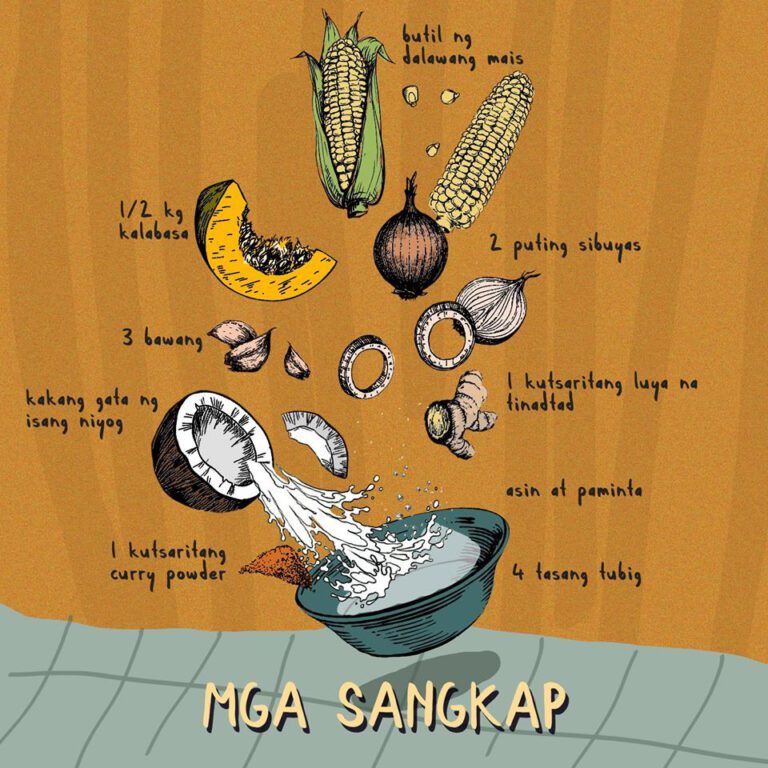
The group found that even in simple grocery or market errands, protest is possible via sandwich boards (worn around the body) and bayongs inscribed with the words “Free mass testing now.” Via its Facebook group, SAKA also released a recipe series titled “Kitchen Kalasag” with food illustrations of “easy-to-make” recipes, which members plan to reproduce into pamphlets for vulnerable communities.

But creativity and innovative interventions should not stop there. For SAKA, creativity goes into reimagining the very system which justifies the need for these interventions even outside the context of a crisis. Suarez says: “We need to mobilize our creativity to fight back — not only against the disease, but against a state that has abandoned us to this disease, against a social order that prevents us from creating mechanisms for protecting each other and our interests, against the ruling classes who will try to take advantage of anything — even a pandemic — to exploit the workers and peasants who make up the majority of our people.”#

Catriona Gray stands firm after red-tagging: ‘Don’t ever allow your voice to be silenced’

0

By: Niña V. Guno, INQUIRER.net / October 25, 2020

Catriona Gray is not backing down from using her voice despite a military official sending a warning over her ties with a women’s rights group.

The Miss Universe 2018 titleholder showed herself being freed from hands covering her mouth in a video yesterday, Oct. 24.

“Please don’t ever allow your voice to be silenced,” Gray urged. “You never know [whose] life may be impacted by your words.”

“You never know who you’ll help feel seen, courageous or comforted. When you speak up for yourself, know that in sharing your stories, you’re speaking up for others too.”

Gray’s camp defended the singer-beauty queen on Friday, Oct. 23, with her legal counsel Joji Alonso stating, “Dragging Catriona’s name, when all she has endeavored to do as an advocate for women’s rights, is completely uncalled for.”

“Catriona will not waiver in continuously championing social causes that uplift women’s lives.”

The statements come after actress Liza Soberano was red-tagged for speaking at a Gabriela Youth webinar, where she gave a personal and moving message on women’s rights.

Armed Forces of the Philippines (AFP) Southern Luzon Command chief Lt. Gen. Antonio Parlade Jr. warned Soberano for associating herself with Gabriela, and urged the actress and Gray to cut ties with the group which he accused of being an “underground mass organization.” His statements have been criticized for “red-tagging” and “harassing” the female celebrities. JB (photo from Inquirer.Net)

Outcry in Philippines Over General’s ‘Warning’ to Female Celebrities

0

By Jason Gutierrez, The New York Times, 23 October 2020

Accusing a women’s rights group of ties to Communist rebels, the general told an actress she could be killed if she associated with the organization.

MANILA — The 22-year-old actress’s voice broke last week as she talked about being threatened online with rape. She said she worried about the environment that her young nieces would grow up in, and called for creating “a better future for everyone.”

This week, a Philippine general said that unless she changed her ways, she could end up dead.

The general, Lt. Gen. Antonio Parlade — the de facto head of a military task force fighting a long-running Communist insurgency in the Philippines — directed his criticism not at the remarks made by the actress, Liza Soberano, but at the forum where she made them: an online discussion on the rights of women and girls organized by the youth wing of Gabriela, a women’s rights group that the military claims is tied to Communist guerrillas. (Gabriela denies the accusation.)

“Liza Soberano, there’s still a chance to abdicate that group,” General Parlade said on Facebook. Otherwise, he said, she would “suffer the same fate” as Josephine Ann Lapira, a young activist who was killed in a 2017 battle between the military and the Communist rebels, the New People’s Army.

The general’s comments led to an outcry from social media users, liberal politicians and the Commission on Human Rights, an independent government body.

“Coming from a high-ranking military official, such a statement is a form of suppression and restriction that serves to dissuade those who speak up for their beliefs and advocacies,” a member of the rights commission, Gwendolyn Pimentel-Gana, said on Friday.

A lawyer for Ms. Soberano, Jun Lim, said that the actress was “apolitical,” and accused General Parlade of “red-tagging” her — that is, accusing her of being a Communist. “Expressing her love and respect for women and children is her personal advocacy,” Mr. Lim said.

General Parlade denied implying that Ms. Soberano was a Communist, saying that he had meant only to warn her against associating with militants. He said he supported women’s rights.

But some of the general’s critics said his comments reflected a hostility toward women that is prevalent in President Rodrigo Duterte’s government.

Senator Risa Hontiveros denounced Lt. Gen. Antonio Parlade for his remarks.“He should not use his power as a general and threaten these women,” she said.Credit…Philippines Senate/EPA, via Shutterstock

In his Facebook remarks, General Parlade also warned another Filipina celebrity — Catriona Gray, who won the Miss Universe pageant in 2018 — against associating with left-leaning activist groups. And he accused Angel Locsin, an outspoken actress, of being involved with the rebels.

Ms. Gray, in particular, has been vocal about the government’s crackdown on human rights organizations and its passage of a contentious antiterrorism law that rights groups say was designed to stifle opposition voices.

“To Liza and Catriona: It is difficult and painful to be at the front lines fighting beside persons oppressed by a norm that advocates rape, murder and exploitation,” Senator Risa Hontiveros said by telephone.

“We will be monitoring him from now on,” Senator Hontiveros said of General Parlade. “He should not use his power as a general and threaten these women.”

Mr. Duterte, a self-confessed womanizer, has been repeatedly accused of misogyny. He once joked about the gang rape of an Australian missionary during a prison riot in the southern Philippines, saying that he should have been allowed to participate.

The New People’s Army, the armed wing of the country’s Communist Party, has been waging guerrilla warfare since 1969. Mr. Duterte, who calls himself a leftist and who once studied under the party’s founder, Jose Maria Sison, wooed the rebels to the negotiating table soon after taking office and had hoped to complete a peace deal before stepping down in 2022.#

‘Kenkoy’ and proud of it: Feting the Father of Pinoy ‘Komiks’

0

By: Ruel S. De Vera, Philippine Daily Inquirer / October 25, 2020

What exactly does it mean to be “kenkoy?”

“Kenkoy usually refers to someone who is boisterously hilarious, funny or amusing,” said Dr. Jose Wendell Capili of the University of the Philippines Diliman, a Pinoy pop culture researcher.

The term entered everyday lingo thanks to Francisco “Kenkoy” Harabas, a fictional funnyman created by comics artist Tony Velasquez in the 1920s, when the country was still under American colonial rule.

But more than just a character in outlandish attire and sporting a slick, combed-back hairdo, Kenkoy was a bright fun house mirror lifted up to the collective face of Filipino society, reflecting the silliness of parroting Western ways, exemplified by his so-called carabao English: “Weitaminit!” “Bay-gali!” “Huat is dat?”

Paying homage to Velasquez as the acclaimed “Father of the Filipino Komiks,’’ the late historian and fellow comics creator Gerry Alanguilan said in 2011: “Even though Jose Rizal himself was the very first comics creator in the Philippines, Tony Velasquez was the man who popularized the medium not only [by creating] Kenkoy … but by pioneering the comic book format through Ace Publications.’’

Velasquez served as editor in chief of an entire line of comic books—Pilipino Komiks, Tagalog Klasiks, Hiwaga, Espesyal and Kenkoy Komiks. “Steering that ship for many decades, [he] quite literally created the Philippine ‘komiks’ industry,” Alanguilan said.

‘Life of the party’

Antonio Santos Velasquez was born in Paco, Manila, on Oct. 29, 1910. His youngest daughter, Remedios “Remy” Velasquez Francisco, 78, is now a retired nurse living in Florida in the United States.

She recalled: “Dad was a kind, gentle, understanding and honest man but he was actually very extroverted, always the life of the party. He always had funny stories and millions of jokes to tell.”

Velasquez would go on to work for Ramon Roces, producing advertisements for the latter’s magazines, including the extremely popular Liwayway.

Kenkoy, the character who would define Velasquez’s career, first appeared in Liwayway on Jan. 11, 1929—just a few months before the debut of global Disney icon Mickey Mouse—in a strip called “Mga Kabalbalan ni Kenkoy,” with Romulado Ramos writing the dialogue.

The character turned out to be so popular that it soon appeared in all but one of the Roces magazines.

It also proved to be most resilient during World War II, when the Japanese occupying forces tried to hijack it. “My dad was pressured to use Kenkoy for war propaganda. He refused, and the President at the time (Jose P. Laurel) convinced my dad to use Kenkoy to promote health programs instead,’’ Francisco recalled.

After Liberation, Kenkoy continued to appear in strips until 1989. Velasquez, despite his failing eyesight, continued to have editorial input during that period.

Mentor to future masters

“Of course, my dad felt proud of his creation,” Francisco said. “It was his favorite character and he enjoyed Kenkoy’s popularity because for him Kenkoy was a manifestation of his own comical personality … My dad felt elated that his character was being used by his fellow Filipinos as a word which refers to a funny person.”

Velasquez formed Ace Publications in 1947, later expanding it into Graphic Arts Services Inc. He went on to mentor more local “komikeros” who would soon develop their own trademarks—Alfredo Alcala, Francisco Coching, Jim Fernandez, Pablo Gomez, Elena Patron, Rico Raval, Rod Santiago and Mars Ravelo, among many others.

Velasquez also got to see Kenkoy and his love interest Rosing inspire two movies and a Ryan Cayabyab musical. The Inquirer even reprinted Kenkoy strips in 2003.

“In many ways, Velasquez was a trailblazer,’’ Capili said. “Back then, most Filipinos had very limited options for entertainment—movies, television, radio and komiks. Of these, komiks was something that anyone can afford to rent or buy, or keep for posterity.’’

“He created opportunities for writers, illustrators and workers. He opened up a variety of characters, narratives and genres—from comedy to romance, to horror, and so on. Keenly sensitive about social and political issues, he also wanted to articulate relevant [topics] but he utilized Kenkoy to [make them] more accessible.”

For his contributions to the field of visual arts, Velasquez received from the Cultural Center of the Philippines the Gawad CCP para sa Sining in 1993. He died four years later at the age of 86.

Birth commemoration

In charge of the commemoration of Velasquez’s 110th birth anniversary on Thursday is Damian “Ian” Velasquez III, his grandnephew and the grandson of Velasquez’s younger brother Damian “Dami” Velasquez who is also a komikero himself. Ian is the administrator of Kenkoy and Tony’s other characters, such as Ponyang Halobaybay.

A teacher at National University, Ian reprinted the original “Album ng Kabalbalan ni Kenkoy” from 1934 to mark the character’s 90th anniversary last year.

The pioneering online komiks platform Penlab is the latest to celebrate Velazquez’s legacy.

“Tita Remy and I will appear in komiks podcasts [on Penlab] as well as an internet radio show as part of the celebration. PTV 4 is also doing a feature … in their ‘Pamana’ segment. There’s a biography that I’m working on—the life and art of Tony Velasquez, similar to the Coching books, which will be published by National University,” Ian told the Inquirer.

“My personal wish on his 110th birthday is that he be proclaimed national artist,” Francisco said of her father.

New artists

While the local komiks industry of the scale reached during the Velasquez era is all but gone, a new generation of creators is enjoying popularity in the Philippines and abroad.

“The growth of new artists nowadays would be the happiest wish of my dad, and he would probably be shouting ‘more power’ to the komiks world,” she said.

“Kikomachine Komix” creator Manix Abrera agreed: “Yes, I think I can say that I am also a spiritual successor, because we were able to continue, hopefully, what was started before. Even if the styles and techniques are now varied, the essence is still there.”

For Capili, “Millennials can probably learn a great deal from Kenkoy. Perhaps, just like Kenkoy, they can poke fun at their mistakes, take things lightly despite stressful situations.”

“Laughing at our problems or being funny [even] in times of negativity, I think it shows how we Filipinos will always be Kenkoy,’’ Ian said. #

Iloilo City’s Rabiya Mateo is Miss Universe Philippines 2020

0

By: Katrina Hallare, INQUIRER.net /October 25, 2020

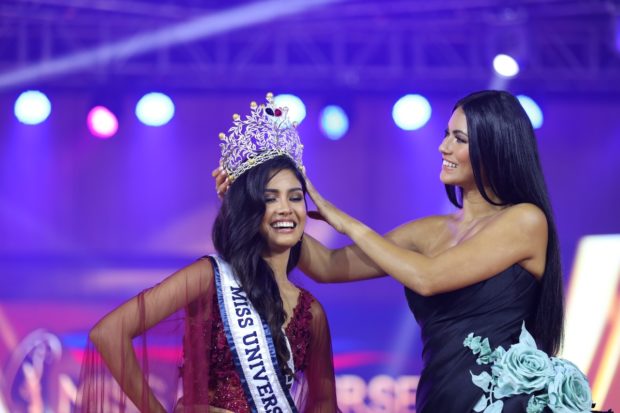
MANILA, Philippines — Rabiya Mateo  of Iloilo City was named Miss Universe Philippines 2020 during the pageant’s pre-taped coronation ceremonies at the Baguio Country Club’s Cordillera Convention Hall over the weekend.

Parañaque City’s Ysabella Ysmael bagged first runner-up honors while Quezon City’s Michele Gumabao was named second runner-up.

Bohol’s Pauline Amelinckx was named third runner-up while Kimberly Hakenson of Cavite was fourth runner up.   

The 22-year-old Mateo, who bested 45 other candidates, will represent the country in the yet to be scheduled Miss Universe pageant

‘Carrying hope and a symbol of light’ 

 During the pageant’s question and answer portion, Mateo was asked where do pageants stand during a  crisis. 

“As a candidate, I know I’m not just the face of Iloilo City, but I am here carrying hope and as a symbol of light in the darkest times,” Mateo told pageant host KC Montero. 

“And as of the moment, I want to help my community. I want to use my strength to make an impact and that is the essence of a beauty pageant. It gives us the power to make a difference,” she added. 

Remembering Miriam: ‘The best president we never had’

Mateo was also asked that should she be given a chance to create a paper currency with the image of any living or dead Filipino, who would it be. 

Mateo instantly thought of her fellow Ilongga, the late Sen. Miriam Defensor-Santiago, who she even described as “the best president we never had.” 

“For those who don’t know, she was an Ilongga, but what I admired about her is that she used her knowledge, her voice, to serve the country,” Mateo said. 

“And I want to be somebody like her. Somebody who puts her heart, her passion into action. And after all, she is the best president that we never had.” 

Beauty and brains

Mateo graduated cum laude at the Iloilo Doctor’s College in 2018, earning a Bachelor of Science degree in Physical Therapy.

She was hailed Best in Swimsuit in the preliminary competition held on Oct. 21.

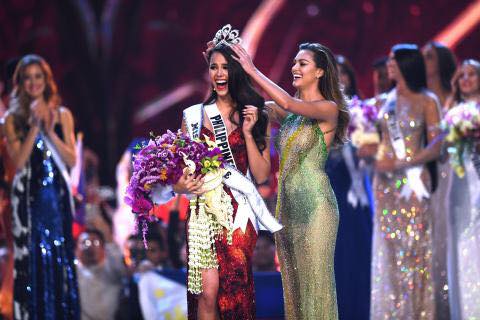
Mateo will try to become the fifth Filipina to capture the Miss Universe crown  after Catriona Gray (2018), Pia Wurtzbach (2015), Margie Moran (1973) and Gloria Diaz (1969).

Mateo was crowned by Bb. Pilipinas-Universe 2019 Gazini Ganados.

Ganados was allowed by the Binibining Pilipinas Charities Inc. to crown her successor.   

This was the first stand-alone pageant proclaiming the country’s representative to the Miss Universe pageant, after the Miss Universe Organization announced in December 2019 that that it was parting ways with the Binibining Pilipinas Charities Inc., which had been sending the Philippines’ candidate to the global tilt since 1964.

The international organization appointed 2011 Miss Universe third-runner up Shamcey Supsup-Lee as national director.

Pageant in the time of pandemic

The Miss Universe Philippines team originally set the coronation program in May, but the COVID-19 pandemic compelled the group to postpone the ceremonies to June and eventually, October.

In an earlier interview, Lee told the Inquirer that adhering to the health and safety protocols was one of the toughest parts of mounting the national competition.

The delegates, organizers, staff, and crew had to test negative for COVID-19 before heading to Baguio City, and were tested again every five days.

Charity missions 

The national pageant organization also embarked on various charity missions to help those who are affected by the pandemic, and invited the delegates to encourage the public to contribute to the causes they choose to champion.

Showcasing world-class Filipinos

The pageant also featured world-class Filipinos.

International celebrity designer Furne One of Dubai-based Amato Couture designed the competition swimsuits, while “American Idol” runner-up Jessica Sanchez performed in the opening number.  (with reports from INQUIRER Northern Luzon, Armin Adina)

General vs the Henerala

0

Mnaila Bulletin, October 23, 2020, by Tonyo Cruz

Actress Liza Soberano ain’t the first actress to approach Gabriela to talk on girls’ and women’s rights. And she won’t be the last.

Founded in 1984 by the likes of Sr. Mary John Mananzan and Maita Gomez, Gabriela first standing up against the kleptocrat and brutal Marcos dictatorship.

Gabriela initially fielded a nominee under Bayan Muna and later ran under its own Gabriela Women’s Party to promote its causes in the male-dominated Congress. Its legislative achievements are too important to the better half of our population to be glossed over – Republic Act 9262, the law against violence against women, and Republic Act 9208, the law against trafficking of persons.

From 1984 up to the present, Gabriela transformed itself into the top-of-mind and actually peerless national organization of Filipino women.  There’s no other organization as fierce and credible, so much so that in the year 2000, Gabriela topped a poll on the most popular people’s organizations in the country.

In a country whose laws are as patriarchal and as sexist as the Philippines, Gabriela is the go-to organization for victims of discrimination, sexual harassment in the community, schools, and workplaces, molestation, and rape. Women, and yes including trans-women, know they can trust Gabriela.

Gabriela helped form Lila Pilipina, the organization of former Filipino “comfort women” forced into sexual slavery in World War II.

Gabriela fought hard to dismantle the US military bases whose personnel objectified and endangered Filipino women.

Gabriela was the nightmare of sexual predators US soldiers Lance Corporal Daniel Smith and Lance Corporal Joseph Scott Pemberton. The victims fought hard to prosecute and convict them, but their own government worked against them.

Gabriela also promoted and encouraged LGBT organizations starting with ProGay Philippines, one of the lead organizers of the country’s and Asia’s first Pride March.

Gabriela has stood up against a dictator, several other presidents, the US military, the Japanese government, and sexual predators of all stripes.  No wonder, Gabriela enjoys the trust and confidence of women. No wonder it has never lost a party-list election.

The list of artists and other celebrities who have approached Gabriela for help is a who’s who in society. They join many nameless and faceless mothers, daughters, aunts, students, co-workers who look up to Gabriela for defense and support against predators and molesters.

There are Gabriela chapters around the country and around the world: Gabriela is there wherever Filipino women are raising their awareness on gender concerns and national issues. There’s a Gabriela Professionals and Gabriela Youth.

It is thus no surprise that Liza Soberano approached Gabriela. Liza wishes to stand up for every girl and women suffering silently, and Gabriela endures in its causes. Liza and Gabriela is simply a collaboration just waiting to happen.

Lt. Gen. Antonio Parlade Jr. has accused Gabriela of “deceiving” or “trying to deceive” Liza Soberano. In his conception of the world, Gabriela is nothing more than a “communist front” unworthy of Liza’s trust, and that his voice and view matter more than Liza’s own mind and intelligence.

Other artists and celebrities have thrown their support behind Liza, standing up to the sexism, red-tagging, and red-baiting. And rightly so. They have explained it rather well: Parlade cannot fathom that in 2020 a woman like Liza can think for herself.

People have tried to link Gabriela to the Communist insurgency, but the cases have all been dismissed for lack of evidence and merit. Disqualification cases too have been trashed by the Commission on Elections.

To some people, Gabriela is no different from the New People’s Army. They see no distinction between a national women’s organization composed entirely of unarmed civilians and non-combatants from the New People’s Army. This distinction is important. Parties to an armed conflict are prohibited by national and international laws from targeting civilians and non-combatants.

Filipino women are not easy to scare. The Spanish, American, and Japanese colonial forces met stiff resistance from Filipino grandmothers and mothers, daughters and aunts, sisters and cousins. Theirs is a heroic and fierce patriotic tradition. They have also been maligned many times, portrayed as weaker, less intelligent, less important than men, and unable to think for themselves.

It is not a coincidence that today’s women stand behind the banners of a national women’s organization and party-list named after the fiercest Filipino woman general of the revolution: Henerala Gabriela Silang.