By: Miguel R. Camus – Reporter / Philippine Daily Inquirer /January 25, 2022
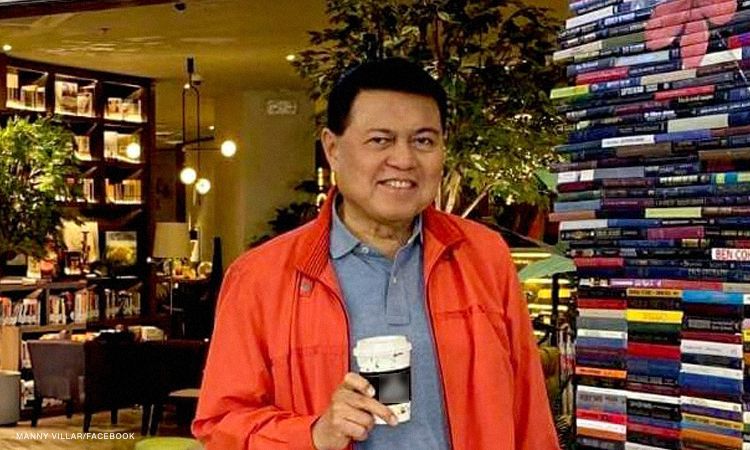
MANILA, Philippines — President Rodrigo Duterte once told Manuel Villar Jr. he would back the campaign supporter, billionaire, and former senator if he ran a second time for president.
Villar, the head of a powerful political and business clan, is not seeking any post in the 2022 presidential elections but through a Malacañang-supported move, he would nevertheless gain a new title, that of media tycoon.
Villar-linked Advanced Media Broadcasting System Inc., whose 25-year franchise extension was approved in 2019, is taking over the television broadcast frequencies previously held by Lopez-led ABS-CBN Corp., according to documents from the National Telecommunications Commission (NTC) that were seen by the Inquirer.
The frequencies were recalled from ABS-CBN after Duterte and his allies in Congress allowed the company’s franchise to expire in 2020 in a move that was decried as politically motivated.
The Inquirer received the documents on Tuesday morning and made multiple requests for comment to the NTC, whose officials have yet to reply.
Based on the NTC documents, Advanced Media was given a “test broadcast” permit to use the coveted Channel 2 spectrum last January 6 and provisional authority to use digital TV frequencies in Metro Manila and Mega Manila on Channel 16.
This effectively gives the Villar group control over the frequencies, a scarce public asset, while blocking future attempts by ABS-CBN to regain use of the spectrum.
It was unclear how the NTC vetted Advanced Media’s capacity to run a TV network. Before awarding the frequencies, it also did not hold the traditional public selection process or “beauty contest”.
The last time radio frequencies were awarded was during the rigorous 2018 bidding for the third telco license—which was bagged by Dito Telecommunity, a venture between Duterte campaign donor and business tycoon Dennis A. Uy and China Telecom.
The documents also showed Malacañang’s support for the move.
The NTC said the 18-month provisional authority to Advanced Media was reviewed by the Department of Justice and Office of the Executive Secretary, which issued a “no objection” on the assignment of the vacated and available frequencies last December 29.
Advanced Media will broadcast the Channel 2 frequency from the Villar Group’s Starmall shopping center along EDSA in Mandaluyong City, Metro Manila, the documents showed.
Moreover, the NTC said the test broadcast permit will be effective until the final shut off of analog TV, which was earlier set in 2023.
Industry player Felipe Gozon, GMA Network Inc. chair and CEO, previously shared his views that the deadline would be extended anew due to the Philippines’ low adoption of digital TV.
This would also extend Advance Media’s hold over the Channel 2 frequencies.
Democracy.Net.Ph co-founder Pierre Galla said the issuance of a temporary permit can be subject to “misuse.”
“One method of misuse is if a permit is granted whose nature is indefinite and not short in duration,” he said.
It is an anti-competitive behavior designed “to prevent any other entity [from using] the frequencies covered by the permit,” Galla told the Inquirer.
According to Forbes Magazine, Villar is the county’s richest individual with a fortune worth $7.2 billion. He owns property giant Vista Land & Lifescapes Inc., broadband company Streamtech apart from water and infrastructure assets.
In September last year, the House of Representatives approved the sale and transfer of control of Advanced Media to Villar-owned Planet Cable Inc.
In latest financial statement to the Securities and Exchange Commission, Advanced Media reported an 80 percent decline in 2020 revenues to P3.1 million while losses widened to P3.1 million from P1.82 million in 2019. It had total assets of P35.7 million.
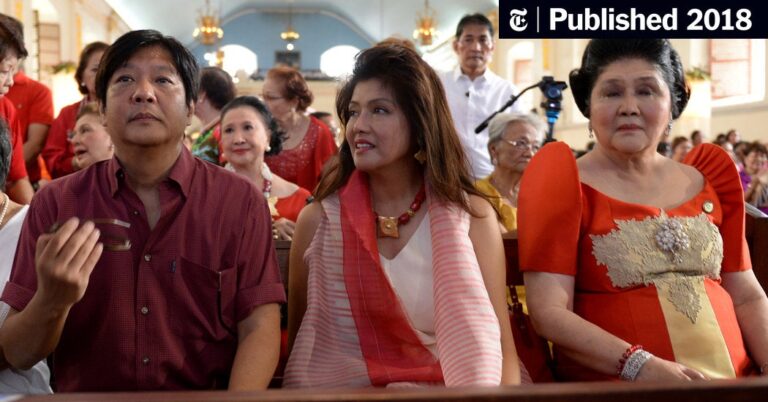
MANILA, Philippines — Presidential aspirant Ferdinand “Bongbong” Marcos Jr. on Monday said he has not seen any of the Yamashita and Tallano gold which have long been associated with his family.
Marcos Jr., the son of late dictator Ferdinand Marcos Sr., laughed at the myth and joked that people should let him know if they see any of the gold.
“Sa buong buhay ko, hindi pa ako nakakita ng gold na ganyan. Marami akong kilala na kung saan saan naghuhukay pero ako wala pa akong nakikita na kahit anong klaseng gold na sinasabi nila,” he said in an interview over One News PH.
(In all my life, I haven’t seen any gold like that. I know many people who are digging for gold everywhere but I have not seen any gold that they are talking about.)
“Baka may alam sila, sabihan ako, kailangan ko yung gold. Wala pa akong nakikitang gold,” he added.
(Maybe they know something, they should tell me. I need the gold. I haven’t seen any gold.)
Marcos’ spokesman, Vic Rodriguez, has previously denied knowledge about the supposed Tallano gold, which was supposedly the source of the Marcos family’s wealth.
According to urban legend, the Marcos family was allegedly entrusted gold bars by the so-called royal Tallano family. This myth, which supposedly explains the wealth of the late dictator’s family, has been spread in social media sites.
Aside from social media posts by supporters, the political party founded by the Marcos patriarch, the Kilusang Bagong Lipunan, posted on its website an unverified story about the gold.
It said that the Marcos patriarch was entrusted — and later paid a commission — of the many metric tons of gold supposedly owned by the Tallano family. The gold supposedly would be used for Marcos’ plan to “establish the former grandeur of the Maharlika.”
The urban legend has even driven thousands to flock to the University of the Philippines Los Baños in September 2017, believing they would receive P1 million each.
Marcos Jr. earlier described the incident as a “scam.”
His sister, Senator Imee Marcos als0 previously said she has not seen any of the mythical gold.
The “Yamashita gold” their family supposedly owns “continues to be an urban legend,” she added.
The Marcoses are accused of amassing billions of ill-gotten wealth during their reign, and the Presidential Commission on Good Governance (PCGG) was created precisely to recover assets from the Marcos family and the ousted dictator’s cronies.
So far, the agency has recovered P172.4 billion.
The PCGG is still trying to recover P125 billion more which are still under litigation.
MANILA, Philippines — Academics, civil society groups, and media outlets have once again pooled their fact-checking efforts to combat election-related disinformation ahead of the 2022 elections.
Building on its earlier collaboration for the 2019 elections, Tsek.ph, a collaborative fact-checking project for the 2022 Philippines’ elections, relaunched its website Monday morning to carry its member organizations’ fact checks and research pieces.
Under the project, partner organizations will “collaborate to provide the public with truthful and factual information regarding the elections by debunking false and misleading narratives from public figures, news media, and social media,” the University of the Philippines said in a statement earlier.
“This global collaboration effort is an important reminder of the importance of working together when facts are under attack, and fact-checking is needed more than ever,” said Baybars Örsek, director of the International Fact-Checking Network, the premier global coalition of fact-checking efforts.
“Tsek.ph is one of the most significant efforts in the world that has been carrying out these activities in such a collaborative way that has inspired so many collaborative initiatives among other fact-checkers.”
Academics have labeled the Philippines as the “patient zero” for digital disinformation, pointing to the disproportionate growth of disinformation operations in the Philippines in recent.
Earlier in the coronavirus pandemic, social networking site Facebook took down a network of some 276,000 accounts for “coordinated inauthentic behavior.”
The same accounts, which reportedly boosted pro-administration content and fake news against the opposition, were found to be linked to the Philippine National Police and the Armed Forces of the Philippines.
Philstar.com is also part of the Philippine Fact-check Incubator, an Internews initiative to build the fact-checking capacity of news organizations in the Philippines and encourage participation in global fact-checking efforts.
“Fact-checking today is at the intersection of journalism and technology,” Orsek also said at the website’s virtual press launch Monday morning.
MANILA, Philippines — Presidential aspirant Ferdinand “Bongbong” Marcos Jr. said that, if elected, he hopes to win over Martial Law survivors and critics of his father’s dictatorship with his sincerity and plans for the country while also maintaining that bringing up issues from the past will not lead anywhere.
When he announced his presidential bid in October, Marcos said he will “bring that form of unifying leadership back to our country.”
But how will he unite the country when wounds from the Martial Law years that have barely healed are reopened as another Marcos vies for the highest seat in the land?
“By presenting the best plan, by presenting the best ideas, and by showing them that I am sincere, that I want to unify. Gusto kong ipagkaisa ang sambayanang Pilipino (I want to unite the Filipino nation),” he told ONE News’ “Sa Totoo Lang” on Monday night.
Marcos said that if critics believe his sincerity, it would be good. But if they do not, he can only continue explaining his goal to unify the country.
“Of course, we’re trying to convince people to support us… Pinapakita ko lang: Ito yung aking iniisip; ito ang pagkatao ko; ito ang dapat gawin, sana tulungan nyo ako,” he said.
(Of course, we’re trying to convince people to support us. I am just showing them: This is what I’m thinking; this is who I am; this is what needs to be done, I hope you help me.)
The Human Rights Victims Reparation and Recognition Act of 2013 makes it state policy “to recognize the heroism and sacrifices of all Filipinos who were victims of summary execution, torture, enforced or involuntary disappearance and other gross human rights violations” during the Marcos regime.
That same law also gave reparations to the victims and their families.
In an interview in October 2021, Marcos reiterated his stand that he “can only apologize for what I have done. That makes perfect sense. You cannot apologize for what somebody else has done.”
‘Anti-Marcos’ is biased
Despite his message of unity, Marcos would rather not discuss events during the dictatorship — one of the reasons why he opted out of GMA 7’s “The Jessica Soho Presidential Interviews”.
His interview with One PH was his second for the day, after the backlash he earned for skipping the program of Soho that aired last weekend. He is also set to appear in more interviews this week.
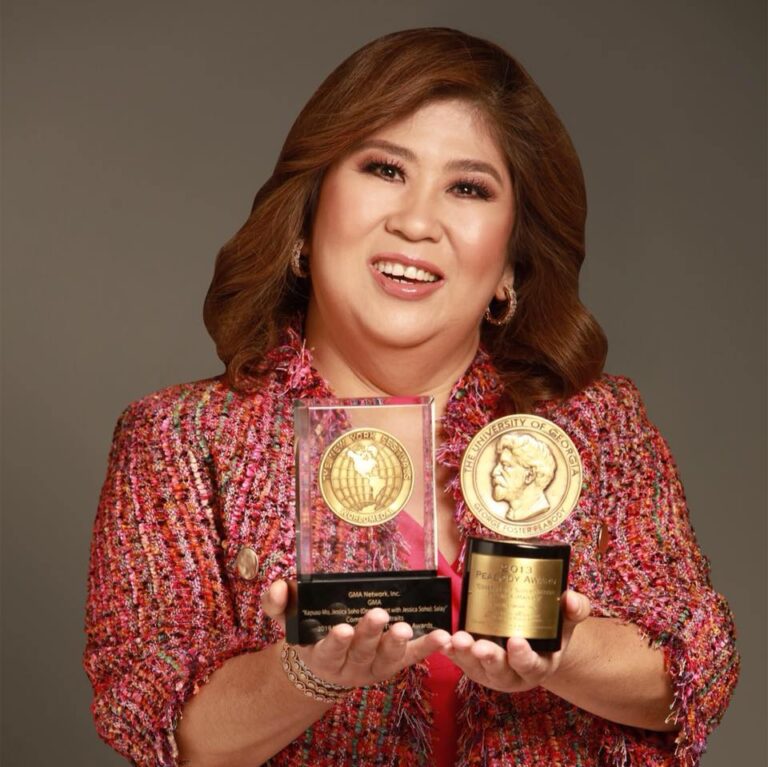
Marcos stood by his spokesperson’s statement that Soho, an award-winning journalist, is “biased” and that it would be pointless to field the same questions about the Martial Law period.
Pressed on what he considers as bias, he said: “Anti-Marcos.”
“I know,” Marcos insisted.
But how did he know? With a chuckle, Marcos replied: “Because of the treatment we (Marcos family) received at her hands.”
He said he believes candidates should be interviewed about their platforms, the problems the country is currently facing, and what they propose to do if they get elected.
“Yun sa palagay ko ang mas mahalaga at hindi na tayo babalik sa mga isyu na 35 years ago na, mga issue nadecide na yan eh. Puntahan natin itong mga bagong progblema na hinaharap,” Marcos added.
(In my view, that is more important and we should not return to issues that are 35 years ago, issues already decided on. We should discuss new problems we are facing.)
But aren’t the issues surrounding Martial Law still important, especially that he’s mounting a campaign to return to Malacañang?
Marcos said: “What questions are going to be asked that have not been asked? And how many answers do you have to give that have not been given before? Nothing is going to change so why are we doing this?”
In 2020, a Philstar.com report featured torture victim Danilo Dela Fuente shared that it took him 35 years to get compensation from the state, through the Human Rights Victims’ Claims Board (HRVCB).
Martial Law victims also said recognition of human rights violations and plunder during that period is one thing, but they also face the difficult task of making sure that they put an end to the cycle of abuse and corruption.
Duterte’s endorsement
Marcos said that, like any other candidate, he would want the endorsement of President Rodrigo Duterte.
The Partido Federal ng Pilipinas bet is running alongside Davao Mayor Sara Duterte-Carpio, the president’s daughter. The president’s political party, PDP-Laban, has already adopted Duterte-Carpio as their vice-presidential bet, but has yet to announce whose presidential bid they will support.
Asked about his chances of getting Duterte’s endorsement, Marcos refused to answer, saying the question should be addressed to the president.
He however shared that he often talks wiht president’s people including on the current political situation. “Napag-uusapan, syempre sasabihin ko, ‘sana mag-sama na tayo (We talk about it, of course I say, ‘I hope we unite already’),” he said.
But with PDP-Laban’s adoption of Duterte-Carpio, Marcos said he believes it could happen.
“There’s movement in that regard. In my case, yes, of course, I think it’s not, hindi naman mahirap na maintindihan na syempre ang isang kandidito ninanais yung endorsement ng nakaupong pangulo,” he added.
(“There’s movement in that regard. In my case, yes, of course, I think it’s not difficult to understand that, of course, a candidate would want the endorsement of the incumbent president.)
In November, Marcos’ spokesperson Vic Rodriguez said that it was “not accurate to say that we have aligned or aligning with the administration because obviously, the administration has its own candidate,” referring to Sen. Bong Go.
Go has already withdrawn as a presidential candidate.
Disinformation, coordinated amplification, use of an extensive network of anonymously-managed pages and groups are part of the Marcos comeback playbook
Nov 20, 2019, Gemma B. Mendoza
MANILA, Philippines – Massive amounts of propaganda and targeted disinformation produced and amplified by an extensive network of websites, Facebook pages and groups, YouTube channels, and social media influencers appear to be part of a systematic campaign to burnish the image of the Marcoses and pave the way for their further rise in Philippine politics.
The content that this network circulated included numerous claims that sought to alter public perception of the Marcoses by either downplaying or outrightly denying kleptocracy and human rights violations during the Martial Law years, exaggerating Marcos achievements, and vilifying critics, rivals, and mainstream media.
Many of these claims have since been debunked and proven to be false. A number of pages and accounts that are part of this network have also been taken down by Facebook for posting “spammy content” and “coordinated inauthentic behavior.”
The campaign ramped up two years ahead of the 2016 elections and continues to produce and amplify content on a scale that rivals the volume of content circulated by mainstream media groups to date.
It involves a network of Marcos and Duterte fan pages and groups, meme and viral content pages, pages circulating claims of allegedly “hidden facts” in Philippine history, and pages attacking and undermining mainstream media.
Personal accounts and pages managed by key social media influencers known for staunchly defending President Duterte and his administration’s policies also took part in the campaign.
The pages and groups involved were observed to be systematically sharing and amplifying each other’s content, along with content from known pro-Duterte and pro-Marcos social media influencers.
Fan pages & groups
The campaign ramp up included the creation of hundreds of fan groups and pages supporting the Marcos family. As of September 5, 2019, the Sharktank, a Rappler database, has tracked over 360 pages and over 280 groups supporting the family – whether it’s now-senator Imee Marcos, Ferdinand “Bongbong” Marcos Jr, their late father, or family matriarch Imelda Marcos. (The Sharktank is a Rappler database built to monitor Philippine conversation channels within Facebook – through public pages, public groups, and publicly available posts.)
The graph below shows the dates the pages were activated based on the first post from these pages that the Sharktank spotted.
The only other local politicians who rival the Marcoses in terms of number of fan groups and pages are President Duterte himself, and Senator Bong Go. Rappler has tracked around 1,800 Duterte fan pages and hundreds of fan groups to date. Initial Duterte fan pages were created as part of the ramp up for the 2016 presidential elections. Most, however, were created after Duterte assumed office.
Rappler has also detected similar messaging in relation to Martial Law and the Marcos dictatorship across pro-Duterte and pro-Marcos pages.
As the graph shows, while a few Marcos pages were created much earlier, the creation of new pages per month really started to ramp up in 2014, around the time former first lady Imelda Marcos first mentioned she wanted her son to run for president.
It was in July 2014, during her 85th birthday celebration, that Imelda Marcos hinted at a plan for a Marcos return to Malacañang. She said her son Bongbong, who was already senator at the time, was “qualified” to contest the presidency in 2016.
The graph above also indicates that new fan pages were created even after the 2016 elections. Further ramp up happened ahead of the 2019 elections when another Marcos offspring, Imee Marcos, ran for the Philippine Senate.
Reclaim Malacañang
Imelda, in 2014, said she still has a “vision” to help the Filipino people and that returning to Malacanang would be a great help in implementing her projects.
POWER BID. Vice presidential candidate Bongbong Marcos joins Ilocos Norte 2nd District Representative Imelda Marcos and Ilocos Norte Governor Imee Marcos after they file their certificates of candidacy for local elective positions during the 2016 elections. Photo from the Provincial Government of Ilocos Norte
But this was not the first time that the Marcoses attempted a return to Malacañang. Since they were evicted in 1986, Imelda herself attempted to return to the Palace twice.
The first attempt was in 1992, when she ran for president under her husband’s Kilusang Bagong Lipunan party. She lost the race, tying at 5th place with then-Senate president Jovito Salonga, getting 10% of the votes.
The second time was supposed to be in 1998, but she withdrew days before the elections. She did not have a chance to win anyway at the time. Already convicted of two counts of graft by then, an exit poll of Social Weather Stations ranked her 9th out of 11 candidates, with only 0.9% saying they would vote for her. (The Supreme Court voided her conviction months after the polls. For more on the Marcos cases, READ: What’s the latest on cases vs Imelda Marcos, family?)
Between 1986 to 2009, no Marcos made it to national office.
Bongbong Marcos himself also attempted to bag a national post in 1995 when he ran for senator under the Kilusang Bagong Lipunan party founded by his father and as part of the Nationalist People’s Coalition ticket. He finished the race ranking a miserable 16th place with more than 8 million votes.
From that point, it took more than a decade before a Marcos sought national office again. It was not until 2010 when Bongbong finally won a Senate seat. He ranked 7th place, with 13,169,634 votes.
Winning the Senate is one thing. The question was whether a Marcos was ready for the final goal: getting Malacañang back. It was doubly difficult because in the 2010 elections, the son of Marcos nemesis, Benigno “Ninoy” Aquino Jr, Benigno Simeon “Noynoy” Aquino III, won as president on an anti-corruption platform.
Social media was a handy trick in the bag. (To be continued) – with Vernise Tantuco and Akira Medina/Rappler.com
Below are links the to the other parts of this series:
MANILA, Philippines — Twitter has suspended hundreds of accounts reportedly linked to supporters of Philippine presidential frontrunner Ferdinand “Bongbong” Marcos Jr., which the social media giant said had violated its rules on manipulation and spam.
Marcos is drawing support from a massive social media campaign seeking to get him elected in May, which critics say is attempting to rewrite the family’s history.
Twitter said it had reviewed the accounts and hashtags identified in a recent article by news site Rappler.
More than 300 accounts had been removed “for violating our platform manipulation and spam policy,” Twitter said in a statement sent to AFP Saturday.
Most of them had been taken down before the Rappler article was published on Tuesday and an investigation was ongoing, it said.
Filipinos are among the world’s heaviest users of social media and the country has become a key battleground for fake news.
“With the Philippine elections taking place this May, we remain vigilant about identifying and eliminating suspected information campaigns targeting election conversations,” Twitter said.
Marcos Jr’s spokesman Vic Rodriguez said there was “no certainty” that all the suspended accounts belonged to supporters of the presidential hopeful.
Election victory for Marcos Jr would mark the ultimate political comeback for the family, which was chased into exile in the United States after its patriarch’s humiliating downfall in 1986.
Marcos Sr and his wife Imelda were accused of massive corruption while in power.
Recent voter surveys show Marcos Jr holding a huge lead over his nearest rival and nemesis Leni Robredo, who is the incumbent vice president.
Rappler said Marcos Jr supporters were “looking to dominate Twitter” and that many of the accounts it investigated were created around the time he announced his bid for the presidency in October.
The accounts pushed the narrative that the Marcoses were “victims” of the 1986 revolt and their return to Malacanang presidential palace is “long overdue”, it added.
Twitter said sharing political content on an account or rallying people do so via hashtags was allowed, “unless the accounts are inauthentic, compensated or automated, which we see no clear evidence of in this case.”
Last Monday, the social media giant said it was expanding a test feature that will allow users in Brazil, Spain and the Philippines to report misleading content. (Inquirer.net, 23 January 2022).
Two bills approved by the House of Representatives (HOR) on January 17 earned nods from groups supporting their enactment and asked the Senate to immediately pass pending counterpart proposals.
In separate statements on Monday, the group Karapatan lauded the passage of the bill giving protection to human rights defenders (HRDs) while election commission employees hailed the approval of the proposed law strengthening Commission on Elections (COMELEC) field offices.
The HOR approved on third reading House Bill (HB) 10576 entitled “An Act Defining the Rights and Fundamental Freedoms of Human Rights Defenders, Declaring State Responsibilities, and Instituting Effective Mechanisms for the Protection and Promotion of These Rights and Freedoms.”
The chamber also passed HB 10579, “An Act Strengthening the Field Offices of the Commission on Elections by Upgrading and Creating Certain Positions,” amending Batas Pambansa Bilang 881, the country’s old Omnibus Election Code.
Long overdue
Karapatan said it lauds HB 10576’s principal authors who want to give protection to HRDs as well as to other rights advocates such as lawyers, church people, journalists, development workers and freedom of expression and association advocates.
“Maraming salamat, (Albay) Rep. Edcel Lagman, (Quezon City) Rep. Kit Belmonte, (Bayan Muna) Rep. Karlos Ysagani Zarate (and the rest of the) Makabayan bloc!” Karapatan secretary general Cristina Palabay said.
In a statement, Lagman said, “The enactment of the Human Rights Defenders Act will put an end to the prevailing impunity on the extrajudicial killings and extreme harassments of HRD.”
Lagman said the following are the proposed measure’s salient provisions:
Defines HRD as “any person, who individually or in association with others, acts or seeks to act to protect, promote, or strive for the protection and realization of human rights and fundamental freedoms, at the local, national, regional, and international levels.” This definition is broad and inclusive enough to cover HRDs in both government and private sector who may not be bona fide connected to any human rights organization.
Embodies the rights and fundamental freedoms enshrined in the United Nations Declaration on Human Rights Defenders such as the rights to: form associations and to peaceful assembly; represent and advocate; privacy; effective remedy and full reparation; and freedom from intimidation, reprisal, defamation, and stigmatization among others.
Prohibits all public authorities from participating, by acts of commission or omission, in violating human rights and fundamental freedoms. Subordinate employees have the right and duty to refuse any order from their superiors that will cause the commission of acts that contravene their duty to protect, uphold, and promote human rights and fundamental freedoms. Such refusal shall not constitute a ground for any administrative sanction.
Strengthens the obligation of public authorities to conduct investigations on suspected human rights violations of HRDs.
Prohibits the public authority offender from invoking presumption of regularity in the performance of duty which presumption is commonly used as a veneer to conceal accountability for violation of human rights and freedoms. The prohibition is consistent with the rule on the Writ of Amparo.
Mandates government agencies to enforce and institutionalize command responsibility and impose sanctions against errant superiors in both military and civilian agencies as provided under existing laws and executive issuances.
Directs public authorities to adopt the human rights-based approach to governance and development including in counter-insurgency and anti-terror programs and policies.
Seeks to strengthen the Witness Protection Program of the Commission on Human Rights and mandates the Commission to provide sanctuaries for high-risk HRDs, particularly those who have filed formal complaints against high-ranking government officials.
Ensures respect for the principle of non-refoulement or the practice of not forcing refugees or asylum seekers to return to a country where they are likely to be subjected to persecution.
States that in exercising their rights under the Act, HRDs shall be subject only to limitations that are prescribed by law, in accordance with international human rights obligations and standards, are reasonable, necessary and proportionate, and are solely for the purpose of securing the recognition and respect for the rights and fundamental freedoms of others and meeting the reasonable requirements of public order and general welfare in a democratic society.
Creates an independent collegial body to be known as the Human Rights Defenders Committee composed of one Chairperson and six members. The Chairperson shall be selected by the Commissioners of the CHR from among themselves in an en banc session. The six members shall be jointly nominated by representatives of human rights organizations. The nominees shall be appointed by the CHR not by the President to underscore the Committee’s independence of the Executive.
States 10 guiding principles that shall be adhered to in implementing the Act and in formulating the corresponding rules and regulations. These include among others: adherence to the rule of law; active participation of HRDs in formulating, implementing and evaluating HRD protection programs; periodic risks assessments; confidentiality of personal data collected on HRDs; special attention to protection of women and LGBT HRD rights; continuous training of the Committee Secretariat; sustained adequate resources; and transparent and equitable resource allocation.
Expressly provides that all provisions of the HRD Protection law shall be construed to achieve its objectives and that all doubts in the implementation and interpretation of these provisions shall be resolved in favor of the HRD.
Karapatan said it is high time Congress fully enacts the measure, as “[h]uman rights defenders were killed, arrested, detained, red-tagged and threatened for so long, and a law to criminalize these acts has been long overdue.”
“We call on the Senate, specifically Sen. Richard Gordon who chairs the Committee on Human Rights, and Senate President Tito Sotto to expedite the hearings and pass the proposed HRD Bill of Sen. Leila de Lima,” Palabay said.
‘Overjoyed’
Meanwhile, the Commission on Elections Employees Union (COMELEC-EU) said its 5,000 members nationwide are “overjoyed” by HB 10579’s passage by the HOR.
The poll body’s personnel added the development is “a booster shot,” lifting morale as they prepare for May’s local and national elections.
COMELEC-EU national president Mac Ramirez said the bill will not only benefit COMELEC employees but will help ensure clean and honest elections in the future.
Principal author and ACT Teachers Party Rep. France Castro said the bill is aimed at correcting COMELEC employees’ lower salary grades and to reform the poll body’s field offices.
Castro acknowledged COMELEC-EU’s role in campaigning for the bill, members of which suffered low wages for many years.
Castro added that COMELEC personnel, whose workloads increase during election years, deserve salary increases and regularization as employees.
Both Castro and Ramirez likewise appealed to the Senate to fast track the approval of the proposed measure’s Senate counterpart. # (Raymund B. Villanueva)
Jan 18, 2022 Gaby Baizas, Pauline Macaraeg, Dylan Salcedo
MANILA, Philippines – After taking over major social media platforms for their propaganda work the past years, the supporter base of presidential aspirant Ferdinand “Bongbong” Marcos Jr. is looking to dominate Twitter as well with the use of mainly newly-created and revived accounts, a Rappler investigation showed.
The hashtag #LabanMarcos trended on Twitter on Monday, January 17, ahead of the announcement by the Commission on Elections (Comelec) on petitions against Marcos’ candidacy.
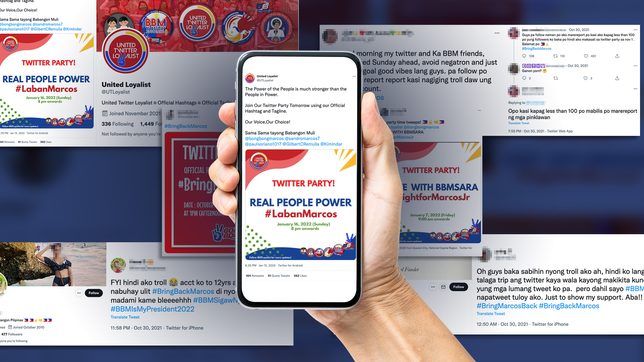
Marcos’ supporters had organized a Twitter party the night before on Sunday, January 16, to make #LabanMarcos trend. One of the accounts known to have started the event was Twitter account @UTLoyalist, created only in November 2021.
TWITTER PARTY. Twitter account @UTLoyalist, created in November 2021, tweets about a Twitter party to make #LabanMarcos trend in January 2022. Rappler screenshot
It would have been just any other Twitter party, except for one curious detail: the accounts behind them were mostly created around the same time in the last quarter of 2021. https://flo.uri.sh/visualisation/8421064/embed#?secret=u1ZDB6HSTd
The graph above shows the creation dates of accounts from a sample of 3,000 tweets mentioning the hashtag #LabanMarcos on Monday.
Like Twitter user @UTLoyalist, many of the accounts who tweeted #LabanMarcos were created in the last quarter of 2021. Most of them were created in October 2021 – the same month Marcos Jr. announced his intention to run and filed his certificate of candidacy for president in the 2022 elections.
Within hours, the hashtag #LabanMarcos reached the sixth trending spot in the Philippines. The phrase “REAL PEOPLE POWER” also trended, as promoted by @UTLoyalist. As of Tuesday, January 18, the account @UTLoyalist has been suspended by Twitter for violating its rules.
The narrative was simple: the Marcoses were victims of the EDSA People Power, and their return to Malacañang was long overdue.
This has been the online messaging pushed by the Marcoses and their supporters as early as 2016, when Marcos ran and lost in the vice presidential race.
The Marcos propaganda network on Facebook has long seeded false narratives about the family and Martial Law, as shown by a Rappler investigation in 2019. They do the same on YouTube and TikTok. Spreading lies that aim to reclaim the Marcoses’ glory proved effective in burnishing their image and, to an extent, bringing members of the family back to power.
When Facebook removed two fake account networks – one from China and one from the Philippines – social analytics firm Graphika noted that the Chinese network had a “particularly striking” focus on Imee Marcos in March and April 2019. During this time, Imee was running for a Senate seat, which she won in May 2019.
Now, similar tactics are being adapted for Twitter, as an emerging supporter base attempts to dominate conversations on the platform.
A closer look at the data showed that the #LabanMarcos Twitter party was much more than a simple campaign to express support for Marcos’ presidential bid.
Apart from #LabanMarcos, Rappler looked into popular hashtags used by supporters of Marcos Jr. All of these hashtags and campaigns followed similar strategies: from using newly-created or revived accounts to amplify their message, to tweeting to make noise and drown out dissent.
Here are the ways Marcos supporters have taken over Twitter in recent months, in time for the 2022 elections.
Using new accounts, reviving old ones
Data of tweets using other popular Marcos hashtags showed that majority of his supporter base on Twitter is composed of new accounts, most of which were also created in October 2021. https://flo.uri.sh/visualisation/8427405/embed#?secret=rT1rL6j7SM
The graph above shows the creation dates of accounts from a sample of 10,000 tweets mentioning pro-Marcos hashtags from September 1, 2021, to January 15, 2022. The tweets from these accounts contain the hashtags #BringBackMarcos, #BBMIsMyPresident2022, #BBMForPresident2022, #BBMSigawNgBayan, #ProtectMarcosJr, #FightForMarcosJr, #BBMSaBalota, #BBM2022, and #UnitedForMarcosJr.
Apart from new accounts, there are also a number of accounts in the network that were created years back, but were only revived after Marcos announced his presidential bid and formally filed his candidacy. These dormant accounts often boast about their older creation dates and use it to defend themselves from being labeled as trolls.
‘HINDI AKO TROLL.’ This user has been on Twitter since October 2010. Before reviving her account to support Marcos Jr.’s presidential run, her last tweet was from February 2018. Rappler screenshotSHOW OF SUPPORT? This user has been on Twitter since February 2011. Her last tweet before Marcos announced his bid was from over six years ago in July 2015. Rappler screenshot
dictator’s son and attack critics in the lead-up to elections
MANILA, Philippines – After taking over major social media platforms for their propaganda work the past years, the supporter base of presidential aspirant Ferdinand “Bongbong” Marcos Jr. is looking to dominate Twitter as well with the use of mainly newly-created and revived accounts, a Rappler investigation showed.
The hashtag #LabanMarcos trended on Twitter on Monday, January 17, ahead of the announcement by the Commission on Elections (Comelec) on petitions against Marcos’ candidacy.
Marcos’ supporters had organized a Twitter party the night before on Sunday, January 16, to make #LabanMarcos trend. One of the accounts known to have started the event was Twitter account @UTLoyalist, created only in November 2021.
TWITTER PARTY. Twitter account @UTLoyalist, created in November 2021, tweets about a Twitter party to make #LabanMarcos trend in January 2022. Rappler screenshot
It would have been just any other Twitter party, except for one curious detail: the accounts behind them were mostly created around the same time in the last quarter of 2021. https://flo.uri.sh/visualisation/8421064/embed#?secret=u1ZDB6HSTd
The graph above shows the creation dates of accounts from a sample of 3,000 tweets mentioning the hashtag #LabanMarcos on Monday.
Like Twitter user @UTLoyalist, many of the accounts who tweeted #LabanMarcos were created in the last quarter of 2021. Most of them were created in October 2021 – the same month Marcos Jr. announced his intention to run and filed his certificate of candidacy for president in the 2022 elections.
Within hours, the hashtag #LabanMarcos reached the sixth trending spot in the Philippines. The phrase “REAL PEOPLE POWER” also trended, as promoted by @UTLoyalist. As of Tuesday, January 18, the account @UTLoyalist has been suspended by Twitter for violating its rules.
The narrative was simple: the Marcoses were victims of the EDSA People Power, and their return to Malacañang was long overdue.
This has been the online messaging pushed by the Marcoses and their supporters as early as 2016, when Marcos ran and lost in the vice presidential race.
The Marcos propaganda network on Facebook has long seeded false narratives about the family and Martial Law, as shown by a Rappler investigation in 2019. They do the same on YouTube and TikTok. Spreading lies that aim to reclaim the Marcoses’ glory proved effective in burnishing their image and, to an extent, bringing members of the family back to power.
When Facebook removed two fake account networks – one from China and one from the Philippines – social analytics firm Graphika noted that the Chinese network had a “particularly striking” focus on Imee Marcos in March and April 2019. During this time, Imee was running for a Senate seat, which she won in May 2019.
Now, similar tactics are being adapted for Twitter, as an emerging supporter base attempts to dominate conversations on the platform.
A closer look at the data showed that the #LabanMarcos Twitter party was much more than a simple campaign to express support for Marcos’ presidential bid.
Apart from #LabanMarcos, Rappler looked into popular hashtags used by supporters of Marcos Jr. All of these hashtags and campaigns followed similar strategies: from using newly-created or revived accounts to amplify their message, to tweeting to make noise and drown out dissent.
Here are the ways Marcos supporters have taken over Twitter in recent months, in time for the 2022 elections.
Using new accounts, reviving old ones
Data of tweets using other popular Marcos hashtags showed that majority of his supporter base on Twitter is composed of new accounts, most of which were also created in October 2021. https://flo.uri.sh/visualisation/8427405/embed#?secret=rT1rL6j7SM
The graph above shows the creation dates of accounts from a sample of 10,000 tweets mentioning pro-Marcos hashtags from September 1, 2021, to January 15, 2022. The tweets from these accounts contain the hashtags #BringBackMarcos, #BBMIsMyPresident2022, #BBMForPresident2022, #BBMSigawNgBayan, #ProtectMarcosJr, #FightForMarcosJr, #BBMSaBalota, #BBM2022, and #UnitedForMarcosJr.
Apart from new accounts, there are also a number of accounts in the network that were created years back, but were only revived after Marcos announced his presidential bid and formally filed his candidacy. These dormant accounts often boast about their older creation dates and use it to defend themselves from being labeled as trolls.
‘HINDI AKO TROLL.’ This user has been on Twitter since October 2010. Before reviving her account to support Marcos Jr.’s presidential run, her last tweet was from February 2018. Rappler screenshotSHOW OF SUPPORT? This user has been on Twitter since February 2011. Her last tweet before Marcos announced his bid was from over six years ago in July 2015. Rappler screenshot
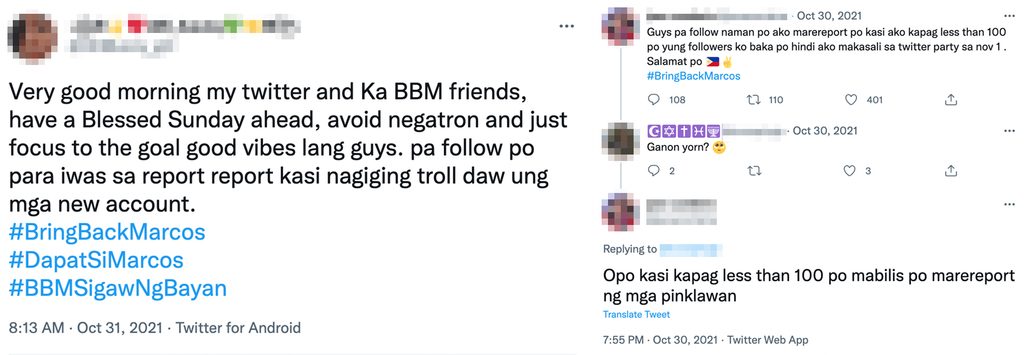
Supporters have also adopted the practice of following each other on Twitter in order to help smaller accounts gain bigger audiences. Some users aim to hit at least 100 followers before they help make hashtags trend and to avoid getting reported to the platform.
IWAS-REPORT. Users encourage each other to follow other Marcos supporters on Twitter to avoid getting reported. Rappler screenshots
Rappler also looked into the hashtag #DisqualifyMarcos, which also trended on Monday, January 17, to compare the behavior of Marcos supporters to those who oppose his presidential bid.
Using the same parameters, data showed that there are more unique users tweeting #DisqualifyMarcos than those tweeting #LabanMarcos. The accounts tweeting the former hashtag were spread across several years. This shows an almost spammy behavior from users tweeting the pro-Marcos hashtag. https://flo.uri.sh/visualisation/8421934/embed#?secret=uTBRtpdwbO
Based on the scan comparing users who tweeted #LabanMarcos and #DisqualifyMarcos, the Marcos network is seen to be adapting tactics in similar online operations, where majority of accounts used in a disinformation campaign were created in batches on the same date.
In the same month Marcos filed his candidacy, data showed that 42.6% of his Twitter followers were fake. Online tool SparkToro said Marcos had more fake followers compared to other Twitter accounts with similar-sized followings.
Making noise, attacking critics, defending Marcos
The #LabanMarcos trend was not the first time Marcos supporters participated in organized Twitter parties in an attempt to dominate online conversation.
PARTY TIME? Several users share graphics containing different hashtags and taglines for Marcos supporters to mass tweet. Rappler screenshots
Supporters trended #BringBackMarcos in October 2021, and had criticized media outlets for not reporting on the said trend. Data also showed that the majority of the accounts that tweeted the hashtag were created in the same month.
On November 7, 2021, thousands of individuals supporting Marcos’ presidential run participated in an Ilocos Sur caravan. There was another spike in tweets on the same day, with some supporters taunting mainstream media, implying that news organizations would refuse to cover the event due to their supposed inherent biases. Rappler, ABS-CBN, and Inquirer covered the said caravan. (FALSE: Media refuses to cover Bongbong Marcos’ campaign)
More than making hashtags trend, the network also attacks critics of the Marcoses. In late December 2021, veteran journalist and Nobel Peace Prize laureate Maria Ressa tweeted several Rappler stories on Marcos propaganda networks and disinformation. After this, there was a significant surge in tweets mentioning Ressa.
Data showed that among these tweets, those that explicitly attacked Ressa were mostly from newly-created pro-Marcos accounts from the same network.
The graph above shows the creation dates of users who mentioned Maria Ressa in their tweets from December 26 to 29, 2021, when Ressa received attacks on the platform. The data showed that the accounts that tweeted about her were also mostly created in the last quarter of 2021 – similar to the accounts that were part of the Marcos Twitter network.
Supporters also came to Marcos’ defense when he failed to attend an online Comelec proceeding on the disqualification cases against him on January 7. When critics renewed calls for the poll body to disqualify Marcos, his supporters tried to drown out dissent by tweeting the hashtags #FightForMarcosJr and #BBMSaBalota, along with the phrases “DQ CASES IBASURA (JUNK THE DISQUALIFICATION CASES)” and “UNITE WITH BBMSARA.” (LIST: Petitions seeking to block Bongbong Marcos’ 2022 presidential bid)
When a Manila Bulletin report on January 10 alleged that hackers had breached into the Comelec servers and had stolen sensitive information related to the election, supporters were also quick to decry the incident. “Protect our vote” was a popular phrase among supporters, and other users had even put the blame on Vice President Leni Robredo, Marcos’ 2016 and 2022 rival.
Comelec later refuted the Manila Bulletin report, and Rappler found that most of the accounts spinning the story to Marcos’ favor were only created between October and December 2021. (Ressa warns: PH polls could see repeat of US Capitol attack if disinformation not stopped)
Why does this matter?
As the coronavirus pandemic continues to rage throughout the country, aspirants and supporters alike have turned to online platforms to engage with one another as the election draws closer. The Philippines witnessed how social media and propaganda played a vital role in Rodrigo Duterte’s 2016 victory, but many tech platforms today have yet to revisit their policies to ensure an honest and safe election in 2022.
The Marcos family is no stranger to taking advantage of social media. Marcos Jr. asked the highly-scrutinized political data company Cambridge Analytica to “rebrand” their family’s image on social media, a claim his spokesman denied. False claims about the Marcoses and Martial Law are abundant on different networks, especially on Facebook, YouTube, and TikTok, some of the country’s most popular social media platforms. (READ: Bongbong Marcos networks gain influence in YouTube election discourse – study)
Marcos Jr. enjoys a significant supporter base both online and offline. He was the top choice for president in a Pulse Asia survey from December 2021, preferred by 53% of respondents if elections were held at the time. This is barely six years after the greatest number of respondents in another poll, by the Social Weather Stations, acknowledged that there was indeed oppression during the dictatorship of Marcos’ father and namesake
For tech platforms and government authorities to deny that voters’ online and offline behaviors are intertwined will be detrimental to elections and, consequently, democracy. – Rappler.com