Home Blog Page 40

Pinay photojournalist opens Maria Ressa Peace Prize exhibit in Oslo

0
Macel Ingles, TFC News Europe

Posted at Dec 14 2021

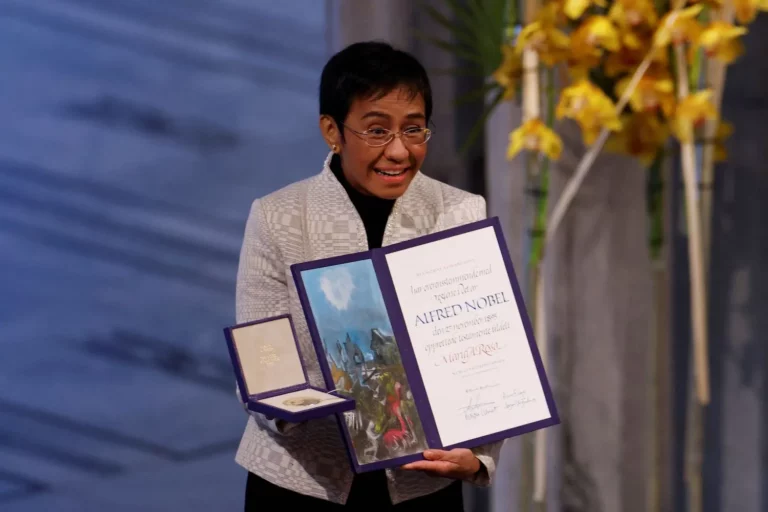
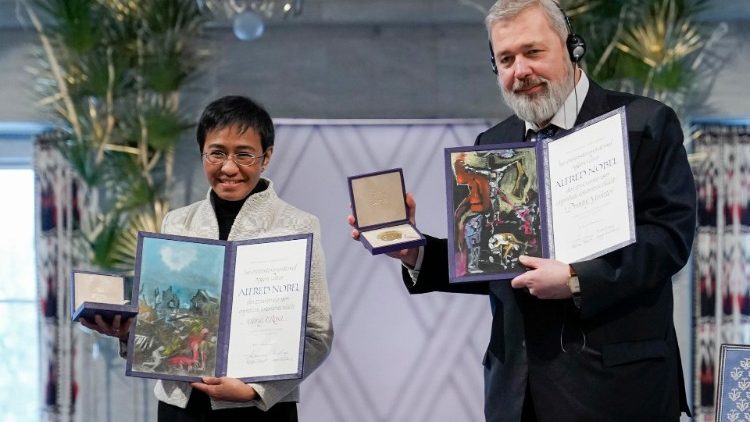
OSLO, Norway – Filipina photojournalist Hannah Reyes Morales is beyond excited going to the public opening of her exhibition to highlight this year’s Nobel Peace prize winners. 

“Siyempre masaya, masaya na nakapunta. Last year, ‘di ako nakakapunta sa kahit anong opening. So yung napuntahan ko, ito pa. Sobrang saya kasi super welcoming ang mga tao dito. Tapos sobrang open nila to listen to our stories. So it’s been really cool,” said Morales.

(I’m so happy to be here. I wasn’t able to attend any opening last year. I’m so happy because people here are so welcoming. They are open and eager to listen to our stories.)

But she admitted being this year’s official photographer of the 2021 Nobel Peace Prize exhibition is a daunting task, a responsibility too heavy to bear.

“Di siya light na responsibility, ‘di ba? Una, konting time lang ibinigay sa akin. Tapos parang ang laki ng sitwasyon. Disinformation and press freedom, important siyang topic, pero ang laki niyang responsibility,” she said.

(It’s not a light responsibility. First of all, I was only given a short period of time. But the situation is big. Disinformation and press freedom are important topics, so it’s a huge responsibility.) 

Director of Exhibitions Nina Frang Høyum of the Nobel Peace Center is all praises for Morales’ work, saying they found her work online and knew that they had to get her to do the exhibit.

“We are looking for a brilliant photographer and we found Hannah Reyes Morales. Her talent for storytelling is magnificent. We are just happy and honored that she is available,” said Høyum.

Høyum said they deliberately hired photographers that had an insider’s look- an insider’s eye on the winners.

“For this particular assignment, we want to work with photographers who have experienced what it’s like to work in situation where freedom of expression is under threat,” Høyum said.

Mother and son Angeli Brujord and Kendrick Aguilar went to see Morales’ exhibition. They heard her account on Ressa’s work against fake news in social media.

Kendrick came to Norway two years ago and said he is bothered by fake news in social media and how it is spreading disinformation among teenagers in the Philippines.

“Nakakaawa po kasi active ako sa Facebook at nakikita ko mga ka-age ko na teenagers, na-brainwash na,” he said.

(I am active on Facebook and I see teenagers my age being brainwashed.)

His mother, Brujord said that she is disheartened by the spread of disinformation and has decided that she will do her part to stem it starting with her family.

“Ang magagawa ko about fake news, siguro, marami rin akong friends na if ever nag-share sila ng fake news, kailangan ko pong i-inform, tulad po ng pamilya ko. Siyempre, madali po silang maniwala. Ini-inform ko sila na ‘di ‘to totoo ang binabasa nila sa Facebook,” she said.

(What I can do about fake news is to inform my family and friends who share fake news, that it’s not true. I will inform them that what they read on Facebook is not true.)

The Nobel Prize exhibit that also displays the works of Russian photographer Nanna Heitman opened to the public on Dec. 12 and will run for a year.

[Newspoint] The three dynasties

0

Dec 4, 2021 Vergel O. Santos

Those three dynasties, having much to account for to the nation, have banded together for common protection and shared power

China’s part in the pandemic, as initiator, is not unlike its part in a number of bad turns in Philippine political life. The decided difference is to do with motives. 

While the virus that started the pandemic originated in China, it’s inconceivable that it was deliberately loosed on the world. But the political victimization of the Philippines by China – that could only have gone according to some plot, which could come to fruition through the victory of the Marcos-Duterte-Arroyo axis in the May 2022 elections.

Speaking of the generational planning China is known for, the plot could well have been mounted in the sixties. By then under Mao Zedong’s “paramount” leadership for half a generation, China had begun to expand its geopolitical influence in the region, exporting its variant of communism. It supplanted the Soviet Union’s Marxist sponsorship of the Philippine movement and reoriented it to Maoism.

Proselytizing on the homegrown quality of Maoism and Mao’s revolutionary triumph in China, the local communists made such gains that Ferdinand Marcos used these as his excuse for imposing Martial Law, in 1972, with the backing of the United States, the Philippines’ traditional patron. But, all too soon, they were left in the cold. Taking a cue from the rapprochement between the US and China, Marcos sent his wife, Imelda, on a charm offensive on Mao that led to the establishment of diplomatic relations between their countries the following year, 1975.

After Marcos’ ouster, in 1986, these relations proceeded uneventfully, but for a visit by his democratically elected successor, Cory Aquino, to her forbears’ native village in China’s Fujian province.

In 1991, inspired by a new independence fever, Aquino’s government made the US dismantle its military bases in the Philippines, ending a 99-year accommodation. But a treaty remained in force – it still does – pledging the two nations to come to each other’s defense in case of a foreign invasion. 

The Chinese were in no rush: neither Aquino nor her successor, Fidel Ramos, qualified as the “receptive” host they had in mind. Their opportunity came in the predisposed and abnormally long (2001-2010) presidency of Gloria Arroyo. 

Arroyo stepped up from vice president to serve the three years left of Joseph Estrada’s presidential term after his impeachment and conviction for plunder, and then won her own six-year term – as it happens, by a rigged vote. The Chinese cultivated her – she visited China 10 times in her presidency. But if anything good came out of the relationship, it was overshadowed by a scandal known by the compound initials NBN-ZTE. 

NBN stands for the scandalous project itself: National Broadband Network. That network was to link all Philippine government offices. A Chinese firm formally listed as Zhong Xing Telecommunication Equipment but more known as ZTE was contracted to do it for $329 million (around P16.4 billion). But allegations of bribes amounting to more than a third of the cost ignited a furor, reached the courts, and forced Arroyo to cancel the contract, giving the Supreme Court a reason to dismiss the case.

Arroyo’s successor proved to be another unreceptive president, like his mother. Benigno Aquino III, Cory’s son, was not letting Arroyo or China off so easily. She was sued for plunder and denied bail, as the law provides for anyone indicted for that crime, thus held in detention while on trial. China itself was taken to the International Arbitration Tribunal for a territorial ruling over the West Philippine Sea when it made aggressive proprietary moves in those disputed waters. 

The court upheld the Philippine claim, but when the ruling came, Aquino had just ended his term and been succeeded by Rodrigo Duterte, who puts Arroyo to shame in receptiveness toward the Chinese: he hijacked the ruling and surrendered control over the West Philippine Sea to China in exchange for its patronage. 

But what has the Philippines actually got in the exchange? As a cornered client, loans at onerous rates and supplies of one of the least efficacious yet one of the most expensive vaccines – Sinovac. China, on the other hand, has got a whole sea that is a strategic waterway in itself and all the marine resources and minerals in it, and, for its nationals doing business in the Philippines and working for them, immigration and tax favors, among others. 

Meanwhile, Arroyo has been back in the swim of things. A Supreme Court she had the time to pack during her long reign acquitted her on all charges, although her first grateful words were for Duterte – for “providing the atmosphere” conducive to her acquittal. The Marcoses might well have thanked him for it, too: their murdering, plundering dictator patriarch was given a hero’s burial in the same friendly atmosphere.

Those three dynasties, having much to account for to the nation, have banded together for common protection and shared power. Marcos’ son Ferdinand Jr. is running for president, in tandem with Duterte’s daughter Sara, for vice-president. Limited by the Constitution to a single term as president and possibly also disqualified from running for vice president, because, if elected, he would be first in the line of succession to the presidency, her father is settling for senator. And Gloria Arroyo is running unopposed for her home district’s seat in the House of Representatives. If Duterte and Arroyo win and become the heads of their legislative houses, they will still be second and third, respectively, in the line of presidential succession.

Actually, everyone comes one level down to make way for their paramount leader – Xi Jinping. – Rappler.com

Fil-Am activists dispute Duterte claim at US summit

0

By: Leila B. Salaverria – Reporter / Philippine Daily Inquirer /December 13, 2021

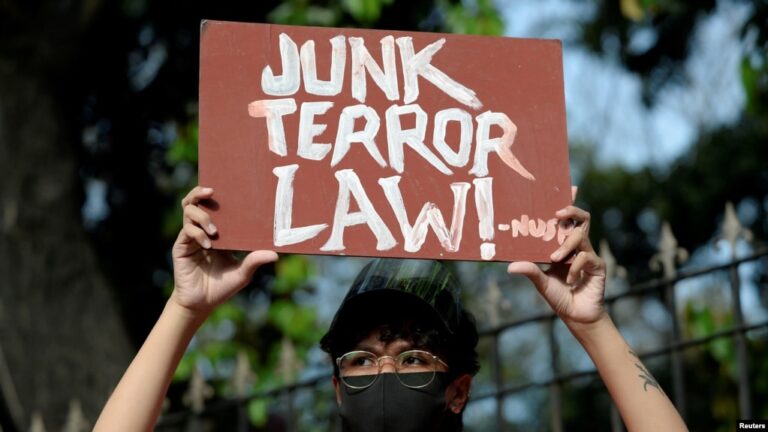
MANILA, Philippines — Filipino American groups disputed President Rodrigo Duterte’s statements at a recent US-led summit that the Philippines has a “vibrant democracy,” saying his administration has attempted to silence and Red-tag critics, waged a war on drugs that targeted the poor, and legalized political repression through the anti-terrorism law.

The groups, led by US Filipinos for Good Governance (USFGG), wrote to US President Joe Biden on Dec. 8 to protest his decision to invite Duterte to the Summit for Democracy, saying that the latter’s presence at the event “makes a mockery of what the US professes, especially given the sheer magnitude of his crimes.”

USFGG and its allied organizations also held a protest in front of the White House on Dec. 10 to air their opposition to Duterte’s participation in the summit.

Duterte said at the summit that Philippine democracy was a work in progress, “but the Filipino is free. The Philippines is free.”

“Today, we have a vibrant democracy and an open and diverse society. Freedom of expression and of the press are fully enjoyed and the regular transfer of power is guaranteed through free and honest elections,” he said.

He also vowed to ensure “honest, peaceful, credible and free elections” next year.

But Chrissi Fabro of Malaya Movement disputed the president’s assessment of the Philippine situation.

Vibrant democracy?

“How can Duterte speak of a vibrant democracy when his regime has robbed the Filipino people of their democratic rights and freedoms?” Fabro asked.

Fabro said that instead of addressing the needs of Filipinos, Duterte waged a war on drugs, which she said was also a war against the poor.

Fabro also said Duterte had undertaken a war against dissent to silence his critics.

The government’s anti-insurgency task force has also Red-tagged activists and branded them as terrorists for advocating people’s rights, she said.

She also said the antiterrorism law, largely upheld by the Supreme Court, “legalized political repression.”

Jon Melegrito of Akbayan North America called on Filipinos to join the fight to defend democracy against those who try to destroy it through violence, suppression of speech, oppression of freedoms, and laws like the terrow law.

“We are in danger of losing this democracy unless we speak out strongly against these efforts to silence us, to intimidate us, to threaten us, to arrest us, to jail us, and even to kill us,” he said.

‘The job is resistance’: Patricia Evangelista at Nobel torchlight procession

0

Dec 11, 2021 10:19 PM PHT Rappler.com

‘Journalism is a tradition, and the line that Rappler holds is one that was drawn decades ago by men and women who stood at the barricades and said this far, no further’

Below is the full text of Patricia Evangelista’s speech during the torchlight walk program for Nobel Peace laureates Maria Ressa and Dmitry Muratov on Friday, December 10, in Oslo. Evangelista, Rappler’s investigative journalist who produced its compelling stories on the brutal drug war of the Duterte government, was one of the four speakers during the ceremony. The other speakers were Dr. Nadezda Azhgikhina, a Moscow-based journalist and writer, director of PEN Moscow; Anette Trettebergstuen, Norwegian Minister of Culture and Equality; and Barbara Trionfi, executive director at the International Press Institute

My name is Patricia Evangelista, and for more than a decade, I worked for a small, independent news agency named Rappler. I’m a trauma reporter. It means that I report about terrible things that happened because those things shouldn’t have happened and shouldn’t happen again.

And then, five years ago, the man who would become the president of the Philippines promised the deaths of his own people. The terrible became ordinary, to thundering applause.

Now I’m going to tell you what terror looks like.

Once, I stood outside a house where five men had been killed. The families gathered outside. Please, they pleaded, tell us who the dead men are. The cops refused, shouted at one mother, shoved another daughter. And then it rained, hard and heavy. People ran and the cops laughed. See, said one police officer. He pointed to the sky. See, even God is on my side. 

Once, I spoke to the families of young men who had been killed in the drug war. They called the deaths executions. One father refused to put his name on the record, but his wife told me to use hers. She said it was the one thing she could do for her dead son.

Once, I sat across vigilantes who told me that the cops had ordered them to kill. I couldn’t talk to the cop they named because he refused to comment. I couldn’t talk to the families of the dead because they were in hiding.

Isn’t it strange, one of the vigilantes told me, that it’s the families of the dead who have to run?

I don’t live with terror every day. They do. One wake was empty of mourners because every neighbor was afraid to be seen paying respects. One teenager dropped out of school to trail her mother because she was afraid Mama would be shot next. One woman who had just buried a son stood outside a police station standing guard because another son had been arrested, and she was afraid he wouldn’t live through the night.

In my country, anyone can be called a terrorist. Addicts, activists, lawyers, journalists. But terror is a complicated word. I’ll give you the other word for it, one that is less bound by politics and privilege. The word is fear. Fear is what makes you faint at a police station, in front of your sobbing son. Fear comes to a father when he kneels on a linoleum floor mopping up his son’s blood, saying sorry, I didn’t fight back. Sometimes it makes you apologize to coffins or withdraw witness statements or refuse to testify. Sometimes it stops you from asking questions. Or publishing your byline. Or sharing the story of a boy who said, please, arrest me instead.

We published these stories, and many others. We were called liars and fake news. Our license was put in jeopardy. Many advertisers disappeared. My bosses were charged, arrested, and convicted. Our reporters were banned from the palace. They were trolled and threatened, and because we are women, the threats included rape.

Maria Ressa said keep going. Tell the stories. At great personal cost, she did not run, she did not hide, she did not compromise, and because she did not, those of us on the field could tell the truth and know she had our backs. 

Rappler is not the only news agency in the Philippines exposing corruption and the brutalities of the drug war. Neither are they the only journalists working under threat. Journalism is a tradition, and the line that Rappler holds is one that was drawn decades ago by men and women who stood at the barricades and said this far, no further. When brutalities are commonplace, the job of everyday journalism is resistance.

Today, after the Nobel Peace Prize was awarded to Maria Ressa and Dimitry Muratov, we celebrate a world that understands that no democracy can exist with a citizenry terrified into silence. Tomorrow, we will go home to our desks, to the field, to newsrooms all over the world, with the awareness that even if we’re afraid, we don’t tell our stories alone. Thank you. – Rappler.com

SC ruling on terror law proves activism not terrorism, but ‘contentious’ parts remain — CHR

0

By: Zacarian Sarao – INQUIRER.net / December 12, 2021

MANILA, Philippines — Despite welcoming the Supreme Court’s (SC) ruling that two portions the Anti-Terror Law are unconstitutional, the Commission on Human Rights (CHR) on Sunday expressed hope that the High Court will clarify other “contentious” provisions in the said controversial law.

“We see the Supreme Court decision as an affirmation that activism is not an act of terrorism. Activism is part of a healthy, functional democracy where citizens can express and demand redress for grievances,” said CHR spokesperson Atty. Jacqueline Ann de Guia.

“However, there are remaining provisions in the present Anti-Terrorism Act that remain to be causes of concern,” she added.

According to De Guia, this includes among other provisions on warrantless arrest, extended detention without formal charge, possible infringements to right to privacy because of surveillance, and absence of adequate safeguards for the erroneous application of the law.

“CHR remains hopeful that the remaining contentious provisions will be clarified by the Supreme Court once it releases the full text of the decision,” De Guia said.

In its declaration, the High Court struck down a portion of Section 4 of Republic Act No. 11479.

According to the SC, it struck down the qualifier portion of Section 4 for being overbroad and violative of freedom of expression, stating that “…which are not intended to cause death or serious physical harm to a person, to endanger a person’s life, or to create a serious risk to public safety.”

Another portion that has been stricken down is the second method for designation under Section 25, which states that “Request for designations by other jurisdictions or supranational jurisdictions may be adopted by the ATC after determination that the proposed designee meets the criteria for designation of UNSCR No. 1373.”

READ: Anti-Terror Law constitutional except for two parts, says SC

On July 3, 2020, the Anti-Terrorism Act was signed into law, and went into effect on July 18. It has been the subject of 37 Supreme Court petitions, making it the most contentious law to date.

Human rights activists rally in San Francisco, call for accountability from Biden administration

0

By Amber Lee Published December 10, 2021, San Francisco KTVU FOX 2

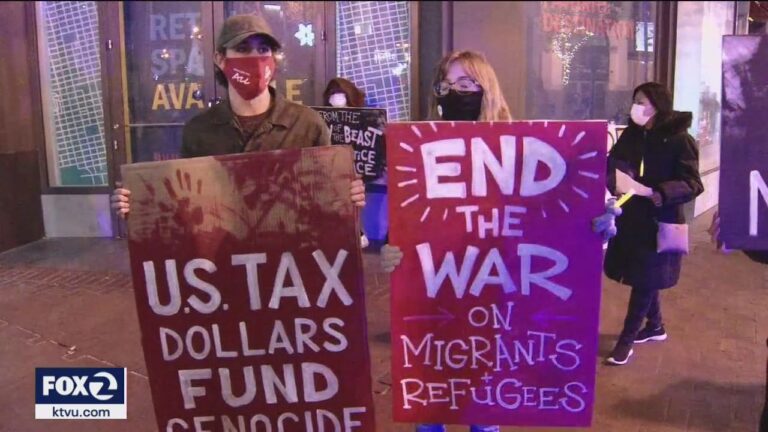
SAN FRANCISCO – More than 100 people rallied, marched and protested in San Francisco Friday night for International Human Rights Day.

Activists are calling on the U.S. government and President Joe Biden to take action against countries that violate human rights. 

Organizers call it the People’s March for Human Rights from the Federal Building on 7th Street to Market Street at Powell by the cable car turnaround.

A coalition of groups said they are speaking out against countries that violate human rights and they’re holding President Biden accountable as he held a summit for democracy.

During the virtual event with other countries, Mr. Biden said in part, “Strengthen our own democracies by pushing back against autocracies, fighting corruption and promoting human rights.”

But activists said the U.S. supports countries that silence their critics by harming and killing them.

SEE ALSO: Biden kicks off summit on democracy, calls on world leaders to ‘lock arms’

“I can no longer walk, but I still have my voice,” said activist Brandon Lee who is now in a wheelchair.

He is with the International Coalition for Human Rights in the Philippines.  

He said he has lost all sensation below his chest.

Two years ago, his family and supporters invited us to cover his medical transport back to San Francisco from the Philippines.

Lee survived what he describes as an assassination attempt by the Philippine military.

He said he was targeted for his work fighting for human rights.

Weaponizing Facebook

0

Editorial, Philippine Daily Inquirer /December 10, 2021

Netizens might describe it as long overdue, but Facebook (FB, now rebranded as Meta) has finally acknowledged its role in enabling “multiple human rights risks” in the Philippines, and has vowed to “stop coordinated campaigns” that manipulate public debate on its apps—especially in the face of the country’s presidential elections next year.

FB’s commitment followed last week’s release of an independent human rights assessment that it commissioned from ethics consulting firm Article One. The firm, which surveyed 2,000 FB users and interviewed 22 Philippine-based stakeholders from March to August this year, found that the tech giant remains the dominant social media platform being used for disinformation and hateful speech to target journalists, human rights defenders, activists, and outspoken citizens.

Aside from being wielded as a tool for threats and intimidation, the social media platform has been flagrantly used for surveillance, terrorist organizing, sexual exploitation, and human and organ trafficking, according to survey results. The survey was commissioned following public pressure on FB to address criticisms that it fans existing social tensions and destabilizes democracies worldwide.

Article One found that spreading political disinformation was the most prevalent misuse of FB in the Philippines, and the hardest to suppress. Analysts and experts point to organized political propaganda through social media as the pioneering strategy that catapulted then Davao City Mayor Rodrigo Duterte to the presidency in 2016. The use of fake news and disinformation to “influence voter perceptions … and attack political opponents” has since created a burgeoning industry of troll farms and clickbait models.

In a presentation last week, Article One cofounder and principal Chloe Poynton noted the incessant social media attacks on journalists and critics of the Duterte administration, which are “organized and deployed to specifically silence any dissent.” Rights defenders are meanwhile “targeted with Red-tagging and terror-tagging … and threatened online across the country,” she added.

Article One’s damning conclusions about FB’s culpability in the toxic culture of social media closely follow the testimony before the US Senate of a former FB employee who accused the company of being “responsible for the rise in authoritarianism in the Philippines” and other countries in its quest for “astronomical profits.” Frances Haugen, who used to work in FB’s civic integrity department, said its algorithm warped information online but that its executives “have not implemented the type of mechanisms nor invested in the human personnel required to conduct content moderation.”

Fake information as political currency was also expounded on in the 2018 study “Architects of Networked Disinformation: Behind the Scenes of Troll Accounts and Fake News Production in the Philippines,” conducted by researchers Jonathan Corpus Ong and Jason Vincent Cabañes. Per a report by PressONE.ph, “the 12-month study [based on] in-depth interviews with 20 ‘disinformation architects’ at both managerial and staff levels and participant observation of Facebook community groups and Twitter accounts” found that advertising and public relations executives served as “chief architects of networked disinformation” in the Philippines. Before this, as PressONE recalled, a 2017 University of Oxford study discovered that “$200,000 or about P10 million was spent to hire trolls who spread propaganda for President Rodrigo Duterte and attack his critics using Facebook and other social media platforms.”

Next year’s national elections, when young voters make up more than 50 percent of the more than 62 million registered voters and can easily shape election results, is set to become another battleground. Unfortunately, a recent Ateneo School of Government study found that college students are struggling to spot fake news amid the well-oiled misinformation campaigns on social media. Supporters of Mr. Duterte—with their mistrust of mainstream media—were “more likely” to fall victims to spurious information, the study noted. Over 7,700 respondents from colleges and universities, most of them 20 to 21 years old, participated in the 10-item quiz of the Ateneo survey conducted from May to June 2021.

The implications of that study make FB’s commitment to prioritize a risk mitigation plan for the 2022 elections a critical initiative. In response to Article One’s recommendations, the company said it would work with local authorities and volunteer groups to monitor social media, and would join advocacy programs that heighten voter education. It also promised to step up efforts to stop coordinated inauthentic behavior and shut down fake accounts. The next months leading to May 2022 should show whether the social media giant has the will to make good on its word.