by E. SAN JUAN, Jr.
Philippines Studies Center, Washington DC, USA
Less augury than symptom, the 2020 Covid-19 pandemic betokens a profound crisis of the neoliberal capitalist global order. Over four million people worldwide have died, 609 thousand in the U.S., 539 in Brazil, and 413 in India (as of July 15, 2021). Variants are multiplying, with no end in sight. People of color, the poor and marginalized everywhere, suffer more than the propertied, as usual. We transitioned from 9/11 “disaster” and “global war on terrorism” to the 2008 meltdown of casino/finance capital without much retribution—except the misery of the impoverished millions. Perhaps the survivors are now regrouping and strategizing their next moves to overturn the predatory iniquitous system.
Crisis is essential to capitalism as a way of what Marx called “the forcible adjustment of all the contradictions of capitalism” (Harvey 2014, xiii). Dispossession as capital accumulation, creative destruction, profitable waste—such as the paradoxes, antinomies, aporias that litter the postmodern landscape. Antagonism between the few plutocratic managers of the security/surveillance state and the redundant majority are bound to sharpen as we face worldwide discontent—witness the mass mobilization after George Floyd’s killing. Aside from the pandemic, drought, fires, floods and all sorts of natural disasters are wreaking havoc on economies and lives in many continents, on top of internecine and multilateral conflicts for control of markets, resources, territories, hopes, dreams, etc.
What we are facing now is however quite unprecedented It is not rebellion from the exploited masses but an ecological catastrophe that capitalist globalization cannot stop, much less prevent from worsening since it has exacerbated the process of disintegration. Commodity-fetishism reigns supreme. Mike Davis has incisively diagnosed our current predicament: “We see a world system of accumulation everywhere breaking down traditional boundaries between animal diseases and humans, increasing the power of drug monopolies, proliferating carcinogenic waste, subsidizing oligarchy and undermining progressive governments committed to public health, destroying traditional communities (both industrial and preindustrial) and turning the oceans into sewers. Market solutions leave in place Dickensian social conditions and perpetuate the global shame of income-limited access to clean water and sanitation.”
Davis sums up the convergent crises of our civilization as “defined by capitalism’s inability to generate incomes for the majority of humanity, to provide jobs and meaningful social roles, end fossil fuel emissions, and translate revolutionary biological advances into public health….The super-capitalism of today has become an absolute fetter on the development of the productive forces necessary for our species survival” (2020).
The implications of this planetary upheaval was recently spelled out by the U.S. National Intelligence Council in its report, “Global Trends 2040.” Not only disruption of international trade would ensue but also an erosion of the world-order, fragmentation, polarization. Distrust and skepticism toward hegemonic institutions would intensify, calling for “alternative providers of governance” (Barnes 2021). Racial, ethnic and national divisions would multiply and deepen. Gobal politics would be more volatile and contentious, as evidenced by the smoldering confrontation between China and the United States. But, unfortunately, the conclusion of this report appeals to the corporate elite, the State executives, to be “anticipatory rather than reactionary,” and solve the crises (Editorial, New York Times, 2021). What about the rebellion of the Green parties and the coalition of indigenous communities defying corporate rapacity?
Rumblings from the “Belly of the Beast”
All accounts of the public response to the pandemic have praised the front-liners, the doctors, nurses and health-care workers in hospitals, for their dedication. The pandemic’s toll on Filipino nurses, however, signals the racialized, unequal burden shared by this group. As of September 2020, 67 Filipino nurses have died of Covid-19, a third of total registered nurses nationwide, though they make up only four percent of nurses overall. Why is this so? Because in the colonized periphery, “an American curriculum as early as 1907 granting degrees to English-speaking nurses who could slot easily into American hospitals” prepared the subalterns for such emergencies (Powell 2021, 30). With the severe staffing shortage in the 1980s due to the AIDs epidemic, recruitment of Filipino nurses for New York and San Francisco hospitals allowed thousands to secure visas. However, since then, this group has earned less than the majority of Americans of the same educational level (Catholic Institute 1987, 44-48), typical of a racialized system of redistribution and social recognition.
About 3.4 million Filipino Americans constitute the second largest group of Asians in the U.S., with over 310,000 undocumented persons (Aquino 2017). Sixty percent of Filipino-Americans are women due to the feminization of exported labor as part of Philippine growth strategy. In 2008, we find 666,00 Filipino-born female workers employed in civilian labor, with 22.9 percent reported working as registered nurses. Throughout over a hundred years of linkage between the neocolony and its imperial tutor, scholars have concluded that Filipinos “endured discrimination, race-based violence, and a series of restrictive federal legislation impacting civil rights and immigration” (Morelli, Trinidad and Alboroto 2020). Nothing to be surprised about, given the pattern of discrimination and exclusion experienced by migrant ethnic labor from Asia and other underdeveloped countries.
Filipino migrant labor contributed to capital accumulation in Hawaii and the West Coast soon after U.S. “pacification” of the islands in the Filipino-American War of 1899-1913. But instead of social recognition, they encountered suspicion. Historians often cite the notorious Watsonville, California 4-day-riots of December 1929 when white vigilantes attacked Filipino farm workers and killed one of them with impunity (Takaki 1989, 327-28). The martyred worker Fermin Tobera was hailed a hero when his body was interred in his homeland.This is only one of many violent incidents that distinguished the militant Filipino presence in the imperial heartland where their leadership of multiethnic union strikes—from the Hawaii sugar plantations to the grape-farms of California in the Sixties—prefigured the multiracial Civil-Rights mobilization of the last quarter of the twentieth-century.
With ironic pathos, the Watsonville riot has been forgotten by Filipinos who now celebrate assimilation as White House chef, Disneyland entertainers, rock stars, etc. With Trump’s canard about “kung-flu” stigmatizing all Asian-looking folks, Filipinos are now targeted as easy scapegoats. Vilma Kari, a 65-year-old Filipina woman, was attacked on a street near Times Square, mid-Manhattan, New York City Three onlookers turned their backs on her (Hong et al, 2021, A15). Earlier, Filipino residents as well as Chinese-American women were attacked in New York City and California as alien-looking migrants, carriers of the deadly virus from Wuhan, China. Asian-Americans and Pacific Islanders have suddenly lost their “model-minority aura” and, with fear and trembling, now call for solidarity over and above class, ethnic or religious differences. They need triage and sanctuary from white-supremacist predation.
Given the nationwide alarm over accelerating hate-crimes, the hashtag “#StopAsianHate” went viral on Twitter. Viet Thanh Nguyen (2021), the award-winning novelist, urged a common political identity for Black Americans, Muslims, Latinos and LGBTQ people to unite together for a decolonizing agenda. Without any warning, the massacre of six women of Asian descent in the Atlanta, Georgia spa, triggered a universal outcry and stirred the White House and Congress to take action. But with the Biden administration focusing on China as the prime enemy that needs to be controlled or contained, how feasible can the task of decolonizing Asian-Americans and Pacific Islanders succeed in halting racialized imperial aggression around the world? In any case, pious teary-eyed wolves guarding sheep are hardly reassuring.
Limahong’s Revenants Roaming the Orient Sea
In the context of the end of neoliberal globalization, I recount in this book the U.S. conquest of the Philippines by bloody subjugation. Over one million dead Filipinos, unfortunately, were not able to enjoy McKinley’s “Benevolent Assimilation.” Regarded as the “first Vietnam,” the colonizing adventure inaugurated the start of U.S. imperial expansion into Asia, specifically China (San Juan 2007, 1-66). It was an earnest step in fulfilling the “civilizing mission” or “White Men’s Burden,” to quote Kipling’s poem written expressly as white-supremacist defense of U.S. aggression in the Philippines. Vladimir Lenin noted that “in annexing the Philippines, the United States cheated Filipino leader Aguinaldo by promising the country independence.” Apropos of Wilson’s 1918 “Fourteen Points” affirming self-determination for all nations, Lenin observed that “most peculiarly, your demands say nothing…about the liberation of the Philippines” (Institute of Oriental Studies 1978, 412-13).
Lenin’s remark, as well as that of Rosa Luxemburg, were only footnotes to Mark Twain’s censure of U.S. butchery of the recalcitrant natives, among them 900 Moro men, women and children at Mount Dajo, on March 9, 1906 (1992, 168-78). The carnage persists with the help of U.S. drones, missiles, logistics, and U.S. Special Forces in the total destruction of Marawi City in May-June 2017.
After World War II, the Philippines served as the convenient springboard for intervention in the Korean and IndoChina War at the height of the Cold War. In 1957, U.S. foreign policy expert Vera Micheles Dean lauded Western colonialism as the midwife of a “plural society” while she lamented the death of the anticommunist, CIA-sponsored Ramon Magsaysay (1957, 180-85). After the IndoChina conflict, another expert William McCord touted Fukuyama’s apocalyptic triumph of market liberalism. At the same time, he bewailed the autocrat Ferdinand Marcos’ wasting of the great potential of the islands, making it “the economic basket case of Pacific Asia,” (1991, 57), while its industrialized neighbors prospered tremendously. The basket case may now be unsalvageable, plunged deeply in more dire circumstances.
The February 1986 “People Power” revolt may be deemed more as cautionary farce than tragicomedy. After Marcos, the Aquino regime returned to the neofeudal, cacique-led democracy bequeathed by U.S. neocolonialism (Bauzon 1991) and retooled by her successors from General Fidel Ramos to the rapacious Arroyo and the murderous Duterte. The once-vaunted “showcase of democracy” for the Free World now serves again to project U.S. power as Washington pivots to the Asia-Pacific region. China is now the new upstart Leviathan to confront and contain, hence the strategic value of the archipelago, in particular the sea lanes next to the contested reefs and isles of the West Philippine Sea. Inaugurated when the Philippines became the “second front” after Afghanistan/Iraq in combating Islamic extremism, this new role for the nation was reaffirmed by then President Trump’s visit to Manila and Clark Field military base in February 2017. Boasting of the U.S. devastation of Japan in World War II, Trump threatened the People’s Republic of North Korea with “fire and fury,” a more savage version of the genocidal campaign against Filipinos in pursuit of “Manifest Destiny.”
Meanwhile, the war against the Abu Sayyaf and other extremists continues as the rationale for the operations of heavily armed U.S. “Special Forces.” The former U.S. military bases in Clark and Subic Bay have been refurbished as counter-insurgency centers against anyone protesting corporate plunder of the neocolony’s human and natural resources. Duterte’s corrupt demagogic rule is supported by U.S. military aid, logistics and advisers in its campaign against drug dealers as well as against terrorists/communists (the terms are interchangeable). This highly publicized campaigns function as pretexts to justify a Plan-Colombia mode of U.S. intervention. This is fully evident in the U.S. participation in the destruction of Marawi City, Mindanao, as well as in the ruthless bombing and massacre of peasants, especially the villages of Lumads, Manobos, and other indigenes located in the rich mineral lands and forests of Mindanao.
Of crucial importance is the controversy over islands in the West Philippine Sea which China claims, building military installations on them. This move is a flagrant rejection of the 2016 judgment of the Hague Permanent Court of Arbitration favoring Philippine jurisdiction over the disputed zone. The fishing grounds around the Scarborough Shoal (Panatag Island), Spratley Islands, and various reefs all lie within the Philippine Exclusive Zone. However, China has ordered its coast guard fleet and armed militia to intimidate and drive away Filipino fishing boats. Duterte has publicly abandoned protecting the territorial integrity of the nation he has sworn to uphold—a stark display of treason that, in other sovereign states, would have summoned the firing squad without much ado. The recent U.S. “pivot to Asia” has converted this region into a powder-keg, a veritable tinderbox, for a shooting match between two nuclear-powered states (already trading belligerent accusations) in which the Philippines may prove to be simply “collateral damage.”
Moralizing Demagoguery & Banal Realpolitik
For over a year now, over a hundred million Filipinos have suffered the ravages of pandemic due to the militarized abuses and criminal negligence of the Duterte regime, with the State apparatus practically managed by police and army officials, retired officers, and their entourage of parasitic minions. The scourge of the planet continues to ravage the neocolony. As of July 2021, 1,181 deaths due to Covid-19 have been reported. Up to now, there are no organized vaccination campaigns, no accessible mass testing, no provision of adequate medical facilities such as public hospitals and clinics. Given the incompetent, avaricious bureaucracy, it is impossible to expect any humane community-oriented and rights-based approach to the pandemic. Unrelieved unemployment, widespread poverty, hunger, hopelessness and misery seem to be the unsavory prospect of millions for the future.
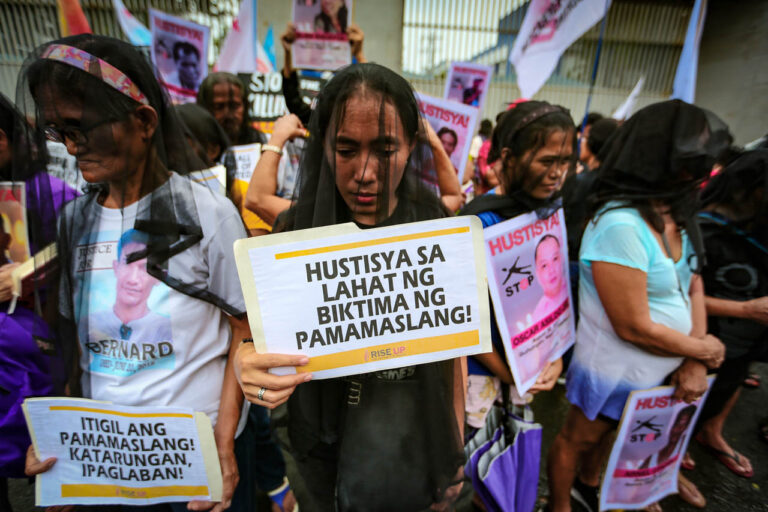
Meanwhile, lame-duck Duterte is gearing to manipulate the 2022 elections to insure his impunity from the International Criminal Court’s ongoing investigation. Duterte’s “crimes against humanity” are horrific. They include mass atrocities, particularly tens of thousands killed during the drug-war crusade and extra-judicial killings of opponents ranging from priests (e.g. Fr. Rustico Luna Tan of Missionaries of the Sacred Heart, Cebu, is the most recent), civil-society activists, human rights defenders, farmers, workers, students, professionals, and lumpen elements. Specifically targeted are the indigenous communities of Tumandoks in Panay, and the Lumads and Manobos in Mindanao, with Lumad families, particularly children in schools being singled out for arrests, torture, prolonged detention, and assassination.
Mass media and internet platforms cannot keep up with the regime’s punitive outrages. The inventory of victims has been diligently kept by Karapatan, the leading human-rights monitor in the Philippines. It has publicized online Duterte’s accomplishments to date: 414 victims of extra-judicial killings, 479 frustrated attempts to kill by State security agents; 1,126 illegal arrests and detentions; forced evictions of 469, 025 peasants, workers, etc.(Karapatan 2021). Currently, there are 713 political prisoners (among the 130 women detained are Senator Leila de Lima, Amanda Echanis, Cora Agovida, Grace Versoza, Reina Mae Nasino, and countless others for which we have no space here to enumerate). While Marcos killed and tortured 3,257 Filipinos, Duterte has surpassed him with a record of at least 30,000 deaths (54 of them children) since 2016 (Robertson, 2020). What’s scandalous is that this routine bloodletting seems to have inured the elected legislators, judges, and bureaucrats to a cursed, malevolent status quo.
Vexed Cynical Perversions
The consensus of pundits may be cited here. Duterte’s “populist authoritarianism” won him the 2016 elections because it addresses, according to Sheila Coronel, “the insecurity of people’s lives and their yearning for effective government” (2017). Unemployment and the seductive, toxic consumerism of a media-saturated milieu heighten this insecurity. The term “populism” is thus misleading since the “people” is a fabrication of commercial polls, social media, etc. It is a free-floating signifier representing anyone not tied to the contested oligarchic hegemony, hence it can be articulated as an antagonistic discourse to challenge whoever is in power (Laclau 1979). Thus Duterte, with appropriate rhetoric and vulgar performance, posed as “the social bandit” who would rescue drug-addicts, the immoral poor, from perversity and perdition. He may be popular but not populist since his game is more theatrical or histrionic than ideological, yielding the illusion of a messianic reality-effect emanating from the propaganda of a local/provincial warlord in search of charisma. In short, it’s all a prestidigitator’s tawdry trick with catastrophic consequences.
Sociologist Wataru Kosaka conducted a survey of impoverished groups and proposed this hypothesis: “Duterte’s extra-judicial violence has been largely accepted as ‘tough love’ because his legitimacy is rooted not in adherence to the law but in the persisting social bandit-like morality that revolves around the compassion and violence of a local patriarchal strongman, who maintains social order outside of the state” (2017, 72). Violence, yes, but compassion?
No doubt the epithet “populist” is an adhoc rubric, not an analytical category. Instead of being a “populist,” in my view, Duterte performs as a master-magician whose technocratic handlers have manipulated the psyche/habitus of poverty-stricken males into a compensatory politics of “we” versus “them,” the “good citizens” versus the criminalized “immoral others” who deserve to be wiped out (Almendral 2017). But this compromised binary is apt to break out in irreconcilable contradiction. Lacking publicly deliberated consensus, this moralizing performance relies on the capricious passivity, fatalism, and temporizing gullibility of its victims. It’s a precarious equilibrium that characterizes a crisis of transition in Philippine politics, from the glamorized Aquino/trapo dynasty back to a parodic Marcos-style clientelism supported by military-police vigilantes/death-squads.
To be sure, Duterte’s power lacks authority in its rejection of traditional jurisprudence and Constitutional imperatives. His tenure, resting on militarized coercion and fortuna (Arendt 1968), cannot last without a foundation in a sovereign, economically stable industrialized republic. Emergencies cannot excuse barbarism. Duterte’s presidency cannot even leave a negative residue (unlike his model Marcos’ martial-law regime) in a feudal-compradorized polity dependent on contingent Chinese investments, and the unrelinquishable hold of Washington-Pentagon via the 1946 Treaty of General Relations, the 2014 Enhanced Defense Cooperation Agreement, and their instrumentalities, the International Monetary Fund and global bank consortiums. Duterte’s gamesmanship with these competing powers is bound to wreck the economy and damage the received social contract.
So far, this putative “social order”—a euphemism for draconian regulations, summary executions, and extra-judicial slayings in police crackdowns—have produced over 30,000 victims. The police operations only officially registered 4,075 deaths, while 16,000 cases are still under investigation (Sarmiento 2018). Impunity or lack of accountability by State agencies explains why the Philippines topped the 2017 Global Impunity Index over 69 countries surveyed, which included numerous Latin American countries (Dalangin-Fernandez 2017). Duterte’s brutal policy in eliminating drug addiction resembles the devastating tragedy in Colombia where the alleged cure—executing suspected drug-addicts in impoverished slums—was “infinitely worse than the disease” (Time Editors, 1-8 May 2017, 74). Meanwhile, new oligarchs linked to drug syndicates with clandestine links to Duterte associates are emerging from old and new compadre networks, as well as from revitalized patrimonial dynasties (Marcos, Arroyo & their ilk) all ready and eager to replace him.
Resurrecting the “Cold War” Syndrome
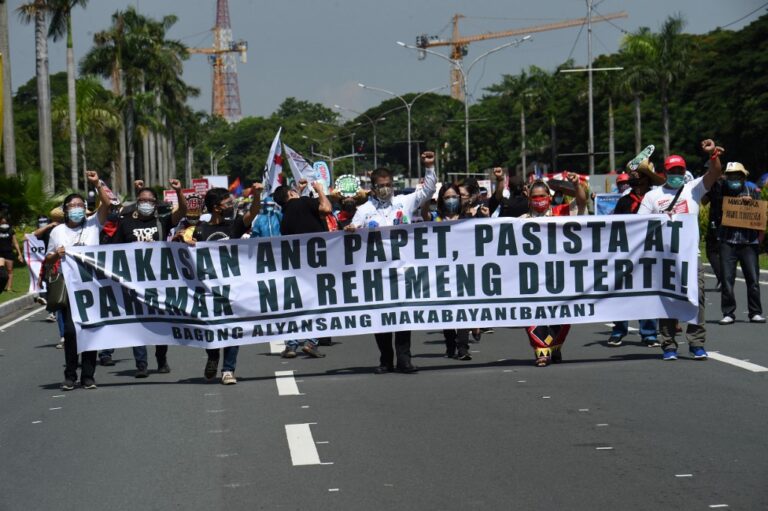
Shock and awe inflicted on millions by a “fatherly” disciplinarian may have worked wonders: slum neighborhoods are supposed to be safe, addicts out of sight; but is anyone accountable or responsible? How is it possible for a “homicidal sociopath,” a foul-mouthed ruffian, to carry out this barbarism in modern-day Philippines? On December 4, 2018, Duterte signed Executive Order 70 (EO70), also known as “the whole-of-nation approach to end the local communist insurgency.” Obviously the targets are the Communist Party of the Philippines and its armed wing, the New People’s Army, and recently the National Democratic Front. Duterte’s Task Force has now implicated their alleged legal fronts: Gabriela, Bayan Muna, Karapatan, Ibon, etc. No one is safe from the dragnet. Reactionary expediency serves to deflect attention from widespread corruption in government to legitimize transnational corporate profiteering and plunder of public funds.
Observes here and abroad have opined that, under cover of the pandemic, the crusade against communism is an attempt to legitimize the carnage of the drug-war and large-scale looting of the public treasury. Reminiscent of Cold War McCarthyism, EO70 has utilized the entire government apparatus for counterinsurgency operations. It is an adjunct to the military’s Oplan Kapayapaan, part of the U.S. “Operation Pacific Eagle: Philippines” which activated U.S. armed participation in the Marawi bloodletting. Various agencies and bureaucratic machineries have been mobilized to redtag critics, dissenters, human-rights defenders, and practically anyone suspected of being critical of Duterte and his regime. EO70 has been reinforced with the Anti-Terror Law which imposes de facto martial law on the whole country, with the pandemic and Marawi City siege lending credibility to the fascist weaponization of law and the judiciary.
EO70 created also the National Task Force to End the Local Communist Armed Conflict (NTF-ELCAC), the country’s prime red-tagger, staffed with military personnel and retired officers With the end of the 2017 peace talks with the “local communists,” the NTF now labels the insurgents and their sympathizers “terrorists.” To implement its spiteful, relentless program to extirpate those terrorists, the NTF was granted a huge budget of P19 billion diverted from the resources needed to address the extreme poverty of millions aggravated by the pandemic and lack of health-care, food, humane shelter, etc. With draconian measures, the State’s coercive agencies, together with the court system, continue to stigmatize and intimidate the poorest sectors of society represented by red-tagged organizations such as the Kilusang Magbubukid ng Pilipinas (KMP, the largest network of peasants struggling for genuine land reform, Anakpawis Party-list, Union ng mga Manggagawa sa Agricultura, KMU (Msy First Labor Federation), and other groups working for the interests of the most oppressed and exploited sectors of society.
With his ascribed “gangster charm,” Duterte has openly endorsed the indiscriminate violence of his police and soldiers, urging them to follow a “shoot-to-kill” policy. He broadcast his command in public: “If a suspect draws out a gun, kill him. If he doesn’t, kill him anyway” (Simangan 2017; Sajor 2020). Over 30,000 suspects, among them juveniles, died, deprived of the citizen’s right to due process, presumption of innocence, fair trial, etc. After junking peace talks with the National Democratic Front (NDF), now labeled a terrorist group in addition to the Communist Party of the Philippines and the New People’s Army, Duterte has begun systematically bombing Lumad villages and terrorizing indigenous tribes occupying mineral-rich regions for allegedly supporting communists. The fascist regime has now concentrated on the assassination of NDF consultants such as Randy Malayao, Randall Echanis, Agaton Topacio, Eugenia Magpantay, Reynaldo Bocala, Julius Giron, among others, and trumped-up charges leveled at environmental activists, human rights defenders such as Karapatan head Cristina Palabay, church workers, indigenous teachers, all accused of being communist fronts, sympathizers, guilty “fellow-travelers.”
Inquiry and Rectification
Diverse international groups such as Amnesty International, Human Rights Watch, UN Human Rights Council, and the U.S. State Department have taken notice of Duterte’s record of killings and wanton defiance of universal norms of justice. Duterte’s regime might claim to honor the right to life, liberty, and security of persons guaranteed by the UN Declaration of Human Rights and other Covenants; but its practice consistently defiles those norms. Duterte’s Anti-Terrorism Bill, for example, nullifies the citizen’s right to due process, fair trial, rights to free speech and assembly, all promulgated in the Philippine Constitution. Under this Bill, anyone can be surveilled, framed-up and arrested without judicial warrant, jailed without charges, based on mere suspicion and planted evidence. The planting of evidence (guns, bombs, etc) has become the modus operandi for police and army. The Bill gives license to abduct, torture and kill suspects. It legalizes Duterte’s full-blown fascist dictatorship without any need for him to formally declare martial law (Anakbayan 2020).
Filipinos have alerted the international community. In her report, UN Special Rapporteur Agnes Callamard has charged Duterte with “widespread and systematic attack directed against a civilian population” (Umil 2921). The UN Office of the High Commissioner for Human Rights reported in June 2020 how the Anti-Terrorism Act and the National Task Force provided institutional mechanisms allowing extensive human rights violations, without domestic remedies to resolve the abuses. The Philippine judicial system has been complicit in repressing any critic or dissenter. Likewise, the Senate has abandoned its duty to inquire into such flagrant atrocities, with one senator even urging the body to grant emergency powers to the autocratic president so as to arrest anyone without a warrant.
Desperation and fragility characterize the despot’s last days. With the Congress and Senate rendered inutile, if not an accomplice of the perpetrator, Duterte has threatened to declare martial law—in imitation of his mentor, Ferdinand Marcos—if the judiciary (Supreme Court) interferes with his war on drug-addicts. Dishevelled impotence and futility distinguish such threats.
Justice may be delayed but not forever denied. Although Duterte withdrew the country from being a signatory party to the Rome Statute for fear of being indicted, the International Criminal Court has not been deterred. It has decided to proceed in its investigation of Duterte’s crimes against humanity, specifically his sponsorship of extrajudicial killings and summary executions while he was mayor of Davao City and as president. On June 14, 2021, Fatou Bensouda, the Court’s outgoing prosecutor, recommended investigation of the regime for “crimes against humanity.” The Court has documented 378 cases of recorded extrajudicial killings and 488 cases of attempted murder. The Court has included within its scope the record of massive human-rights violations in Davao City when Duterte was mayor. His notorious death-squad in Davao City has served as the institutional template for his ruthless war against drug-addicts, farmers, teachers, lawyers, doctors, journalists, trade unionists, indigenous leaders and urban poor organizers in their own homes. This looming indictment has driven Duterte to speculate on vying for the position vice-president in the 2020 elections to insure that he can use the state apparatus to defy and elude the Court’s outreach. Counter-intuitively, doomsday cannot be postponed.
Denouement Without Catharsis
The international group InvestigatePH has called on the UN Human Rights Council to hold the Duterte regime responsible for thousands of extra-judicial killings, abductions, illegal arrests, detentions and other forms of violation of human rights and humanitarian law. It recommends that Duterte be held criminally liable for official orders to kill drug users and civil-society activists, allowing government agencies to utilize public funds and networks to weaponize the law and stifle dissent (Cabana 2021).
Since the U.S. has been actively involved in funding military and police training, as well as providing arms and equipment, various international groups have called on the U.S. Congress to pass the Philippines Human Rights Act (PHRA). This Act will halt military funding, weapon sales and donations of armament, to the police and army until the Philippine government guarantees respect for the human rights of its citizens. It also requires the Philippine judicial system to prosecute members of the police and military responsible for human-rights violations. Since 2014, the US. has given $550 million in military aid or security assistance. More than $33 million of U.S. taxpayers money has been given to the Philippine police for its war on drugs.
In 2018, U.S. aid amounted to $193.5 million. Last July 2020, the U.S. Congress was discussing the terms of $2 billion arms sales including twelve attack helicopters, hundreds of missiles and warheads, guidance and detection systems, machine guns, over eighty-thousand rounds of ammunition, and so on (Chew 2020). All these will be used in Duterte’s campaign to crush the opposition with the pretext of fighting terrorism. Much of the earlier aid has been used in the Marawi City battle where indiscriminate warfare by massive aerial bombing and artillery fire have killed civilians and displaced over 450,000 civilians. U.S. personnel, weapons, intelligence and training were all involved in this breach of international humanitarian law. This war on the BangsaMoro nation has provided cover for land seizures from displaced residents, denying the Moro people’s right to self-determination (InvestigatePH, 2021),
Vigil on the Eve of Judgment Day
Responding to a worldwide campaign, the International Committee of the AFL-CIO has urged the passage of the PHRA to suspend U.S. taxpayer-funded military aid to the Duterte regime “until security officials stop the routine violations of human rights and those responsible for abuses are held accountable” (2020). This move is supported by the Communication Workers of America, International Coalition for Human Rights in the Philippines, Malaya, and others. On the face of this international outcry, the plight of 110 million Filipinos has worsened with the militarized handling of the pandemic, aggravating the misery caused by lack of social provisions for health care and basic necessities of food, shelter, clothing, sanitation, etc. Precarity, fatalism, servility, and arbitrary violence characterize the chaotic milieu of millions of ordinary Filipinos today, including those in the diaspora.
What’s the prospect? The research group IBON warned two years ago of the precarious situation of high inflation, high unemployment, slowing growth, rising interest rates, swelling trade deficits, a falling peso, stagnation of agriculture and industry, and decline of remittances from migrant workers. IBON also noted that sharpened political uncertainty from resurgent, wider protests induced by economic discontent, assertions of human rights, and opposition to corrupt authoritarian governance are bound to destabilize the old order (IBON 2018). These trends will surely intensify and ripen the fundamental contradictions of a neocolonized social formation.
Meanwhile, the plague spreads and the fabled Geist/Spirit of contradiction rides on. What is to be done? Our civic duty/vocation seems clear. My conviction is that in the antagonism between the oligarchic State machine and the counter-hegemonic popular bloc, ultimately the conscienticized “wretched of the earth” will overcome. The future can only be forged by the people’s combative will for radical social transformation. In this wager, we are inspired by Marta Harnecker’s axiom of emancipatory politics as the art of making possible the impossible, “the art of constructing a social and political force capable of changing the balance of forces in favor of the popular movement, so as to make possible in the future that which today appears impossible” (2016). The spirit of negation is bound to release the repressed potentialities lodged in the past and present in the ongoing project of national-popular liberation. This process is ineluctable. Only the organized mobilization of millions of Filipinos can determine whether the maelstrom of resistance can generate the necessary structural changes that will bring about the conditions needed for the majority to enjoy the long-awaited benefits of social justice, participatory democracy, equality, and genuine sovereignty.
REFERENCES
AFl-CIO Executive Council. 2020. “Congress Should Introduce and Pass the Human Rights Act.” Council Statement. Washington DC: June 19.
Amendral, Aurora. 2017. “The General Running Duterte’s Antidrug War.”
The New York Times (June 2): A15.
Arendt, Hannah. 1968. Between Past and Present. New York: The Viking
Press.
Anakbayan. 2020. “‘On the So-called Anti-Terrorism Bill.” Anakbayan
(June 24). <http://anakbayan.org/facebook>
Aquino, Alyssa. 2017. “Undocumented Filipinos Are Living a Special
Nightmare in Trump’s America.” Foreign Policy in Focus.
Washington DC: FPIF.
Bauzon, Kenneth. 1991. “Knowledge and Ideology in Philippine Society.”
Philippine Quarterly of Culture and Society 19: 207-34.
Barnes, Julian. 2021. “Intelligence Report Warns Pandemic is Chipping Away at
the World Order.” The New York Times (9 April): A 11.
Cabana, Ysh. 2021. “Philippines: International pressure to investigate Duterte
crimes against humanity.” MRonline (28 January). <www.mronline.org>
Catholic Institute for International Relations. 1985. The Labour Trade. London:
Catholic Institute.
Coronel, Sheila. 2017. “A Presidency Bathed in Blood.” Democracy Journal (29
June). <http: democracyjournal.org/arguments/a-presidency-bathed-in-
blood/>
Davis, Mike. 2020. “Beware the light at the end of the Covid tunnel.” The Nation
(11 March). <www.thenation.com/podcast/society/mike-davis-covid/>
Danguilan-Fernandez, Lara. 2017. “Worst yet to come.” InterAksyon (22 Sep
tember). <http://interaksyon.org/>
Dean, Vera Micheles. 1957. The Nature of the Non-Western World. New York: New American Library.
Editors, The New York Times. 2021. “Opinion: Why Our Spies Say the Future is Bleak.” The New York Times (April 16): A22.
Harnecker, Marta. 2016. “Ideas for the Struggle.” Old and New Project/Monthly
Review. <www.oldandnewproject.net/Essays/Harnecker.html>
Harvey, David. 2014. Seventeen Contradictions and the End of Capitalism. New York: Oxford University Press.
Hong, Nicole et al. 2021. “Brutal Attack on Filipino Woman Sparks Outrage:
Everybody is on Edge.” The New York Times (30 March): A15.
IBON. 2018. “Philippine Economy Deteriorating.” Ibon Features (29 August).
Institute of Oriental Studies (USSR Academy of Sciences). 1978. Lenin and
National Liberation in the East. Moscow: Progress Publishers.
InvestigatePH. 2021. “Second Report of the Independent International
Commission of Investigation into Human Rights Violations in the Philippines, 6 July 2021.” May 18, 20, 25, and 27 Hearings. New York: Investigateph.
Karapatan. 2021. Karapatan Monitor. January-March 2021.
<www.karapatan.org/resources/reports/>
Kosaka, Wataru. 2017. “Bandit Grabbed the State: Duterte’s Moral
Politics. Philippine Sociological Review 65: 49-75.
Laclau, Ernesto. 1977. Politics and Marxist Ideology in Marxist Theory. London: Verso.
McCord, William. 1991. The Dawn of the Pacific Century. New Brunswick: Transaction Publishers.
Morelli, Paula, Alma Trinidad, and Richard Alboroto. 2020. “Asian Americans: Filipinos.” Encyclopedia of Social Work. New York: Oxford University Press.
Nguyen, Viet Thanh. 2021. “The Flawed Fiction of ‘Asian American.’ “ The New York Times (June 6): A23.
Powell, Luca. 2021. “The Pandemic’s Toll on Filipino Nurses.” The New York Times (17 January): 30.
Sajor, Leanne. 2020. “State Repression in the Philippines During COVID-19 and Beyond.” Open Democracy (7 July).
<http://opendemocracy.net/en/state-repression-philippines/>
San Juan, E. 2007. U.S. Imperialism and Revolution in the Philippines. New York: Palgrave Macmillan.
Simangan, Dahlia. 2017. “Is the Philippine ‘War on Drugs’ an Act of Genocide?” Journal of Genocide Research (October): 1-22.
Takaki, Roland. 1989. Strangers from a Different Shore. Boston: Little Brown & Co.
Time Editors. 2017. “Rodrigo Duterte.” Time (May 1-8): 74.
Twain, Mark. 1992. Mark Twain’s Weapons of Satire. Ed. Jim Zwick. Syracuse: Syracuse University Press.
Robertson, Phil. 2020. “Another Spike in Philippine Drug War Deaths.” Human Rights Watch (28 September). New York: Human Rights Watch.
Umil, Anne Marxe. 2021.”Long Wait for Justice Finally Coming to Light.”
Bulatlat (26 June).
__________
About the Author:
E.SAN JUAN, Jr. is emeritus professor of English, Ethnic Studies and Comparative Literature, University of Connecticut, and was recently visiting professor, University of the Philippines and Polytechnic University of the Philippines. He was previously a fellow of the W.E.B. DuBois Institute, Harvard University; and Fulbright professor of American Studies, Leuven University, Belgium. His recent books are In the Wake of Terror (Lexington), Toward Filipino Self-Determination (SUNY Press); and Carlos Bulosan: Revolutionary Filipino Writers in the U.S. (Peter Lang).



![[EDITORIAL] Sining at pagpupumiglas: Bakit namamayagpag ang ‘Tumindig’ ngayong SONA?](https://pinoyabrod.net/wp-content/uploads/2021/07/animated-duterte-sona-2021-no-year.gif "[EDITORIAL] Sining at pagpupumiglas: Bakit namamayagpag ang ‘Tumindig’ ngayong SONA?")