Home Blog Page 77

Without income, half of Filipino households would survive for only 2 weeks – study

0

Mar 30, 2021, Ralf Rivas

MANILA, Philippines

If the COVID-19 pandemic is prolonged, many households in Southeast Asia may suffer from hunger and increased poverty, says the Asian Development Bank Institute

If they lose their income amid the coronavirus pandemic, around half of Filipino households would have enough resources to cover necessary expenses for only up to two weeks, results of a study by the Asian Development Bank Institute (ADBI) showed.

The household finance crunch in the Philippines is more severe than most countries in Southeast Asia, with the regional average showing that nearly 50% of households can survive with no income under a month.

Only 8.8% of surveyed Filipino households reported that they can survive for over 3 months with no income, while only 14.1% can last for up to 3 months.

Indonesian households reported that 86.6% can only afford less than two weeks.

“This suggests that if the COVID-19 pandemic is prolonged, many households in these countries may suffer from hunger and potentially increased poverty,” the study said.

The ADBI study, released in March, comes as the capital region of Metro Manila and nearby provinces revert to a stricter coronavirus-triggered lockdown, disrupting jobs once more.

The Duterte administration plans to give P1,000 or $20 per person for a one-week lockdown. Health experts have urged the government to extend the lockdown to prevent COVID-19 from spreading further.

In 2020, it took months for cash assistance to be distributed to poor households.

Meanwhile, more than half of households in countries that managed to contain COVID-19, particularly Cambodia, Laos, Malaysia, Myanmar, and Vietnam, did not experience financial difficulties.

Thailand, while successful in containing the virus, had three-quarters of respondents saying that they experienced financial difficulties.

“Although Thailand has not suffered from the pandemic as much as Indonesia and the Philippines, the pandemic may have severely affected tourism, which is a very important sector in that country,” the ADBI said.

Not surprisingly, Indonesia and the Philippines, the countries with the worst COVID-19 infection rates in the region, had the largest shares reporting financial difficulty, at 84% and 85%, respectively.

“Nearly 80% of respondents who suffered from financial difficulty reduced their food consumption. This may have some implications for food security. Other items that people reduced include utilities and non-essential daily expenditures,” the report said.

The Philippines also topped the list with the most households with at least one person losing work amid the pandemic.

Some 70% of Filipino households reported that they had at least one person who lost their job or had to reduce work hours.

The proportion of those in the Philippines who lost their job permanently or temporarily is very high at 22.5% and 28.5%, respectively.

he country’s unemployment rate rose to 8.8% in February, equivalent to some 4.2 million people, the Philippine Statistics Authority said on Tuesday, March 30.

Meanwhile, the underemployment rate stood at 18.2%, equivalent to 7.9 million individuals.

The ADBI survey was conducted over the phone, in 8 countries in Southeast Asia. Around 1,000 calls were made per country. – Rappler.com

No room for elitists and purists in a united opposition in 2022

0

Mar 30, 2021, Mara Cepeda

MANILA, Philippines

The 1Sambayan coalition must remember that their true enemy is the Duterte regime. Not themselves.

To defeat President Rodrigo Duterte’s anointed one in 2022, opposition forces must leave their ivory towers.

That line alone will certainly raise not a few eyebrows among those who identify themselves as part of the dissenting voices against Duterte. But this is the reality that the newly-formed 1Sambayan coalition must grapple with if they are to succeed in their goal of fielding a united slate in the next presidential elections. 

“We have discussed this, again and again, and this is the understanding of everybody: That unless we are united, we cannot win in 2022,” said lead convenor Antonio Carpio, retired Supreme Court associate justice, during their group’s launch on March 18.

The opposition must agree on only one standard-bearer, but this is easier said than done. 

At this early stage, 1Sambayan’s supporters are already bickering online, bringing up old but festering wounds and brandishing the “holier than thou” narrative that political pundits believe led to the opposition’s embarrassing loss in the 2019 midterm elections. 

Questions have been raised if supporters of Vice President Leni Robredo would ever settle for anything less than a presidential candidacy for her. Others refused to consider moderates like Senator Grace Poe and Manila Mayor Isko Moreno even if they are on the list of the 1Sambayan convenors. 

There are doubts if Makabayan would ever be at peace with the once-ruling Liberal Party (LP), after its chairman emeritus Benigno Aquino III was indicted for usurpation of legislative powers due to a petition filed by the progressive bloc. The tension between the Binays and the liberals, mortal enemies in the pre-Duterte era, is still as potent as ever. 

Never mind the President’s own supporters belittling 1Sambayan; there are those within the opposition movement who say the coalition is just another political farce by the same old elites.

But for political science professor Carmel Abao of the Ateneo de Manila University, insisting on ideologies would only lead to 1Sambayan’s downfall. To win, the convenors – and their supporters, most specially – must be tactical, ready to make sacrifices for the sake of the greater good.

“You insist on ideology alone, you’re not really going to unify, so I think people shouldn’t be looking for ideological allies,” Abao told Rappler. “They should be looking for tactical allies. All I’m saying is that, those in that room need more allies. It cannot be just them.”

Before facing the well-oiled machinery of the Duterte administration’s bet in 2022, the 1Sambayan coalition must first overcome the faults of its own people.

Go beyond the anti-Duterte rhetoric

For now, what binds 1Sambayan’s convenors together is their collective rejection of the abuses of the Duterte regime – from extrajudicial killings in the bloody drug war to the President selling out to China.

This is why the coalition was very quick to rule out any endorsement of presidential daughter and Davao City Mayor Sara Duterte as well as Senator Manny Pacquiao, whom they aptly described as the President’s enablers.

Good governance and competence were the buzzwords during 1Sambayan’s launch. The plan is to select the final slate by subjecting potential bets to a vetting process, where they would be screened based on their track record, “upright” stand on key issues, platforms, and winnability.

The danger here, argued governance expert Michael Yusingco from the Ateneo School of Government, is 1Sambayan getting stuck in the anti-Duterte narrative. They could end up failing to articulate the specific programs they can offer to the people – much like what happened to the LP-led Otso Diretso slate in 2019.

“That’s actually one of the problems of Otso Diretso – their grandstanding [overshadowed] their platform… So this is exactly what the 1Sambayan should avoid,” said Yusingco

The Otso Diretso bets focused on attacking Duterte, instead of presenting themselves as the better alternative to the senatorial candidates whom the President was endorsing. They even resorted to a publicity stunt with a jet ski and a boat docked at a pier to showcase their intent to protect the West Philippine Sea from the Chinese military.

There’s much to be disgruntled about with Duterte, the misogynist president whose government could not stop the coronavirus infection of hundreds of thousands of Filipinos. Yet Duterte remains popular among ordinary Filipinos, who remain averse to confrontational politics and prioritize livelihood and survival over everything else. 

So what can 1Sambayan do? Stick to a clear post-pandemic plan, suggested Yusingco, because the Duterte administration has clearly failed to address the COVID-19 crisis. 

Escaping the trap of the anti-Duterte narrative also means hinging the platform not just on competence, but seeking accountability from officials who fail to be competent. 

Otherwise, explained Abao, 1Sambayan could end up perpetuating the culture where those in power – regardless of their political affiliation– insist that they are the only ones who can do things right. 

Case in point: In rejecting Pacquiao, Carpio said in an ANC Headstart interview that the lawmaker being a top absentee back in the House of Representatives is a sign that he is not qualified to run for president. Pacquiao clapped back with a well-crafted message: He appealed to 1Sambayan to give the people a chance to know the “real” him, and that he would treat the criticism as a reminder to do better. 

It’s a page straight from the Duterte handbook of escaping accountability by claiming helplessness in the face of an insurmountable burden. This, even if he was directly responsible for that burden in the first place, having downplayed the coronavirus early on when he could have stemmed its spread.

In Pacquiao’s case, he said he was absent because he had to visit his district, not because he was training for his boxing matches. 

“So that’s what I’m saying: Competence cannot be the main issue here because it’s also very easy for them to claim they are competent,” said Abao. “The debate should not be about, ‘Who’s better between us?’ The issue in 2022 will really be accountability. That’s what people are going to listen to, especially at a time of crisis.”

Aim for the gut, not the brain

It is also quite clear that the 1Sambayan coalition is glued together by the convenors’ deep respect for the triumvirate that is Carpio, former ombudsman Conchita Carpio Morales, and ex-foreign secretary Albert del Rosario.

Other convenors include La Sallian Brother Armin Luistro, retired rear admiral Rommel Jude Ong, lawyer Howie Calleja, former Negros Occidental governor Lito Coscolluela, former Commission on Audit commissioner Heidi Mendoza, Partido Manggagawa chair Renato Magtubo, and Ricky Xavier of the People’s Choice Movement.

But it has to be said: a mother struggling to feed her children in the slums of Tondo will not be able to relate with the legal luminaries in 1Sambayan. Would she care about the Chinese military ships on Philippine territory if she can’t even buy a kilo of rice for her children?

In 2022, the opposition can no longer afford to be elitist and out of touch with reality. 

“The professionals, those in the academe, their discourse is going to be intellectual, but it’s far from the actual concept of democracy. For the people, it’s not just about being cerebral; it’s about their gut issues. And I don’t think a Tony Carpio can articulate it, right?” said Abao.

The coalition has to work harder to involve crucial sectors in its activities, including the urban poor, laborers, women, and the youth – representatives of whom were noticeably missing from the main table during 1Sambayan’s launch.

Labor leader Leody de Guzman of the Bukluran ng Manggagawang Pilipino described 1Sambayan as a “breath of fresh air,” but challenged the coalition to go beyond the rhetorics of good governance. Failure to do so, he said, would only lead to more personality-driven politics.

If the coalition wants to taper off the base of the authoritarian yet popular Duterte regime, then it must espouse the principle of ‘good governance’ by pushing for the direct participation of the masses in politics, and start with practicing this within the coalition itself,” De Guzman said in Filipino via a Facebook post.

That 1Sambayan has made the call for other organizations and potential candidates to join their fold is a welcome step in this direction.

The ultimate sacrifice

The elephant in the room: Will any of 1Sambayan’s initial choices for its president-vice president tandem even stick it out with the coalition?

The convenors are eyeing to endorse Robredo, Poe, Moreno, former opposition senator Antonio “Sonny” Trillanes IV, and Senator Nancy Binay for the two highest positions in the land.

So far, only Trillanes appears to be all in for 1Sambayan, saying that addressing the COVID-19 pandemic and preparing the country for the 2022 polls “are not mutually exclusive advocacies.” 

This is in contrast to the stance of Robredo and Moreno, who both said they are honored to be considered by 1Sambayan but would rather focus on pandemic response for now. 

Binay agrees that only a united opposition can win in 2022, but insists she is not planning to gun for higher office. She pointed out the difficulty of having to work with certain personalities in 1Sambayan whom she believes were responsible for the attacks against her family when she ran for senator in 2013 and 2019, and when her father, former vice president Jejomar Binay, sought the presidency in 2016. 

Poe has remained silent so far, but this is not surprising: 1Sambayan is led by Carpio who once said in 2016 that allowing a foundling like Poe to run for the presidency is a “mockery” of the election process. The High Court later ruled Poe is a natural-born Filipino and can thus run for president, but she still lost to Duterte.

The reluctance of these potential bets to commit to 1Sambayan only proves that it is still a loose coalition that lacks the ability of traditional political parties to enter into quid pro quo arrangements with candidates.

“It’s really going to be a challenge for them because we do not know who will give up what, and who will gain what,” said governance expert Yusingco. 

1Sambayan’s success, however, rests on the willingness of the candidates to be a part of the process through and through. This means that once 1Sambayan chooses its presidential bet, the rejected candidates must actively campaign for the opposition’s standard-bearer – and not just stay silent, or worse, run for president, too.

1Sambayan convenor and former Bayan Muna congressman Colmenares put it best: “Many of us are here because we agree that we all want a united opposition to resoundingly defeat the forces of tyranny that have ruled this country in the last 5 years. For us, that is the main unifying point here.”

History provides precedence here: In the 1985 snap elections, Doy Laurel of the United Nationalist Democratic Organization gave way to LP’s Corazon Aquino so she can become the opposition’s presidential candidate and defeat the late dictator Ferdinand Marcos. 

To once again topple a popular strongman like Duterte, the opposition must be willing to make the ultimate sacrifice – whether that means sharing tables with their rivals or giving up their own dreams of sitting in Malacañang altogether. 

As election day looms, the opposition must never forget that their true enemy is the authoritarian forces under Duterte. Not themselves. – Rappler.com
Albie Casino hits gov’t for ‘worst COVID-19 response in the world’

0

Mar 29, 2021, Rappler.com

MANILA, Philippines

Online users, however, also point out that using slurs and elitism ain’t the way to go when making arguments online

Following the announcement of an “NCR Plus” lockdown, actor Albie Casino took to social media on Saturday, March 27 to express his dismay over the government’s COVID-19 response. 

“My face when they said ECQ season 2. Congrats to everyone who voted nung 2016, sana natutuwa kayo ngayon. Vote wisely sa 2022,” Albie wrote on an Instagram post. (Congrats to everyone who voted in 2016, I hope you’re happy now. Vote wisely in 2022.)

The actor’s statement drew mixed reactions from followers, with some praising him for speaking out and others defending the government. One Instagram user praised him for not being “blind and deaf” on politics. “Thanks at hindi ka bulag at pipi. Buti hindi ka takot ihayag ang saloobin tungkol sa politics, hindi kagaya ng ibang artista takot ma-bash,” the user said.

(Thank you that you’re not blind and deaf. It’s a good thing that you’re not afraid to speak up about your opinion regarding politics, unlike other celebrities who are afraid to get bashed.)

Others were quick to criticize the actor’s sentiment. One comment read: “Control ba ng government officials ‘yung virus? Galing mo din [mag] isip noh. Duh” (Does the government control the virus? Such a big brain. Duh.) 

The actor replied: “Imma hit you with some knowledge so try to understand if you can. They obviously don’t control the virus but they do have control over how they handled the virus (we are literally the [WORST] COVID RESPONSE IN THE WORLD) our neighboring countries should be used as a measuring point look at them and compare to us. Now alam kong bobo ka kasi DDs ka but if you still don’t get it after this wala ka na pag-Asa please don’t breed.” (I know you’re dumb because you’re a DDS but if you still don’t get it after this, you’re a lost case. Please don’t breed). 

Not the way to go

But it was Albie’s choices of words in responding to comments that also drew flak from online users. In replying to those who criticized his original post, Albie used the word “retards” and “mentally challenged” as insults.

“The slur??? The classism and elitism??” Frankie Pangilinan reacted to the actor’s replies, which have since gone viral.

“Not coming for Albie Casiño personally, but can we please not revere him for this and instead let him know just how awful many of these arguments are,” she continued.

In a separate tweet, Frankie stressed that there’s no need to be disrespectful during arguments: “Some of y’all forget the people you’re fighting with are the people you are fighting for. Tapos gagamitin pa ang pera para makaflex?? Insensitive af ang daming nawalan ng trabaho? Ang daming hindi nakakain?” (Then you’re going to use your money to flex? That’s so insensitive. A lot of people lost their jobs and can’t eat.) 

Singer Janina Vela also echoed Frankie’s sentiment. “It’s great to be speaking up for what’s right, but it’s also important to do it the right way,” she said.

Albie is only one of many celebrities who’ve expressed their frustration over the government’s inadequate response to the COVID-19 pandemic. As of March 29, the Philippines has a total of 721, 892 cases.

Metro Manila and nearby provinces were again placed under the strictest version of a lockdown, following a surge in COVID-19 cases. – Rappler.com

Myanmar’s Han Lay stands for democracy at Miss Grand International 2020 finals show

0

Mar 28, 2021, Rappler.com

MANILA, Philippines

The beauty queen takes the pageant stage to shed light on the dangerous fight for democracy in her home country

Amid the glitz and glamor of the Miss Grand International 2020 coronation night, Myanmar candidate Han Lay took the stage to speak about the worsening situation in her country.

Myanmar is currently experiencing a crisis of democracy, after the military took control of the country on February 1, detaining elected leader Aung San Suu Kyi and other members of the National League for Democracy.

Since then, the country’s citizens have taken to the streets to protest the military takeover, with nearly 400 losing their lives since the coup.

On March 27 – the same day as the pageant – 64 people were killed by Myanmar’s security forces, including a young boy.

“It is very hard for me to be able to stand on stage tonight,” Han Lay said, in a solemn moment in between pageant events.

“Today in my country Myanmar, why I am doing a speech on this stage, there are so many people [who have] died,” she said, tearing up. “I deeply feel sorry for all the people who have lost their lives.”

She went on to say that as her people walk the streets for democracy, she stands on the stage to call for democracy as well.

“Please help Myanmar. We need your urgent international help right now,” she said. She also urged people around the world to help find a solution to their problem.

“Let’s create a better world…may the world be at peace with Myanmar.”

She ended her speech by singing part of Michael Jackson’s “Heal the World.”

It is not the first time that the beauty queen has raised awareness on the violence in Myanmar. In previous posts on her social media, she shared a fundraiser for Myanmar’s Civil Disobedience Movement, which leads non-violent protests against military rule.

She also shared a tribute to those who have been killed, and posted information on the arrests of protesters, including some of her fellow students at Yangon University.

Han was among the Top 20 in the pageant, which saw USA’s Abena Appiah take home the crown. – Rappler.com

Labor rights leader shot dead in Laguna

0

Mar 29, 2021, Jodesz Gavilan

MANILA, Philippines

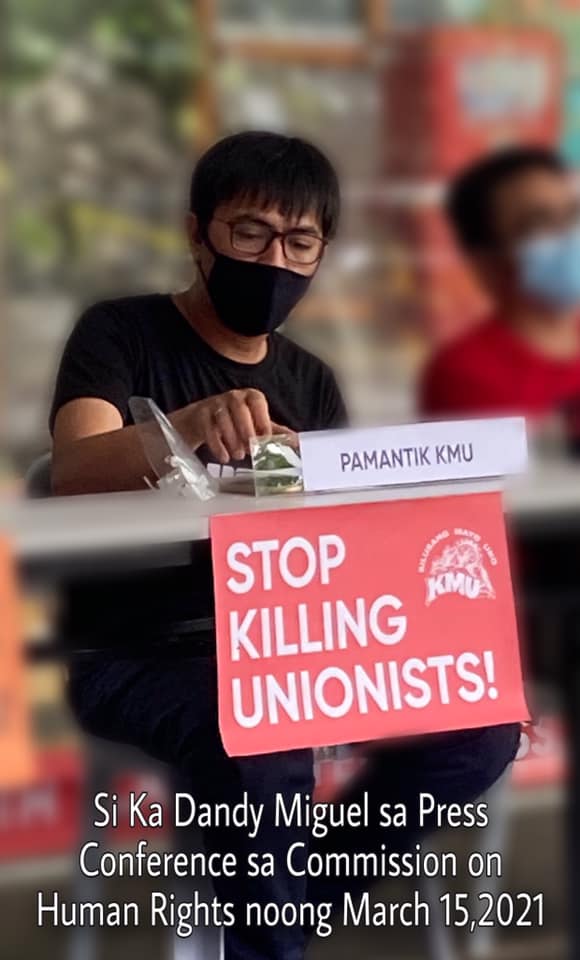
PAMANTIK-KMU vice chairperson Dandy Miguel is killed 3 weeks after the ‘Bloody Sunday’ raids in Calabarzon. He earlier told Rappler that he feared for his safety amid the killings of activists.

A union leader and longtime labor rights activist was killed in the province of Laguna on Sunday, March 28, 3 weeks after the “Bloody Sunday” raids that left 9 activists dead in the Calabarzon region.

Calamba City Police said Dandy Miguel was gunned down by a still unidentified man while riding his motorcycle in Barangay Canlubang around 8:45 pm.

He was dead on the spot, police told Rappler in a phone call.

Miguel, 35, was the vice chairperson of Pagkakaisa ng Manggagawa sa Timog Katagalugan (PAMANTIK-KMU), an almost 4-decade-old labor rights center based in Southern Tagalog.

He was also the president of Lakas ng Nagkakaisang Manggagawa ng Fuji Electric-OLALIA-KMU and a national council member of Kilusang Mayo Uno, according to the group.

Miguel’s killing comes less than a month after the March 7 crackdown by police and soldiers that led to the deaths of 9 activists in Calabarzon, the highest number of fatalities in a single incident in the region, according to the Commission on Human Rights (CHR).

Members of PAMANTIK-KMU have been constantly tagged as communist rebels, Miguel told Rappler in an interview on March 9, after the “Bloody Sunday” crackdown.

He also told Rappler then that he feared for his safety as killings were happening left and right.

Calabarzon covers the provinces of Cavite, Laguna, Batangas, Rizal, and Quezon.

Karapatan Southern Tagalog spokesperson Kyle Salgado told Rappler in an earlier interview that there are reports of labor issues in the various economic and industrial zones in the region.

At least 30 activists have been killed in Southern Tagalog from July 1, 2016, to March 10, 2021, according to Karapatan.

CHR data, meanwhile, showed that 130 activists have been killed under the Duterte administration as of March 7.

“Pamamaslang ba ang regalo kay Duterte sa kanyang kaarawan? Mas marami pa bang mga pamamaslang at pag-aresto ang aasahan sa loob ng pagbabalik ng ECQ?” PAMANTIK-KMU tweeted on Sunday.

(Is murder a gift to Duterte for his birthday? Should we expect more killings and arrests as ECQ returns?)

Sunday was President Rodrigo Duterte’s 76th birthday. It was also the eve of the Greater Manila Area’s return to enhanced community quarantine as Filipinos face a worsening COVID-19 outbreak. – with reports from Jairo Bolledo/Rappler.com

Eastern Samar church marks Lent – and its place in PH art, history

0

By: Tina Arceo-Dumlao – Business Features Editors/ Philippine Daily Inquirer / March 28, 2021

Today, Palm Sunday, the people of Guiuan in the southern tip of Eastern Samar are expected to make their way to their beloved Immaculate Conception Parish Church with an extra spring in their step.

Renewed lockdown restrictions due to surging cases of COVID-19 prevent other Roman Catholics in Metro Manila and its neighboring provinces in Luzon from going to places of worship for the second Palm Sunday in a row. But the people of Guiuan are free as one flock to mark the beginning of the most important week in the Catholic liturgical calendar, albeit with masks and proper physical distancing.

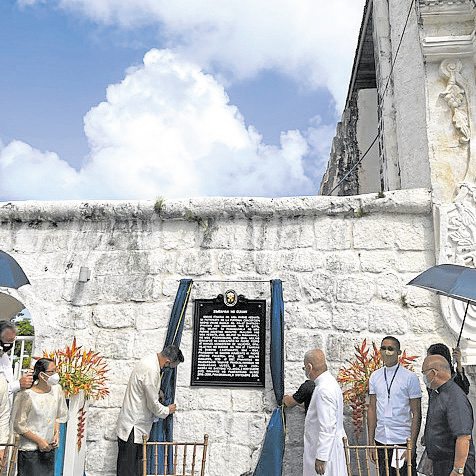
And they will do so in their church that was recently given its own marker by the National Historical Commission of the Philippines (NHCP), in recognition of not just its stature as one of the finest examples of Spanish colonial church architecture but also of its special place in the history of Christianity in the country.

As NHCP Chair Rene Escalante said in a speech at the unveiling of the marker on March 18, the town of Guiuan was “the figurative portal through which the Christian faith arrived in our shores five centuries ago, when the fleet under Ferdinand Magellan’s command anchored on the islands of Suluan and Homonhon after months spent adrift across the Pacific.”

Jubilee church

The ceremony was part of the celebration in the town of the Philippine part in the first circumnavigation of the world and the beginning of relations between Spain and the Philippines with the arrival of the Magellan-Elcano expedition in 1521.

“By our unveiling of a historical marker, the historical significance of the site becomes visible for all to see,” Escalante said. “Every parishioner and pilgrim who pass through the doors of this church shall be afforded the opportunity to learn the history of how this place became the intersection of nations and cultures.” Indeed, the Immaculate Conception Parish Church, or Guiuan Church, expects to welcome more than the usual number of pilgrims and parishioners with its being named one of the special jubilee churches by the Catholic Bishops’ Conference of the Philippines. The recognition is part of the celebration of the 500th year of Christianity in the Philippines, the largest predominantly Roman Catholic nation in Southeast Asia.

The Catholic Church in the Philippines will formally inaugurate the yearlong celebration of the quincentennial of Christianity with the theme “Gifted to Give” on April 4, Easter Sunday, when the “Holy Doors” of pilgrim churches will be opened. The celebration will end on April 22, 2022.

The 18th-century church that dominates the Guiuan landscape is one of 537 pilgrimage churches in 85 dioceses across the country to be granted the privilege of being a jubilee church where Catholic pilgrims can receive plenary indulgence, or the total removal of God’s punishment for sins that had already been forgiven.

Guiuan was one of the first parishes to be formally established on the island of Samar upon the arrival of the first Jesuits led by Fr. Francisco de Otazo in 1595.

National cultural treasure

The church was under the Jesuits for the next century until 1768, when King Charles III of Spain decreed the suppression of the Society of Jesus.

The Augustinians took over and, in 1805, were replaced by the Franciscans, who completed the church in 1844 and stayed until the end of Spanish colonial rule in the Philippines, when Filipino diocesan priests took over.

Guiuan Church is considered one of the best examples of baroque church architecture and the only one decorated by natural shells and corals as well as “azulejos,” or Spanish glazed ceramic tiles.

It was recognized as a national cultural treasure by the National Museum of the Philippines in 2001, for its “outstanding historical, cultural, artistic and scientific value which is highly significant and important to the country and the nation.”

Restoration

In November 2013, Guiuan Church was practically leveled by Supertyphoon “Yolanda” (international name: Haiyan) which made its first landfall in the town packing winds that reached speeds of up to 380 kilometers per hour.

It was painstakingly restored to its former glory in just six years and rededicated in 2019 through the herculean efforts of the National Museum, US Ambassador’s Fund for Cultural Preservation, the Diocese of Borongan, and heritage advocacy partners and private donors in the Philippines and abroad.

But Guiuan Church’s historical marker is not just about “a beautiful building we call a church,” according to the diocese of Borongan.

Said Fr. Edwin Lanuevo, Guiuan’s parish priest: “Rather, this historical marker invites us to see Christianity’s rootedness that can never be ignored and removed at our whims and caprices. The testimony of this marker goes deeper to see how Christianity, symbolized by this Church, had and continues to have an impact on our nation’s consciousness, and, in particular, on the life of our people here in Guiuan both collectively as a community and personally as individuals.

“It is our desire that this historical marker would help us become more aware of humanity’s limitless potential realized in history and humanity’s profound aspiration to go beyond [itself], to transcend the here and now of history. In other words, to meet God, which for us Christians is to encounter Jesus.”


[Opinion] The opposition is rising

0

Mar 24, 2021, Jayeel Cornelio

There’s a growing sentiment that any form of opposition is now welcome.

The reason is clear: The opposition has been effectively decimated.

Five years into Duterte’s presidency, the opposition is either yellow or red. Either way, the opposition — whoever it might comprise — has no credibility in the eyes of this administration and its most ardent supporters.

Last week, highly respected entities came together to form an alternative political force. Its conveners were rather unexpected: Howard Calleja, Antonio Carpio, Conchita Carpio-Morales, Albert del Rosario, Paring Bert Alejo, Brother Armin Luistro, and Neri Colmenares. They and their allies call themselves 1Sambayan.

For Winnie Monsod, it’s a sign that “there’s light at the end of the tunnel.”

Now we are beginning to see the rise of a viable opposition. But will it work?

What doesn’t work?

With only one year left to his presidency, Duterte is sticking to his guns (pun intended). In every speech, he resorts to exactly the same elements, beginning with the problem at hand but deflecting its significance by going off script to turn to his enemies. Depending on his mood, the enemy is either drugs or corruption. 

On other occasions, he makes fun of women. Take your pick: Leni, Leila, or rape victims.

While his unpredictability catapulted him to fame in 2015, there’s nothing unpredictable about Duterte anymore. In fact, he has become banal, the very mark of his leadership.

The trouble with the political opposition, however, is that they repeatedly fall for his crassness. They keep saying they wish to bring back “disente” to politics. During the launch of 1Sambayan last week, del Rosario noted that Filipinos “ought to…restore decency in the public sphere.”

Obviously, this message did not work in 2016, and we have no reason to believe that it will in 2022 in favor of the opposition.

What is ironic is that it was precisely this message of decency that made the public turn to Duterte. Wataru Kusaka’s ethnographic work in communities shows that many Filipinos are in fact trying to be “good citizens” — independent and hardworking. They are, in effect, already trying to lead decent lives. When they turned to Duterte in 2016, it was because they wanted someone to protect them from all the social evils that endangered their disciplined existence.

In this light, the “disente” discourse deployed by the Liberal Party then and being replicated now is not only elitist, it is also out of touch with the realities of ordinary people around the country.

What might work?

I’d like to believe that the opposition does not intend to be elitist. But elitism, as a result of groupthink, is too often unintentional. 

For the emerging opposition, a potent antidote is by going outside their comfort zones into the very communities they wish to transform. This is perhaps what Teddy Casiño means when he asserts that “entering into such a broad coalition requires going beyond one’s comfort zones…in order to work together” and “capture the imagination of the country’s voters.”

And the opportunity is there. When one visits communities around the country, one realizes that the tide has begun turning.

A recent survey by the ASEAN Studies Center shows, for example, that 53.7% of Filipino respondents “disapproved” of the government’s response to COVID-19. 72.2% believed that the government must instead listen to more scientists and medical practitioners.

And yet all our officials did was impose more lockdowns. Moreover, instead of making sure that medical facilities are well equipped and have enough manpower, the Secretary of Health has been posing for the cameras. Harry Roque, a former professor, must be embarrassed to have given the administration an “excellent” mark. 

These people underestimate the Filipino public. 

Rising opposition

It is in this other sense that I would like to suggest that the opposition is rising. Many Filipinos might still trust the President, but we cannot deny too their growing dissatisfaction with how the administration has been handling the pandemic.

Too often, journalists and commentators like myself are preoccupied with political parties and figures. But the success of these entities lies in whether they resonate with the rising tide of frustration among Filipinos. 

In 2022, our people will still be reeling from the impact of the pandemic. Schools have to open, small businesses have to restart, and the jobless will still have to make ends meet. Those who lost their loved ones will still be grieving.

Meanwhile, in the run-up to the next presidential elections, politicians — trapos many of them — are less concerned about their constituents than they are about winning. 

We have a lesson to learn from Durterte. He won with a convincing vision of safety and security. The irony is that at the end of his presidency, Filipinos still desire both. Can the emerging opposition offer something far more compelling?

The answer lies in being right there in the suffering of our people. – Rappler.com

Jayeel Cornelio, PhD is Associate Professor and Director of the Development Studies Program at the Ateneo de Manila University. He is a 2017 Outstanding Young Scientist of the National Academy of Science and Technology. Follow him on Twitter: @jayeel_cornelio.