Home Blog Page 55

A statement? Aspiring VP only showed photo of alleged ‘Oplan Tokhang’ victim in COC filing

0

By Jeline Malasig – October 2, 2021, Interaksyon.philstar.com

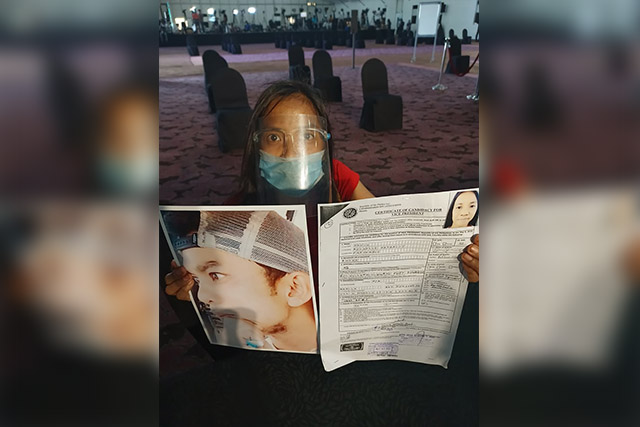
As political aspirants file their respective Certificates of Candidacy for the upcoming elections, an individual gunning for vice presidency earned attention for showing a photo of an alleged “Oplan Tokhang” victim.

Reports said that a lady named Rochelle David has submitted her COC at the Harbor Garden Tent in Sofitel Hotel on Friday and insisted that her name on the ballot appear as “Rochelle ‘Medium ng Puti Dwende.’”

She didn’t speak to the media but she showed a close-up full-page picture of a male relative looking sideways. She alleged that he was a victim of the administration’s “War on Drugs” campaign.

Her photo was also posted on the Commission on Elections’ Twitter account, who identified David as “Rhona.”

David does not belong to any political party.

Online Filipinos thought that her COC filing was a “statement” due to her action in the venue.

“She is making a statement by filing for COC. I would rather vote for her than Sotto, Duterte, or Atienza,” a Twitter user said.

“Idk (I don’t know) but her candidacy looks like a protest and that’s her statement,” another online user commented.

“This looks like a protest candidacy,” a different Filipino wrote in response to David’s filing.

“May her loved ones and all the victims of the gruesome EJK under this admin (administration) get the justice they deserve. What a statement,” a Twitter user likewise commented.

“EJK” is short for extrajudicial killing in which “extrajudicial” is defined as “not forming a valid part of regular legal proceedings” and “not done in contravention of due process of law.”

The “Oplan Tokhang” is part of the Project Double Barrel, an anti-illegal drug campaign of the Philippine National Police launched under the Duterte administration.

It initially “involves the conduct of house visitations to persuade suspected illegal drug personalities to stop their illegal drug activities.”

Under “Oplan Tokhang,” drug suspects are primarily identified through the watch list submitted by the Barangay Anti-Drug Abuse Council to the police. The law enforcers then validate the submitted list with their own.

President Rodrigo Duterte‘s anti-narcotics campaign has since caught the attention of the International Criminal Court due to the allegedly committed crimes against humanity.

During the 76th Session of the United Nations General Assembly last month, he said that those who are found to have “acted beyond bounds” in his anti-narcotics campaign would be held accountable under national laws.

Duterte and his police chiefs said that the killings in the campaign were done in self-defense while his government insists ICC supposedly has no right to meddle in the country’s affairs.

“If there are complaints, it should be filed in the Philippines because our courts are working. The ICC has no jurisdiction,” Duterte’s spokesperson said.

“When we became a party in the (ICC’s) Rome statute, we did not surrender our sovereignty and jurisdiction,” he added.

ALSO READ: THE WAR ON DRUGS: In-depth reports and analyses on the government’s bloody anti-narcotics campaign

Swindling gov’t is ‘cheap talk’?

0

EDITORIAL: Philippine Daily Inquirer / October 01, 2021

Could it be Stockholm Syndrome?

The way the administration has been most protective toward Pharmally and its officials to try to shield them from withering public scrutiny readily calls to mind that emotional response when victims develop positive feelings toward their abusers.

As has emerged in the ongoing Senate investigation, the company may have committed serious irregularities involving billions of public funds in its transactions with the government. But Pharmally appears to command extraordinary heft, because its defenders are led by no less than President Duterte. In his late-night address on Monday, the President suddenly rediscovered the notion of human rights and due process when he yet again took up the cudgels for the company. He described as “worse than martial law” the Senate’s detention of Pharmally executive Linconn Ong, who was cited for contempt for his refusal to cooperate fully with the Senate probe.

The President stressed that “(t)he Constitution really provides that no person should be deprived of life, liberty, or property without due process of law,” which is a complete turnaround from his repeated declarations over the last years of his contempt for such principles: “I don’t care about human rights, believe me” (August 2016), “I say to the human rights [defenders], I don’t give a shit with you” (December 2020), “Ignore human rights” (March 2021). He had also previously given orders for police to “shoot dead” drug suspects and, in the first months of the quarantine last year, anyone “who creates trouble.”

Mr. Duterte’s hectic defense of Pharmally comes at a time when the company is in an even bigger hole with the sworn testimony of Pharmally officer Krizle Grace Mago that she ordered warehouse employees to tamper with the production date of face shields ordered by the health department. Mago said she was merely following instructions from Pharmally management, specifically corporate secretary and treasurer Mohit Dargani.

Asked by Sen. Richard Gordon if Pharmally had in effect “swindled” the government with its deceitful act of changing the expiry dates in face shields to conform with government specifications, Mago answered in the affirmative.

That staggering revelation should have roused the administration to a fury at having been subjected to cheating and mendacity by a supplier, and one that involved a most critical item during the pandemic: medical-grade face shields for health frontliners, whose very lives would be put at risk if they were supplied substandard protective equipment.

The response of the Palace, however, was to belittle Mago’s admission. “Talk is cheap,” said presidential spokesperson Harry Roque. “Physical evidence should be presented before the court… (because testimony) can be bought (or given because of) fear. Let’s look for substantiated evidence, not just the testimony of one person.”

Mago’s testimony was in fact corroborated by two witnesses with firsthand knowledge of the incident. In a video shown by Sen. Risa Hontiveros, a Pharmally warehouse worker was heard naming Mago as having ordered them to repack the “deformed, dirty and wet face shields” and to change their production date from 2020 to 2021.

Roque’s cavalier reaction finds its equal in the breathtakingly mindless remarks by Diwa party list Rep. Michael Aglipay during the House hearing on the same issue. Trying to downplay the gravity of Mago’s testimony, he asked Health officials: “May namatay ba?” According to its Facebook page, Aglipay’s party list aims “to protect workers’ rights and promote workers’ welfare.” Apparently, that does not cover health care workers, at least 103 of whom have succumbed to COVID-19 since the onset of the pandemic. The health department itself has acknowledged that the foam component in the shields could deteriorate over time and render the protective equipment ineffective. And despite Roque’s contention that the shields would have been inspected before being accepted, Jorge Mendoza, a former inspection chief from the Procurement Service of the Department of Budget and Management, had previously testified that they were instructed to sign inspection documents for the medical equipment even before deliveries were made, to facilitate payment to the Chinese firm.

Pharmally having been caught red-handed with sworn testimony against it, the administration’s defense of the favored company now boils down to this proposition: that government-mandated standards of safety for health equipment shouldn’t matter at all in the end. Put another way: The Duterte administration will champion the well-being of Pharmally over that of the country’s citizens. The mental and legal calisthenics required for such a leap—Malacañang forsaking public welfare to act as the virtual lawyer of a compromised private firm—is what qualifies as the cheapest, and most sordid, of cheap talks.

1Sambayan endorses Leni Robredo for president

0

MANILA, Philippines

1Sambayan’s internal presidential survey also shows Vice President Leni Robredo narrowly edging out Manila Mayor Isko Moreno

Sep 30, 2021, Mara Cepeda

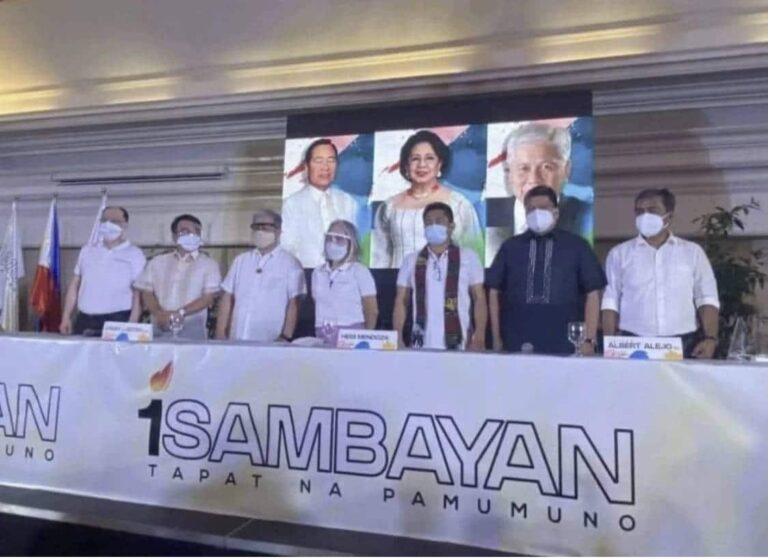
The 1Sambayan coalition, which has taken on the tough mission of forging a united front for all dissenting forces against President Rodrigo Duterte in the 2022 elections, has endorsed Vice President Leni Robredo as its presidential bet. 

The 1Sambayan opposition coalition made the announcement on Thursday, September 30, after a months-long selection process that eventually saw its convenors torn between two potential presidential contenders: Robredo and Manila Mayor Isko Moreno. 

1Sambayan ultimately cast its lot with Robredo, who also believes only a united opposition stands a chance to defeat the Duterte regime in 2022.

The Vice President, however, has yet to formally declare her bid for Malacañang. She is expected to decide on her presidential run soon.

The latest Pulse Asia survey conducted in early September showed the Vice President still lagging behind five other possible presidential contenders. Robredo’s voter preference rating was virtually unchanged, from 6% in June to 8% in September.

The 1Sambayan convenors are hoping Robredo would soon accept their endorsement, especially with the filing of candidacies set to begin on Friday, October 1. 

That Robredo is 1Sambayan’s choice for the 2022 presidential race is not surprising. Out of all potential presidential contenders, it was only the Vice President who went out of her way to reach out to other bets in a bid to a build an umbrella coalition. 

The chair of the once-ruling Liberal Party (LP) was also among the only two politicians out of six nominated by 1Sambayan who agreed to be part of the selection process. The other 1Sambayan nominee was former senator Antonio Trillanes IV.

Convenors wanted to nominate Moreno too, but he asked that his name be taken out of 1Sambayan’s list in June. Moreno, who has already announced his presidential run, continues to be in talks with 1Sambayan.

1Sambayan convenors earlier said the legacy of decent and honest governance left behind by the late former president Benigno “Noynoy” Aquino III will be a factor in choosing their standard-bearer in the 2022 polls. 

Aquino was chairman emeritus of the once-ruling LP, which Robredo now leads.

Robredo also top pick in 1Sambayan survey

Robredo was also the primary choice of 1Sambayan’s members, based on the results of the group’s internal survey obtained by Rappler. The Vice President, however, edged second placer Moreno by a slim margin. 

The Vice President received the highest votes with 44,000, closely followed by the Manila mayor with 40,275, then Trillanes with 38,197. 

1Sambayan had also included the names of senators turned presidential hopefuls Manny Pacquiao and Panfilo Lacson in the survey. Only 9,211 wanted Pacquiao to be 1Sambayan’s presidential candidate, while Lacson received 4,049 votes. 

Though 1Sambayan has formally nominated Robredo, convenor Howard Calleja told Rappler the coalition will continue with their unity talks with other candidates. 

“Despite the announcement, we are pushing and hopeful for a united ticket. All unity talks are still open and her choice is something that we did among the members. But communication lines are still open and unity talks are still possible,” Calleja said. – Rappler.com

UP Visayas won’t ditch ‘subversive’ materials

0

University exec vows to protect academic freedom as another state school in Aklan pulls out NDFP books, pamphlets

By: Nestor P. Burgos Jr. – Reporter/Philippine Daily Inquirer / September 29, 2021

ILOILO CITY, Iloilo, Philippines — The University of the Philippines Visayas (UPV) will not remove from its libraries reading materials and books considered as “subversive” by the government’s anti-insurgency task force, saying “libraries are an extension of academic freedom.”

“Sorry, not a single Marxist book, or any similar or so-called ‘subversive’ material, will be removed from UPV’s library collection. Baka dagdagan ko pa ’yan eh (We might even add more),” UPV chancellor Clement Camposano said in a Facebook post.

A university, according to Camposano, is a “free marketplace of ideas.”

“Our business in a university is to train and sharpen the minds of our students by challenging and exposing them to the widest latitude of ideas to produce intellectuals and reformers…,” Camposano told the Inquirer in a telephone interview on Tuesday.

“When we are afraid of books, then we have a problem,” said Camposano, who holds a doctorate in anthropology and a master’s degree in political science.

The Kalinga State University and the Isabela State University in Luzon earlier this month removed from their libraries books and pamphlets mostly related to the peace negotiations between the government and the National Democratic Front of the Philippines (NDFP), the underground umbrella organization that includes the Communist Party of the Philippines (CPP) and its armed wing, the New People’s Army (NPA).

The books and other reading materials were turned over to police and military officials purportedly to protect the students from the communist insurgency.

Five campuses

On Sept. 24, the Aklan State University (ASU) in Banga town also turned over mostly donated books and pamphlets that it considered “subversive” to the Regional Task Force to End Local Communists Armed Conflict (RTF-Elcac). The books were pulled out from libraries in ASU’s five campuses.

These include primers on the Comprehensive Agreement on Respect for Human Rights and International Humanitarian Law, one of the agreements signed between the NDFP and the government, and the document “The NDFP Declaration and Program of Action for the Rights, Protection, and Welfare of Children.”

Also included were copies of the “Foundation for Resuming the Philippine Revolution” by CPP founding chair, Jose Maria Sison.In a statement, prosecutor Flosemer Chris Gonzales, spokesperson for the RTF-Elcac in Western Visayas, commended ASU “for their commitment to protect their faculty, personnel and students from any and all forms of influence from the CPP-NPA terrorist organization and their pseudo legal fronts.”

Gonzales said the Aklan provincial police, with the support of the RTF-Elcac, “reached out to ASU for them to turn over books that are not mentally healthy for students.”

He added: “Academic freedom is always subject to control and supervision by the state when the welfare of the people or overriding public welfare calls for it. We are at war with terrorism and of course, our university officials exercising sound discretion and good judgment can always decide for the welfare of their students.”

Gonzales stressed that the books’ turnover was the decision of ASU officials in response to communications from the Aklan police and the RTF-Elcac.

Critical thinking

But Raoul Manuel, former UP student regent, said removing these books from library shelves was “no different from what has been done under Hitler’s Nazi regime and anticommunist witchhunts decades ago.”“State forces don’t want the youth to know how to think critically. They want to feed us what to think—this is exactly the brainwashing and indoctrination they have been talking about,” he said in a statement.

Camposano said all books and ideas are welcome in UPV. “If they have better ideas, then they should sell them in the open market of ideas,” he said.

A writer’s truth: The legacy of National Artist Bienvenido Lumbera

0

BIEN

Paano kita tatawagin?

Guro? Patnubay? Uliran?

Kaibigan, kalahati ng danas ko’y nagunaw

Sa iyong pagpanaw.

Rio Alma, 28 Setyembre 2021

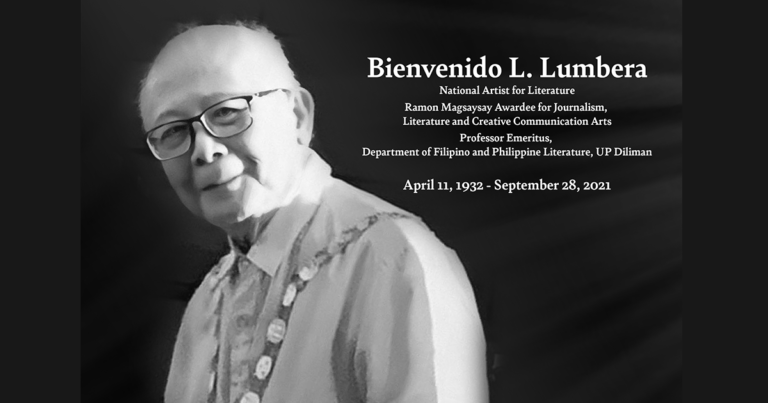
Writer, poet, critic, dramatist, mentor, scholar, political prisoner, activist. Dr. Bienvenido L. Lumbera, National Artist for Literature, was all this and more.


With his passing on September 28, 2021, at the age of 89, Dr. Lumbera—Ka Bien to his friends and colleagues—left behind a distinguished body of works and a legacy of fearless activism, harnessing the power of literature and the arts for the cause of freedom, truth, and nationalism.
 
A writer’s childhood
Dr. Lumbera’s literary work encompasses multiple genres, from poetry to stage plays and librettos. His love for these different genres stems from his childhood. Born in Lipa, Batangas, on April 11, 1932, to Timoteo and Carmen Lumbera.  Young Bienvenido was orphaned at an early age. He and his older sister Leticia were cared for initially by their paternal grandmother, then when the war ended, by his godparents, Enrique and Amanda Lumbera.


Despite the tragedy he had experienced at such a young age, Lumbera recalled having a rich childhood. He played with the neighboring kids, played the action movies he watched and listened to his aunts read aloud from the novella series in Liwayway magazine. His childhood experiences in the historic town of Lipa formed the foundation of his writing career.  One of his renowned musical dramas, Hibik at Himagsik nina Victoria Laktaw, is set in his childhood town.
Lumbera went to Lipa Elementary School and finished high school at Mabini Academy. Initially, he wanted to attend college at the University of the Philippines. However, his guardians, who supported his education, convinced him to enroll at the University of Santo Tomas instead. It was closer to their place of work. In 1957, he earned his B.Litt in Journalism from UST.  In 1967, he obtained his M.A. and Ph.D.  in Comparative Literature from Indiana University.  His groundbreaking dissertation focused on Tagalog poetry from the seventeenth to the nineteenth centuries. While studying in the U.S., he threw himself entirely into education in culture—film, theater, opera, jazz, and everything in between.


After coming home from the U.S., Lumbera taught Literature, Philippine Studies, and Creative Writing at the Ateneo de Manila University. This period saw his activist spirit ignite. He was involved in the Filipinization movement in the 1960s, and served as the chairman of the Panulat Para sa Kaunlaran ng Sambayanan (PAKSA), an organization of activist-writers. His activism was so well-known that when Ferdinand Marcos declared Martial Law in 1972, Lumbera knew he was among those targeted for arrest and was forced underground. He was arrested in January 1974, and released a year later after Cynthia Nograles, his former student at Ateneo de Manila University, appealed for his release. The two were married a few months later.
A nationalist writer in the time of Martial Law and beyond
In an interview with Rappler published on April 12, 2017, Lumbera shared an experience he had following his release from prison during Martial Law. He described how department stores hired people to dress up and pose in shop windows as living mannequins.


“So nandoon naka-display sila. Alam mong buhay ang mga tao na ito, pero hindi sila nakikipag-usap, hindi sila gumagalaw. Ang laki ng epekto noon sa akin. Naiyak ako,” Lumbera revealed. “Ang mga tao na ito ay mga tunay na tao, pero nagpapanggap na hindi tao. Parang ganon ang sitwasyon sa panahon ng Martial Law—na kailangan ng mga tao na magpanggap na iba sila sa tunay na pagkatao nila [So there they are on display. You know they’re alive, but they don’t speak, they don’t move. This had a profound effect on me. I wept. These are real people pretending not to be. This was how it was like during the time of Martial Law—people having to pretend that they are not who they are].”
Photo from UP AVP Jose Wendell Capili.
For Lumbera, this experience and imprisonment only cemented his commitment as a truth-teller and nationalist writer. In 1976, through Professor Petronilo Bn Daroy, Lumbera began teaching at the Department of Filipino and Philippine Literature, UP College of Arts and Sciences (CAS). A year later, UP CAS Dean Francisco Nemenzo appointed him to become editor of the Diliman Review, which was critical of the Marcos dictatorship.


Lumbera began writing librettos for musical theater, starting with the Philippine Educational Theater Association’s (PETA) request to create a musical based on Carlos Bulosan’s America Is in the Heart. Eventually, Lumbera wrote several highly acclaimed musical dramas such as Tales of the Manuvu, Rama: Hari, Nasa Puso ang Amerika, Bayani, and Noli me Tangere: The Musical. He counts his adaptation of Dr. Jose Rizal’s novel, Rama Hari and Hibik at Himagsik nina Viktoria Laktaw, a tribute to Filipino revolutionary women during the revolution of 1896, as his most successful plays. In 2004, De La Salle University-Manila Press published Sa Sariling Bayan: Apat na Dulang May Musika, an anthology of Lumbera’s musical dramas.
Lumbera authored numerous books on literary criticism, textbooks, and anthologies such as Revaluation: Essays on Literature, Cinema, and Popular Culture; Pedagogy; Philippine Literature: A History and Anthology; Rediscovery: Essays in Philippine Life and Culture; Filipinos Writing: Philippine Literature from the Regions; and Paano Magbasa ng Panitikang Filipino: Mga Babasahing Pangkolehiyo. He once admitted he preferred writing poetry rather than short stories because he disliked using a typewriter for more extended periods. Most of his poems are collected in Likhang Dila, Likhang Diwa, published in 1994. These include “Ka Bel”; “The Yaya’s Lullaby,” “Servant,” “Sadness,” “Jamborzkie Light,” and the frequently anthologized “Eulogy of Roaches.”


Bayan at Lipunan: Ang Kritisismo ni Bienvenido Lumbera, edited by UP Professor Emerita Rosario Torres-Yu, was published and launched by the UST Publishing House, and celebrated by UP in January 2006.


Aside from UP, Lumbera also taught Literature, Philippine Studies, and Creative Writing in the Ateneo de Manila University, De La Salle University and his alma mater, the University of Santo Tomas. He also served as Visiting Professor of Philippine Studies at Osaka University from 1985 to 1988. He is also the first Asian Scholar-in-Residence at the University of Hawai’i at Manoa.


He mentored generations of outstanding Filipino writers and scholars, including the highly-acclaimed critic Doreen Gamboa Fernandez, UP Professors Emeriti Teresita Gimenez Maceda, and Nicanor G. Tiongson, Ateneo de Manila University Professor Emerita Soledad S. Reyes, De La Salle University Professor Emeritus Isagani R. Cruz, University of California at Berkeley faculty member Joi Barrios-Le Blanc, University of Hawai’i at Manoa Indo-Pacific Languages and Literatures Department Chair and Center for Philippine Studies Director Pia C. Arboleda and National Artist for Literature and UP Professor Emeritus Virgilio S. Almario. He also taught undergraduate students who became distinguished academics, such as UP Professors Glecy Cruz Atienza, Galileo S. Zafra, and Alwin C Aguirre.


Legacy of a writer, dramatist, and activist
In the end, Lumbera lived true to his belief that writers should immerse with the masses and help to improve society. He remained actively involved in progressive organizations fighting for social justice and true equality, from the Philippine Comparative Literature Association in 1969 to the Pamana ng Panitikan ng Pilipinas in 1970, to the progressive poets’ group Galian sa Arte at Tula (GAT) during Martial Law. Other writers’ organizations he helped lead include the Kalipunan para sa mga Literatura ng Pilipinas, the Philippine Studies Association of the Philippines, and Manunuri ng Pelikulang Pilipino.


Lumbera is also the founding chairperson of the Board of Trustees of the multi-awarded media group Kodao Productions. He was an active member of the Concerned Artists of the Philippines (CAP) and the Bagong Alyansang Makabayan (Bayan). He also served as president of the Alliance of Concerned Teachers (ACT), a national organization of more than 40,000 teachers and employees in the education sector.


He earned numerous awards and accolades throughout the years, including the Ramon Magsaysay Award for Journalism, Literature, and Creative Communication Arts, the Pambansang Gawad Pambansang Alagad ni Balagtas from Unyon ng mga Manunulat ng Pilipinas (UMPIL), the National Book Awards for Literary History/Literary Criticism from the Manila Critics’ Circle, the Carlos Palanca Memorial Award for Literature, the Philippine Centennial Literary Prize for Drama, and the Cultural Center of the Philippines Centennial Honors for the Arts. He became Professor Emeritus of the University of the Philippines and, in 2006, was named National Artist for Literature.


Dr. Lumbera’s legacy lies not just in his immense body of works and in the generations of writers and artists he taught. Most importantly, he is noted for his abiding commitment to nationalist writing and to his belief that a writer must, above all, write the truth of their experiences. (https://up.edu.ph/a-writers-truth-the-legacy-of-national-artist-bienvenido-lumbera/) | Written by Celeste Ann Castillo Llaneta

2022 gov’t spending plan: Less for COVID, more for NTF-Elcac

0

By: Cristina Eloisa Baclig – Content Researcher Writer /INQUIRER.net / September 29, 2021

MANILA, Philippines—A 73 percent cut in funding for COVID response. An 11 billion-peso increase in the budget for a counterinsurgency task force created by President Rodrigo Duterte.

A close look at the numbers in the 5-trillion peso proposed national budget in 2022 would show where the Duterte administration, outgoing in several months, is headed in terms of spending preference in its last expenditure proposal to Congress.

As both chambers of Congress—Senate and House of Representatives—now deliberate on the proposed budget, it would be interesting to take a closer look at the numbers.

INQUIRER.net tries to break down the proposed P5.024 trillion national budget for 2022 based on documents from the Department of Budget and Management (DBM).

Weighing in

According to DBM data, the proposed P5.024 trillion national budget for 2022 increased by 11.5 percent or is P518 billion higher than the adjusted 2021 budget amounting to P4.506 trillion.

Proposed spending on various programs for 2022 is 16.58 percent higher than P4.309 trillion in 2020.

Of five basic sectors—social services, economic services, general public services, debt burden, and defense—social services has the largest slice in the 2022 budget pie.

Proposed allocations per sector in 2022 were:

  • Social services: P1.9 trillion
  • Economic services: P1.47 trillion
  • General public services: P862.7 billion
  • Debt burden: P541.2 billion
  • Defense: P224.4 billion

Social services will have a 15.2 percent, or P253.8 billion, increase from its 2021 allocation of P1.6 trillion. The sector carries 38.3 percent of the 2022 proposed budget.

Economic services will have an 11.4 percent increase, or P150.4 billion, more than the P1.3 trillion budget allocated in 2021.

While the social services sector gets the highest allocation share, the biggest increase will be in the general public services sector.

In 2021, general public services was given P747.8 billion. For 2022, it is set to have P862.7 billion, a 15.4 percent jump or P114.9 billion more.

The allocation for the defense sector also grew by 8.5 percent from P206.8 billion in 2021 to P224.4 billion in 2022.

The budget share for the country’s debt burden will see a decrease under the proposed 2022 budget. The sector will have a 3.4 percent budget cut from P560.3 billion in 2021 to P541.2 billion in 2022.

In the proposed 2022 National Expenditure Program (NEP) report, the DBM said the allocations “reflect the administration’s thrust to address the impact of the COVID-19 pandemic and resume the path towards inclusive economic growth.”

Lion’s share

The proposed P5.024 trillion 2022 expenditure program will be divided among various government departments.

From the proposed P5.024 trillion expenditure program, at least P2.8 trillion would be allocated to departments. It is equivalent to a 5.76 percent increase from the P2.7 trillion allotted for departments this year.

According to documents from the DBM, the top 10 highest recipients of the proposed 2022 budget will get around P2.6 trillion, or 93.4 percent, of the total allocation for departments.

The education sector will again have the highest allocation with P773.6 billion—15.4 percent of the total 2022 budget—higher than P751.7 billion under the 2021 program.

The Department of Education (DepEd) will get a P630.8 billion budget for 2022. The DBM said this will cover “basic education, development, reproduction and delivery of learning resources for basic education-learning continuity plan, computerization program, among others.”

For tertiary education, around P75.4 billion will be given to state universities and colleges (SUCs), P52.6 billion for the Commission on Higher Education (CHED), and P14.7 billion for Technical Education and Skills Development Authority (TESDA).

The DBM said the appropriation will support the implementation of the law on universal access to quality tertiary education and other programs like financial assistance for students in SUCs and private educational institutions.

The second highest allocation, P686.1 billion, is going to the Department of Public Works and Highways (DPWH).

In 2020, DPWH also ranked second among the top 10 departments in terms of budget allocation. But the DPWH allocation in 2022 would be 1.4 percent—P9.6 billion—lower than the P695.7 billion that was given to the department in 2021.

The budget slash, according to the DBM, was caused by the devolution of some programs to local government units (LGUs) with the implementation of the Mandanas ruling of the Supreme Court which increased the share of LGUs in national revenue.

READ: Gov’t to transfer some functions to LGUs

The DPWH is followed by the Department of Interior and Local Government (DILG) with P250.4 billion.

But the 2022 budget allocated for DPWH—which implements  Duterte’s Build, Build, Build program—and DILG were much higher than that for the Department of Health (DOH).

The DOH, which included PhilHealth, will get P242 billion in the 2022 spending program. The budget for DOH included funding for the country’s COVID-19 response for 2022.

Also among the top 10 departments and branch of government with the highest allocation were:

  • Department of National Defense (DND) with P222 billion
  • Department of Social Welfare and Development (DSWD) with P191.4 billion
  • Department of Transportation (DOTr) with P151.3 billion
  • Department of Agriculture (DA) with P72 billion
  • The judiciary with P45 billion
  • The Department of Labor and Employment with P44.9 billion

Among the 10 departments, DOTr will have the highest increase–72.1 percent or P63.4 billion—in allocation for 2022. It had a budget of P87.9 billion in 2021.

But removed from the 2022 spending plan was the allocation for the DOTr’s “Libreng Sakay” program which offered free rides to workers and those on the frontline of the battle against COVID at the height of the still ongoing pandemic.

The P10 billion proposed budget by the DOTr to fund Service Contracting Program (SCP) and free-ride service was scrapped by the DBM.

READ: Transport sector aid scrapped in 2022 budget

At least P190.6 billion will be allocated to other departments that are not on the top 10 list.

Among the notable agencies outside the top 10 is the Commission on Elections (Comelec) with a proposed budget of P26 billion for 2022—80.41 percent higher than its 2021 budget of P14.8 billion.

But according to the Comelec, the DBM slashed 37 percent from its original P41.9-billion proposed budget. The agency said the budget cut will have an impact on preparations for the 2022 national and local elections.

“A lot of things in our budget will be affected. One of them is our COVID-19 preparation,” Comelec spokesperson James Jimenez said.

“The other big thing that will be affected is the request of our teachers,” he said. The DepEd, according to Jimenez, is asking for an increase in honoraria and other benefits of teachers who would be tapped for election duty.

READ: Comelec’s election year budget slashed by 37%

Priorities and budget cuts

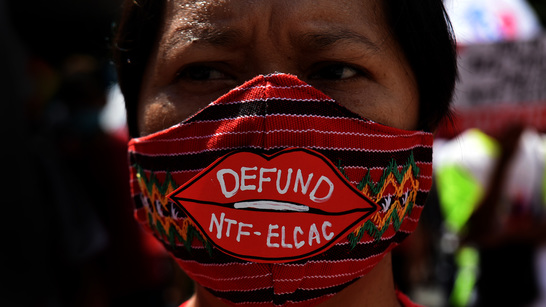
The National Task Force to End Local Communist Armed Conflict (NTF-Elcac) is among the government agencies which will get a huge increase in its budget allocation for 2022.

Under the 2022 expenditure program, NTF-Elcac—the government’s counterinsurgency task force — will get a P29.2 billion budget, which is P11 billion higher than its 2021 budget.

Budget Undersecretary Tina Rose Marie Canda, acting DBM chief, said the budget hike for the task force was due to an increase in the number of barangays that NTF-Elcac listed as beneficiaries of grants being given for development projects in villages already cleared of communist rebels.

“The rationale for the increase is that this year, 822 barangays were cleared,” said Canda. “That is the equivalent amount for the 2021 level and for 2022 the number of barangays cleared increased to 1,406,” she said.

Allocation for every cleared barangay is P20 million, Canda said.

The 75 percent increase in the NTF-Elcac budget, however, was questioned by many legislators amid cuts made by the DBM in other allocations considered as more important, particularly that for COVID response.

As the country continues to grapple with the impact of continuing infections by SARS Cov2, the virus that causes COVID-19, the DOH is getting only P19.68 billion for pandemic-related spending in 2022.

The DBM slashed at least 73 percent of the proposed P73.99 billion COVID response budget by DOH.

At a budget hearing in the House committee on appropriation in early September, Health Secretary Francisco Duque III said the supposed P73.99 billion would cover hazard duty pay, special risk allowance, meals, accommodation and transportation, and life insurance for health care workers, which would require at least P50.41 billion.

According to Duque’s spending list, these amounts were part of the proposed COVID spending by the DOH:

  • P9.9 billion support for DOH hospitals
  • P6.6 billion for hiring of vaccinators
  • P1.2 billion for hiring of disease surveillance officers
  • P4.4 billion for oxygen supply
  • P1.5 billion for other pandemic expenses

READ: Duque: DBM only approved P19.68B out of P73.99B DOH-proposed budget for 2022 COVID response

The proposed budget for the University of the Philippines (UP) also faces a P1.3 billion budget cut for 2022. The state university’s budget includes funding for the UP Philippine General Hospital—a major COVID referral center—and the Philippine Genome Center, the lead in bio-surveillance for genome sequencing of SARS Cov2 variants.

READ: NTF-Elcac budget up 75%; funds for PGH cut

The Research Institute for Tropical Medicine (RITM), the country’s primary coronavirus testing center, also suffered a budget cut after the DBM approved only P223 million for it in 2022. In 2021,  the RITM received an allocation of P393 million.

Unlike NTF-Elcac, other departments also faced a huge decrease in their 2022 proposed budget compared to their 2021 allocations.

The Commission on Human Rights (CHR) saw a 6.25 percent budget cut from P904,635 in 2021 to P904,635 in 2022.

The Office of the Ombudsman was given P3.9 billion for 2022, or a 14.16 percent cut in its P4.6 billion budget for 2021.

READ: House solons want Ombudsman’s budget for 2022 restored

The Department of Science and Technology (DOST) proposed a P42-billion budget for 2022 but the DBM gave it only P24 billion, or nearly half.

Science and Technology Secretary Fortunato Dela Peña attributed the decrease in the proposed budget to a reduction in the DOST’s capital outlay spending. He said the department budget focuses on six areas:

  • Accelerating generation of technologies and innovations to against COVID-19
  • Support transition of micro, small, and medium enterprises to the new normal through upgrading technology
  • Promoting regional technology-based development
  • Nurturing startups and technology-based enterprises
  • Strengthen business and service continuity
  • Leverage alliances with academe and other partners

Under DOST, the budget proposed by the Philippine Atmospheric Geophysical and Astronomical Services Administration (Pagasa) dropped from P1.8 billion in 2021 to P1.3 billion in 2022.

According to Dela Peña, the budget cut will affect the state weather agency’s modernization program.

READ: P1.6-B budget cut to affect Pagasa’s modernization efforts — DOST

The Philippine Institute of Volcanology and Seismology (Phivolcs) got more funding for 2022 with P544.5 million compared to its P529.2 million budget this year.

The Department of Information and Communications Technology (DICT) will also get a lower budget of P10 billion for 2022 from P12 billion in 2021.

The Office of the Vice President (OVP) was also not spared from budget cuts.

During budget deliberations, Vice President Leni Robredo said her office initially proposed P714.56 million for i2022. The DBM, however, approved only P713.41 million—21.50 percent less than the OVP’s P908.79 million budget this year.

Unprepared for COVID

Amid the continued increase of COVID cases, lawmakers believe that the P19.68 billion allocated for pandemic response in 2022 is a mirror of the lack of preparation by the Duterte administration against the disease.

The pandemic response budget cut will have a negative impact on health workers’ benefits, according to Duque. The cut was made even as health workers suffer from burnout, are overwhelmed by the pandemic, are underpaid, and are driven to resignation.

Robredo said that there seemed to be “a lot of disconnect” in the government’s declaration of pandemic response as a priority and what is in the 2022 national budget.

She said the proposed 2022 national budget does not appear like it was meant for COVID response.

READ: Robredo: 2022 nat’l budget doesn’t look like it was made for COVID response

Sen. Nancy Binay echoed the same sentiments as she noted the lack of funding for contact tracing, health workers, and financial aid for individuals who lost jobs during lockdowns.

“The 2022 budget is not ready for a war with COVID. There is so much that is lacking,” Binay said at the Kapihan sa Manila Bay forum last Sept. 15.

“COVID-19 is here to stay and is not going away anytime soon. They should have had this in mind when they were crafting the budget,” she added.

Despite getting a bigger share in the budget pie, Local Government Secretary Eduardo Año admitted at a House hearing that the department does not have funds for contact tracers.

READ: 2022 budget not ready for war vs COVID – Garin, Binay

TSB

RELATED STORY:

As NTF-Elcac budget grows, lawmakers start to frown

Int’l community urged to help stop Intensified human rights crisis and widespread violence in PH

0

By Lea Luciano
The Philippine Reporter, September 24, 2021

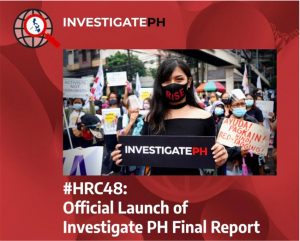
INVESTIGATE PH released its third and final report on Monday, September 13, that examines the intensified human rights crisis and widespread violence in the Philippines under the Duterte administration.

The launch of the third report coincided with the 48th Regular Session of the UN Human Rights Council (UN HRC), and it focuses on violations of economic, social and cultural rights, the right to development, self-determination and peace, and the harsh impact of the COVID-19 pandemic.

“We urge the international community to increase the pressure on the Philippine government to correct the serious abuses we and others have been exposing,” Patricia Lisson said.
Lisson is a member of the Investigate PH Core Working Group and the chairperson of ICHRP Canada.

The first report demonstrated the intensifying political repression and raised alarm at the lack of domestic remedies to address abuses, and the second report spotlighted State terror in the Philippines: a War on Poor People in the guise of anti-drug operations, a War on Dissent, and a War on the Moro People.

“It showed how the Duterte government was breaching international humanitarian law by failing to discriminate between civilians and combatants in the conduct of military operations,” Lisson said.

“The Supreme court of the Philippines took some action to reign in abuses of judicial processes uncovered in our initial report. We are encouraged by these developments and we know they have given many Filipinos hope that they may see justice.”

Four panellists were present during the North America launch. Reverend Doctor Susan Henry-Crowe, General Secretary of the General Board of Church, spoke about the rights of children, the right to education and freedom of religion which have all been attacked by the Duterte government.

“Duterte’s budget boosts spending on the security forces and cuts spending on welfare, housing, education and health,” Henry-Crowe said. “This really hurt the people and especially during the pandemic.”

In 2020, the passing of Duterte’s Anti-Terror Law and the National Task Force to End Local Communism Armed Conflicts (NTF-ELCAC) issued attacks on church people, indigenous communities, teachers, students and children.

“As this issue relates to children and youth, we have seen stories of over 122 children that have been killed in the war on drugs in 2019. It will be even higher now.”

The killing of 17-year old Kian Delos Santos resulted in lowering the age of minimal criminal responsibility from fifteen to twelve where children are being arrested and detained with adult prisoners.
Henry-Crowe added “Children have become victims of militarized pandemic lockdowns. Children have become victims of the state’s counterinsurgency operations.”

Attorney Jeanne Mirer of the International Association of Democratic Lawyers talked about the violations of economical, social and cultural rights.

“The commission found in the report that the Duterte government’s neoliberal economic policies violate the rights contained in the economic rights including the right to a job and livelihoods of peasants, workers, migrant workers, and women,” Mirer said.

The resources are misallocated and put into militarization rather than public health response to the COVID-19 pandemic. The Philippines has the lowest relief package during the pandemic in all of Asia.

Under Duterte’s regime, the social services budget was cut in favour of increased spending on armed security forces intensifying state terror, extra-judicial killings and mass arrests.

Duterte has violated the rule of non-regression by cutting social service spending in favour of increased spending on armed security forces intensifying state terror, extra-judicial killings and mass arrests,” Mirer said.
Reverend Derek Duncan of the Global Ministries of the Christian Church reported that the United States military aid that supports Duterte’s counterinsurgency operations in Mindanao since 2017.

“Despite several severe economic hardships during the pandemic, Duterte has cut social services while increasing the spending on armed security forces,” Duncan said.

The Anti-Terror Law of 2020 has become Duterte’s main instrument to implement his counterinsurgency program to vilify activists and their organizations and to criminalize dissent.

Attorney Suzanne Adely of the National Lawyers Guild highlighted a few recommendations by INVESTIGATE PH and its commissioners to the government of the Philippines and the international community.

“The report brings attention to the widespread and outrageous violations of international human rights mechanism and humanitarian law and then speaks to what are the obligations of the International Community and the obligations of states to act to ensure that violence is stopped,” Adely said.

Normal browsing, what? PH Army intended to disrupt news sites, curtail free press, IT experts say

0

By JANESS ANN J. ELLAO
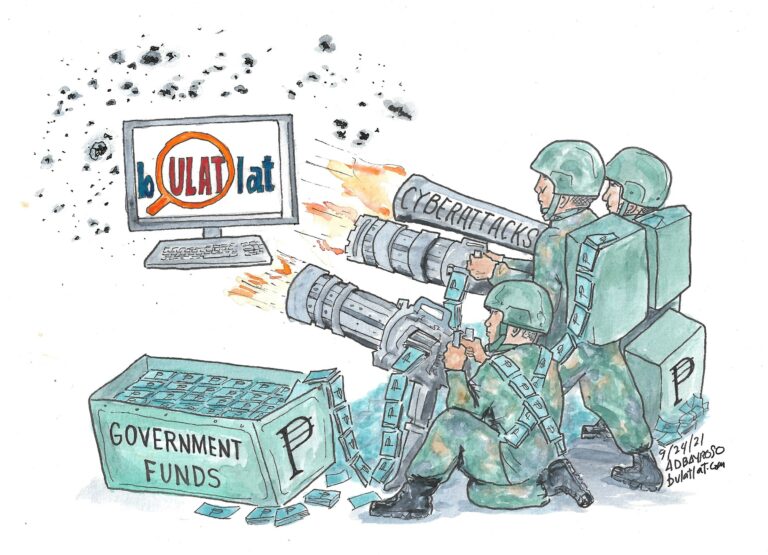
Illustration by Dee Ayroso
Bulatlat.com

MANILA – A group of Filipino IT experts belied military claims that they were merely browsing through the websites of independent media outlets.

In a statement, the Computer Professionals’ Union (CPU) said that what Armed Forces of the Philippines Spokesman Ramon Zagala described as “mere surfing” is more “like a targeted attempt to significantly disrupt a crucial platform and curtail freedom of the press.”

On Friday, alternative news Bulatlat and AlterMidya – People’s Media Network said that the government’s own initial findings, through its Computer Emergency Response Team (CERT-PH), confirmed earlier digital forensic investigations that traced cyberattacks to the Philippine Army.

Earlier, Sweden-based Qurium Media Foundation’s investigation showed that an IP address publicly registered to the Department of Science and Technology conducted a vulnerability scan on Bulatlat after one of the DDoS attacks. The IP was traced to the Philippine Army, and DOST, as per the CERT-PH August 11, 2021 report, confirmed that the said IP was assigned to the Philippine Army.

The military has since denied their involvement, saying that they respect freedom of expression. However, CERT-PH’s attempts at investigating the cyber-attacks did not prosper as they were not able to establish “coordination with the organization currently using the said IP,” referring to the Philippine Army.

This has resulted in the classification of the CERT-PH findings as “TLP: Amber,” which meant that information is restricted to involved parties. However, both Bulatlat and AlterMidya, in their earlier statement, found it necessary to publish the findings as these are of public interest.

CPU stood by the attacked news sites.

“Attacks on alternative news outlets is an attack on the press and we call on everyone to resist all attempts to snatch from us the freedoms we have fought for,” the group said.

Under the Duterte administration, cyberattacks have been repeated launched against alternative news outfits, which have also been subjects of red-tagging and harassment.

Read: What you need to know about the ongoing cyber-attacks vs. alternative news Bulatlat

In a statement, the National Union of Journalists of the Philippines (NUJP) said it is concerning that the Philippine Army did not respond to the government’s own investigation when it denied involvement in the cyber-attacks.

“Government agencies have always emphasized bringing complaints to the proper forums and through the proper procedures,” said the NUJP, “it is doubly frustrating, then, that attempts at accountability through the processes they prescribed get only a denial, or, worse, silence.”

Information crucial to people’s sovereign will

In a separate statement, the Freedom for Media Freedom for All also criticized the cyber-attacks against the websites of the two news outfits, saying that they are joining their voices “in the collective resistance of these violations of Constitutionally-protected rights.”

The media coalition also urged the Philippine Army to demonstrate their respect for a free press both in words and in deeds.

“Information has always been crucial to the exercise of the people’s sovereign will that is the core of a democracy. A free press must provide a diversity of views so that society can engage in the decision-making process, debate, and argumentation that is crucial to good governance,” said the media coalition.

Members of the coalition are the NUJP, the Center for Media Freedom and Responsibility, Philippine Center for Investigative Journalism, MindaNews, and the Philippine Press Institute.

The group added, “since the military by its function is not a repository of democratic values, we call on our soldiers to cease forthwith this insidious campaign to silence media and its members, to limit citizen access to views and perspectives that may differ from those held by the government in power.”