Home Blog Page 66

Trillanes accuses Bong Go of plunder over P6.6-B road projects awarded to family

0

Jul 5, 2021, Pia Ranada, Rappler.com

MANILA, Philippines

The former senator promises to file a complaint of plunder against Go and President Rodrigo Duterte after the Duterte presidency

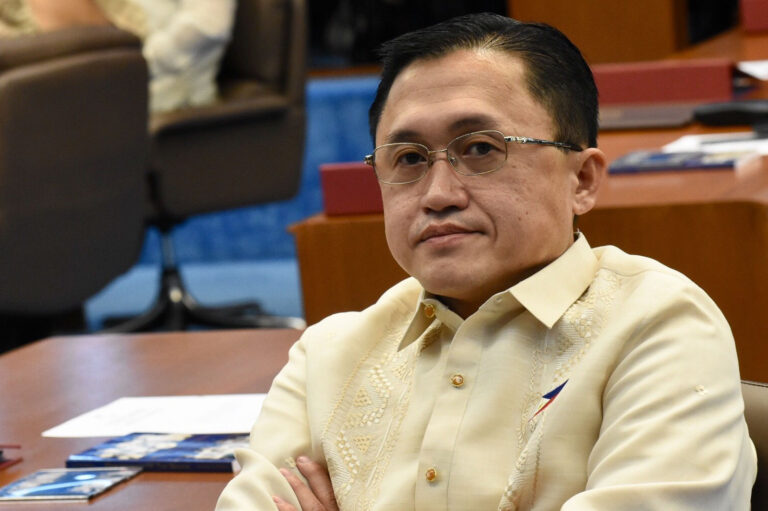
ormer senator Antonio Trillanes IV accused Senator Bong Go of plunder over P6.6-billion worth of road widening and concreting projects awarded to companies owned or managed by his father and half-brother.

Trillanes, in a video posted on social media, presented what he said were Department of Trade and Industry and Commission on Audit documents about these projects.

CLTG Builders, owned and managed by Desiderio Lim, Go’s father, was awarded 125 road widening projects from March to May 2018, worth a total of P4.89 billion, said Trillanes.

All were projects in Davao City or within the Davao region.

In 2017, CLTG Builders was awarded 27 projects worth P3.2 billion. The biggest of these projects was worth between P177 million to P252 million.

“CLTG” matches the acronym of Go’s full name, Christopher Lawrence Tesoro Go.

Meanwhile, Alfrego Builders, owned by Go’s half-brother Alfredo Amero Go, was awarded 59 projects from June 2007 to July 2018, according to Trillanes. They are altogether worth P1.74 billion.

A big chunk of this, worth P1.3 billion, were projects awarded midway through the Duterte presidency. The biggest projects were worth between P93 million to P181 million.

As with CLTG Builders, Alfrego’s projects were in Davao City or Davao region and were mostly road widening or road concreting projects.

Taken together, CLTG’s and Alfrego’s road projects were worth P6.6 billion, said Trillanes.

The ex-senator also computed that, of the P6.6 billion, P5.1 billion worth of projects were awarded in the first two years of Duterte’s presidency while P1.5 billion was awarded when he was mayor of Davao City.

Trillanes, who has announced plans to run either for president or vice president in 2022, accused Go and Duterte of plunder.

Maliwanag na ginamit ni Bong Go ang kaniyang posisyon, in connivance with and obvious consent of Duterte as mayor and later on as president, para makinabang ang kanyang pamilya,” said Trillanes in the video.

(It’s clear that Bong Go used his position, in connivance with and obvious consent of Duterte as mayor and later on as president, to benefit his family.)

Plunder is defined in Philippine law as the amassing, by a public officer, of ill-gotten wealth, with the help of family or business associates, through overt or criminal acts. For an act to be considered plunder, it must involve a minimum of P50 million.

Trillanes then said he would file a plunder complaint against Go and Duterte after the Duterte presidency, explaining that if he did so before then, the two officials would “use their power to make sure any case against them is dismissed.”

Is this new?

Trillanes’ information, if to be believed, is new since previous reports cited older projects awarded to CLTG and Alfrego Builders.

In 2018, the Philippine Center for Investigative Journalism had written about how CLTG Builders won P1.8 billion in government contracts, P750 million of which were awarded in 2016 and 2017.

They reported that Alfrego Builders got P2.7-billion worth of contracts through joint venture deals.

Trillanes’ information deals with projects awarded in 2018 as well.

Malacañang reacts

Malacañang sought to dismiss Trillanes’ accusations, calling it old news and that it lacked proof that Duterte or Go committed any crime.

Matagal na pong negosyo ng pamilya ni Senator Bong Go ang pangongontrata para sa infra projects. Tama naman dahil ang sinasabi niya eh may mga proyekto daw diumano na 2007 pa. Ano naman pakialam ni Senator Bong Go doon sa mga kontrata na 2007 pa, mukhang naka-shorts ba si Senator Bong Go,” said Roque on Monday, July 5, during a press conference.

(Contracting infrastructure projects has long been the business of Senator Bong Go’s family. It sounds about right since he’s said that they’ve had projects since 2007, supposedly. Why would those contracts from all the way back in 2007 matter to Go? Does it look like he’s still in kid’s shorts?)

In 2007, Go had already been Duterte’s executive assistant for nine years. He would have been 33 years old. (READ: The man they call Bong Go)

Go has yet to respond to Rappler’s request for comment. – Rappler.com

The deadly Delta variant

0

“People cannot feel safe just because they had the two doses. They still need to protect themselves.”

Philippine Daily Inquirer / July 04, 2021

The first half of 2021 is over, but dark clouds continue to hover on the horizon as new variants of the coronavirus have prompted several countries to close borders anew and impose another round of lockdowns. Should the new variants, particularly B.1.617.2 or the Delta variant, spread in the Philippines, it could further delay the reopening of sectors of the much-battered economy.

An expert group convened by the World Health Organization (WHO) has labeled the new variants using the letters of the Greek alphabet: Alpha, initially detected in the United Kingdom; Beta, initially detected in South Africa; Gamma, initially detected in travelers from Brazil at an airport in Japan; and Delta, initially detected in India. Among these variants, experts have dubbed the Delta variant as a “variant of concern” and is considered a major threat because it is more infectious and pathogenic than SARS-CoV-2, the virus that causes COVID-19.

“The transmissibility is unquestionably greater than the wild-type SARS-CoV-2, as well as the Alpha variant. It is associated with an increased disease severity, as reflected by hospitalization risk, compared to Alpha,” Dr. Anthony Fauci, chief medical adviser on COVID-19 to President Joe Biden, told a White House briefing last June 22.

At least two studies, one conducted by German scientists and published on the bioRxiv preprint server for biology and the other by researchers at the Gujarat Biotechnology Research Centre, said the Delta variant has the ability to evade antibodies made by the body after COVID-19 infection, or vaccination. The “immune escape” happened, according to the Gujarat study, because of changes in the Delta variant, such as two missing amino acids and a mutation on the spike protein of the virus. In other words, the variant didn’t match the copy of the virus the antibodies had in their memory. This development bucks the expectation that a person, once infected by COVID-19, has less chances of a second infection due to antibodies developed.

There is good news, however. Fauci said three vaccines—Pfizer, Moderna, and Johnson & Johnson’s Janssen, all authorized for use in the US—are effective against the Delta variant. “We know our vaccines work against this variant,” Dr. Rochelle Walensky, director of the Centers for Disease Control and Prevention, said in the same White House briefing last month. “However, this variant represents a set of mutations that could lead to future mutations that evade our vaccine. And that’s why it’s more important than ever to get vaccinated now, to stop the chain of infection, the chain of mutations that could lead to a more dangerous variant.”

The Delta variant has caused about 10 percent of new COVID-19 infections in the US as well as new outbreaks in the United Kingdom and Australia. Indonesia reported that its latest surge of infections has accelerated much faster than what was seen early this year, with the country’s Red Cross warning that the Delta variant is pushing it “closer to the edge of a COVID-19 catastrophe.” Even Israel, which implemented the world’s fastest vaccination program, reported a surge due to the Delta variant and had to reimpose mask-wearing outdoors last month.

What about the Philippines, where not even five percent of the population has been vaccinated since the government rolled out the vaccination program in March? No local case of the Delta variant reported—so far. But, as Inquirer columnist Gideon Lasco wrote last Friday, “our limited genomic surveillance capabilities mean that we cannot be too sure.” The Department of Health (DOH) has earlier reported a total of 17 Delta variant cases, all of them returning overseas Filipinos. Of these cases, 15 have recovered, one has died, and one was still ill per the DOH report last June 22.

Presidential adviser for entrepreneurship and Go Negosyo founder Joey Concepcion said the government must continue being extra cautious in opening up its borders to countries that have cases of the Delta variant, “because if that penetrates the Philippines, then we will definitely not be able to achieve a merry Christmas.” He also urged the government to ramp up vaccination, which remains the most effective way to protect the public.

Full vaccination, however, won’t stop community transmissions especially since, as the WHO noted, a large portion of the world remains unvaccinated. Dr. Mariangela Simao, WHO assistant director-general for access to medicines and health products, said even people who have received the vaccines should continue wearing masks, maintain social distance, observe hand hygiene, and avoid poorly ventilated places: “People cannot feel safe just because they had the two doses. They still need to protect themselves.”

And with the Delta variant emerging as the dominant variant of COVID-19 worldwide, the WHO’s strong advice is: “Play it safe.”


More than 2,000 flee as Taal Volcano spews toxic gas

0

(Agence France-Presse) – July 3, 2021

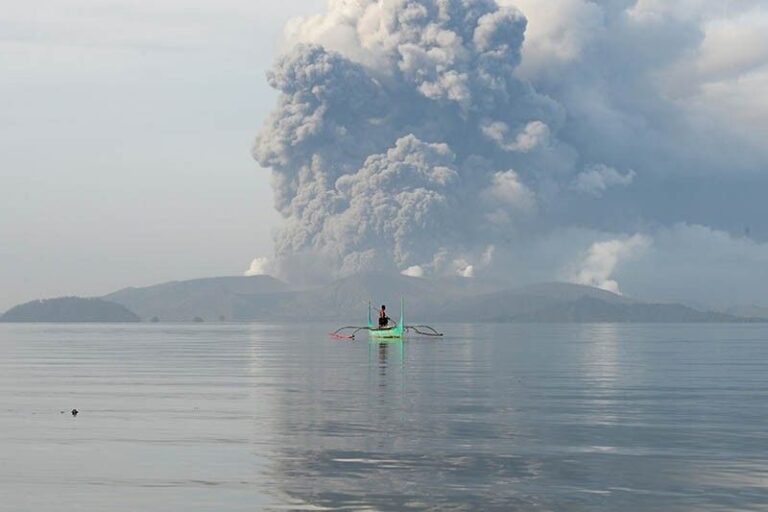
MANILA, Philippines — More than 2,000 people have fled from a volcano eruption that has filled the air near the Philippine capital with toxic gas, officials said Saturday.

Taal Volcano, which sits in a picturesque lake, has been belching sulphur dioxide for several days, creating a thick haze over Manila and several surrounding provinces, and prompting health warnings. 

At least 2,400 people have left their homes since the government called for evacuations of hamlets on the lake’s shores, provincial disaster official Joselito Castro told AFP.

“We expect more residents to evacuate over the coming days,” he said, adding that they were seeking refuge either in schools closed by the coronavirus pandemic or in the homes of relatives.

Taal lies just 50 kilometres (30 miles) south of Manila and for much of the past week has discharged volcanic smog that has blotted out the sun in the capital.

Civil defense officials have warned that upwards of 317,000 people could be vulnerable to toxic gas emissions from the volcano under the current eruption’s worst-case scenario.

Taal is one of the most active volcanoes in a nation hit periodically by eruptions and earthquakes due to its location on the Pacific “Ring of Fire” — a zone of intense seismic activity. 

The last eruption there in January 2020 shot ash 15 kilometres (nine miles) high and spewed red-hot lava, crushing scores of homes, killing livestock and sending over 135,000 people into shelters.

Militarization in Philippines has ‘damaging effects’ on civic space, democratic freedoms — think tank

0

Franco Luna (Philstar.com) – July 4, 2021

MANILA, Philippines — Academics cast fear over what they said was the blow to human rights caused by the “explosive cocktail” of the global drive to counter-terrorism coupled with the Philippine government’s “autocratic instincts and violent tendencies.”

In its paper entitled “An explosive cocktail: Counter-terrorism, militarisation, and authoritarianism in the Philippines,” nonprofit Saferworlds said that President Rodrigo Duterte has weaponized counter-terrorism, a “core framework influencing security decisions” that worsened following Duterte’s election. 

Researchers Aries Arugay, Marc Batac and Jordan Street expressed concern over the potentially “damaging effects on conflict dynamics, civic space and the democratic freedoms of Filipino citizens” moving forward, pointing to the global war on terror’s “patterns of failure” where “civilians continue to bear the brunt of the violence.”

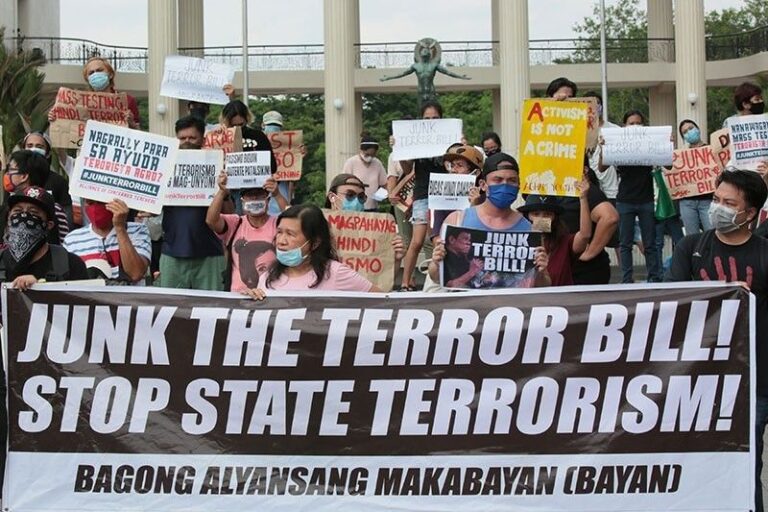
The research, done in cooperation with Initiatives for International Dialogue, pointed to the highly contested Anti-Terrorism Act, seen by many as the latest move by Filipino authorities to use countering ‘terrorism’ as the pretext to limit dissent and undermine democracy. 

In Duterte’s Philippines, the communist insurgency is the boogeyman — right along with the illegal drug trade as public enemy number one. The president’s nightly addresses feature lengthy asides that see the chief executive railing against left-leaning activists and drug suspects alike.

“Through the dramatic militarisation of civilian governance structures, President Duterte has weaponized counter-terrorism to pursue a narrow, securitized political agenda that is having widespread impacts on peace and human rights,” the paper read. 

“The increase in human rights violations, the shift away from democracy and towards authoritarianism, and the increasingly hostile approach towards armed groups in the 2000s had many interconnected roots. But none of them were as important as the authorities’ seizing upon and imposing counter-terrorism measures in the Philippines.”

‘Crackdown on opposition and dissent’

Echoing critics of the measure, the group said that the Anti-Terror Law adopted an “overbroad definition of what constitutes ‘extremism’ and radicalism,” which only led to a crackdown “targeting student groups, dissenting movements and certain minority groups” that constituted “government efforts to label ‘terrorists’…as enemies of the state.”

“The criteria used for assessing ‘radicalization’ include an individual’s political persuasion, religious belief, or education institutions where they study,” the paper read. 

State forces continue to defend what progressive groups say is a crackdown on left-leaning activists, going as far as implying that the targeting of activists and government critics in many police operations is a mere coincidence. 

In operations claiming to be anti-terrorism efforts, members of progressive groups continue to be jailed or shot, which rights groups have said is a sign of a “creeping martial law.” 

It’s not just left-leaning activists: Saferworlds said that rampant securitization plays a role in dividing society and discriminating against minority communities, who “often find themselves in the crosshairs of conflict and at the receiving end of harassment from both violent groups and security forces alike.” 

More than just the Anti-Terrorism Law, the group said that Executive Order No. 70, which created the National Task Force to End Local Communist Armed Conflict and instituted a “whole of nation” approach against the communist insurgency, was “largely dictated by elements of the military establishment.”

“This unconditional order is believed to have been strongly influenced by the military establishment’s enduring interest in taking advantage of the current administration’s subservience to their goals,” they said. 

“The Duterte administration’s inability to impose democratic civilian control has put the military in the driver’s seat in this anti-communist drive. With both retired and active generals leading on implementation, the military is determined to put a violent – rather than negotiated – end to one of the world’s longest-running Maoist-inspired insurgencies.”

Securitization without national security?

To recall, Duterte formally ended peace talks with the National Democratic Front in 2017 following on-and-off negotiations where both parties could not settle on a venue.

The researchers also pointed to the detrimental effect of heavy security measures on genuine developmental measures which can, in turn, boost national security. 

“In a country with a long history of internal violent conflict, the push to treat political insurgencies as ‘terrorism’ is closing the space for many developmental and peacebuilding-based responses,” the paper reads. 

As a result, even basic engagement with communities around the country, perceived threats are tackled through the lens of “hard security narratives.”

“This is not providing security, but instead driving and enabling rising levels of conflict and repression,” the paper said. 

The researchers said that even sources from inside the Duterte administration have observed “a lack of diverse perspectives in peace and security policy circles and an absence of debate on policy direction” when it came to the “military-first approach.”

This approach has translated well into the administration’s pandemic response, too, which has drawn criticisms of being draconian and militaristic. 

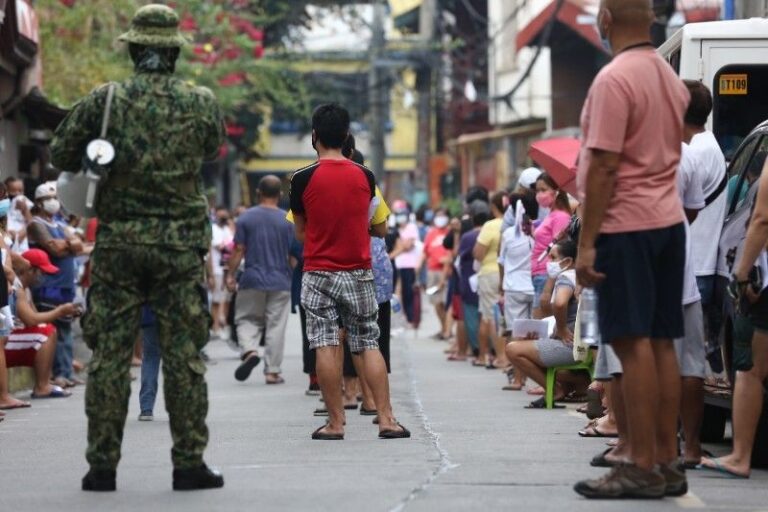
In separate periods throughout the more than two years of quarantine in the Philippines, thousands of cops were deployed in the streets to enforce health protocols. Violators who were caught going against these were thrown in jail. 

With a litany of former military generals littering the coronavirus task force, enforcement has been the norm over the past 474 days of community quarantine, with police leadership justifying it as a “health measure.” 

And even amid the coronavirus pandemic, anti-insurgency efforts are center stage in Duterte’s administration, with operations carried out often by state forces. 

“Authorities are securitizing engagement with many communities in the country, tackling perceived threats through hard security narratives, policies, interventions, and partnerships,” the researchers said. 

“This is not providing security, but instead driving and enabling rising levels of conflict and repression.”

People before policy

The discussion paper recommended “a significant change in approach by security and development partners in the Philippines,” stressing “it is not too late to reverse securitization and militarization.” 

First and foremost, Saferworld said, engagement with those affected on the ground should “be central and primary” to efforts at building lasting peace. 

The researchers also called on non-government and civil society organizations to “promote human security and reassert democratic norms, and opt out of supporting securitized efforts” in their projects. 

On the part of the government, efforts at preventing or countering violent extremism “should include a conflict sensitivity assessment and a gender analysis in the design, implementation and evaluation phases.”

“Programming should focus on upholding international human rights standards rather than undermining them. Where this cannot be guaranteed, projects should be suspended until the human rights situation is addressed,” it said. 

It also reminded implementing organizations that “those working to build peace and prevent violence cannot be neutral about an agenda that is causing significant human rights harms, exacerbating conflict and derailing peace processes.”

— with a report from Jonathan de Santos 

‘Lust for power, fear fuel Duterte’s VP run’

0

By: Julie M. Aurelio – Reporter / Philippine Daily Inquirer /July 03, 2021

President Duterte’s “interest” in another high-ranking position is only fueled by a “lust for power and fear of retribution,” a member of the House of Representatives said on Friday after the 76-year-old leader said he would run for Vice President in next year’s election “to maintain equilibrium.”

“I thought the President will resign if he fails to keep his campaign promises in three to six months? I thought he was already tired of his job? Now he has a sudden interest in being Vice President,” said Magdalo Rep. Manuel Cabochan III, a former Navy intelligence officer who joined the Oakwood mutiny in 2003.

“That [only] boils down to two things: lust for power and fear of retribution,” Cabochan said in a statement. “Both are wrong. Let’s not add to the drama and fooling people.”

Mr. Duterte surmised that floating his possible candidacy was part of “political posturing” so he would not be “treated badly” as he nears the end of his term as the country’s Chief Executive. He earlier said he would support the bid of House Majority Leader Martin Romualdez for Vice President in next year’s polls.

But presidential spokesperson Harry Roque Jr. also earlier said that the President had tasked Energy Secretary Alfonso Cusi to rally members of the Partido ng Demokratikong Pilipino-Lakas ng Bayan (PDP-Laban) behind a ticket that would include Mr. Duterte as Vice President and his daughter, Davao City Mayor Sara Duterte, as President.

Cabochan warned that Mr. Duterte and his allies are scrambling for ways to preserve their political leverage in the face of possible prosecution after the President steps out of office in June 2022.

‘To escape accountability’

Bayan Muna Rep. Ferdinand Gaite agreed with Cabochan but argued that Mr. Duterte’s candidacy “would be more of a liability than a boost.”

“That tandem would carry the public’s disappointment and exhaustion from Mr. Duterte’s leadership … The President will be just excess baggage for his running mate,” he said.

Gaite said it was “clear that Mr. Duterte’s goal in running is to escape accountability for the cases waiting for him, especially the investigation of the International Criminal Court on the bloody war on drugs.”

Who will be his president?

Former Speaker and Taguig-Pateros Rep. Alan Peter Cayetano, for his part, said he would respect Mr. Duterte’s decision if he pushes through with his intent to run as Vice President.

Cayetano earlier advised Mr. Duterte to take on the role of an “elder statesman,” like former President Fidel Ramos, instead of gunning for the second-highest post in the land.

“Having said that, we have to respect that when he said he might run. And everybody has the right to run [for public office]. There’s no doubt in my mind he will be a good Vice President. The question will be, who will be his President?” the lawmaker said on Friday.

As to the rift within the PDP-Laban between the President and Sen. Manny Pacquiao, the party president, Cayetano said Pacquiao might have only wanted to help Mr. Duterte expose corruption. INQ

A year into Anti-Terror Law, kin of terror-tagged peace consultant left with frozen assets, constant anxiety

0

Kristine Joy Patag (Philstar.com) – July 3, 2021

MANILA, Philippines — Peace consultant Rey Claro Casambre has been detained since 2018 for a crime that he said he did not commit. While in jail, he found himself being accused in May of being a terrorist.

Casambre was first included in the 2018 Department of Justice petition for proscription but was later dropped from the government’s long list. In 2021, he saw himself again labelled as a terrorist — and with the new law in effect, what few assets he had were frozen, leaving his family in anxiety.

“Freezing my father’s and others’ almost negligible accounts purportedly to cripple the communist movement is pathetic. Instead, it has deprived my elderly parents of their funds for essential needs, magnified the crisis of the pandemic, and is bringing anxiety to our family and friends,” Casambre’s daughter, Xandra Bisenio, told Philstar.com in a statement.

Amid mounting opposition and while the country grappled with a raging pandemic, President Rodrigo Duterte signed Republic Act 11479, or the Anti-Terrorism Act of 2020 (ATA), on July 3, 2021.

The signing led to one of the biggest protests at the University of the Philippines in Diliman, Quezon City during a months-long lockdown in Metro Manila.

Thirty-seven groups from different sectors of the country — from Framers of the Constitution, legal luminaries and law professors to students and even social media influencers — fired legal challenges against the law. Among them is Casambre.

‘The account does not exist’

The Anti-Terrorism Council (ATC) in a resolution issued December 2020 designated the Communist Party of the Philippines and its armed wing, the New People’s Army, as terrorist groups.

Five months later, the council tagged 19 supposed members of the CPP’s Central Committee as terrorists.  The government list included at least four peace consultants.

The designation triggered the authority that the ATA gives the Anti-Money Laundering Council to freeze the assets of a designated person or group.

Bisenio shared they experienced the adverse impact of this shortly after the designation was made public. In May, she said they “attempted, as was usual, to withdraw cash from Mr. Casambre’s ATM account to pay for some groceries, and got the message: ‘The account does not exist.’”

The family obtained copies of official bank documents of her father’s accounts as being frozen on June 16.

Bisenio continued: “It is doubtful they had as much as lifted a finger to determine whether such ‘assets’ were actually being used to finance or support terrorism as they allege [since they have publicly disclosed] neither supposed evidence nor proof.”

She asserted that the money in her father’s bank accounts is accumulated savings from allowances from a non-government organization he worked for for three decades, honoraria from speaking engagements and cash gifts from relatives in past holidays.

Fruit of a poisonous tree

Under the law’s Implementing Rules and Regulations, designated terrorists may file a verified request for delisting with the ATC within 15 days of publication of the lists. The appeal may be filed more than once depending on the applicable grounds of delisting, but once denied the next request can only be filed six months later.

The ATC resolution designating Casambre and 18 others were published in newspapers on May 13, but Justice Undersecretary Adrian Sugay, who is also ATC spokesperson, said that the council had yet to receive any request for delisting as of June 21.

With no requests filed, Sugay said “it may be reasonably presumed that they have waived” their right to contest the terrorist tag. He acknowledged that the people the council designated can still seek judicial remedies.

But Bisenio hit the DOJ’s statement that she said suggested “as though silence were an indication of guilt.”

“The ATC designation is the fruit of the poisoned ATA tree. Why and how would one seek or expect relief from a toxic brew by consenting [to] more of it?” she said.

The request for delisting is not part of the law, but was included in Rule 6.5 of the Implementing Rules and Regulations, the guidelines on how the executive branch will apply the law. Sugay earlier explained that the ATC’s internal mechanism on the designation “also contains provisions [regarding] delisting,” but he noted that these rules are confidential.

It is yet unclear whether the same panel that designated the personalities as terrorists would evaluate requests for delisting or if hearings would be conducted.

The DOJ official said they are “proposing a few additional provisions and this will hopefully be taken up during the next ATC meeting.”

Hope remains at the Supreme Court

In less than 24 hours after the Palace announced the signing of the ATA, the first legal challenge was lodged before the country’s highest court.

In the succeeding weeks, the high court saw dozens of different groups trooping to their gates at Padre Faura to urge the SC to strike down the law as unconstitutional for infringing on people’s rights.

In the span of nearly four months, the SC held nine settings of oral arguments on these 37 legal challenges. Petitioners filed their memoranda earlier this week, but it is unclear whether the OSG has already submitted theirs.

A year since the law was signed, the SC has yet to issue a Temporary Restraining Order on its implementation as petitioners have asked.

Peace consultants like Casambre have, in the meantime, been designated as terrorists, counsels for petitioners have reported attacks and intimidation and the red-tagging of progressives has continued.

Bisenio, however, vowed that while her father’s designation and subsequent freezing of assets have left the family deprived of funds, magnifying the effects of the pandemic on their family, their commitment to helping others continues undiminished.

“Despite all this, we want the ATC to know that in our family’s case, our real assets, our most valued possessions, the source of our joy, security and peace of mind cannot be found in any bank or monetary institution,” she said.

“They lie in our lifetime commitment to serve the common good, in solidarity with the downtrodden who are the real giants and heroes in this world. Intangible yet real and vibrant, these treasures are inextricably embedded in our minds, beyond the reach of any state entity, and silently but fiercely ablaze in our hearts, which no statute can ever freeze,” Bisenio also said.

Pacquiao says lockdown ‘ayuda’ marred by corruption

0

By: Gabriel Pabico Lalu – Reporter /INQUIRER.net / July 03, 2021

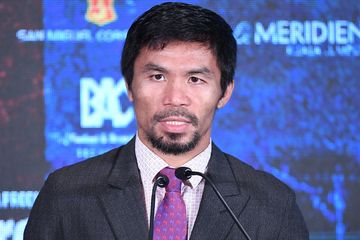
MANILA, Philippines — Senator Manny Pacquiao on Saturday claimed that several government transactions were marred by corruption, mentioning, in particular, the distribution of social amelioration program (SAP) subsidies through the use of e-wallets.

Pacquiao said in a briefing that Starpay, an e-wallet application used by the Department of Social Welfare and Development (DSWD) has failed to distribute the SAP fully — with P10.4 billion of the social aid missing even though it was noted that all of the payouts have been completed.

“Bilyong-bilyong halaga ang inutang ng ating pamahalaan na nilaan para sa ayuda ng ating mga kababayan na nawalan na ng mga kabuhayan.  Naglaan po ang ating gobyerno ng P207.6 billion para sa pangalawang SAP,” Pacquiao said.

(Our government borrowed billions of money to fund the social amelioration program for our countrymen who lost their livelihood.  The government allocated P207.6 billion for the second SAP.)

“Mr. President, alam niyo po ba na sa kabuuang halaga na ito ay may nilaan na P50 billion more or less ang Department of Social Welfare and Development para lamang sa isang hindi po kilala na e-wallet na kung tawagin ay Starpay na may build-up capital lamang po na P62,000,” he added.

(But Mr. President, do you know that part of this amount, around P50 billion, was allocated by the DSWD to a relatively unknown e-wallet application platform called Starpay, which had a build-up capital of only P62,000.)

Pacquiao said that out of the 1.8 million beneficiaries who would access the SAP through the said application, only 500,000 were able to receive the assistance.  The remaining 1.3 million, the senator said, did not receive the payouts.

“Batay sa aking imbestigasyon Mr. President, lumalabas sa initial po na disbursement sa Starpay account para sa 1.8 million beneficiaries na katumbas ay P14 billion.  Kung tutuusin maganda po ang layunin ng paggamit ng e-wallet para sa distribution ng SAP, maiiwasan kasi ang kalakaran na ang pera ay mauuwi sa bulsa ng mga kawatan,” Pacquiao said.

(According to my investigation, Mr. President, it appears that the initial disbursement for the Starpay accounts for the 1.8 million beneficiaries amounts to over P14 billion.  If you think of it, the goal of using an e-wallet for distributing SAP is a good idea as it prevents the practice of letting corrupt officials handle the money.)

“Bakit sa 1.8 million na binigyan ng SAP mula sa Starpay, 500,000 lamang po na katao ang na-download nito.  Sa mga hindi po nakaka-alam, hindi ka pwedeng mag-receive or mag-withdraw kung wala kang nada- download na Starpay app.  Ang tanong ko po, anong nangyari sa 1.3 million katao na hindi naka-download ng Starpay app pero sa record po, nakatanggap na po sila,” he added.

(Why is that only 500,000 out of the 1.8 million beneficiaries have downloaded this?  For those who do not know, you cannot receive or withdraw any amount if you do not download the Starpay app.  My question is, what happened to the 1.3 million beneficiaries who were not able to receive the Starpay app — but on the record, received the payouts?)

Other agencies

Aside from DSWD, Pacquiao mentioned that other government agencies like the Department of Health (DOH) and the Department of Energy (DOE) are also affected by corruption.

Pacquiao claimed that the DOH has been procuring medicines that are near expiration at a regular price when these should already be priced lower.

“Sa DOH naman po, tungkol sa DOH, marami pong issue dito sa DOH, unang-una po ay bumibili ito ng mga malapit nang mag-expire na gamot.  Binibili nila ang mga gamot na ito sa regular price samantalang dapat ay bagsak na ang presyo ng mga ito,” Pacquiao said.

“Hindi na ito mapapakinabangan ng mga kababayan natin dahil sa naabot na nga ito ng expiration, at iilan lang po ang napapakinabangan,” he added.

As for the DOE, Pacquiao mentioned the Independent Electricity Market Operator of the Philippines, which he said allegedly receives part of the payments made by consumers for electricity.

“Alam niyo po rin po ba, na sa issue dito sa DOE, sa bawat kilowatt-hour na binabayaran ng bawat Pilipino sa kanilang kuryente, ay may halos kalahating sentimo na napupunta sa isang pribadong kumpanya na itinayo sa pamamagitan lamang ng P7,000 na build-up capital,” the Senator said.

“Bilyon-bilyon ang halaga ang nakakamal ng kumpanyang Independent Electricity Market Operator of the Philippines, IEMOP na siyang binigyan ng kapangyarihan ng Department of Energy bilang independent electricity market operator,” he added.

Pacquiao’s presentation comes after he and President Rodrigo Duterte traded barbs over the former’s claims that the government is riddled by corruption. Duterte said he would campaign against Pacquiao if he could not name the agencies involved and provide evidence.

Pacquiao accepted the President’s challenge, saying that the government can start with the Department of Health (DOH) and its COVID-19 pandemic response.

Pacquiao is rumored to be running for president in the 2022 polls with other Duterte allies to include Duterte’s daughter Davao City Mayor Sara Duterte-Carpio, Senator Bong Go, and former senator Bongbong Marcos.

PDP-Laban officials loyal to Duterte like Energy Secretary Alfonso Cusi, who is the party’s vice-chairperson, have indirectly asked Pacquiao to leave the party. Cusi also joked that the PDP in the party stands for President Duterte’s Party — a joke that Pacquiao did not find funny.

Breaking Invisibility in Canada

0

Filipino Canadians in Politics

By Lea Luciano
The Philippine Reporter (Canada), June 25, 2021

Breaking Invisibility is a 3-part conversation series that explores the challenges of the Filipino community engagement in leadership and politics.

On June 19, 2021, the Philippine Advancement Through and Culture (PATAC) that hosts this series invited an intergenerational group of Filipino leaders across Canada to share their experiences and stories on how they found their political voice.

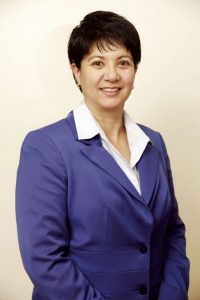
France Stohner is the first Filipina to run for city council in the district of Snowdon in Montreal and part of the Côte-des-Neiges—Notre-Dame-de-Grâce borough with a huge Filipino community.

“We’ve actually never even had a person of colour on our council, which is quite appalling for how diverse our neighbourhood is,” said Stohner.

Stohner addressed the housing crisis, the alarming rate of high school dropouts, the lack of resources and support for the youth, and the low voter turnout rate during elections in her community.

“A lot of folks don’t even know what their city councillors do, don’t even know how to vote, are not sure if they’re registered, and some have also pretty much given up because they don’t see themselves reflected in Council,” she said.

“Some don’t get involved because they don’t see themselves reflected.”

Rowena Santos, City of Brampton Councillor

Councillor Rowena Santos of the City of Brampton, Ontario, is inspired by her community and driven by her passion to change the culture of politics.

“We don’t have enough Filipinos around the leadership tables, and so that is why the growing work that all of you are doing is so important because we need to make space at those tables for our voices,” said Santos.

As the first Filipina to win as a councillor in Brampton, Santos advocates for more people of colour and women in her community to be elected.

“When I would talk to them about being Filipino how much they love the Filipino community was amazing to see,” said Santos.

“And that’s the level of support because they know we are the personal support workers, we are the nurses, we are the people who work tremendously hard and so that respect and that support is there.”

Before being elected she worked at the Ontario legislature for over a decade. Most recently, she was relected at the Federation of Canadian Municipality’s Board of Directors from 2021 to 2022.

Santos has witnessed a tremendous rise in youth voices when it comes to advocating and speaking up for their community against Anti-Asian racism.

“I’ve always said since I was first elected, that and I’ve seen and I’ve experienced when I believe wholeheartedly, there’s so much potential in the Filipino community,” said Mable Elmore, the first MLA (Member of Legislative Assembly), British Columbia, of Filipino heritage for Vancouver-Kensington.

“When we look right across the continuum of business, public sector, private sector, Filipinos are under represented. We’ve heard from many speakers that racialized folks are under represented, and this reflects the reality of systemic racism.”

Mable Elmore, first MLA (Member of Legislative Assembly), British Columbia

Elmore is the spokesperson for Temporary Foreign Workers and Immigration and was the Deputy Spokesperson for Finance. She is an active member of the peace movement and has also worked tirelessly on a wide range of migrant, immigrant, social justice, and workers’ rights issues.

“Some of the structural barriers that the Filipino community experiences, in particular around, you know, the need for permanent residency for temporary foreign workers, the need for adequate resourcing for our community and immigrant and racialized communities to address systemic racism,” she said.

In British Columbia, second-generation Filipino’s have been actively participating and getting involved in civic engagement. They have been connecting and engaging with their communities, and showing solidarity with the Indigenous communities.

“I encourage you all to continue your effort and really work to encourage the community to become more active, to become more engaged, to step up for leadership, to organize, to come together, and really assert your rights, work for social justice, work for dignity.”

Other speakers present during the event were Julius Tiangson, founder of Filipino International Network and an advocate for temporary foreign workers and new immigrants and certainly not a stranger in the political circles here in the province of Ontario; Garry Tanuan, Trustee in Ward 8 of the Toronto Catholic District Board since 2012 as well as Regional Director of the Ontario Catholic School Trustees Association, and Dr. Rey D. Pagtakhan, the only Canadian of Philippine Heritage elected as Member of Parliament from Manitoba.