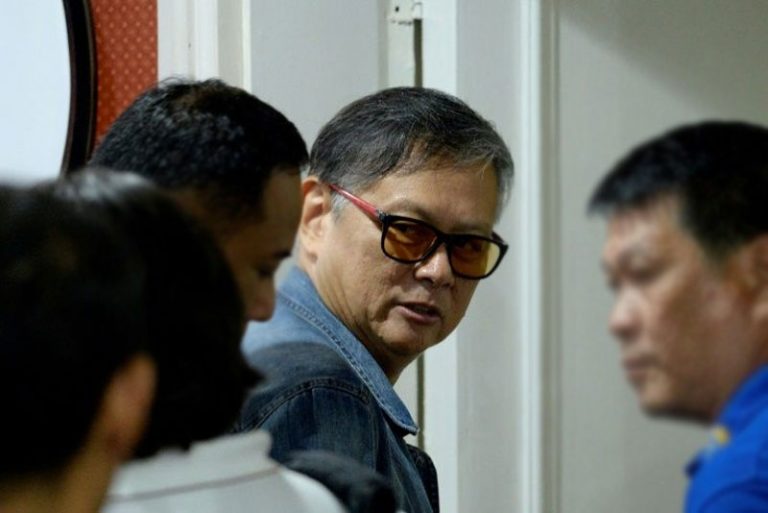
MANILA, Philippines — Former Palawan governor Joel Reyes yesterday surrendered before the Sandiganbayan, a few hours after the anti-graft court released a ruling ordering his arrest and revocation of the bail bond he had earlier posted.
Reyes was accompanied by his two children and his lawyer Demetrio Custodio when he surrendered before the court’s Sheriff’s Office. He was then escorted to the court’s Third Division handling his graft case.
“We respect the decision of the court, kaya nga po ako nandito (that’s why I’m here),” he said.
Following his surrender, Reyes was brought by the personnel of the Sheriff’s Office to the Quezon City Jail Annex at Camp Bagong Diwa in Taguig, where the court committed him for detainment.
In an interview with reporters, Reyes maintained that he is not a flight risk and is ready to face a tougher legal battle ahead.
“My surrender shows that I am not a flight risk and I am here to face this case together with my lawyer and my family,” he said in Filipino.
He admitted that he was saddened by the court’s decision but he respects it none the less.
“It has only been three weeks since I was reunited with my family after I was released from detention. Now we are going to part ways again. But I will face the case,” Reyes said.
Yesterday, the Third Division released to the media a resolution dated Jan. 17 ordering the revocation of the bail bond that Reyes earlier posted for his graft case in connection with the alleged anomalous renewal of the permit of a small-scale mining company in 2006 found to have been over-extracting mineral ore in Palawan.
The court sided with the prosecution that the former governor must remain in detention as he is a “flight risk,” given his previous record of fleeing the country to evade his murder case in connection with the killing of broadcaster and environmentalist Gerry Ortega in 2011.
“Indeed, accused Reyes managed to go to Thailand despite the existence of a hold-departure order against him. His return to the Philippines was not voluntary but was effected through a compulsory process resulting from his arrest by the authorities in Thailand,” the Third Division’s ruling read.
“These circumstances are most telling. They unquestionably evince the strong probability that accused Reyes might go into hiding again while his case is on appeal and thereby frustrate the ends of justice,” it added.
Reyes was released from the Puerto Princesa City Jail last Jan. 5 after the Court of Appeals, in a controversial decision, dismissed his murder case.
This prompted the Office of the Ombudsman’s prosecution team to file an urgent motion before the Sandiganbayan Third Division, praying to the court to cancel Reyes’ bail and order his commitment to prison.
Reyes, together with his younger brother, former Coron, Palawan mayor Mario Reyes, fled the county in 2012 after the Puerto Princesa regional trial court found probable cause to put them on trial for the murder of Ortega.
The Reyes brothers were arrested in a lavish resort in Phuket, Thailand in September 2015.
A bill that will give church-decreed annulment of marriage the same weight as a court ordered annulment has been approved by the House of Representatives on third and final reading.
Not a single lawmaker among the 203 House members opposed the passage of House Bill 6779 identified as An Act Recognizing the Civil Effects of Church Annulment Decrees authored by Reps. Yedda Marie Kittilstvedt-Romualdez of Leyte, Gwendolyn Garcia of Cebu and Sol Aragones of Laguna.
Under the bill, in the event that a marriage duly and legally solemnized by a priest, minister, rabbi or presiding elder of any church or religious sect in the Philippines is annulled or dissolved in accordance with the canons or precepts of the church or religious sect, that annulment or dissolution will have the same effect as a decree of annulment or dissolution issued by a competent court.
The measure also mandates that the final judgment or decree of annulment or dissolution issued by the church or religious sect should be recorded in the civil registry within 30 days from the issuance of the final judgment or decree of annulment or dissolution.
“I thank my colleagues for the swift passage of the bill without jeopardizing the indissolubility of marriage,” Romualdez said in a statement.
The state recognizes divorce under the Code of Muslim Personal Laws of the Philippines based on the Sharia or Islamic law even if Philippine laws do not provide for divorce.
House Bill 6779 also provides that either of the former spouses may marry again.
In securing a marriage license, the spouse involved must present a certified true copy of the final judgment or decree of declaration of nullity, annulment or dissolution of marriage registered with the appropriate civil registry.
In addition, the bill states that the status of children of marriages subject of the church annulment decree will be determined in accordance with the provisions of Executive Order 209, otherwise known as the Family Code of the Philippines.
In case the ground for church annulment decree is not similar to any of the grounds provided in the Family Code of the Philippines, their common children born or conceived before the issuance of the Church annulment will be considered legitimate.
The liquidation, partition and distribution of the properties of the spouses, the custody and support of the common children, and the delivery of their presumptive legitimes, on the other hand, will be agreed upon by the spouses and embodied in a public document. In case no agreement is met, the provisions of the Family Code of the Philippines will be enforced.
Former Chief Justice Hilario Davide Jr. asserted on Monday that “federalism is anti-poor” as he warned of “at least two kinds of taxes” that would be “totally unavoidable” under a federal form of government.
“People will really be tortured with various problems, as a matter of fact, on the matter of taxation alone,” Davide said in an interview over ABS-CBN News Channel’s Headstart.
Davide explained that one form of taxation under federalism would comprise state tax and federal tax against the people that are inevitable since the citizens would be expected to fund the region as well as the central government.
“Federalism is anti-poor because if you are a citizen of the country, and you belong into a state, the state would be imposed upon you — one form of taxation, that is the state tax; and at the same time, the federal government would also impose a tax against you,” he pointed out.
When asked if it would be possible not to have double taxations, Davide noted: “It is not possible that we don’t have, it has to have.”
“You have to maintain the state of the region and at the same time, you have to contribute to the central government. So, totally unavoidable. There will always be at least two kinds of taxes,” the ex-top magistrate also said.
During the hearing of the Senate constitutional amendments and revision of code committee on the proposed revision of the 1987 Constitution, Davide said that shifting from the prevailing unitary system to federalism would be a “lethal experiment, a fatal leap, a plunge to death, a leap to hell.”
Davide also earlier said that there is “absolutely no need” to amend the 1987 Constitution, as it remains to be the “best in the world” despite its “imperfections.” /kA
Don’t miss out on the latest news and information.
Subscribe to INQUIRER PLUS to get access to The Philippine Daily Inquirer & other 70+ titles, share up to 5 gadgets, listen to the news, download as early as 4am & share articles on social media. Call 896 6000.
For feedback, complaints, or inquiries, contact us.
This photo taken on January 27, 2018 shows farmer Jay Balindang tending to his water buffalo under heavy rains in a rice field at the foot of the Mayon volcano in the town of Guinobatan in Albay province. Balindang is among nearly 10,000 farmers who have been affected by the eruption of Mayon volcano that began earlier this month. / AFP PHOTO / TED ALJIBE
As blistering lava spews from the seething volcano nearby, farmer Jay Balindang leads his buffalo through the ash-strewn paddy fields of the no-go zone, creeping closer to danger in a desperate bid to support his family.
Tens of thousands of people have been evacuated from around the erupting Mayon volcano, as a white-hot cocktail of gas and volcanic debris streaks down its flanks, threatening local communities who rely on the fertile land at its base.
Fearing a significant eruption that could engulf whole swathes of the nearby land in burning rock and lava flows, authorities have cordoned-off a nine kilometer (six mile) danger zone around Mayon.
ADVERTISEMENT
But that has not stopped defiant farmers like Balindang from tending to crops and livestock that are a crucial part of their livelihoods.
Each day the father-of-eight leaves his children at a government evacuation centre, sneaking past police as he returns to his small farm at the foot of the volcano to feed his precious “carabao” water buffalo.
“I am not afraid of the volcano. We are used to its activity,” the 37-year-old told AFP, at the edge of his rain-lashed rice fields, a few kilometers inside the danger zone.
This photo taken on January 28, 2018 shows Mayon volcano spewing lava ash from its crater, as seen in Daraga town, south of Manila in Albay province. Authorities have imposed a no-go zone around the 2,460-metre (8,070-foot) mountain as they warned of a hazardous eruption within days, leaving more than 77,000 people stuck in crowded shelters, likely for months. / AFP PHOTO / Ted ALJIBE
Farmers make up around 10,000 of the 84,000 people displaced by the eruption of Mayon in Albay province, some 330 kilometers southeast of Manila.
The lush region is famous for its chili peppers, as well as less fiery crops like rice, corn and vegetables.
All are threatened by the volatile volcano, which has gushed molten lava and belched giant clouds of superheated ash since it began erupting two weeks ago.
Local authorities say that beyond the immediate damage to crops caused by the coating of smoldering embers, there are concerns that heavy rainfall could combine with ash and rock to form deadly, fast-moving mudflows that could sweep away entire settlements and block vital rivers.
“This is a new and daunting challenge to our agriculture workers who in the past had to cope with typhoons, landslides and floods,” Agriculture Secretary Emmanuel Pinol said.
ADVERTISEMENT
Farming the ‘Ring of Fire’
Farmers are among the most vulnerable to the meteorological miseries that afflict the Philippines, which is hit by an average of 20 typhoons a year and is in the earthquake-prone volcanic belt around the Pacific known as the “Ring of Fire.”
The 2,460-meter (8,070-foot) Mayon has been both a blessing and a curse to the farmers living near its slopes for generations.
Volcanic ash can kill vegetation immediately after an eruption, but as it seeps into the ground it can also enrich the soil with minerals that sustain future crops.
“If the ash is thin, it would become a fertiliser but if the ash is thick it would mean farmers who had spent money a lot of money to plant the vegetables lose everything,” Renato Solidum, head of the Philippine Institute of Volcanology and Seismology, told AFP.
Vegetable prices have already begun to soar in parts of Albay as the eruption hampers access to key crops.
“We are very famous for these dishes wherein the (taro) leaves are being grown just at the foot of Mount Mayon,” Elsa Maranan, chief of the agriculture department’s local breeding station, told AFP.
“If all this will be destroyed then the production of our delicacies and the income of our farmers will be very much affected.”
Dangerous dash
In a bid to stop farmers from slipping back to tend their own fields, local authorities have set up communal areas, where farmers can graze livestock on ash-free grass.
“We appeal to them not to be stubborn because they are putting the lives of our responders in danger,” Brigadier-General Arnulfo Matanguihan, head of a local task force for the eruption, told AFP.
But many still make a daily hazardous dash back to their own land.
Balindang said the choice was clear — if he ensures that his pigs, carabaos and cows are fed, then his family will also be assured of something to eat.
“It’s very difficult because I don’t know if we will have any rice left to harvest. For now, we have nothing,” he said.
Don’t miss out on the latest news and information.
Subscribe to INQUIRER PLUS to get access to The Philippine Daily Inquirer & other 70+ titles, share up to 5 gadgets, listen to the news, download as early as 4am & share articles on social media. Call 896 6000.
For feedback, complaints, or inquiries, contact us.
Corporate income tax collection takes center stage in the second round of the government’s tax reform initiative.
Following up on the previous administration’s collected data from the Tax Incentives Management and Transparency Act (TIMTA), the aim is to reform 360 laws that grant businesses tax breaks and other incentives, as well as plug loopholes.
Reforms will generally be guided by the principle that only businesses that generate jobs, stimulate the economy in the countryside, and promote research and development will continue to receive incentives and that sunset provisions on tax perks are not unnecessarily extended.
The passage of TIMTA in 2015 gave government the ability to promptly measure the value of incentives given to businesses, while at the same time analyzing their economic impact. Through the required reports, the government was able to determine the cost-benefit impact to the economy.
TIMTA requires companies that receive incentives to file their tax returns and pay their taxes through an electronic system with the Bureau of Internal Revenue. Companies should clearly quantify income-based tax incentives, value-added tax and duty exemptions, deductions, credit, or exclusions from the tax base.
Centralized data
The data gathered is centralized at the Department of Finance, and together with the actual information that the BIR and Bureau of Customs collects on tax and duty incentives, becomes a powerful tool to analyze the overall impact on the country.
Business ( Article MRec ), pagematch: 1, sectionmatch: 1
The DOF analysis includes sector and industry reports detailing the actual amount of tax incentives availed, the estimated claims during the previous year, the programmed incentives for the current year, and the projected incentives for the following year.
The data collected over the last two years has enabled the DOF to come up with the second tax reform package, this time targeting a flawed and outdated system that provides tax incentives from 150 investment laws and 210 non-investment laws.
Should this second round prove effective, the Philippines would see its collection efficiency rate from taxes of large companies and other private firms rising from the current 12.3 percent to a figure more attuned to what our neighboring countries are achieving.
According to the DOF, Thailand has a lower corporate tax rate of 20 percent, but it collects almost triple the amount because of a 30.5 percent collection efficiency rate. Vietnam has a 29.2 percent tax efficiency rate, while Malaysia has 27.1 percent. We definitely have room for a lot more improvement.
Revenue-neutral
Unlike the first package in the overall Comprehensive Tax Reform Program (CTRP) of the Duterte government, or the Tax Reform for Acceleration and Inclusion Act (TRAIN), this second package – including the next three or more – will be revenue-neutral.
TRAIN is expected to raise P90 billion this year, with the supplemental package (raising motor vehicle users charge, declaring a general tax amnesty, and relaxing bank secrecy restrictions) bringing in an additional P40 billion, if passed within the year.
On the other hand, the second package should raise about P35 billion from the rationalization of fiscal incentives during the first year of implementation, much about the same amount that will be lost when the corporate tax rate is slashed from 30 percent to 25 percent.
Competitive corporate income tax rate
Bringing down the Philippines’ corporate income tax rate was also one of the campaign promises of the President, but this commitment to Philippine businessmen, as well as interested foreign investors, is well-placed to support the country’s bid to attract further investments to spur domestic growth to more sustainable levels.
A 25 percent corporate income tax will be at parity with Vietnam’s, and almost the same as Malaysia’s 24 percent, although still higher than Thailand’s 20 percent. But it will take the Philippines off the list of having the highest corporate income tax take in the ASEAN.
Plugging leaks
While the second package of the CTRP will be a welcome tightening of our existing tax laws, much more needs to be done to plug the leaks in the government’s tax collection system.
Transparency in tax payments should not only involve companies that are registered with investment promotion agencies like the Board of Investments, Philippine Economic Zone Authority, Bases Conversion and Development Authority, and Subic Bay Metropolitan Authority, but all businesses that operate in the country.
The sooner all that operate in the country are mandated to file their returns electronically based on a simplified corporate income tax system, the better for our tax collection efforts.
One of the biggest problems encountered is the existence of corruption – both on the sides of government and the private sector – in the area of tax collection.
While administrative sanctions may be imposed on government servants who negotiate tax payments for personal gain, so should there be a rule that penalizes companies that condone or even initiate measures that would bring down their income tax assessments.
Moving on the right track
The government’s Build Build Build program and its promise of a golden age in infrastructure building will need all the measures that would ensure a robust flow of tax collections for the state coffers. As it stands, the CTRP will be able to raise only a quarter of the P8 trillion of the amount programmed until 2022.
A show of renewed fiscal disciple and commitment to improving tax collections would help assuage foreign investors and credit rating agencies that the Philippines is indeed moving on the right track, and will have enough steam to make it to the finish line.
Facebook and Twitter
We are actively using two social networking websites to reach out more often and even interact with and engage our readers, friends and colleagues in the various areas of interest that I tackle in my column. Please like us at www.facebook.com and follow us at www.twitter.com/ReyGamboa.
Should you wish to share any insights, write me at Link Edge, 25th Floor, 139 Corporate Center, Valero Street, Salcedo Village, 1227 Makati City. Or e-mail me at reydgamboa@yahoo.com. For a compilation of previous articles, visit www.BizlinksPhilippines.net.
THE Department of Social Welfare and Development (DSWD)-Davao said Monday, January 29, that indigent social pensioners will be receiving P200 more in monthly social pension, from P500 to P700 starting this year.
DSWD-Davao Director Mercedita Jabagat bared last week that all pensioners will be given P200 more monthly pension following the directive of the national office.
“The pension will be distributed every quarter. With the additional P200, our pensioners here will now receive a total of P2,100 per quarter,” DSWD-Davao public information officer Carmela Duron told SunStar Davao.
Duron said the additional P200 monthly grant is under the Unconditional Cash Grant, provided for by the Tax Reform for Acceleration and Inclusion Law. It will increase to P300 in 2019-2020.
The agency will implement the Unconditional Cash Grant scheme for three years as stipulated in the tax reform. It will release P2,100 in 2018 and P2,400 in 2019 and in 2020 in Davao.
“Our social pensioners will be surely happy. This would be a big help lalo na para sa pambili ng kanilang gamot and/or vitamins, and other stuffs that a social pensioner needed,” Duron added.
Duron also reiterated that only indigent older persons aged 65 years old and above are covered by the Social Pension Program under the Republic Act 9994 or The Expanded Senior Citizen Act.
The law specifies that seniors qualified to receive a monthly pension under the Social Pension Program of the DSWD are those who are frail, sickly or with disability; without any pension from other government agencies; and without a permanent source of income or source of financial assistance/compensation to support their basic needs.
Duron said as much as they would like to include all senior citizens from aged 60 and above, the budget for the Social Pension Program is only limited.
The DSWD-Davao recorded a total of 136,067 pensioners who received their monthly pension with a total fund of P816,404,000 while a total of 107 centenarians received a total fund of P10,700,000 cash grant last year.
WRITTEN REQUEST – Barred from speaking, former Customs commissioner Nicanor Faeldon holds up a handwritten note asking permission for a bathroom break from an exasperated Senate Blue Ribbon Committee Chairman Richard Gordon (right). (Jansen Romero)
Senator Panfilo M. Lacson revealed on Monday the existence of a new mode of bribery at the Bureau of Customs (BOC), replacing the regular “tara” (payola) system that prevailed in past Customs administrations.
Lacson called the new bribery scheme as “demurrage,”defined in Webster dictionary as “the payment made to the ship owner by the charterer for exceeding the time allowed for loading and unloading.”
“Pagna delay ang shipment ang pag-release napipilitan sila mag-shell out ng kung anong amount hinihingi sa kanila para ma-facilitate and dokumentong lumakad para ma-release and shipment(When the release of a shipment is delayed, the importer is forced to fork out the amount they are asking to facilitate the flow of documents for their eventual release),” he explained.
Lacson said this is now the common complaint his office has been receiving from importers.
Some10,000 containers arrive daily at the Manila port, Lacson said.
“Umiiyak ang mga importer (Importers are crying),” he added.
Late last year, Lacson, in a privilege speech, alleged that former BOC Commissioner Nicanor Faeldon and his favorites received weekly or monthly tara, an allegation denied by Faeldon and company. Faeldon, who is currently detained at the Senate on contempt charges, eventually resigned his post.
Lacson said he has called the attention of current BOC Commissioner Isidro Lapeña about this new form of bribery “although I know he is busy.”
He said there were times his office sent text messages to Lapeña for him to correct the immoral situation “pero mukhang di pa nako-correct ang common complaint nayan (But it appears that this situation has not been corrected).”
On Monday, Faeldon showed up at the Senate hearing for the first time, but had a heated argument with Sen. Richard Gordon when the former insinuated that the Senate Blue Ribbon Committee’s investigation into the prevailing corruption at the BOC.
During the hearing, Faeldon said Senators Vicente “Tito” Sotto III and Franklin Drilon were among the lawmakers who made “illegal requests” with the agency.
Faeldon was responding to Senator Paolo “Bam” Aquino IV’s question during the continuation of the Senate’s probe into the P6.4-billion shabu shipment and corruption in the BOC, when he dropped the names of Drilon and Sotto.
Before disclosing their identity, Faeldon apologized to the senators after noting that they were not present during the hearing.
“I’ll start with Sen. Drilon. As early as 2016, he requested that I meet with him here at the Senate, twice, to sign a Memorandum of Agreement between the BOC and the office of Maria Serena Diokno, the chairperson of the National Historical Commission of the Philippines (NHCP),” Faeldon told the committee, chaired by Gordon.
Faeldon said Drilon wanted him to sign a document agreeing to have the BOC office in Iloilo City renovated for the NHCP. After the renovation, he was told that the building will be converted into a museum and the BOC will occupy the third floor of the building.
“Twice, I attended his meeting and said sir, hindi po puwede. On the third meeting, I have forcibly changed the provision of the MOA and signed it.”
“I never acceded, why because meron na tayong karanasan, sir,” Faeldon told Aquino and Gordon.
Faeldon said he doesn’t want a repeat of what happened during former President Gloria MacapagalArroyo’s time when she ordered the restoration of the so-called Malacañang of the South in Cebu.
“And until today, yung Cebu employees namin, are housed in a condemned building. So ayaw po natin na maulit po yun na tatanggalin na naman yung mga Customs (employees) dyan at bawal na po silang pagpapalitan,”
“Sa tingin ko hindi po tama itong request ng senador. Kaya tinanggihan ko po siya diyan,” he pointed out.
Faeldon said that Sotto “illegally requested” the appointment of a Customs official as director for intelligence as early as 2016.
“Idol kita sir, pasensya na Sen. Sotto. But this is illegal as far as I am concerned. As early as 2016 twice, he asked me to appoint one official in the BOC as director of intelligence. Eto kasi yan, dalawang beses niya akong kinausap, sabi ko titingnan natin,” Faeldon said.
When he interviewed the said official, Faeldon said he was surprised that the person was already serving the BOC for 42 years but have not yet apprehended any crooked employee nor reported anybody involved in anomalous transactions.
But Aquino and Gordon said they found nothing erroneous on the requests made by Sotto and Drilon.
Drilon clarified that the budget for the renovation he requested was of the NHCP and not the BOC’s.
“(The NHCP) was asking for my help, because their budget was going to revert if it was not used. In fact P9 million was reverted out of the P20 million that they had allocated (for the project),” Drilon told reporters.
“There was nothing illegal, the MOA is to allow the NHCP to do the repairs of the building. In fact, the building is not being owned by the BOC, the title is in the name of the Republic of the Philippines.”
Sotto, for his part, denied he was insisting on the appointment of a BOC employee, although he admitted there was a request for someone’s promotion.
He said the BOC employee who sought his recommendation has long been working in the agency. “What’s illegal in a request?” he asked.
Sotto, in an unsolicited advice, told Faeldon to stick to the issue and instead address the supposed corruption in his former agency that led to the swift release of the P6.4-billion shabu from China.
Meanwhile, Faeldon asked the Supreme Court (SC) to order his release from detention.
Faeldon was cited in contempt, ordered arrested and detained for refusing to participate in the Senate investigation on the P6.4-billion shabu shipment from China.
But even while in detention, President Duterte appointed Faeldon as deputy administrator for operations of the Office of Civil Defense (OCD).
Two weeks ago, he was given a two-week furlough to witness the birth of his child and to be able to take his oath of office as OCD official.
Aside from Gordon, named respondent in his petition was retired Maj. Gen. Jose V. Balajadia Jr., Senate sergeant-at-arms.
Faeldon is expected to be transferred to the Pasay City Jail due to his continued contempt citation.
Gordon said the Senate has agreed to submit Faeldon under the custody of the Pasay City Jail, following the resumption of the probe on alleged corruption at the BOC.
Faeldon may be transferred to the city jail anytime within the day, information reaching Senate reporters said.(With reports from Vanne P. Terrazola and Rey G. Panaligan)