Home Blog Page 714

Leftists slam rearrest of NDF consultant over ‘trumped-up charges’

Malacañang says it would be a ‘dereliction of duty’ not to arrest National Democratic Front consultant Rafael Baylosis

Published 1:07 PM, February 01, 2018

Updated 1:09 PM, February 01, 2018

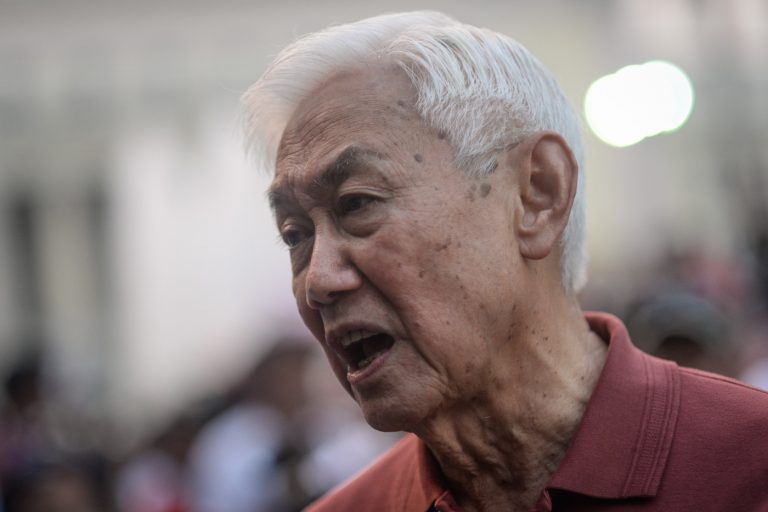
NDF ADVISER. National Democratic Front senior adviser Luis Jalandoni condemns the arrest of NDF consultant Rafael Baylosis. File ohoto by LeAnne Jazul/Rappler

NDF ADVISER. National Democratic Front senior adviser Luis Jalandoni condemns the arrest of NDF consultant Rafael Baylosis. File ohoto by LeAnne Jazul/Rappler

MANILA, Philippines – The National Democratic Front and progressive lawmakers on Thursday, February 1, condemned the arrest of NDF consultant Rafael Baylosis.

“This illegal arrest and detention of NDFP Consultant Rafael Baylosis is a flagrant violation of the GRP-NDFP Joint Agreement on Safety and Immunity Guarantees,” NDF national executive committee member Luis Jalandoni said in a statement.

The JASIG, signed between the Philippine government and the NDF in 1995, guarantees “free and unhindered passage” inside and outside the Philippines for persons involved in the peace talks. It also means they are immune from “surveillance, harassment, search, arrest, detention, prosecution and interrogation or any other similar punitive actions.”

“The NDFP demands the immediate and unconditional release of NDFP Consultant Rafael Baylosis and his companion, Jun,” said Jalandoni.

Presidential Spokesperson Harry Roque defended the move, saying it would be a “dereliction of duty” on the part of the government not to arrest a person “who has a case, who has a warrant of arrest, if there is basis for a warrantless arrest.”

“Kung tingin nila illegal, magfile sila ng habeas corpus. Wala namang martial law sa Luzon…Tungkulin ng Presidente na ipatupad ang batas (If they think that this is illegal, file a habeas corpus. There is no martial law in Luzon….The President has the duty to enforce the law),” Roque said in a news briefing in Baguio City, when asked about criticism over the arrest of Baylosis.

Roque also stressed that the JASIG, which shielded NDF consultants from arrest, was no longer in effect following the termination of the peace talks.

“Wala namang saysay ang JASIG na ‘yun kasi wala nang peace talks (That JASIG is useless since there are no peace talks),” Roque said.

‘Harassment’

Baylosis was arrested by personnel of the police’s Criminal investigation and Detection Group National Capital Region (NCR). He was detained at the CIDG in Camp Crame after his arrest at around 3:45 pm on January 31 in Quezon City.

According to Philippine National Police chief Director General Ronald dela Rosa, Baylosis was arrested for alleged possession of illegal firearms.

Baylosis, believed to be a former leader of the Communist Party of the Philippines (CPP), was the first NDF consultant to be rearrested after President Rodrigo Duterte ended the talks and declared members of the CPP-New Peoples’ Army as terrorists. The President had also called on the NDF consultants to “surrender.”

Progressive lawmakers also criticized Baylosis’ arrest. Bayan Muna Representative Carlos Zarate pointed out that the Philippine government’s peace panel has yet to send a written and official termination of the peace talks.

“The arrest can be interpreted as harassment against the NDFP consultants and personnel to weaken their stance in the talks, particularly in the signing of the Comprehensive Agrrement on Social and Economic Reforms (CASER) now pending in the peace table,” he said.

Kabataan Representative Sarah Elago also condemned the arrest, saying it was the first of a “grand crackdown and all-out war against the Filipinos.”

“Duterte’s insincerity is manifest in his fickle-mindedness in pursuing the peace talks,” she added.

Progressive groups staged a protest in front of Camp Crame Thursday morning to call for the release of Baylosis.

ACT Teachers Representatives Antonio Tinio and France Castro both criticized the arrest, saying it was based on a warrant that “stemmed from false or trumped-up charges, and after the peace talks were terminated by Duterte.” – Rappler.com


With fewer trains, buses come to the aid of MRT 3 passengers

Published

By Chito Chavez

In the midst of mounting complaints, 10 buses which started Thursday will be deployed at the North Avenue and Quezon Avenue Metro Rail Transit (MRT) 3 stations during rush hours to provide the commuters with other viable options.

(DOTr / MANILA BULLETIN)

(DOTr / MANILA BULLETIN)

These buses will serve MRT-3 passengers from 6:30 am to 9am and 6pm to 7pm bound to Shaw Blvd in Mandaluyong City and Ayala Avenue in Makati City.

The fixed fare for each passenger is pegged at P15.

The Metro Rail Transit 3 (MRT-3) deployed fewer trains due to maintenance issues, the Department of Transportation (DOTr) said.

“Ibinaba sa 15 ang bilang ng mga tren na pinapatakbo araw-araw kapag ‘peak hours’ upang mabigyang daan ang mas mabusising pagmementina ng mga bagon na hindi na maayos ang kondisyon,” the DOTr statement read.

Bombarded by massive criticism which sometimes reached the level of hate messages, the DOTR begged for understanding, citing maintenance issues from the previous provider, Busan Universal Rail, Inc. (BURI) caused the deployment of fewer trains.

The DOTr in an earlier message said it understood the plight and hardships of the commuters daily at the MRT 3 but reiterated its call for the public’s patience as the agency waits for progress.

The DOTr expects the first batch of MRT 3 spare parts to arrive this month.

When the spare parts arrive, the DOTr assured that it would gradually increase the number of working trains and make glitches less frequent during travel, especially during rush hours.

In 2017, the MRT line reported over 500 glitches which were up from about 400 the previous year.

Meanwhile, a team of more than 50 railway experts and engineers from the Japan International Cooperation Agency (JICA) will start on Thursday the due diligence and system audit of MRT-3.

The DOTr said the system audit is necessary to determine what rehabilitation and restoration works needed on the MRT3 system.

“We obviously need all the help we can get and we are very grateful that the Japanese Government answered our call for assistance to rehabilitate and restore the MRT-3 system,” said OIC Undersecretary for Railways T.J. Batan.

The system audit by JICA is separate from the ongoing Independent Audit and Assessment by TUV Rheinland, an ISO 17020 and ISO 17065 certified and IFIA member certifier (International Federation of Inspection Agencies) for the entire MRT-3 system, including the 48 train cars from CRRC Dalian.

The TUV Rheinland audit commenced on Jan. 3, 2018 and will run for three months. (Chito A. Chavez)

Related Posts

PH, US, other governments unprepared to fight hackers – cybersecurity expert

Published

By Emmie V. Abadilla

Governments the world over, from the Philippines to the United States, are not prepared to fight hackers, cybersecurity expert Marc Goodman declared Wednesday, during the PilipinasCon 2018, a Forum on Cybersecurity and the Internet of Things at the Enderun Colleges in Taguig City.

Elections worldwide are being hacked by those who want to cling to power and these incidents have skyrocketed because of automation, according to Goodman, author of the best-selling book Future Crimes, founder of Future Crimes Institute, and chairman of Policy, Law and Ethics at Silicon Valley’s Singularity University.

At the Def Con, the world’s longest running and largest underground hacking conference, he said, “They were able to break into 25 different vote counting machines remotely and directly – which means that every single counting device is hackable.”

In the Philippines, the susceptibility of its elections to hacking was established when Filipino hackers committed the biggest government data breach in history in April, 2016, one month after the national elections.

“The Commission on Elections was taken over by the Philippine group of Anonymous to show how hackable the elections were. Over 55 million voter’s data were leaked, 200,000 emails leaked, 2.3 million passport details leaked, and 15.7 million fingerprints are now available in the dark web. That was the largest government data breach in the world so far and it was carried out by a 23-year-old Filipino,” Goodman said.

The US is also facing a hacking controversy with respect to its elections, with the intelligence community concluding that the Russian government had interfered in its elections through propaganda. “We are faced with hacking our democracy with the intelligence community concluding with a high degree of certainty that (Russian) President (Vladimir) Putin interfered with our elections by propaganda and manipulating social media,” he said.

For everyone, the biggest challenge is that governments are still not well-equipped to cope with ever advancing cyber criminals.

“I think governments around the world will struggle on this more and more because people in power use everything available to fight their enemies and protect themselves from being removed from power,” he said.

Worse, hacking is going to get more sophisticated because of the exponential growth of technology.

Governments like that of the Philippines are not well prepared to cope with such growth in cybercrime.

“Cybercrime has been growing dramatically but our governments’ means to counteract them are on plateau,” Goodman said. Hence, the need for vigilance in fighting hackers.

He called on Filipinos to take a more active part in making the election system more transparent and hold government officials in charge of the elections accountable for violations in the system.

“Democracy is always a good idea and we should protect it by holding our leaders accountable. Citizen activism is key and I encourage you to come together and be vigorous in your pursuit to fight irregularities that threaten your democracy,” he said.

Cybercrime is expected to cost international businesses $2 trillion by 2019, Goodman said. “It is growing exponentially but our defenses are not and that’s what we need to fix.”

“We need to invest in trustworthy machines and implement a cybersecurity plan to back up our system, he reiterated. “We have to think like hackers in order to protect ourselves and hold a cybersecurity fire drill so we will know what to do when we are under threat.”

Tags: , , , , , , ,

Related Posts

Taguba: Release of arrest warrant too swift

Subscribe to INQUIRER PLUS to get access to The Philippine Daily Inquirer & other 70+ titles, share up to 5 gadgets, listen to the news, download as early as 4am & share articles on social media. Call 896 6000.

For feedback, complaints, or inquiries, contact us.

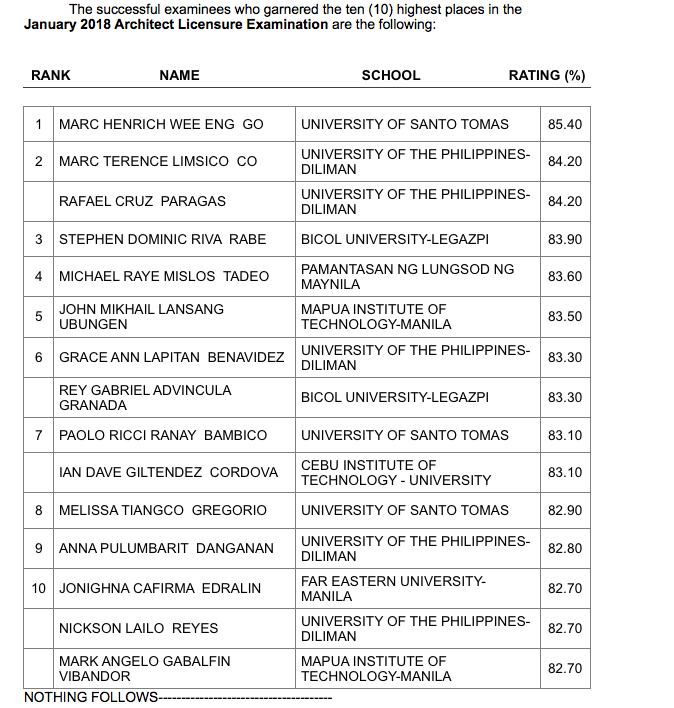
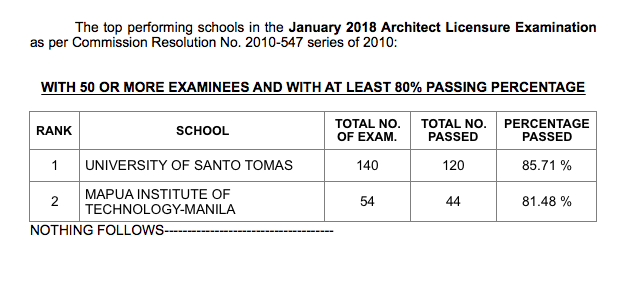
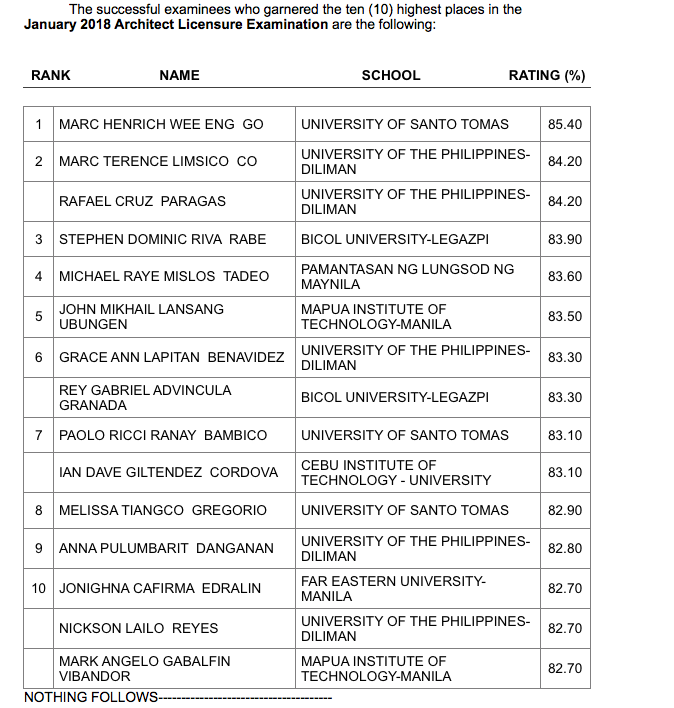
PRC results: Architecture licensure examination January 2018

Congratulations to the latest batch of licensed architects!

Published 7:12 PM, February 01, 2018

Updated 7:17 PM, February 01, 2018

The Professional Regulation Commission (PRC) announces that 1,126 out of 1,955 passed the Architect Licensure Examination (ALE) given by the Board of Architecture headed by its Chairman, Arch. Robert S. Sac and board member, Arch. Robert M. Mirafuente. The examination was heldin Manila, Baguio, Cebu, Davao and Legazpi last January 26 and 28, 2018.

The results were released in four (4) working days after the last day of examination.

From February 8 to February 15, 2018, registration for the issuance of Professional Identification Card (ID) and Certificate of Registration will be done on-line. Please go to www.prc.gov.ph and follow instructions for initial registration. Those who will register are required to bring the following: duly accomplished Oath Form or Panunumpa ng Propesyonal, notice of admission (for identification only), 2 pieces passport sized pictures (colored with white background and complete name tag), 2 sets of documentary stamps, 1 piece short brown envelope and proof of membership issued by the Accredited Integrated Professional Organization. Successful examinees should personally register and sign in the Roster of Registered Professionals.

The date and venue for the mass oathtaking of the successful examinees in the said licensure examination WILL BE ANNOUNCED LATER.

Arch0118 Pos by Rappler on Scribd

Arch0118 Alpha by Rappler on Scribd

PME0118 by Rappler on Scribd

– Rappler.com/Press Release

Villegas tells parents: Help kids discern fake news

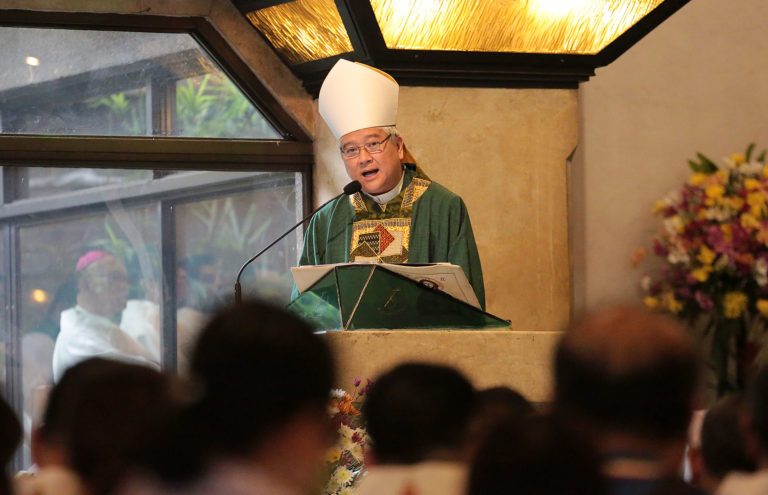
Bishop Socrates Villegas INQUIRER FILE PHOTO / GRIG C. MONTEGRANDE

ANGELES CITY—Archbishop Socrates Villegas has called on parents and educators to help the youth develop critical thinking to distinguish the fake news from the legitimate ones on social media.

“You do not just allow others to make a judgment on your behalf because there is no substitute to a conscience that is enlightened and then a conscience that is making its own discernment,” he told a national conference of the Association of Catholic Universities of the Philippines (Acup) at the Holy Angel University here on Wednesday.

“They don’t even have to be Christians. If you see evil, you should not keep quiet. You should call evil, evil. You should call it wrong because it is wrong and offer an alternative which is right, which is what it is to be human, and what it is to be Christian,” he said.

ADVERTISEMENT

Villegas, head of Archdiocese of Lingayen-Dagupan and past president of the Catholic Bishops’ Conference of the Philippines, also said the Christian message is “essentially confrontational” as he encouraged youth leaders and educators to defy evil.

He gave the advice to conference delegates who gathered here to reflect on the “Amoris Laetitia” (The Joy of Life), the apostolic exhortation on the family.

“We are not afraid to shake up principles, beliefs, paradigms and viewpoints that are essentially and evidently contrary to the Gospel values,” Villegas said.

“Cowardly companions are not allowed. We are not war freaks. We are not troublemakers but we should not offer consolation without challenging and confronting evil.”

He reminded Acup members that Christ rebelled against the wrongs committed in his time.

Family life and education, he said, should be both an “encounter” and an “accompaniment” with Christ.

“The accompaniment that the Pope offers in Amoris is [one] that confronts evil, [while] at the same challenges you to be better. Accompaniment is not a see-no-evil, speak-no-evil thing. It is rather confronting evil,” he said.

In an interview, Villegas said young people are immersed in “so many values that are contrary to the Gospel and to authentic values.”

ADVERTISEMENT

He said: “Amoris Laetitia is not about sex. It has been misunderstood. It has been misinterpreted and this is sad.” Amoris is “not a lighthouse but a torch that walks with the people,” he added. /jpv

Don’t miss out on the latest news and information.

Subscribe to INQUIRER PLUS to get access to The Philippine Daily Inquirer & other 70+ titles, share up to 5 gadgets, listen to the news, download as early as 4am & share articles on social media. Call 896 6000.

For feedback, complaints, or inquiries, contact us.

No term extension for Duterte in our proposal – PDP-Laban think tank

However, there is no assurance that the PDP-Laban Federalism Institute model would be the one adopted by Congress, as both the Senate and House are proposing their own versions

Published 5:55 PM, February 01, 2018

Updated 7:30 PM, February 01, 2018

PDP-LABAN. Jonathan Malaya, head of the PDP-Laban Federalism Institute, assures the public there is no term extension allowed for President Rodrigo Duterte in its version of a new constitution. Rappler screenshot

PDP-LABAN. Jonathan Malaya, head of the PDP-Laban Federalism Institute, assures the public there is no term extension allowed for President Rodrigo Duterte in its version of a new constitution. Rappler screenshot

MANILA, Philippines – The head of the PDP-Laban Federalism Institute hit critics and assured the public that its version of federalism does not allow a term extension for President Rodrigo Duterte.

Interior and Local Government Assistant Secretary and PDP-Laban executive director Jonathan Malaya told the Senate that “nothing” in the ruling party’s proposal allows an “unlimited” term of office for Duterte, contrary to what critics say. (READ: Pimentel says Duterte’s term may be extended ‘if necessary’)

He also said their version does not allow local officials to continue serving in regional government, not until they are elected.

“Nothing in the PDP-Laban model states that the incumbent president, President Duterte, will serve continuously until the 10-, 12-, 13-, 15-year transition period. There is nothing in this model – because we were the ones [who] prepared it – that will give the President unlimited time in office,” Malaya said on Thursday, February 1, during the 4th Senate hearing on Charter Change.

After all, Malaya said, Duterte himself has said he does not want to stay in power any longer than June 2022. (READ: Duterte to military, police: Shoot me if I extend my term)

“The President himself and his spokesman [have] continuously stated that the President will not serve a day beyond the term to which he was installed..and that an extension of his term is the greatest blunder he would commit,” Malaya said.

Duterte, however, is known for repeatedly changing his public statements. This, and the push for a Constituent Assembly (Con-Ass) – or Congress filled with Duterte allies amending the Constitution – led critics to vehemently oppose calls for Cha-Cha.

While Malaya defends the ruling party’s model, there is no assurance it would be the version that Congress would adopt. The Senate and the House of Representatives could propose their own. In fact, in the House, there are already several proposals, which significantly differ from the PDP-Laban version.

Critics sowing fear?

Malaya also hit critics for sowing fear among Filipinos and said there is nothing to worry about.

“I’m afraid critics of federalism are seeing monsters when there are none. They’re using problems or the specter of fear because since federalism is a totally new concept and a totally new concept is not easily understood, they are propagating a lot of fear among people, questioning even motives of those proposing [a] federal form of government,” he said.

House Speaker Pantaleon Alvarez, the secretary general of PDP-Laban, earlier opened the possibility of canceling the 2019 elections during the transition period of federalism – which minority senators vehemently opposed.

Alvarez also insists that the Senate is not needed for a Constituent Assembly, despite what the 1987 Constitution says. (READ: Cha-Cha without Senate ‘pathetic, ridiculous’ – senators) – Rappler.com

Anti-drug cops to get body cams by June—PNP chief

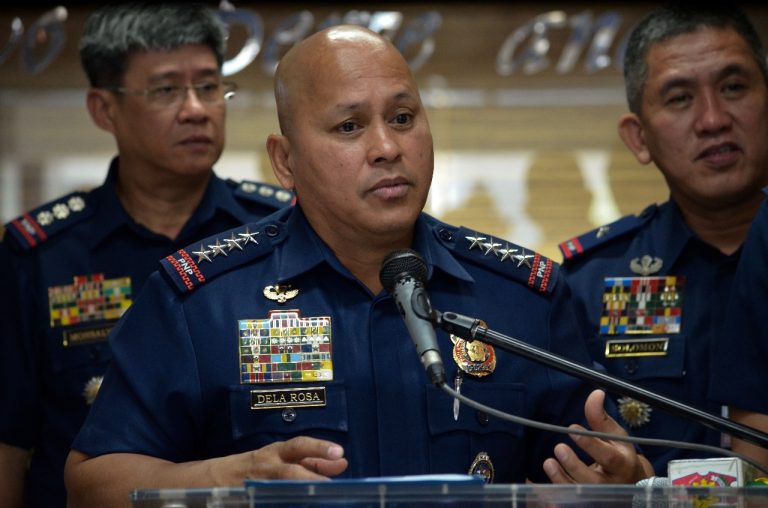
PNP chief Director General Ronald “Bato” dela Rosa. Noy Morcoso / INQUIRER.net FILE PHOTO

Expect anti-illegal drug operatives of the Philippine National Police (PNP) to wear body cameras by the middle of the year when the acquisition of the devices is complete.

PNP chief Dir. Gen. Ronald dela Rosa has ordered the allocation of P334-million for the purchase of body-worn cameras for local drug enforcement units by June.

Dela Rosa tasked PNP directorate for logistics Director Jose Victor Ramos to fast track the purchase of body cameras for anti-narcotics operatives and ensure transparency in their operations.

ADVERTISEMENT

The body-worn cameras would ideally be connected to a system where there would be a live feed in the drug enforcement units’ respective operations centers so their commanders would be able to monitor their movements.

“We are really fast tracking the process. We are not dilly-dallying because the longer we do not have those (body-worn cameras), the more uneasy our critics. We want to let the critics feel they are being considered for everyone’s good,” the PNP chief said.

He clarified that the procurement of body cameras was not prioritized in the 2017 annual procurement plan in favor of the equipment needed for anti-crime and counter-terrorism operations.

Among last year’s procurement priorities were mission-essential equipment for mobility, fire power, communications and investigation to boost police operations against crime and terrorism.

The PNP chief said that the procurement last year of 48 K9 units, composed of Belgian Malinois and Labrador breeds that are currently undergoing training at the PNP kennel in Alfonso, Cavite, was prompted by “the need for enhanced target-hardening efforts amid threats posed by foreign-inspired local terrorist movements.”

Each K9 unit costs P545,000, including the training of both the dog and its handler and maintenance.

Speaking to reporters on Thursday’s blessing and presentation of newly procured equipment at the National Capital Region Police Office, Dela Rosa explained that body-worn cameras were not priority last year.

“Maybe to critics, body-worn cameras are priority. They are really looking for holes in our operations. Our priority was dogs because of the threat of ISIS (the Islamic State of Iraq and Syria), terrorism, many lives will be lost. Our airports will be in danger if our Avsegroup (Aviation Security Group) does not have bomb-sniffing dogs,” he remarked in mixed Filipino and English.

ADVERTISEMENT

He added, “you cannot prevent a bomb from exploding with body-worn cameras but you can prevent it with bomb-sniffing dogs.” /jpv

Don’t miss out on the latest news and information.

Subscribe to INQUIRER PLUS to get access to The Philippine Daily Inquirer & other 70+ titles, share up to 5 gadgets, listen to the news, download as early as 4am & share articles on social media. Call 896 6000.

For feedback, complaints, or inquiries, contact us.